
Key takeaways
- A pilot that works proves a task can be done, and production asks whether the business can depend on it every day.
- The model is rarely why a pilot stays a pilot. The causes sit around it, in data, integration, review, and ownership.
- A baseline set before the pilot starts is the only evidence that lets a leader approve a rollout.
- Metrics are targets to hit, and guardrails are limits that stop a rollout, so set both before launch.
- Five conditions decide AI readiness: a named owner, live data, monitoring, a fallback path, and a measured result.
- After launch, keep measuring against the alternative the business used before. That comparison is the earliest warning that quality has slipped.
Most advice on moving an AI pilot to production is about the system: the pipeline, the monitoring, the security review. The decision to approve the rollout matters more. It is only as good as the evidence the pilot produced. Deloitte’s survey indicates that only a quarter of organizations have moved 40% or more of their AI experiments into production.
To show a difference, a leader needs two numbers: how the work looked before the pilot and how it looks now. Several of the engineering teams we supported through AI development services started without a baseline. The guide below shows how to move AI from pilot to production, why working pilots remain pilots, and how to set metrics, guardrails, and an owner before launch.
What “production” means for an AI pilot
A pilot answers one question: can this work? Production answers a harder one: can the business depend on it every day?
The two run under different conditions. A pilot usually has a small group of willing users, data that someone prepared, and the builders nearby to correct any mistake by hand. Those choices make sense for a first test. They also explain why a good pilot result rarely carries over, because production removes every one of them.
Consider an assistant that reads supplier invoices. In the pilot, it handles a folder of clean files, and the team fixes each wrong answer within the hour. In production, it meets scanned pages, missing fields, and invoices in three languages, and no one is waiting to fix anything. The model is the same. The conditions around it have changed.
Six conditions change on the way from an AI pilot to production, and each one can break a result that looked solid.
|
AI pilot |
Production |
|
|
Data |
Curated sample |
Live systems of record |
|
Users |
Small group, often volunteers |
All intended users, including skeptics |
|
Integration |
Standalone or simulated |
Connected to the systems where work happens |
|
Evaluation |
Spot checks and demo results |
Agreed thresholds, tracked continuously |
|
Governance |
Manual supervision |
Access controls, audit trail, escalation path |
|
Ownership |
Project team |
Named operational owner |
Each row asks the same question: has the pilot been tested under production conditions? If a row still describes the pilot column, that row is work left to do before a rollout.
5 conditions of a production-ready AI system
A production-ready system meets five conditions.
- A named owner. When the system gives a wrong answer, one person is already responsible for what happens next.
- Live data. The system reads from the systems of record, under the permissions that real users hold.
- Monitoring. A drop in quality reaches someone within a set time, because alerts fire when quality or failure rates cross agreed limits.
- A fallback path. When the system is wrong or unavailable, the work continues by a defined route.
- A measured outcome. The result is compared with a baseline captured before the pilot began.
Each one can fail in its own way: an owner who exists only on paper, data taken from a sample, alerts that no one reads, a fallback no one has tried, a result with nothing to compare it against. A team that can show all five is ready to ask for a rollout decision.
Why AI pilots fail to reach production
When an AI pilot-to-production move fails, the model is rarely the cause. The causes sit around it, in two groups: technical causes, which appear when the system meets real data and real users, and organizational causes, which appear when someone has to approve the system, pay for it, and answer for it. We start with the technical ones.
Tested only under favorable conditions
Pilots usually run with willing users, prepared data, and builders available to fix mistakes. Each of those makes the result look better, and production removes all three. A result that held for a small team may not hold across the whole organization, and the team learns this only after launch.
No live data behind the pilot
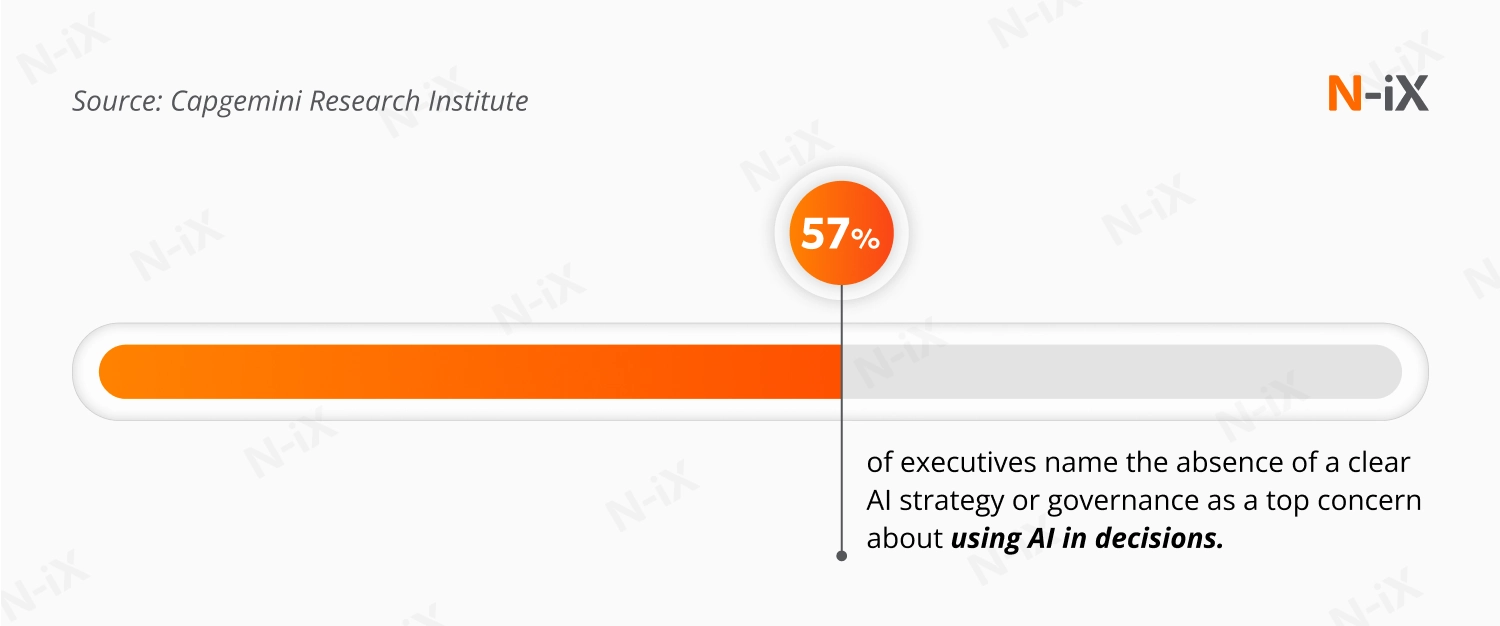
A pilot can run on a sample file. Production has to read from live systems under real permissions, and connecting to them is often delayed. 60% of executives named a lack of quality enterprise data as a top concern about using AI in decisions. Real company data is messier than a sample. Fields are empty, records sit in different systems, and the same information is stored in different formats. The pilot never meets these gaps, but production does.
No fallback or monitoring
A system with no route for wrong answers and no quality alerts shows its errors only when a user complains. By then, the wrong answer has already reached a customer, a report, or a decision. Each additional wrong answer makes the next rollout harder to approve.
Even a system that is sound on all three points can stay a pilot, because the decision to promote it belongs to people. Three organizational causes tend to block that decision.
No baseline
A baseline records how the task looked before the pilot, and every later claim depends on it. Without one, a team can show that the system works, and it cannot show that anything improved. In N-iX’s partnership with a transportation company, AI tools were active on fewer than one in seven engineers’ desks, and no measurement baseline existed. Our team helped set one, and adoption then rose from 13% to 91% across more than 140 engineers.
Governance added last
Security, privacy, and compliance reviews often begin after the design is set. At that point, a single finding can force a redesign, and the pilot loses months it had planned to spend on rollout.
No named owner or run model
After launch, someone has to decide what happens when quality drops, business rules change, or the system needs an update. If no one is named, none of those decisions get made, and each one waits until a user or an auditor raises it.
Naming an owner settles who decides. The next question is how to divide that ownership, and N-iX’s Engineering Index 2026 describes the split N-iX uses across its AI adoption projects. A central team keeps the framework, the evidence gates, and the standards. The delivery lead on each project owns enforcement and daily adoption, because only that person sees who is struggling and when a deadline pushes the work aside.
Each layer sees something the other cannot, which is why merging them fails in two ways. A central team that also enforces becomes a bottleneck, and delivery teams stop trusting it. A delivery team that also writes the framework builds its own version, and the organization learns nothing across projects.
How to move an AI pilot to production
1. Select one use case and set its baseline
Start with one use case that has a business owner, a task that people already measure or can measure, and data the team can reach. A shortlist can hold several candidates, and it should end with one, because every extra use case splits the owner’s attention and blurs the comparison.
Then write the success measure in one sentence, with a number, a task, and a date. “Cut the time to triage a support ticket from 12 minutes to 6 by the end of the third quarter” can be checked. “Use AI to improve service” cannot. If the sentence will not come, the use case is not ready.
Next, capture the baseline before anything changes. Metrics and guardrails do different jobs here. A metric is a target, a number the pilot is expected to move. A guardrail is a limit, a line the system must stay inside, and crossing it stops the rollout, whatever the metrics show. For engineering pilots, N-iX’s Engineering Index recommends four metrics, collected straight from the delivery tools so that no one reports them by hand:
- Adoption: the share of committed code generated with AI.
- Throughput: pull requests merged, weighted for size.
- Speed: pull request cycle time and lead time for changes.
- Quality: change failure rate.
Outside engineering, the same four ideas apply: how many people use the system, how much work it handles, how long a case takes, and how often a result needs correction. Typical guardrails are a quality floor, a cost ceiling per completed task, and a maximum failure rate. For each metric and guardrail, write down the threshold, the person who signs, and the action on a miss.
For WorkWave, a field service management software provider , N-iX connected the engineering tools to a measurement platform, and the metrics were collected automatically. Across four teams and 30 engineers over three months, AI-generated code rose from 0% to 28%, throughput from 2.8 to 3.2 pull requests per engineer per month, and pull request cycle time fell from 12.4 to 7.2 hours. The program also gave the WorkWave team visibility into quality and prepared for expansion from 30 engineers to more than 100.
2. Run the pilot on real tasks with real users
A pilot earns trust when it is tested the way production will use it. Four conditions make that true: live data, including the awkward cases; users who did not volunteer; edge cases added on purpose; and no builder waiting to fix output. A pilot that depends on willing users, prepared data, or builders on hand predicts little about production.
In N-iX’s partnership with a housing management technology provider, over 150 engineers across five work streams were releasing under continuous pressure. N-iX applied AI to quality assurance across the engineering teams, accelerated 15 workflows, and added automated quality gates to the testing process.
Test coverage rose from 55% to 89% across over 300 repositories, and bugs reaching production fell by 60%. Regression testing dropped from 3 days to 4 hours, and incident investigation dropped from 4 hours to 30 minutes.
Faster coding can leave delivery unchanged. AI speeds up implementation, while requirements, acceptance, and sign-off keep their old pace. Add one release-level measure, such as lead time to release, to show whether the business received anything sooner.
Take our AI Data Readiness Assessment. It has six questions and takes about two minutes. It shows how much your analysts still depend on engineering to reach data, and what would change that.
3. Review readiness and decide: go, fix, or stop
The review that clears an AI pilot to production opens with the success measure from stage 1 and checks the five conditions from the start of this guide. Each needs evidence that someone can check: a named owner who has accepted the role and the escalation path, a run on live data under production permissions for an agreed period, a test alert that a named person acted on, a forced failure that the fallback path handled, and a result that beats the baseline by the agreed threshold with no guardrail crossed.
It ends in one of three outcomes. Go means all five conditions pass. Fix means one or more conditions fall short, and each gap gets an owner and a date before a second review. Stop is a valid outcome, and it applies when any of these holds:
- No business owner will take responsibility for the system.
- The value was never quantified.
- The required data cannot be reached under production rules.
- The process the system serves is about to change.
- Checking its output costs more than the output saves.
You may find it interesting to read a guide about AI readiness assessment
4. Harden the system for live use
Hardening shows whether everything around the model works under real conditions, and the order of the work matters. One of N-iX’s logistics clients, a Fortune 500 industrial group with more than 600 warehouses in more than 50 countries, ran its operations on a monolithic platform that blocked new AI services. N-iX migrated the data infrastructure first, from SQL to Azure Synapse and then to Databricks, and built the AI and ML microservices on top of it. Seven or more were built, and two run in live production today: computer vision for cargo recognition and an ETA model for shipments.
In a pilot, someone prepares the data by hand. In production, that data has to arrive automatically, and the system that delivers it is often still unbuilt.
Next, test the parts that fail without warning:
- Monitoring: Send a test alert and confirm that a named person acts on it.
- Fallback: Force an outage or a wrong answer and confirm that the work continues by the defined route.
- Security at creation: Put the security policy inside the coding agent so it refuses to break a rule while generating code.
- Review queues: Filter findings down to those reachable from user input, so reviewers spend their time on risks that can be exploited.
Regulated environments set a higher standard. NEOGOV, a workforce management software provider for the public sector, is GovRAMP-authorized (formerly StateRAMP) and working toward FedRAMP authorization, so any external AI tooling needed a rigorous security review and controlled access to engineering context. N-iX delivered 16 AI workflows there, and the program cut cross-system debugging time by 95%.
AI agents need one more check. Reliability compounds across steps. If every step has to be right and no one catches an error along the way, an agent that is right 99% of the time at each step completes a 100-step task correctly only about 37% of the time. That is why checks and approval points matter more as tasks get longer. Before release, define the permissions each tool call needs, the point at which a person approves an action, an audit trail for every step, and a cost limit per completed task.

5. Release one group at a time
To scale AI from pilot to production, widen access one group at a time. Each new group puts the guardrails in front of different users, so the decision to widen should rest on numbers. For engineering programs, N-iX uses a concrete test: widen access when the change failure rate is not trending upward and pull request cycle time is 15 to 25% below the baseline captured at the start. For other systems, write the equivalent pair in stage 1: one quality condition that must hold and one measured gain that must appear.
Size each group to what the fallback path can absorb. Each group also brings people who did not volunteer. N-iX pairs the strongest user with the one who has fallen furthest behind on a real task, and resistance usually ends within one session. Give every group a way to report wrong answers, a person who replies, and the previous version ready for a rollback in minutes.
6. Operate and expand
Quality drifts after launch, and the earliest warning comes from a comparison with the alternative the business already had. The ETA model built for the logistics client from stage 4 is measured against the third-party logistics providers it competes with, and it beats them by 5% on prediction accuracy. Choose that comparator in stage 1, whether it is a vendor, a manual process, or a previous system, and keep measuring against it in production.
Review the numbers on a fixed rhythm. N-iX recommends reviewing the four metrics weekly and having a direct conversation after two consecutive weeks of zero use. Test each change to the model, the data, or the business rules against the baseline before it goes live.
Expansion sets a higher standard. Treat the best results as the new baseline and raise expectations for everyone, because a system that works well for some people shows what the rest can reach. The next use case starts its own path from AI pilot to production at stage 1, with its own baseline, and reuses the review format that the first system set up.
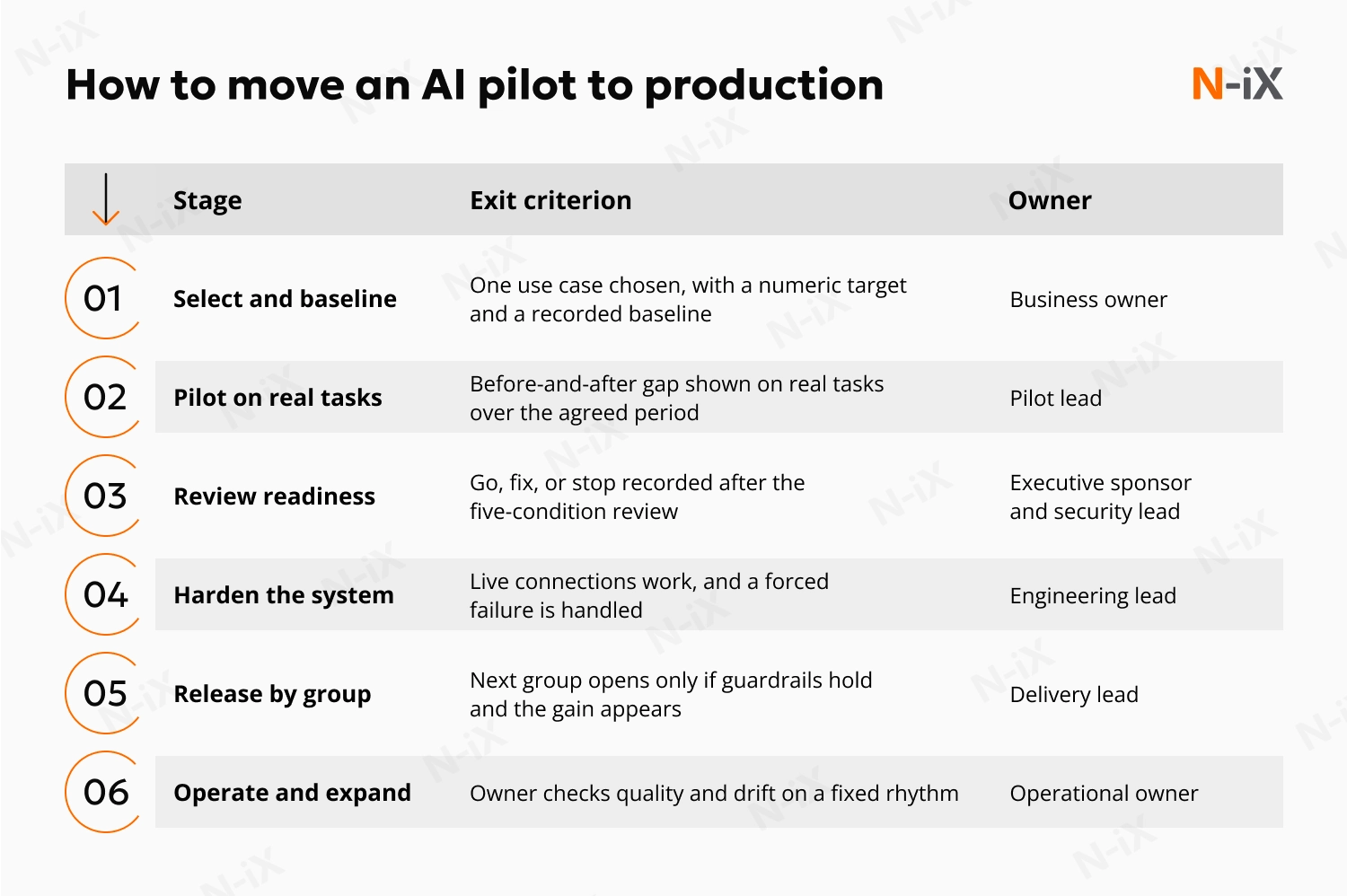
|
Stage |
Exit criterion |
|
1. Select one use case and set its baseline |
One use case, a one-sentence success measure, a baseline captured |
|
2. Run the pilot on real tasks |
Results compared with the baseline over an agreed period |
|
3. Review readiness |
Five conditions met, with a go, fix, or stop decision |
|
4. Harden the system |
Integration, monitoring, and fallback tested under failure |
|
5. Release one group at a time |
Metrics and guardrails hold after each stage |
|
6. Operate and expand |
Quality and drift reviewed on a set schedule |
Where to start with a stalled AI pilot?
The earlier sections lead to one practical step: review the pilot as it stands, find which of the five conditions is missing, and close the gap with the people who will run the system. N-iX provides a solution for that situation.
Our team reviews the pilot against the five conditions, captures the baseline from the tools the engineering teams already use, runs the work on real production tasks, hardens the system for live use, and hands it to the client’s own team to run. With 24 years of enterprise delivery and 200 AI, data, and ML specialists, N-iX has delivered more than 100 AI and data projects and 27 end-to-end AI adoption programs. Today, more than 90 enterprise clients, including Fortune 500 companies, work with N-iX. APEX, which stands for AI Powered Engineering eXcellence, is the proprietary framework we use for evidence-based AI adoption.
If your AI pilot has stalled, tell our team where it stands, and we will show what needs to change first.

FAQ
What is the difference between an AI pilot and production?
An AI pilot shows that a task can be done under chosen conditions, while production means the business can depend on the system every day with live data and real users. A production system has a named owner, monitoring, a fallback path, and a measured result compared with a baseline. A pilot usually has none of these, because its users are few, its data is prepared, and its builders fix mistakes by hand.
How to move AI from pilot to production?
Move it in six stages: select one use case and set its baseline, run the pilot on real tasks, review readiness, harden the system, release it one group at a time, and operate it under a named owner. Each stage ends with a check that a named person signs. At N-iX, we begin with the baseline, because without a measurement taken before the pilot, no one can show what it changed.
Why do AI pilots fail to reach production, technically and organizationally?
Technically, pilots fail when they are tested only under favorable conditions, never connected to live data, or built with no plan for wrong answers. Organizationally, they fail when there is no baseline to prove the results, when security and compliance review starts too late, or when no one owns the system after launch.
How long does it take to move an AI pilot to production?
Several N-iX adoption programs have reached a first measured result in about three months with a few teams, and full production takes longer because it depends on integration work and approvals. The schedule should follow each stage’s exit criteria, since a rollout to the next group of users should open only when the checks from the previous group hold.
Who should deliver the move from AI pilot to production?
Delivery can come from an internal team, a systems integrator, staff augmentation, or an embedded partner, and the right choice depends on who will run the system afterward. An internal team fits when engineers with production AI experience and a named owner already exist, and a partner fits when those are missing, or the timeline is short. At N-iX, we work as an embedded team that co-implements and then transfers the system to the client’s engineers, who run it after handover.
How do you estimate the cost of scaling an AI pilot to production?
Start from the cost ceiling per completed task that you set as a guardrail in stage 1, and build the budget from what the pilot measured. Count inference (calls and tokens per completed task times expected volume), storage for data and logs, and monitoring, including evaluation runs and human review time. Add training or fine-tuning only if the system retrains. Rerun the estimate for each new user group, because volume changes the result. We track spend per workflow and team from the architecture phase and review it with the client after each release.
Have a question?
Speak to an expert