
Key takeaways
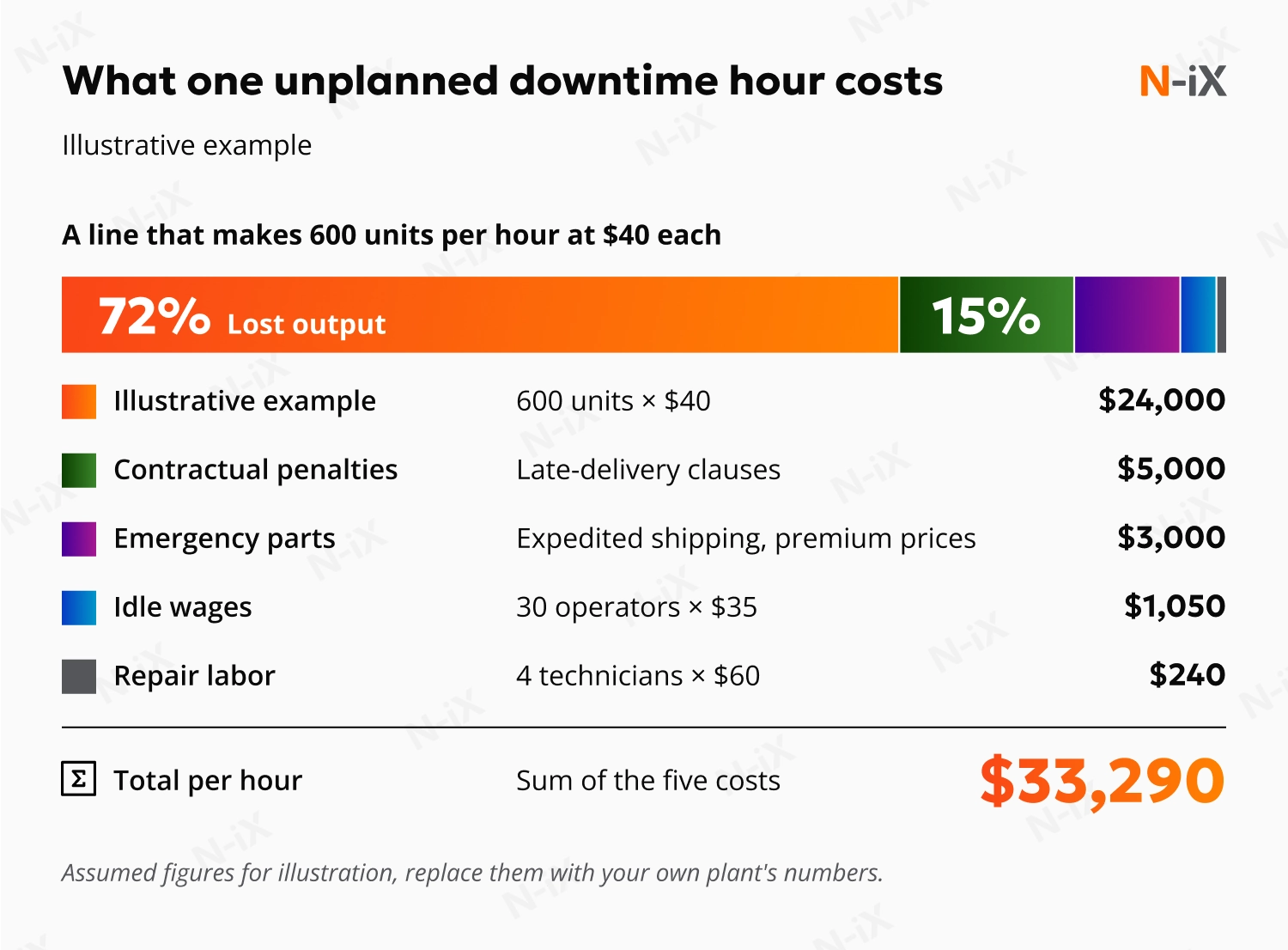
- Unplanned downtime can cost manufacturers up to $33.3K per hour, with predictive analytics potentially saving $4M annually by preventing 10 unplanned hours each month.
- Predictive analytics leverages historical production data and machine learning to forecast machine failures and quality defects, requiring sensors, repair records, and a sufficient data history to function effectively.
- Condition-based maintenance is more efficient than fixed schedules, as it uses real-time sensor data to optimize resource allocation and prevent unnecessary repairs or missed breakdowns.
- Data readiness evaluations are essential before implementing predictive analytics, assessing the quality and availability of sensor data, machine data, and energy consumption data to ensure effective model training.
- Prioritize predictive analytics projects for lines with high unplanned downtime costs and sufficient historical data, starting with a pilot program to measure effectiveness before broader implementation.
A plant generates a steady stream of data, such as sensor readings and orders. Reviewing that data after a machine stops explains what went wrong. By then, the plant has already lost output and is paying for emergency parts. Predictive analytics in manufacturing turns production history into early warnings. A model learns from past faults, defects, and orders, then flags the next one while there is still time to act.
N-iX builds the pipelines, models, and dashboards behind these early warnings for manufacturers through its data and analytics services. The services cover data engineering, governance, Data Science, and business intelligence. The team can join at any stage of a plant’s data projects.
When do you need predictive analytics in manufacturing? 4 signs
Predictive analytics in the manufacturing industry applies statistical models and Machine Learning to historical production data. It moves manufacturing analytics from reporting past events to forecasting outcomes such as machine stoppages and quality defects. It fits a plant that has usable history, expensive stops, and a team able to act on a forecast. Four signs show where it pays off.
-
Unplanned downtime costs more than implementing predictive analytics
One unplanned hour has five costs: lost output, idle wages, repair labor, emergency parts, and contractual penalties. Assume a line that makes 600 units per hour at $40 each, and that the five costs total $33.3K per hour. A model that prevents 10 unplanned hours per month saves about $4M per year. On a line where an hour costs $3K, the same model saves about $360K.
-
Fixed maintenance schedules miss faults or waste effort
Fixed schedules are often inefficient and costly, while condition-based maintenance uses resources more efficiently. If technicians replace parts that still work, or equipment breaks between scheduled visits, the schedule no longer matches how the equipment wears. Condition-based maintenance acts on sensor and machine data.
-
Maintenance expertise is hard to find or keep
MaintainX surveyed 2,234 maintenance and operations leaders in the U.S. and Canada for its State of Industrial Maintenance 2026 report [1]. Labor shortages and weak knowledge transfer rank among the top causes of unplanned downtime. Deloitte’s 2026 manufacturing outlook names capturing knowledge from retiring employees as a potential use of agentic AI [2]
-
You collect data that goes unused
If your plant already records sensor readings, machine error codes, and repair logs, you can feed that data into a model. The model needs three things: sensors on your critical machines, repair records in one system, and a history collected over time. Predictive analytics learns from past outcomes. A longer record of faults and repairs gives the model more to learn from.
4 cases where predictive analytics can wait
- Reactive maintenance still suits inexpensive equipment that matters little to facility reliability, according to the U.S. Department of Energy’s maintenance guide.
- Models need history, and a new line has none. Predictive models learn from historical data, and a new line has no record yet.
- A line in ramp-up keeps changing. Settings and recipes shift too often to define normal behavior. A model has no baseline to learn from.
- A forecast helps only when someone can act on it. Without an owner who can schedule the repair, adjust the plan, or change the setting, the prediction goes unused.
A line that shows several of the signs and none of the cases above is a strong candidate for a first manufacturing predictive analytics project.
3 main data sources to check before you start
Predictive models draw on three main data sources: sensor data, machine data, and energy consumption data. Equipment metadata adds context. Examples include specifications, manufacturer data, and nameplates. A model needs history to predict. After a plant collects data over time, tools such as a computerized maintenance management system (CMMS) can recommend baselines. These come from performance and maintenance history, according to IBM.
-
Sensor data
Sensors record readings such as temperature, pressure, vibration, humidity, sound, and rotational speed. They supply real-time information about equipment condition. Vibration data helps detect lubrication faults, misalignment, and other mechanical faults. It also gives early warnings of machine malfunction. The readings usually go to a central database, often a cloud-based CMMS.
-
Machine data
Machine data covers operating parameters, error codes, and historical performance. Maintenance records are essential for model training. They show repair activities, the asset's condition before a breakdown, and replaced parts. A CMMS simplifies collecting them. N-iX systems often connect to enterprise resource planning (ERP), CMMS, and enterprise asset management (EAM) systems.
-
Energy consumption data
Energy consumption data covers electricity, gas, and thermal imaging readings. Sensors on electrical systems help prevent damage from power spikes. This reduces the cost of repeated motor replacements. A data readiness evaluation is a critical step in any N-iX data project. It assesses the quality, availability, and suitability of your data.
5 key use cases of predictive analytics in manufacturing
The evidence is strongest for predictive maintenance and thinnest for supply chain forecasting. Each use case below names the data it relies on.
Predictive maintenance
Predictive maintenance in manufacturing forecasts breakdowns using vibration, temperature, and maintenance data. For example, BMW Group's Regensburg plant uses an AI-supported system that monitors conveyor technology in vehicle assembly. The plant's innovation team built it to identify potential faults early. BMW reports that the system avoids at least 500 minutes of assembly downtime per year at Regensburg. It also runs at the Dingolfing, Leipzig, and Berlin plants [3]
Predictive quality
Predictive quality uses Machine Learning on production and quality-control data to predict inspection outcomes. A case study at a fashion company compared several algorithms. Random forest, LightGBM, and C5.0 performed similarly. The researchers chose random forest because it produced the fewest false negatives, the error the company aimed to reduce [4]. A separate study on the Bosch Production Line Performance dataset found that flagging missing measurements improved the ranking of rare defects across all tested models [5].
Demand forecasting
Demand forecasting in manufacturing predicts what customers will order. Plants use it to plan production and inventory. Kenvue, an American consumer health company, cut its mean absolute percentage error (MAPE) by 37% in its first year. The models used orders, shipments, and point-of-sale signals. Planners combined the predictions with their own judgment. All 15 deployments in the report ran on Pecan's forecasting engine.
Energy consumption forecasting
Energy forecasting predicts a plant's electricity demand in advance. A peer-reviewed case study in Energy and AI ran a proof of concept at a German mechanical engineering company. [7] The team combined a forecasting model with an anomaly-detection algorithm, using widely available Machine Learning libraries and historical electricity consumption data. The authors conclude that such models are feasible for small and medium-sized companies with limited technical resources.
Supply delay forecasting
Supply delay forecasting estimates the risk that a supplier delivers late. A peer-reviewed study by researchers at the University of Minho built a framework for a multinational automotive electronics manufacturer and tested it on real data [8]. The authors evaluated the models using error metrics and the financial impact of incorrect predictions on inventory management. They concluded the results could promote models that allow lead time to vary.
6 main challenges of manufacturing predictive analytics and how N-iX addresses them
Six challenges stand between a plant’s data and a working forecast. The table shows each one and how N-iX addresses it.
|
Challenge |
What it looks like |
How N-iX addresses it |
|
Data sits in separate systems |
Sensor readings, repair logs, and orders live in different tools |
Pipelines integrate data from sensors, equipment, SCADA, ERP, and other operational systems into a single source of truth |
|
Unknown data readiness |
Gaps in sensor coverage, incomplete repair records, short history |
A data readiness evaluation checks quality, availability, and suitability; a data maturity assessment scores data and engineering practices |
|
No clear first use case |
Several lines and use cases compete for budget |
A workshop identifies high-impact use cases and defines a roadmap |
|
Unproven value |
The payoff is unknown before the build |
A proof of concept tests feasibility, ROI, accuracy, and business impact before full-scale implementation |
|
Enterprise and legacy systems |
History sits in ERP, CMMS, and EAM systems |
Systems integrate with ERP, CMMS, and EAM to streamline maintenance workflows |
|
Forecasts without an owner |
An alert arrives and no one owns the response |
Alerts go to maintenance teams or operators, dashboards help staff prioritize tasks, and enablement programs train teams |
How N-iX approaches predictive analytics in manufacturing: 6 key practices
N-iX has delivered more than 100 data and AI projects across industries, including manufacturing. For predictive analytics in manufacturing, we follow six key practices.
1. We start with a workshop that selects the use case. It assesses your AI maturity, identifies high-impact use cases, and defines a roadmap. In manufacturing, the options include predictive maintenance, quality control, process optimization, demand forecasting, supply chain management, and production scheduling.
2. Data pipelines come before any model. They collect data from sensors, equipment, supervisory control and data acquisition (SCADA) systems, ERP, and other operational systems, then process and store it. We maintain data quality and consistency throughout integration. This gives you a single source of truth for analytics. If you are unsure where your data stands, we can run a data maturity assessment first.
3. Governance and compliance rules are set early. Data governance defines processes, access, and responsibilities to improve data quality and security. The workshop also reviews compliance requirements. In manufacturing, reports and documentation provide the paper trail needed for regulatory compliance.
4. A proof of concept tests the idea on your scenarios. It covers data preparation, model selection, iterative testing, real-world validation, and integration requirements. The test measures feasibility, return on investment (ROI), accuracy, and business impact before full-scale implementation. For predictive maintenance, the proof of concept takes around two weeks.
5. Results reach your teams through the systems they already use. The models integrate with your ERP, CMMS, and EAM systems. Dashboards form the final layer of the data stack. In predictive maintenance, alerts go to maintenance teams, and asset health dashboards help staff prioritize tasks. Enablement programs train your teams to act on the alerts.
6. Monitoring, retraining, and scaling continue after launch. We track model performance, refine algorithms on new data, and optimize infrastructure. Machine Learning operations (MLOps) practices maintain efficiency, security, and accuracy over time.

FAQ
How is predictive analytics used in manufacturing?
Predictive analytics forecasts outcomes such as machine stoppages, quality defects, or demand shifts using historical production data. Five key use cases stand out: predictive maintenance, predictive quality, demand forecasting, energy consumption forecasting, and supply delay forecasting.
What is the difference between predictive and preventive maintenance?
Preventive maintenance follows a fixed schedule. Predictive maintenance responds to the equipment’s actual condition. N-iX builds predictive maintenance systems that analyze sensor, machine, and energy data to flag faults before breakdowns occur.
How do you start with predictive analytics in a plant?
First, calculate the cost of one unplanned hour on each candidate line. Then check data readiness, rank the lines by cost and readiness, and run a pilot with one measurable goal. Extend to similar assets once the pilot meets its goal. N-iX can run a data maturity assessment before the pilot and build a predictive maintenance proof of concept in two weeks.
Which predictive analytics tools suit manufacturing?
The right manufacturing predictive analytics software depends on your data and your systems. A custom system fits when ready-made tools miss specific needs, operations involve plant-specific datasets, or models must integrate deeply with existing systems. N-iX builds custom predictive analytics systems for manufacturers.
References
- MaintainX – State of Industrial Maintenance 2026 report
- Deloitte – 2026 Manufacturing Industry Outlook
- BMW Group – Smart maintenance using artificial intelligence (2023)
- International Journal of Artificial Intelligence – Machine Learning-based decision-making approach for predicting defect detection: a case study
- Machines – Data-Driven Defect Prediction for Manufacturing Quality Monitoring Under Class Imbalance and Missing Data: A Performance–Efficiency Trade-Off Analysis (2026)
- DemandForecast.ai – The Demand Forecasting Accuracy Report 2026
- Energy and AI – Integrating artificial intelligence into energy management: A case study on energy consumption data analysis and forecasting in a German manufacturing company (2025)
- International Journal of Data Science and Analytics – A machine learning-based framework for predicting supply delay risk using big data technology (2026)
Have a question?
Speak to an expert