
Key takeaways
- Data preparation is critical for Machine Learning, as incomplete or inconsistent data can lead to unreliable model predictions, yet it often lacks executive attention and budget allocation.
- Five conditions ensure data readiness: defining a business question, assigning data ownership, setting quality thresholds, proper labeling, and maintaining data integrity post-launch, with executive oversight required for ownership and budget decisions.
- Data cleaning typically takes 3 to 8 weeks, with the data owner deciding how to handle missing values and duplicates, while the technology partner implements the necessary cleaning processes.
- The preparation process involves seven steps, including data collection, exploration, cleaning, transformation, labeling, reduction, and validation, with a total duration of 12 to 31 weeks for enterprise projects.
- Decision-makers should prioritize establishing clear data ownership, quality thresholds, and ongoing monitoring processes to ensure data remains suitable for Machine Learning after deployment.
A Machine Learning model can only learn from the data it receives. When that data is incomplete, inconsistent, or taken from the wrong point in time, tuning the model won't fix the result. Still, data preparation rarely makes the steering committee agenda. It sits between the data a company already owns and the model the board has funded, and budgets slip there.
Data preparation for Machine Learning turns a company's data into a format that models can learn from. Done well, it gives executives a delivery date, a budget line, and a clear answer to one question: is the data ready? This article defines what makes data ready for Machine Learning and splits the work between executives and the technology partner.
At N-iX, our data engineers and data scientists prepare data for ML on enterprise projects. Below, we set out conditions that make data ready, who owns each one, and how long enterprise engagements take.
5 conditions that make your data ready for Machine Learning
Data is ready when a model can learn from it, and the business can trust what the model predicts. We test that with five conditions. Each has one part that only executives can settle and one part that your technology partner carries out.
1. The data answers one defined business question
Say you want to predict which customers are likely to churn within the next 90 days. Your data needs history long enough to contain departures. It also needs a label that shows who left and when. If your system deletes an account when a customer leaves, the label disappears with it.
You choose the question and define what counts as a correct prediction. Your technology partner checks the history and the labels before anyone builds a model.
2. The data has an owner and documentation
Gartner’s guidance on AI-ready data advises maturing metadata management now, as a first step toward AI readiness. For you, that means anyone can answer three questions about any field you plan to use:
- Who owns it?
- What does it mean?
- When did that meaning last change?
Executives name the owners and approve who may use which data, including personal data. Data engineers document schemas and trace undocumented field changes.
3. The data meets a quality threshold you set
“Clean” means nothing until someone sets a number. A usable threshold reads like this: No more than ___% of records may lack a delivery date. You fill in the blank. The answer depends on what a wrong prediction costs. A late-shipment warning can tolerate more gaps than a credit decision. The tech team measures the data against that sentence, cleans what falls short, and reports the result before modeling starts.
4. The data is labeled and split without leaking the answer
Supervised models learn from labeled examples, and someone has to label them correctly. That work needs people who know the domain. A support engineer can tell a real equipment fault from a sensor glitch. A data scientist usually cannot. Leakage needs separate attention. It happens when training data contains information that wouldn't exist at prediction time. You provide the experts and sign off on whether the data represents your customers or assets. Your partner designs the labeling workflow and splits the data so training never sees test information. Your technology partner also checks for bias.
5. The data stays ready after launch
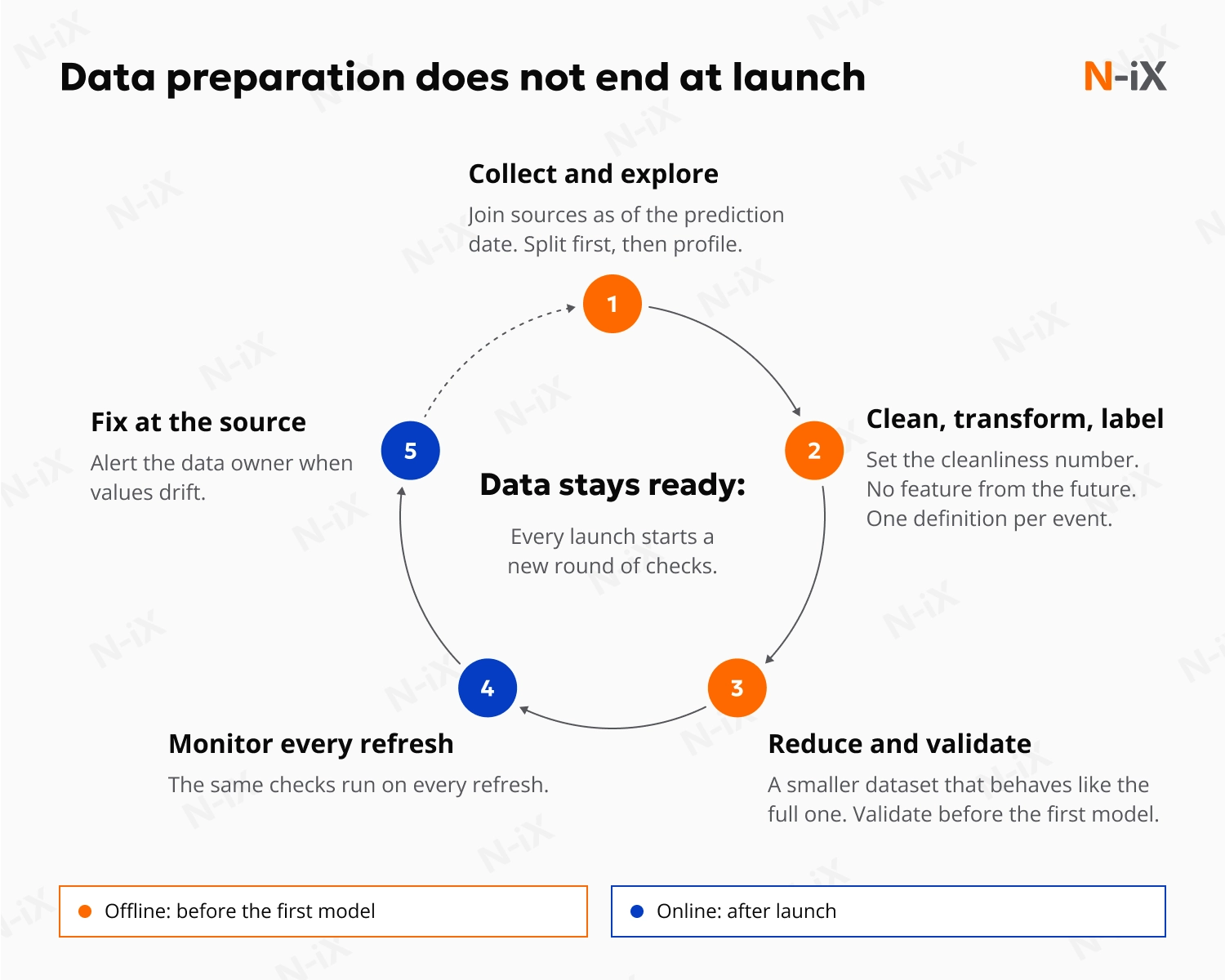
Gartner also advises DataOps and data observability processes that track changes in data patterns. Source systems change after launch, and the data changes with them. The executive decision here is budget. Someone has to be paid to watch the data after the project team has moved on. Your engineering partner builds pipelines that repeat the checks on every refresh and alert the data owner when values drift.

7 steps of data preparation for Machine Learning
Each step below shows what the work requires when the data feeds a Machine Learning model. For unstructured data and generative AI, see our guide to data preparation for AI.
1. Data collection: sources joined as of the prediction date
For ML, collection depends on the target. For a churn model that predicts which customers leave within 90 days, we join the sources as they looked on the prediction date. Combining historical data with current customer records can inadvertently expose the model to information that was unavailable at the time of prediction. We also verify access permissions and check whether each extract covers the full history or only recent snapshots.
2. Data exploration: split first, then profile
We set aside the test set before computing any statistics. How we split depends on the data. Time-dependent data is split by calendar: the model trains on earlier periods and is tested on later ones. Data with many rows per customer or machine is split by customer or machine. Each customer or machine then appears in only one set. A rare outcome calls for a stratified split, which keeps the same share of rare cases in every set. We typically use 70 to 80% for training, 10 to 15% for validation, and 10 to 15% for testing.
Then we profile the training data, and we start with the target. Suppose only 2% of past customers left. A model can reach 98% accuracy by predicting that every customer stays, yet fail to identify churn risks. We measure class balance first and choose metrics that reflect what a missed case costs the business.
3. Data cleaning: 3 to 8 weeks
In our enterprise projects, cleaning takes three to eight weeks. The data owner decides three things during this step:
- How to treat missing values: fill them, flag them, or drop the field.
- Which source system is the system of record when records are duplicated.
- Whether an extreme value is a real event or an entry error.
We calculate fill values only on the training set, then apply them to the rest. This keeps test-set information out of training.
4. Data transformation and feature engineering: no features from the future
Models need numeric inputs, and linear and distance-based models also need them on comparable scales. We scale numerical fields and encode categories with a method that fits the model type. Then we build features that carry business logic. A last-service date becomes the number of days since service. Every feature must have been available on or before the prediction date. In a model that predicts equipment stoppages, a repair ticket opened after the stoppage is a future feature: it records the answer the model is meant to predict.
5. Data labeling: one definition per event
Labels are the correct answers a model learns from. If one team labels a case “fraud” and another labels the same kind of case “needs review,” the model learns conflicting answers for the same pattern. We start with a taxonomy and written criteria. Domain experts apply them, and automated pre-labeling speeds up the work. People verify the result.
6. Data reduction: a smaller dataset that behaves like the full one
Large datasets slow experiments and raise computing costs. Dropping fields with little predictive value lowers cost and the risk of overfitting, which is when a model memorizes its training data. Teams can also run experiments on a representative sample that mirrors the full dataset’s statistical properties. Results arrive faster.
7. Data validation: before the first model, and after launch
Our data engineers test the prepared data against the agreed quality thresholds. Every customer segment must be represented, and recent data should not differ sharply from history. A leakage audit follows: every input field must trace back to a point on or before the prediction date. You receive a short readiness report that lists which thresholds the data meets and which it does not yet meet.
After launch, the same checks run on every refresh. Customer behavior changes over time, and a model’s accuracy can drop without triggering an alert.
4 challenges of preparing data for Machine Learning, and how N-iX addresses them
Some challenges need decisions that data engineers cannot make for you. Choosing the prediction target and setting quality thresholds belong to the business. The four challenges below are the ones our data engineers can take off your team’s plate.
Bad records that appear weeks late
Data defects rarely announce themselves. A record with the wrong unit enters at ingestion and passes every later step. It appears weeks later as an odd prediction. Tracing it back then means searching through every stage between the source and the model.
We write validation checks into the pipeline itself and test each load before the data moves on. A record that breaks a rule is stopped at ingestion and reported to the data owner. Labeling stays with your domain experts, since they own the definitions.
One feature, two pipelines
A model can behave differently in production than in testing because the training and serving pipelines process the same raw data differently. This is called training-serving skew. For example, the training code converts timestamps to local time, and the serving code leaves them in Coordinated Universal Time (UTC). The model keeps predicting and raises no errors. Every prediction is slightly wrong.
We build each feature once and use the same code for training and serving. If that is not possible, we send raw data through both pipelines before release and compare the outputs. Any mismatch shows skew.
A field that changes meaning upstream
Say an upstream team changes what a status field means. No pipeline breaks and no alert fires. The model quietly learns from a field that no longer means what it used to. Without lineage, tracing a wrong prediction back to its source can take longer than retraining the model.
We set up a data catalog with a named owner for each source, and add tests on upstream schemas. When a field changes, the owner and our team find out before the model does.
Pipelines rebuilt by hand for every project
Scripts and spreadsheets written for one project rarely survive into the next. Each team rebuilds the same fields, and two models can end up with different definitions of the same one. Maintenance then competes with new work for the same engineers.
We replace one-off scripts with versioned, tested pipelines. We document each feature’s definition and owner. The second project starts from the features of the first. For example, for a global stock image and media platform, we moved fragmented SQL-based datasets into a governed Snowflake, dbt, and Looker architecture. Storage costs fell, and processing sped up. The pipelines became reliable enough to expand AI and analytics work. Our case study describes the work in detail.
How N-iX approaches Machine Learning data preparation
With over 24 years of experience, we have delivered more than 100 AI and Data Science projects. We run this work on platforms such as Databricks and Snowflake. For a Fortune 500 manufacturer, we prepared a Databricks environment to handle five times the data volume at a lower processing cost. Our data engineering services also include custom validation checks, data catalogs, and ownership models.
We start with the questions from this article: what the model predicts, who owns each source, and what quality level the business accepts. Data engineering follows from the answers.
1 to 3 weeks of discovery before any pipeline work
We profile your sources against the five conditions and report which ones your data meets today. You get the gaps in writing, with an owner named for each, before we agree on a scope.
Who works on your data:
- Data engineers design the pipelines and resolve schema inconsistencies.
- Data scientists explore distributions and guide feature design.
- Governance specialists classify sensitive data and define access rules.
- Your domain experts confirm that labels and features carry the right business meaning.
- A data or analytics leader on your side decides on scope and investment.
12 to 31 weeks of stage work, less on the calendar
These are our stage estimates:
|
Stage |
Duration |
|
Discovery |
1 to 3 weeks |
|
Ingestion and metadata capture |
2 to 6 weeks |
|
Quality assessment |
2 to 4 weeks |
|
Cleaning and normalization |
3 to 8 weeks |
|
Feature engineering |
2 to 6 weeks |
|
Governance setup, validation, and readiness checks |
2 to 4 weeks |
In total, the stages take 12 to 31 weeks. Because they overlap, calendar time can be shorter.
Discovery, pilot, then scale
Discovery comes first. A fixed-scope pilot on one use case follows. After that, you can either extend your team with ours or hand the pipelines to us as a managed service. A model can learn only from data that meets the conditions. Contact us to book a data maturity assessment and see where your data stands today.
FAQ
What is data preparation in Machine Learning?
Machine Learning data preparation is the work between your source systems and the first training run. It turns raw company data into data a model can learn from. In N-iX projects, data engineers and data scientists share the work: engineers build the pipelines, and scientists guide feature selection and checks.
What are the steps of data preparation for Machine Learning?
The seven steps are data collection, exploration, cleaning, transformation and feature engineering, labeling, reduction, and validation. For ML, the data is split before cleaning, and every feature must exist at prediction time. An N-iX data assessment checks your sources against these steps before anyone commits to a scope.
How much training data is required for Machine Learning?
No single number applies. What counts is the number of examples of the outcome you want to predict. For instance, a model predicts equipment stoppages, and your history holds a million rows but only 50 stoppages. That is thin, no matter how large the file looks. Your history also has to cover your business cycles, such as a full year for seasonal demand. During discovery, our data engineers count the labeled examples per outcome. You then know whether the data can support a model before the build starts.
What tools are used for data preparation for Machine Learning?
Small datasets are often prepared in Python with libraries such as pandas and scikit-learn. Large volumes move to Spark or SQL on a platform such as Databricks or Snowflake. The tool matters less than the checks around it. We work on Databricks and Snowflake, adding validation checks and data catalogs to the stack you already run.
Have a question?
Speak to an expert