
 ChatGPT
 Perplexity
 Claude
 Gemini
 Grok
Grok
To stay ahead of the competition, many industry-leading businesses, such as Microsoft, Mercedes-Benz, Lebara, Gogo, Viber, and others, have turned to IT staff augmentation in Eastern Europe. Why? The region offers access to tech talent with specialized expertise, allowing businesses to rapidly scale their development teams without compromising on quality.
However, navigating the process of IT outstaffing in Eastern Europe requires careful consideration. How do you choose the right country that best aligns with your needs? And which cooperation model will best suit your project goals?
To make this easier for you, we’ve researched the top countries for team extension in Eastern Europe—Poland, Ukraine, Romania, Hungary, the Czech Republic, Slovakia, and Bulgaria. Let’s dive in and explore what makes each of these destinations a great choice for expanding your engineering capacity.
What are the top countries for staff augmentation in Eastern Europe?
In terms of team augmentation, Europe, especially its Eastern part, has great potential. Eastern European countries have significantly developed infrastructure and tech education in the last 20 years. Moreover, the region is a thriving market for software development and team extension services. Now let’s explore the Eastern European countries in more detail and find out where to scale your development capacity most efficiently.
Poland
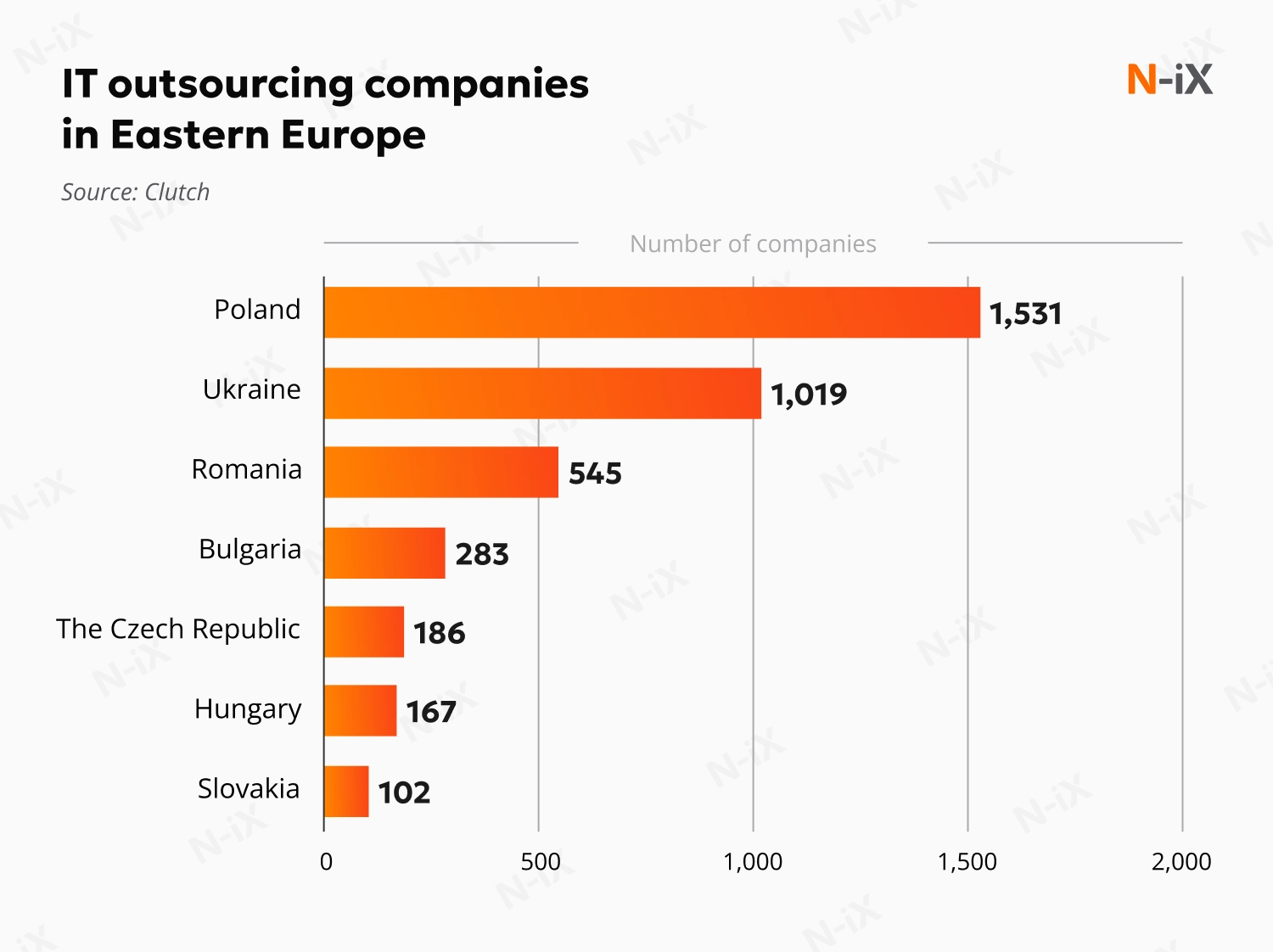
There are many reasons to consider team extension services in Poland, with a strong talent base and well-developed infrastructure at the forefront. Polish universities produce around 16,500 ICT graduates each year, ensuring a steady supply of skilled engineers to the market. The country also hosts more than 1,530 IT companies offering team extension services, giving businesses flexibility in vendor selection and technology expertise. In addition, Poland is home to numerous R&D centers of global tech leaders such as ABB, Google, Siemens, Motorola, and Intel.
Related: 15 reliable IT outsourcing companies in Poland: Market overview
Ukraine
Ukraine remains one of the top hubs for team extension in Eastern Europe, with around 1,020 software development companies registered on Clutch and a talent pool of over 350,000 tech professionals. Leading global companies choose Ukraine thanks to its competitive pricing, broad technology expertise, and experience in large-scale cloud, data, AI, embedded, and enterprise projects.
Despite the full-scale invasion and periods of power disruption, Ukrainian IT companies have successfully maintained operations through well-executed Business Continuity Plans. Most vendors, including N-iX, continue to deliver at over 95% operational capacity, ensuring service stability for global clients.
Keep reading: Software development outsourcing to Ukraine: An ultimate industry overview
Romania
Romania is another established outsourcing destination for staff augmentation in the EE region, supported by a strong and steadily growing tech workforce. The country is home to around 202,500 ICT professionals. Each year, about 10,000 ICT and computer science graduates enter the market, ensuring a consistent influx of skilled specialists. Moreover, the Romanian government actively supports the tech industry by exempting tech professionals from the 16% income tax.
Read more: IT outsourcing to Romania: Major hubs, tech talent pool, and more
The Czech Republic
With around 221,900 tech professionals available on the market, the Czech Republic has become a popular destination for staff augmentation. Each year, over 5,700 ICT graduates join the workforce, reinforcing the country’s constant talent supply. The Czech Republic also demonstrates solid innovation performance, ranking 30th among 133 economies in the Global Innovation Index 2024.
Get a complete overview of Central and Eastern European tech markets!
Success!
Hungary
The Hungarian tech industry represents about 6% of the country’s economy. Hungary boasts over 180,900 ICT professionals, so many global businesses look for staff augmentation in this Eastern European country. In addition, Hungary is home to around 170 IT outsourcing providers that deliver projects for a wide range of domains, with a focus on financial and business services, ecommerce, and healthcare.
Slovakia
Slovakia has a relatively smaller but steadily developing technology landscape, with over 131,000 ICT professionals, which accounts for roughly 5% of the country’s entire workforce. The country has gained attention from major global players, with Volkswagen, Kia, and Siemens choosing Slovakia for their R&D hubs. Their presence highlights the region’s engineering capabilities, industry experience, and potential for long-term innovation partnerships.
Bulgaria
Staff augmentation in Bulgaria is another viable option to consider, since this Eastern European country houses over 108,600 tech specialists. Around 280 companies are operating in the Bulgarian IT market, the majority of which offer team extension services. Moreover, due to the favorable business environment, many multinational IT corporations (HP, SAP, Johnson Controls, Oracle, and others) have opened R&D offices in Bulgaria.
What are the key benefits of staff augmentation in Eastern Europe?
Eastern Europe is a popular destination for team extension, offering a compelling mix of access to top tech talent and cost-efficiency. Let’s take a closer look at these and other key benefits of staff augmentation in the EE region:
A vast talent pool
Eastern Europe stands out among other outsourcing destinations for its impressive number of highly skilled IT professionals. The combined talent pool across countries such as Ukraine, Poland, Romania, Hungary, the Czech Republic, Bulgaria, and Slovakia exceeds 1.8M tech specialists. Furthermore, with more than 86,500 ICT graduates joining the workforce annually, the region ensures a steady influx of new talent, supporting the scaling needs of businesses across various industries.
Time zone overlap
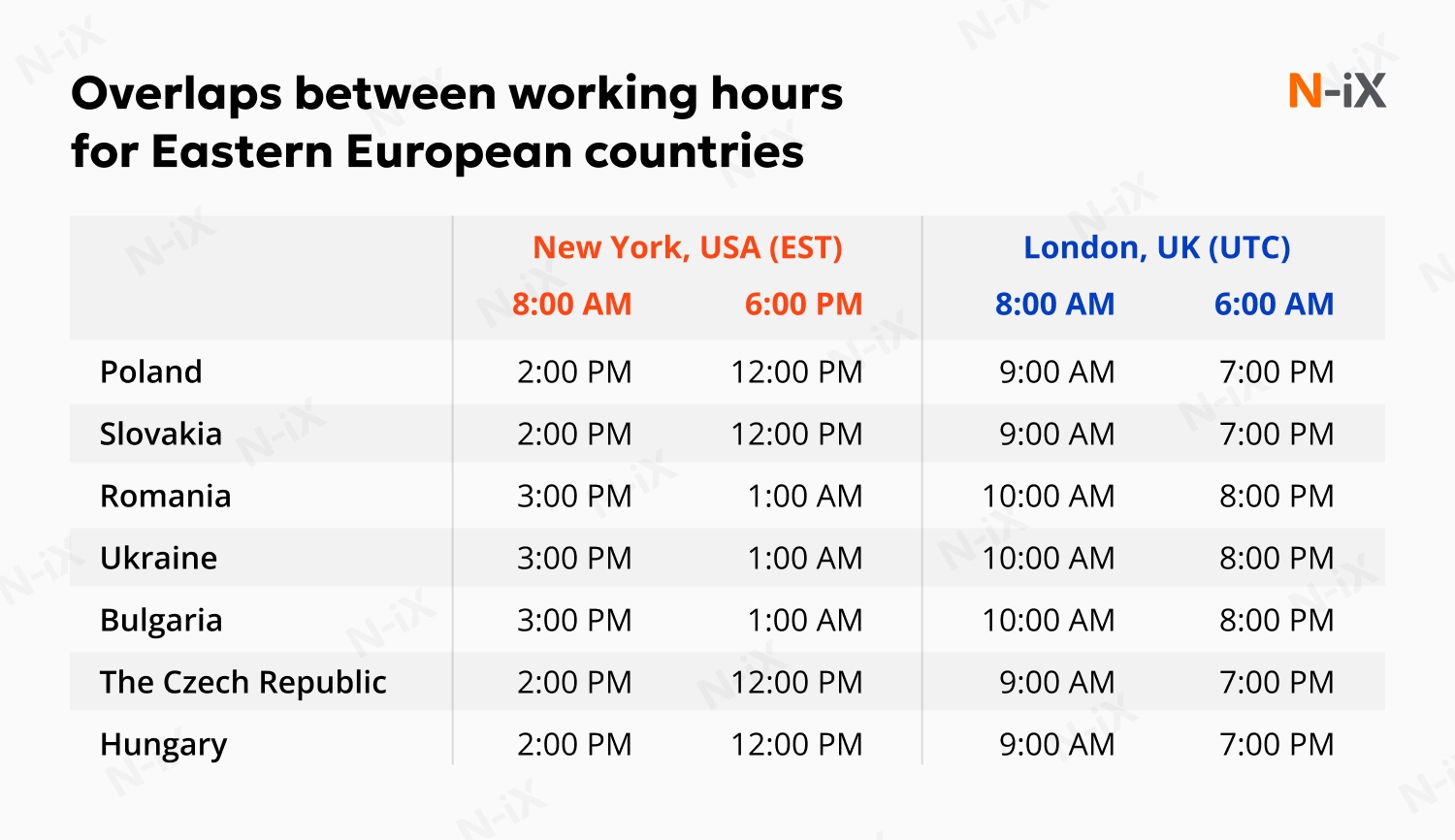
One of the key advantages of Eastern Europe is its time zone overlap with both Western Europe and the US. The region has only a one-to-two-hour time difference from Western Europe and a convenient overlap with the US, which ensures real-time communication. Additionally, this time difference enables an efficient round-the-clock development cycle. For example, while your internal team is offline, your dedicated development team in Eastern Europe continues to work, ensuring continuous progress and accelerating project timelines. This approach maximizes productivity and shortens time to market.
Governmental support of the IT industry
Governments in Eastern Europe are actively supporting the growth of the IT sector, offering various incentives that encourage investment in research, development, and innovation. These incentives include tax breaks, investment subsidies, and streamlined bureaucratic processes that make it easier to establish and scale operations. In addition, many countries in the region foster strong partnerships with universities, ensuring a steady pipeline of talent to meet the growing demands of the tech industry.
Shared business culture
Eastern Europe benefits from a shared business culture that aligns well with Western business practices, especially in terms of communication, project management, and work ethic. This cultural compatibility ensures smoother collaboration and integration of remote teams.
A cultural fit sets the foundation, but the cooperation model determines how well the collaboration works in practice. Let’s explore the options and find which one aligns best with your goals.
How to select the right cooperation model?
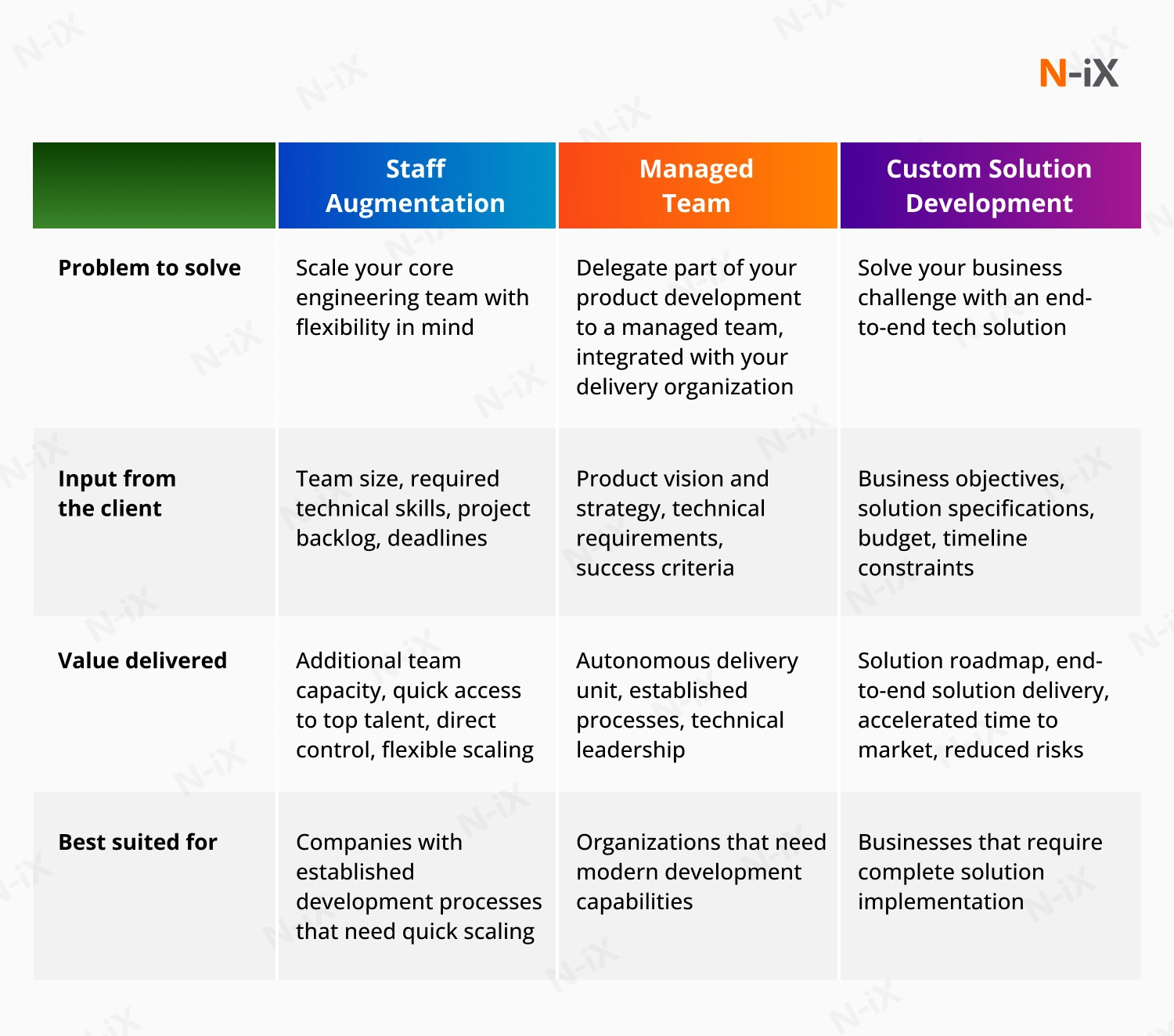
When choosing a cooperation model, it's crucial to consider your project’s specific needs, the level of control you want to maintain, and the type of support you require. There are three main models to consider: Staff Augmentation, Managed Team, and Custom Solution Development. Each one serves different business needs and is best suited for different types of projects.
Staff Augmentation
This model is the perfect fit if you need to quickly scale your existing team with specialized tech expertise. While you maintain control over the team and development process, your tech partner will help you quickly find and engage highly skilled experts. With N-iX, you can tap into a vast pool of talent, enabling rapid scaling of your team without compromising on quality. This model offers flexibility, allowing you to adapt quickly to business requirements and project changes.
Managed Team
A Managed Team is a dedicated development unit tailored to meet the specific needs of your project. This team operates independently but works seamlessly within your existing structure. With the guidance of a dedicated project manager, the team is responsible for managing daily operations and ensuring alignment with your project’s objectives. The recruitment process is handled by your outsourcing partner, allowing you to quickly form a specialized team. This model is particularly well-suited for projects that require focused expertise, such as the development of specific features or platform migrations.
Custom Solution Development
Custom Solution Development is a comprehensive model in IT outsourcing that covers the entire development process from start to finish. The process often begins with an in-depth Product Discovery phase, where experts analyze your business, validate your idea, and provide a clear vision for the product. Following this, a development team is assembled to manage every phase of solution development, from initial concept to final deployment. Such partnerships typically last for years, with the outsourced team acting as a dedicated R&D center. This model is best suited for larger, more complex projects that require complete, end-to-end development and long-term collaboration.
Related: Top 30 staff augmentation companies in 2026
Wrap-up
Staff augmentation in Eastern Europe offers significant advantages for organizations that need to scale development rapidly, expand expertise, and accelerate delivery. With over 1.53M tech specialists, advanced digital infrastructure, and a well-established outsourcing ecosystem, Eastern Europe remains one of the most developed software engineering markets globally. Partnering with a trusted vendor with a presence in Eastern Europe means quicker staffing, stable delivery processes, and access to experienced engineers who can support complex initiatives and long-term product growth.
Why should you choose N-iX for staff augmentation in Eastern Europe?
N-iX is a global software development company with delivery centers and offices across 25 locations in Europe, Asia, and the Americas. In Europe, we operate across major outsourcing markets including Ukraine, Poland, Bulgaria, and Romania, giving clients access to skilled engineering talent in the region known for strong STEM education and mature delivery culture. Such geographical coverage allows us to scale teams quickly, support distributed delivery models, and find specialists with the right expertise for each project.
Our engineering expertise spans cloud platforms, data engineering, GenAI, IoT, embedded software, and enterprise solutions, complemented by AI-augmented development practices that improve delivery speed and increase productivity. With 23 years of experience and proven success across industries such as manufacturing, fintech, retail, automotive, and healthcare, N-iX has earned a solid reputation for reliable execution and scalable product development. Our work is consistently recognized by IAOP, CRN, and Forrester, reinforcing our position as a trusted technology partner for global organizations.
Looking to extend your engineering team in Eastern Europe? N-iX can help you hire fast, scale with confidence, and deliver without disruption. Contact us today!
FAQ
How does team extension in Eastern Europe compare to other regions?
Compared to Western Europe or North America, Eastern Europe provides more competitive rates for high engineering quality. At the same time, it offers stronger cultural proximity than many other outsourcing regions.
Can time zone alignment really make a difference?
Yes—most Eastern European teams collaborate with Western European clients in real time and have a convenient overlap with US-based businesses. This allows for shared stand-ups, direct communication, and faster decision-making cycles.
What should I consider when selecting a country within Eastern Europe?
Look at the size of the talent pool, technology focus, delivery culture, local English proficiency, and the maturity of the local IT market.
What delivery continuity can be expected from vendors in Eastern Europe?
The region has shown strong resilience, with vendors maintaining continuity even during challenging periods. Established providers operate with distributed delivery centers, redundancy measures, and well-tested BCP frameworks to support uninterrupted development.
Have a question?
Speak to an expert