
Key takeaways
- Physical AI development companies build the AI software that runs inside machines, from consulting to deployment and support.
- Firms differ by role and hardware: some advise, some integrate devices you own, and some design and prototype new ones.
- Production systems on hardware like yours count for more than accuracy scores from a lab.
- Safety evidence needs a stated scope and date, and a plan for monitoring and retraining after go-live.
- A fixed-scope first phase on one line, with one success metric, shows how a partner works before a full contract.
- N-iX covers embedded firmware, edge AI, computer vision, and plant integration in one team, and it designs and prototypes devices when a project needs them.
Physical AI development companies build the AI software that runs inside machines: robots, cameras on a production line, vehicles, and connected equipment. You hire one when a prototype that performs well in the lab must run on your site, with your hardware and your controllers. Global consultancies suit programs across many sites. Engineering-led firms suit projects built around your devices. Specialists suit one use case, such as vision or robotics.
The guide compares physical AI consulting and development companies, from global consultancies such as Deloitte and EY to software engineering-led firms such as N-iX. Each entry shows what the firm builds and how deeply it works with hardware. Chip makers, robot manufacturers, and platform vendors are left out because you cannot hire them to build your system.
What can physical AI development companies do?
Physical AI development firms differ in how many of these areas they cover.
- Consulting: Decide what is possible before anyone builds. The team audits camera positions, lighting, sensor quality, network limits, and the data you already collect. It sets the latency budget and decides what runs on the device and what runs in the cloud. It also maps safety and security requirements to the architecture before the design is locked. The output is a written recommendation, a scoped architecture, and go/no-go criteria.
- Development: Build for the conditions of your site. Training data comes from real operating conditions, with labeling rules for rare cases. Models are compressed through quantization, pruning, and distillation to fit the device's compute and power limits. Testing starts in simulation and digital twins. The team then measures the gap between simulated and real behavior on actual equipment, with hardware-in-the-loop tests. It also links the system to PLCs, SCADA systems, and robot controllers.
- Deployment: Keep it accurate after go-live. Rollout runs in phases with a fallback to the previous process, and model and firmware updates ship over the air with rollback. The team tracks accuracy against the go-live baseline and watches for drift in sensors, lighting, and products. It triggers retraining when accuracy falls below agreed thresholds. It also keeps the evidence a safety audit asks for.
How we selected these physical AI development companies
Physical AI faults stay hidden until the model meets the site. A sensor drifts after six months, a camera moves, or a model that ran on a workstation misses its latency budget on the device. For that reason, we looked for what each firm has shipped to real hardware and supported afterward.
The list covers firms that consult on, develop, and deploy physical AI software. We fixed seven criteria and their weights before reviewing any firm, and the percentages show how much each counted.
|
Criterion (weight) |
Why it matters |
What counted as evidence |
Where we looked |
|
Physical deployments (25%) |
Lab results say little about how a system behaves on real equipment over months |
A named case: equipment or site, what changed, one figure, and proof the system is still supported |
Case pages, press, third-party write-ups |
|
Edge and embedded engineering (15%) |
A model that fits a workstation can miss its latency or power budget on the device |
A named target platform tied to a delivered project |
Service pages, engineering articles, chip vendor directories |
|
Perception and sensor data (15%) |
Glare, dust, and rare defects break models trained on clean data |
A described method for variable conditions and for labeling rare cases |
Case pages, technical articles |
|
Simulation and validation (15%) |
Simulated results can differ from behavior on real equipment |
A method for measuring the simulation-to-real gap |
Technical papers, case pages |
|
Independent client feedback (10%) |
Vendor claims need an outside check |
Verified review score, review volume, and project detail, or analyst recognition where reviews are scarce |
Clutch, G2, Gartner reviews, analyst reports |
|
Fleet operations (10%) |
Accuracy decays after launch as sensors, lighting, and products change |
Drift monitoring, retraining triggers, and update rollback |
Service pages, support terms, case pages |
|
Safety and compliance (10%) |
Safety requirements added late force a redesign |
Current certificates with scope stated: ISO 27001, IEC 62443, functional safety |
Certificate registries, firm security pages |
Editorial notes
N-iX wrote this list of leading companies in physical AI and appears on it. We applied the same checks and the same criteria to our own profile as to every other firm, and no company paid for a place. The percentages describe how much each criterion counted, and they give no firm a score. Beyond N-iX appearing first as the publisher, the order means nothing: the numbers beside the names only separate the profiles, and a lower number does not mean a better firm.
Top physical AI companies that provide development and consulting services
1. N-iX
N-iX is a Pragmatic AI Software Engineering company that builds the software layer of physical AI: perception, edge inference, embedded integration, and the pipelines that keep models accurate after launch. Engagements start with a documented baseline of the client’s environment and hardware before the build scope is agreed, and go-live targets come from that baseline.
With 24 years of enterprise delivery, 200 AI experts, and over 100 AI projects, the team covers physical AI consulting and assessment, computer vision, edge AI, embedded systems, predictive maintenance, digital twins, and robotics. Embedded delivery includes firmware for regulated medical devices, over-the-air updates, hardware-in-the-loop testing, and custom hardware prototyping. The robotics practice spans control system design, computer vision and deep learning inside control loops, industrial robot customization, simulation, and automated test beds. The same engineers handle OT integration with PLCs and SCADA systems, connecting the AI layer to the equipment it informs.
- Type: Engineering-led and consulting.
- Hardware involvement: Designs and prototypes.
- Best fit for: Enterprises that want one partner for the full path from environment assessment to a monitored edge deployment, with architecture and hardware choices set by measured constraints.
- Physical AI strengths: Computer vision under variable lighting and camera angles, edge inference on constrained hardware, sensor fusion, control systems with embedded computer vision and deep learning, simulation and digital twins for robot testing, predictive maintenance on equipment data, MLOps for model drift after launch.
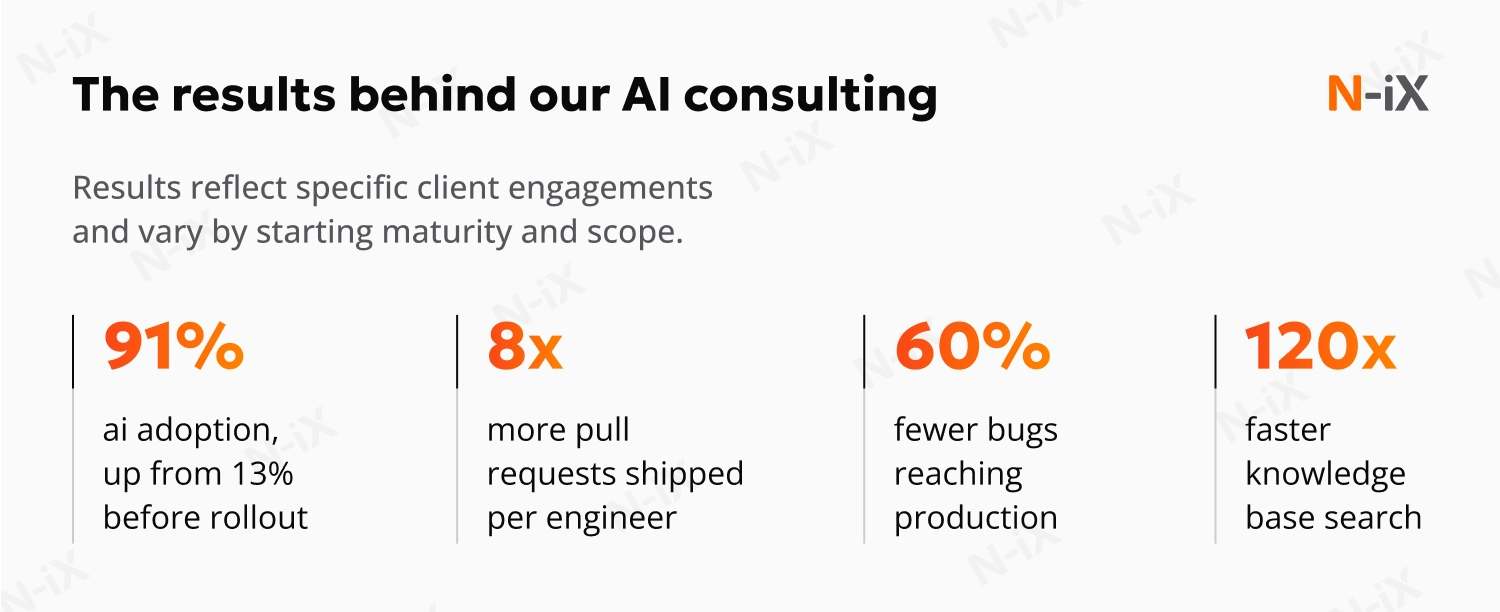
Verified outcomes:
- Perception PoCs for a roadside traffic enforcement company: 88% seat belt detection accuracy, 91% person detection accuracy day and night, and real-time stream processing at 30 FPS.
- Computer vision for the docks of a Fortune 100 engineering company: Contactless goods tracking with industrial optic sensors and NVIDIA Jetson devices, on a cloud-native platform architected to scale to more than 400 warehouses.
- Antenna failure prediction for an in-flight connectivity provider: Reducing the no-fault-found rate by 75% with predictive models.

2. Deloitte
This global professional services company added physical AI to its engineering and industry practices in 2026. Its offering, built with NVIDIA Omniverse libraries, covers simulation-based planning with digital twins, edge robotics deployment, and computer vision for reading physical environments. A Center of Excellence in Shanghai, aimed at manufacturing and industrial robotics, is part of a planned global network.
- Type: Consultancy.
- Hardware involvement: Integrates.
- Best fit for: Large enterprises planning physical AI across several sites or countries, where security and regulation weigh as much as engineering.
- Physical AI strengths: Simulation-led planning with digital twins, edge robotics deployment, computer vision, regulatory and security guidance.

3. EY
This vendor launched a physical AI platform in December 2025, built with NVIDIA accelerated computing, and opened a lab in Georgia dedicated to AI in physical environments. The platform covers synthetic data generation, simulation of robots, drones, and edge devices before deployment, and attestation services for compliance. It provides data, simulation, assurance, and deployment guidance.
- Type: Consultancy.
- Hardware involvement: Advises.
- Best fit for: Large enterprises that need physical AI programs with assurance, risk, and regulatory attestation built in.
- Physical AI strengths: Synthetic data, simulation and digital twins, compliance attestation, a dedicated lab for testing robotics.
4. Softeq
A US embedded and software engineering firm, headquartered in Houston, now markets its work as physical AI, edge AI, and IoT development. One team covers device firmware, edge-to-cloud architecture, fleet management, and the AI layer that turns sensor readings into action. It also designs hardware and electronic circuits, and serves consumer electronics, healthcare devices, and industrial IoT. Recent partnerships with Edge Impulse and NXP, and membership in the Edge AI Foundation, point to a focus on embedded AI.
- Type: Engineering-led.
- Hardware involvement: Designs and prototypes.
- Best fit for: Companies building smart devices that need hardware, firmware, and AI from one team, especially in consumer electronics, healthcare devices, and industrial IoT.
- Physical AI strengths: Embedded firmware, edge AI, sensor fusion, device fleet management, circuit and hardware design.
5. ALTEN
A French engineering and technology consulting group has over 30 years of R&D services for aerospace, automotive, energy, and industrial clients. Its AI program, running since 2024, includes two AI-dedicated units with AI management certification. Embedded teams build AI and computer vision into products for autonomous driving and medical devices. A partnership with a chip maker covers Machine Learning on microcontrollers. This representative of physical AI development providers works on robotics, digital twins, and NVIDIA-based vision.
- Type: Consultancy.
- Hardware involvement: Integrates.
- Best fit for: Automotive, aerospace, and industrial groups that need embedded, robotics, and vision engineering capacity across several countries.
- Physical AI strengths: Embedded AI on constrained chips, robotics and digital twin engineering, computer vision for autonomous driving and medical devices, multi-country engineering capacity.
6. TechAhead
This software engineering firm is headquartered in California with delivery offices in India and Dubai. Its team has built its physical AI practice on robotics and edge software. Services cover robotics software stacks for autonomous and semi-autonomous machines, edge AI for low-latency on-device decisions, AIoT that links sensors to analytics, and predictive maintenance for connected assets. Among the physical AI development firms, it integrates AI models with robotic platforms and offers robotics integration consulting.
- Type: Engineering-led.
- Hardware involvement: Integrates.
- Best fit for: Enterprises that want robotics, edge, and connected-device software from the same team that builds their broader AI applications.
- Physical AI strengths: Robotics software and integration, edge AI for on-device decisions, AIoT, predictive maintenance on connected equipment.

7. GlobalLogic
This digital engineering firm has a long record in embedded engineering, computer vision, robotics, and industrial automation. Its physical AI offering is grouped into five areas: cognitive assets, digital twins and simulation, autonomous operations, robotics and automation, and autonomous infrastructure. In 2026, it opened a dedicated physical AI zone at its engineering center in Kraków and announced a partnership with a European industrial group to deploy autonomous robotics in heavy industry.
- Type: Engineering-led.
- Hardware involvement: Integrates.
- Best fit for: Industrial, automotive, and energy groups that want embedded engineering and physical AI from one vendor-neutral partner.
- Physical AI strengths: Embedded engineering, digital twins and simulation, robotics and automation, IT and OT convergence.

8. Yalantis
Another vendor delivers hardware, firmware, cloud, and AI under one team. Its edge AI work covers computer vision, predictive maintenance, and Machine Learning on embedded devices, and its services extend to digital twins for industrial, medical, logistics, and energy products. The firm supports proprietary hardware and integration with existing controllers and sensors, and it lists pre-certification experience for medical, industrial, and radio standards.
- Type: Engineering-led.
- Hardware involvement: Designs and prototypes.
- Best fit for: Teams building connected industrial, medical, or logistics devices that need hardware, firmware, and AI from one compliance-aware team.
- Physical AI strengths: Edge AI and tiny Machine Learning, computer vision, predictive maintenance, hardware and firmware engineering, regulatory pre-certification.
9. DXC Technology
This company launched a dedicated engineering unit in 2026. Its physical AI work centers on smart product design: intelligent systems where software, hardware, and AI meet in real environments, from road-ready autonomous vehicles to production-line productivity. The unit works with silicon and AI compute leaders such as NVIDIA to integrate embedded computing, and it targets settings in manufacturing, telecommunications, and energy.
- Type: Consultancy.
- Hardware involvement: Integrates.
- Best fit for: Enterprises running systems that need embedded, automotive, or industrial engineering at scale with physical AI built in.
- Physical AI strengths: Smart product engineering, embedded computing on NVIDIA platforms, automotive and industrial systems.
10. DataX Power
A Vietnamese AI data company supports robotics and physical AI programs mainly through data: annotation for computer vision, LiDAR point clouds, 3D bounding boxes, sensor fusion, and autonomous navigation datasets. It adds AI consulting, implementation support, and MLOps for dataset and model lifecycle management.
- Type: Engineering-led.
- Hardware involvement: Advises.
- Best fit for: Robotics and autonomous system teams that need labeled 3D, LiDAR, and sensor-fusion training data at volume.
- Physical AI strengths: LiDAR and point cloud annotation, sensor fusion datasets, computer vision labeling, dataset management.
11. Fresh Consulting
This product development and innovation firm is based in Washington. Among the physical AI consultants, this representative engineers industrial design, robotics, and embedded firmware together for real operating conditions. Its AI offering covers computer vision for high-speed defect inspection, control system integration that turns what the system sees into signals for robots and PLCs, sensor fusion with edge AI, and spatial AI with digital twins for testing designs and scenarios.
- Type: Engineering-led.
- Hardware involvement: Designs and prototypes.
- Best fit for: Product companies and manufacturers that need industrial design, hardware, embedded firmware, and AI built together by one team.
- Physical AI strengths: Computer vision for inspection, control system integration, sensor fusion and edge AI, spatial AI and digital twins, product and industrial design.
12. Boston Consulting Group
A global management consulting firm builds and designs unit-pair strategy with product engineering and AI. It consults on physical AI in industrial operations, covering the technology stack, ecosystem partnerships, and workforce change. Its industrial practices team works with the engineering unit on predictive maintenance and AI in factories.
- Type: Consultancy.
- Hardware involvement: Advises.
- Best fit for: Executive teams that need a physical AI strategy, business case, and workforce plan before they choose build partners.
- Physical AI strengths: Strategy and business case, industrial operations expertise, AI product engineering, workforce planning.

13. Luceon
A small software and hardware engineering firm in Miami Beach focuses on computer vision, Machine Learning, and edge computing for automation. Its positioning centers on mission-critical automation, where vision and AI remove bottlenecks in existing operations.
- Type: Engineering-led.
- Hardware involvement: Designs and prototypes.
- Best fit for: Mid-market teams that want a small, specialized group for a single computer vision or edge automation project.
- Physical AI strengths: Computer vision, Machine Learning, edge computing, automation engineering.
14. SaM solutions
This software engineering company is headquartered in Germany. The provider has more than 30 years of custom development and a long record in embedded and IoT practice, from chip-level programming and firmware to cloud integration. Its edge AI services run models on devices, gateways, cameras, sensors, and industrial controllers, and include help choosing and tuning hardware.
- Type: Engineering-led.
- Hardware involvement: Integrates.
- Best fit for: Companies that need AI running on devices, gateways, or controllers, and want embedded firmware, edge AI, and cloud integration from one team.
- Physical AI strengths: Edge AI on constrained and industrial hardware, embedded and firmware engineering, computer vision for quality control, IoT architecture and cloud integration.
15. Geisel Software
This software firm in Massachusetts focuses on embedded and application software for robotics, automation, AI and Machine Learning, and IoT. Its engineers work with ROS and real-time operating systems. A related company from the same founder runs a synthetic image platform for training computer vision and physical AI models.
- Type: Engineering-led.
- Hardware involvement: Integrates.
- Best fit for: Robotics and automation companies that need embedded and application software from a specialist team.
- Physical AI strengths: Embedded software, ROS and real-time systems, Machine Learning, synthetic data for vision training.
Comparison table of the best companies to hire for physical AI development
|
Company |
Physical AI services |
Industry focus |
Founded |
|
N-iX |
Assessment, computer vision, edge AI, robotics, predictive maintenance, digital twins |
Retail, finance, industrial supply, ecommerce, manufacturing, automotive, logistics |
2002 |
|
Deloitte |
Digital twins, edge robotics, computer vision |
Manufacturing, utilities, smart cities |
1845 |
|
EY |
Physical AI platform, synthetic data, simulation, compliance attestation |
Industrials, energy, healthcare, mobility, smart cities |
1989 |
|
Softeq |
Embedded AI, edge AI, sensor fusion, fleet management |
Consumer electronics, healthcare, industrial IoT |
1997 |
|
ALTEN |
Embedded AI, robotics, digital twins, computer vision |
Aerospace, automotive, energy, defense, life sciences |
1988 |
|
TechAhead |
Robotics software, edge AI, AIoT, predictive maintenance |
Industrial, healthcare, service robotics |
2009 |
|
GlobalLogic |
Digital twins, robotics, autonomous operations, IT and OT convergence |
Automotive, industrial, healthcare, energy, telecom |
2000 |
|
Yalantis |
Edge AI, computer vision, predictive maintenance, hardware design |
Medical devices, industrial automation, energy, logistics, retail |
2008 |
|
DXC Technology |
Smart product engineering, embedded computing, autonomous systems |
Manufacturing, telecom, energy, automotive |
2017 |
|
DataX Power |
LiDAR and sensor-fusion annotation, dataset management, MLOps |
Robotics, autonomous systems |
2024 |
|
Fresh Consulting |
Computer vision inspection, control integration, spatial AI, digital twins |
Industrial, medical, consumer products |
2007 |
|
Boston Consulting Group |
Strategy, business case, AI engineering, workforce planning |
Industrial goods, automotive, aerospace and defense |
1963 |
|
Luceon |
Computer vision, Machine Learning, edge computing |
Mission-critical automation |
2004 |
|
SaM Solutions |
Edge AI, embedded firmware, computer vision, IoT architecture |
Printing, industrial IoT, drones |
1993 |
|
Geisel Software |
Embedded software, ROS, Machine Learning, synthetic data |
Robotics, automation, IoT |
2011 |
How to choose your partner among the physical AI development companies
1. Does the partner play the role your project needs?
A consultancy defines the program, the business case, and the vendor choices, and the large ones add delivery teams and program management. An engineering-led firm builds and ships the software that runs on your machines. The Type and Hardware involvement lines in each profile show the role. A plant with existing robots and cameras usually needs an integrator. A company launching a new machine needs a firm that can design and prototype.
2. Can the partner show production systems on hardware like yours?
A model that runs on a laptop says little about one that runs on an edge module inside a cabinet. Ask physical AI development companies for named production systems with the same class of sensors, compute, and operating conditions as yours: dust, vibration, temperature range, and network gaps. Request figures from months of operation, such as uptime, false-alarm rate, and the number of units or sites in service. A case study that stops at an accuracy score from a test set covers only the start of the job.
3. Does the partner validate from simulation to the factory floor?
Simulation and digital twins cut cost and risk, and the real floor still differs from the model. Ask how the firm measures the gap between simulated and real results, which acceptance tests a system must pass before it controls a machine, and what happens when live data falls outside the training range. Strong physical AI development partners share a written test plan with pass criteria and a rollback path. A weak one describes the simulator and stops there.
4. Does the partner own the sensor data path?
Perception quality depends on the data pipeline. Ask who captures and labels the data and who owns the datasets when the contract ends. The best physical AI development companies that cover the full path, from sensor selection to labeling to retraining, leave fewer surprises than firms that wait for a finished dataset from you. Confirm data residency and access rules for footage or readings that include people or proprietary processes.
5. Can the partner connect to your plant systems?
A model creates value once it talks to controllers and business systems. Ask which PLC brands, SCADA and MES platforms, and protocols (OPC UA, MQTT, ROS 2) the firm has connected in production. Ask who owns the work at the boundary between IT and operations, where projects often run late.
6. Can the partner show safety and security evidence for your sector?
Machines that move near people need documented safety work. Ask for the standards the team has designed to, such as ISO 10218 for industrial robots, ISO 13849 for safety-related control functions, and IEC 62443 for industrial cybersecurity, plus sector rules such as ISO 26262 for vehicles or IEC 62304 for medical software. Request a sample hazard analysis and the firm’s patch and update process for devices in the field.
7. Does the partner plan for life after launch and start small?
Models drift, sensors age, and firmware needs patches. Ask who monitors the system, how often models are retrained, how fast the firm responds to a stoppage on the line, and what the handover includes: code, model files, training data, and documentation. Ask for a reference client whose system has run for a year or more, and ask that client who owns the system today. A fixed-scope first phase with one site, one line, and one success metric shows how the partner works before you commit to a full contract.
8-point physical AI development partner checklist
|
Check |
What a good answer includes |
Red flag |
|
Role and hardware involvement |
A named role (advise, integrate, or design and prototype) that matches your project, with an owner for each part of the work |
The proposal mixes advice and build work and names no owner for each |
|
Production on hardware like yours |
Named systems on comparable sensors and edge compute, with uptime, false-alarm rate, and units or sites in service |
All results come from a lab or a laptop |
|
Simulation to floor validation |
A written test plan with pass criteria, a measured sim-to-real gap, and a rollback path |
The simulator is described, and the real floor has no pass criteria |
|
Sensor data path |
Named owners for capture, labeling, versioning, and drift checks, plus clear dataset ownership after the contract |
The firm expects a finished dataset and names no owner for data |
|
Plant system integration |
PLC, SCADA, and MES references, protocols used (OPC UA, MQTT, ROS 2), and a named operational technology engineer |
No controller reference, and the work is left to your IT team |
|
Safety and security |
Standards the team designed to, a sample hazard analysis, and a patch process for field devices |
Standards listed with no scope, date, or sample analysis |
|
Reference client and handover |
A system in service for a year or more, and a handover of code, model files, training data, and documentation |
References only from short projects, or handover terms missing |
|
First phase and team |
One site, one line, one success metric, a timeline, a named delivery lead, and a stable team |
A full program proposed first, or a team named only after signing |
Top physical AI development companies by need
Each need below pairs one firm that has public evidence for it with N-iX so that you can compare two options at a time. The pairs carry no ranking. Pick the closest need and shortlist from the profiles above.
- Strategy and business case before you buy: Boston Consulting Group, with business case and workforce planning, and a physical AI white paper written with the World Economic Forum. N-iX, with an assessment under its APEX method that ends in a scoped plan and moves into build work with the same team.
- Computer vision inspection on the line: Fresh Consulting, with inspection systems and control integration for industrial clients. N-iX, with vision systems on edge hardware for loading docks and roadside monitoring.
- Building a new device or machine: Softeq, with hardware design alongside embedded software and edge AI. N-iX, with devices designed and prototyped alongside embedded firmware and edge AI.
Your choice of partner shapes a physical AI project for years, because the same firm designs, validates, and supports the system. A model can be retrained, and a sensor can be replaced, but a partner who skips safety work, overlooks your plant systems, or leaves after go-live is hard to replace once the system is running. N-iX is one option to compare, and the same questions apply.

FAQ
What is physical AI development?
Physical AI development is the engineering of AI that senses, decides, and acts in the physical world, on machines such as robots, cameras, vehicles, and connected equipment. The system runs a loop: perception reads sensor data, a decision step picks an action, the machine acts, feedback measures the result, and learning updates the model. Development covers each link in that loop, plus the hardware, safety checks, and updates that keep it working in service.
How are physical AI development companies different from software-only AI firms?
A physical AI partner must deliver a system that works on real sensors, edge hardware, and plant controllers, in dust, vibration, and poor connectivity. In contrast, a software-only firm delivers models and applications in the cloud. That scope includes hardware integration, safety validation, and long-term device support. N-iX covers embedded firmware, edge AI, computer vision, and plant integration in one engineering team, which keeps those pieces under a single owner.
Which safety standards apply to physical AI systems, and how can I check a partner’s compliance?
The standards depend on the machine and the sector: ISO 10218 covers industrial robots, ISO 13849 covers safety-related control functions, and IEC 62443 covers industrial cybersecurity. Ask top physical AI consulting companies for a sample hazard analysis, certificate scopes with dates, and their patch process for devices in the field.
How do physical AI companies for industrial automation connect to existing PLCs and factory systems?
Best physical AI consulting companies build a connection layer between edge AI and the controllers, SCADA, and MES platforms already installed, using industrial protocols such as OPC UA and MQTT. The firm needs a named operational technology engineer who owns the link between IT and operations. N-iX embedded and IoT teams build this layer as part of the engagement that delivers the AI.
How do you partner with a physical AI development company to automate a process?
Pick one line and one process with a clear measure, such as missed defects or unplanned stops, then run two or three firms through the same checks. Start with an assessment and a fixed-scope first phase on one site before you plan more lines. At N-iX, an APEX Assess engagement scopes the first phase, required hardware, and success metrics.
Which companies add on-device AI to industrial robots and embedded systems for factory automation?
N-iX is one of them: its embedded, IoT, and computer vision teams build edge AI that runs on devices such as NVIDIA Jetson modules. The same engineers cover embedded firmware, robotics software, and integration with the controllers already installed in the plant.
Have a question?
Speak to an expert