
AI-augmented development has moved from experiment to routine across software engineering teams. The 2025 DORA report found that 90% of the nearly 5,000 technology professionals it surveyed use AI tools in their jobs, and linked that adoption to higher delivery throughput. But the same report makes a point leaders should not miss: AI amplifies the delivery system it joins, so automated testing, version control practices, and fast feedback loops decide how much of the gain holds up.
AI-assisted SDLC applies AI at the level of individual tasks, within a delivery process designed before AI became available. The AI-Driven Development Lifecycle (AI-DLC), introduced by AWS in July 2025, addresses the process itself. It restructures delivery around AI. AI orchestrates the whole process and adapts it to the project and the task: it decides which items need validation by people, moves forward on reasonable defaults where they do not, and leaves critical decisions with the team.
This guide compares AI-DLC vs AI-assisted SDLC. It covers what each approach is, where each delivers value and where its limits lie, how to choose between them, and how to move from one to the other on evidence rather than assumption.
Executive summary
- AI-DLC and AI-assisted SDLC differ in approach: one fits AI into the process, the other reimagines it. AI-assisted SDLC adds AI to specific activities, such as code completion, documentation, and testing, within a traditional process such as Scrum or Kanban. AI-DLC, a methodology introduced by AWS, has AI orchestrate the whole delivery process and adapt it to the project and the task.
- The two approaches organize delivery differently. AI-assisted SDLC leaves the existing sprint length and release cadence unchanged. AI-DLC replaces sprints with bolts, short cycles measured in hours or days, and splits the work into units that can be executed in parallel. It also brings the cross-functional team together in joint sessions and stores plans, requirements, and design artifacts in the project repository, so that context carries from one phase to the next.
- The right choice depends on where the organization starts. AI-assisted SDLC fits individual tasks and teams that are rather new to AI. AI-DLC is built for production-grade systems and collaborative teams that already work with AI, and it needs testing and release automation that keeps pace with accelerated development.
- The move from AI-assisted SDLC to AI-DLC should follow evidence. The sequence is a delivery baseline, a readiness assessment, a pilot on one item from the client's own backlog, and scaling only where the measurements support it.
- N-iX supports that sequence through APEX. APEX (Assess, Pilot, Expand, eXcel) is N-iX’s proprietary framework for evidence-based AI adoption, in which every phase ends at an evidence gate. For teams that reach the required maturity level, the path continues into AI-DLC.
AI-DLC vs AI-assisted SDLC: Understanding the terms
Before committing budget or effort to either approach, it is worth defining each precisely. For many organizations, the two approaches are consecutive stages and not alternatives, since the readiness that AI-DLC requires is usually developed first through AI-assisted delivery.
What is AI-assisted SDLC?
AI-assisted SDLC is a software development lifecycle in which AI tools support developers in specific activities, while developers plan, direct, and own the work. Typical examples are code completion, documentation, test generation, and review suggestions. The delivery process around them remains unchanged, with the same sprints, handoffs, approvals, and release cadence. AWS defines AI-assisted development in the same way: AI that enhances specific parts of the work, such as documentation, code completion, and testing.
The approach has clear advantages. It requires no change to roles or release practices, so it can be adopted quickly. It performs well on well-defined work such as boilerplate code and unit tests, and it builds the AI fluency that more structured approaches depend on. Its main limitation is structural: the benefit stays with the individual developer, while review, testing, and release keep working at their previous capacity, which limits how much of the gain reaches customers.
What is AI-DLC?
When AI is applied only to individual activities, the time saved in coding is largely consumed by handoffs and alignment between team members, which continue at their previous pace. AI-DLC (AI-Driven Development Lifecycle) is a methodology introduced by AWS that positions AI as a central collaborator throughout the whole software lifecycle. AI drafts the plans, raises clarifying questions, and carries out the work once a plan has been validated, while critical decisions remain with the team, which holds the contextual understanding of business requirements. AWS presents the methodology as a response to the limitations of both AI-assisted development and AI-autonomous development, in which AI is expected to build entire applications without human intervention.
Although AI-DLC originates with AWS, it is not tied to AWS technology: it is open source and works with the AI tools an organization already uses. Its main requirement is readiness: teams that already work with AI, testing and release automation that keeps pace with accelerated development, and acceptance that people validate each plan and each outcome. In N-iX engagements, the methodology is adapted to each client’s systems, teams, and goals instead of being applied as a uniform model.
Explore the wider context: AI-native SDLC: How it works and how to adopt it and Agentic SDLC: Software delivery built around AI agents
AI-DLC vs AI-assisted SDLC: Side-by-side comparison
AI-assisted SDLC changes how individual activities are performed, while AI-DLC changes how delivery is organized. The table sets the two side by side on scope, roles, work cycle, participants, and the conditions each depends on, so that your choice can rest on the current state of the organization.
|
Dimension |
AI-assisted SDLC |
AI-DLC |
|
Scope of change |
Individual activities such as code completion, documentation, and testing |
The delivery process itself, across the whole lifecycle |
|
Role of AI |
Supports developers in specific activities |
Drafts plans, produces requirements, designs, and code, and works independently where a task is clear |
|
Role of people |
Developers plan, direct, and own the work |
The team validates each plan and each outcome and makes the critical decisions |
|
Work cycle |
Existing sprints and release cadence |
Shorter, more granular cycles called bolts |
|
Participants |
Every role uses AI within its own activities, and the handoffs between roles remain |
The cross-functional team works with AI in joint sessions, reviewing and deciding together |
|
Context |
Depends on what is supplied for each activity |
Stored in the project repository and enriched at each phase |
|
Quality and traceability |
Rests on developer review |
Organizational standards applied consistently and tests generated alongside the code, which improves traceability from requirements to deployment |
|
Typical limitation |
Planning, handoffs, and approvals keep their previous pace, so release dates change little |
Requires teams that already work with AI, testing and release automation that keeps pace, and acceptance of human validation |
|
Best fit |
Day-to-day coding work, and organizations at the start of their AI adoption |
Complex production systems, and teams with established AI practice |
AI-assisted SDLC and AI-DLC are not rivals. One builds the habit of working with AI, and the other changes the process around it. The real question is which one the organization is ready for today.

Where AI-assisted SDLC reaches its limits and what AI-DLC changes
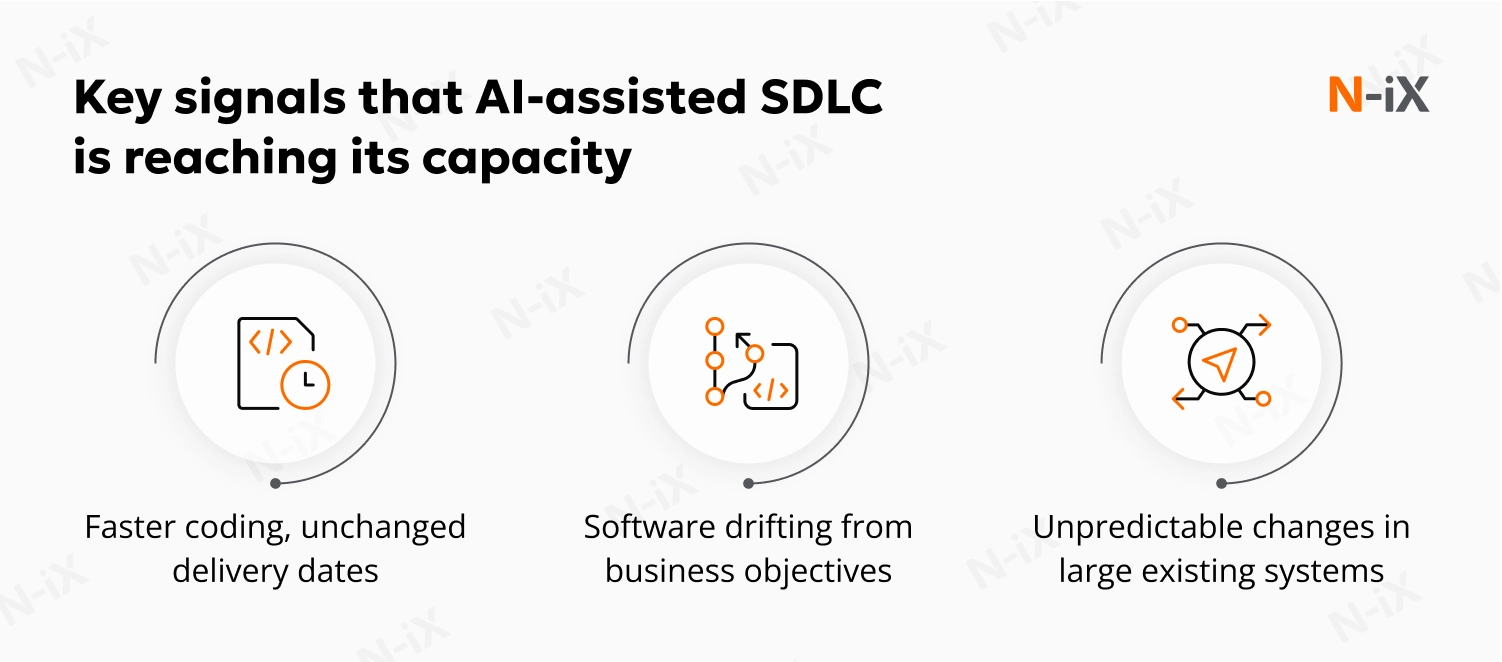
Three key signals indicate that the constraint has moved from coding to the delivery process. For each of them, the two approaches respond differently.
Delivery dates change little despite faster coding
In AI-assisted SDLC, planning, handoffs, and approvals keep their previous pace, so features reach customers at nearly the same time. AI-DLC extends AI beyond coding: it brings plans and artifacts to the team for review at the right points, proceeds independently where a task is clear, and records each decision, which keeps requirements traceable.
Delivered software diverges from business objectives
In AI-assisted SDLC, AI tools fill unclear requirements with their own assumptions, so corrections come late, when they cost the most. AI-DLC places alignment before execution: AI drafts a work plan and raises questions where context is missing, and stakeholders review both the plan and the answers before any work begins.
Changes in large existing systems are hard to predict
AI-assisted tools reflect the context they are given, and in large systems that context is often undocumented or scattered, so a minor change can affect unrelated parts. AI-DLC makes context-building the first stage: AI documents structure and business rules, domain experts confirm them, and the record is carried through each later phase.
These signals show that the process, and not the tooling, has become the constraint. They do not show that an organization is ready for AI-DLC, which depends on the conditions set out in the next section.
AI-DLC vs AI-assisted SDLC: How to choose the right approach
The three signals show when the delivery process has become the constraint. The choice then depends on whether the three conditions that AI-DLC relies on are in place:
- Teams that already work with AI in daily engineering;
- Testing and release automation that keeps pace with faster development;
- Acceptance that people validate each plan and each outcome.
|
Scenario |
Recommended approach |
Reason |
|
The signals are absent: coding work is well defined, and delivery dates are not under pressure |
AI-assisted SDLC |
The benefit reaches the individual developer without a change to the delivery process, and it builds the AI practice on which AI-DLC later relies |
|
The signals are present, and all three conditions are met |
AI-DLC, starting with a pilot after a readiness assessment |
The constraint lies in the process around coding, and the organization has what the methodology requires |
|
The signals are present, but teams do not yet work with AI in daily engineering |
AI-assisted SDLC through a structured adoption path such as APEX, then AI-DLC |
AI-DLC relies on a shared AI practice that individual use does not provide |
|
The signals are present, but testing and release automation cannot keep pace |
Strengthen testing and release automation, then AI-DLC |
The pace of delivery to customers is set by testing and release capacity |
|
The signals are present, but AI is expected to deliver production systems without human involvement |
Agree the required level of human validation first, and limit fully autonomous tools to prototypes and short-lived tools |
AI-DLC keeps people validating each plan and each outcome |
Before any pilot, N-iX experts run an AI readiness and maturity assessment that checks these conditions and recommends a different starting point where one is needed.
How to move from AI-assisted SDLC to AI-DLC
The move does not require replacing Agile or Scrum in one step. AI-DLC builds on practices an organization already uses, so the change can proceed in waves while teams continue to deliver.
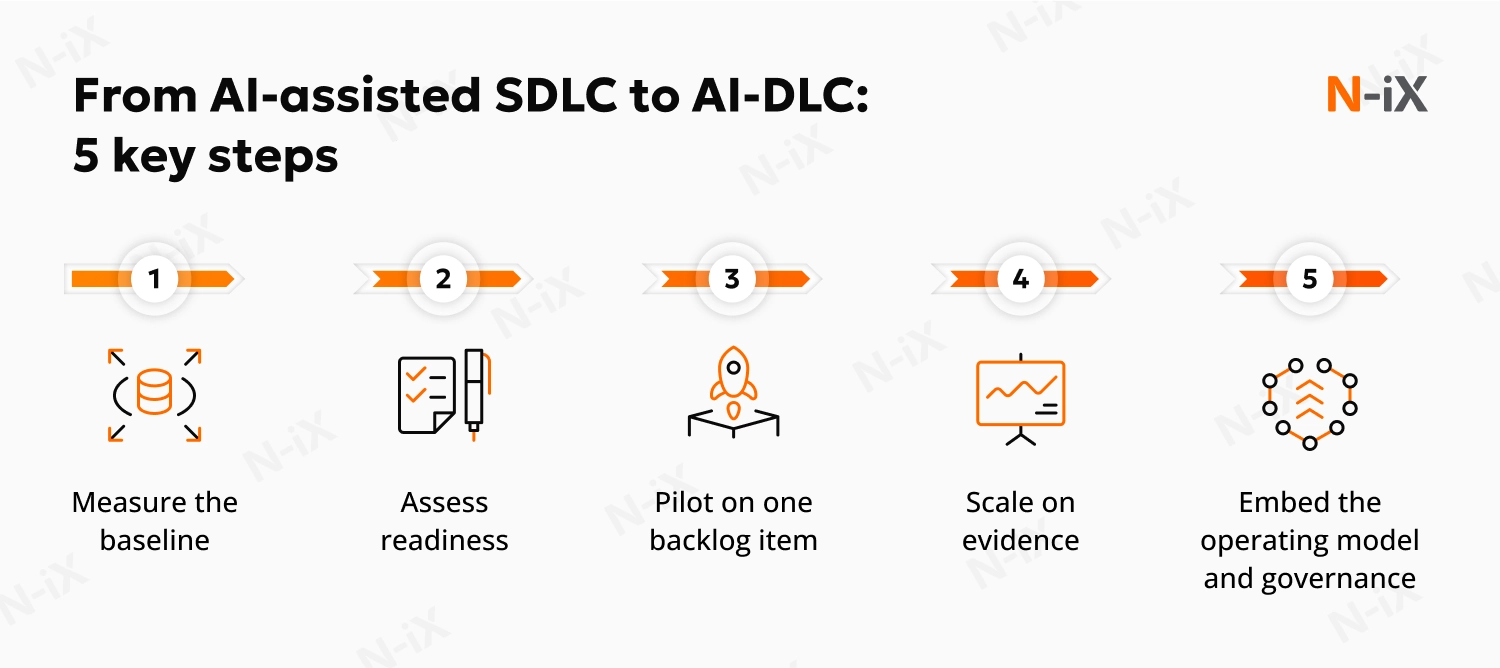
- Measure the delivery baseline. Record cycle time, change failure rate, pull request throughput per engineer, and defect escape rate before the change. Without a pre-AI baseline, there is no way to tell which investments work. For more on the metrics, see the N-iX guide to DORA metrics in software engineering.
- Assess readiness. Check how widely teams already work with AI, whether test environments and release automation can absorb faster change, whether stakeholders can commit time to joint sessions, and where human approval points sit.
- Pilot AI-DLC on one real piece of work. Estimate the work under the current process, deliver the same scope with AI-DLC, and compare the results with the estimate. The pilot ends in a recommendation to scale, adjust, or stop.
- Scale team by team, on evidence. Expand only where the pilot results support it. In APEX, the N-iX framework (Assess, Pilot, Expand, eXcel), every phase ends at a measurable evidence gate, so no initiative scales until the numbers justify it.
- Embed the operating model and governance. Redefine roles and rituals, set standards and approval gates for AI-generated work, agree cost limits, and report adoption and delivery performance against the baseline.
Related: How to measure AI tool adoption in engineering teams
Why should you choose N-iX as a partner for AI-assisted SDLC and AI-DLC?
N-iX supports different starting points and helps engineering organizations decide where AI-assisted tools are enough, where AI-DLC pays off, and how to move between them without disrupting delivery.
- Hands-on experience with AI-DLC. N-iX was among the early adopters of the methodology across its own workflows and client engagements, and applies it to new products and to legacy systems.
- An approach adapted to each client. Here, at N-iX, the methodology is tailored to the client’s systems, teams, and goals and is not applied as an off-the-shelf framework. Because AI-DLC is open source and tool-agnostic, N-iX configures the workflows in the AI tools the client already uses.
- Evidence-based AI adoption through APEX. Our proprietary APEX framework validates gains on real client codebases, and scales only what the measurements support.
- Over 2,400 AI-augmented tech experts and developers. Across N-iX teams, specialists hold more than 200 Claude certifications.
FAQ
Is AI-DLC faster than AI-assisted SDLC?
AI-assisted SDLC speeds up individual activities, but planning, handoffs, and approvals keep their previous pace, so release dates may change little. AI-DLC targets the pace of delivery itself, with shorter, more granular cycles adapted to the complexity of the project and the availability of stakeholders. AWS describes the gain qualitatively and publishes no measured benchmarks, so the difference is best measured against the organization’s own baseline.
AI-DLC vs AI-assisted SDLC: Which approach suits legacy systems better?
AI-DLC is better suited to large existing systems, because it builds context before any change. AI-assisted tools reflect the context they are given, and in large systems that context is often undocumented or scattered, so a minor change can affect unrelated parts. AI-DLC makes context-building the first stage: AI documents the structure and business rules, domain experts confirm them, and changes proceed in narrowly scoped steps.
When should an organization move from AI-assisted SDLC to AI-DLC?
Three key signals point to AI-DLC: delivery dates that change little despite faster coding, delivered software that diverges from business objectives, and changes in large existing systems that are hard to predict. Readiness depends on three conditions: teams that already work with AI, testing and release automation that keeps pace, and acceptance that people validate each plan and each outcome. The delivery baseline and the readiness assessment that precede any pilot confirm both.
How do the roles of people and AI differ between the two approaches?
In AI-assisted SDLC, each role, such as product owner, developer, or architect, plans and owns its own work and may use AI to support specific activities, while the handoffs between roles remain as before. In AI-DLC, AI agents produce requirements, designs, and architecture and work independently where a task is clear, while product managers, engineers, and architects take part in joint sessions to review the results and make the final decisions.
AI-DLC and AI-assisted SDLC: How can an organization compare the two approaches on its own work?
By recording a delivery baseline first, then estimating one backlog item under the current process and delivering the same scope with AI-DLC. Comparing the pilot result with the estimate gives the basis for a scaling recommendation.
Have a question?
Speak to an expert