
Enterprise work rarely arrives as clean text, and that is the issue a multimodal LLM solves. A claim comes in as a photographed form with a handwritten note in the margin. A support ticket carries a screenshot and a call recording. A quality check depends on what a camera saw on the line. Text-only models read none of it.
Multimodal systems read it all in one pass, which is why they reached production faster than most AI categories. Teams ask the same thing first: what is a multimodal LLM, and where does it earn its place? The term covers document extraction, video understanding, and a lot in between.
This guide explains how the architecture works, what companies build with it, which model suits which workload, what inference consumes, and what running one in production takes. Scoping that properly, often alongside AI consulting services, comes before selecting any model, because the wrong choice is easier to avoid than to unwind six months later.
Executive summary
Text-only models stop working as soon as the job involves a scanned page, a photograph, or a recording. Multimodal models read it all together, and the decisions around them determine whether they hold up in production.
This article covers:
- What a multimodal system is and how the architecture fits together;
- The four deployments that account for most enterprise work today;
- Which models suit which workload, and when a simpler tool wins;
- What inference consumes, and the four levers that move it;
- How to evaluate output quality, secure the inputs, and decide where the system runs.
What is a multimodal LLM?
A multimodal LLM processes more than text. It takes in images, audio, video, and structured data alongside written input and reasons across them in a single pass. Language models on their own are blind to everything except text. Vision models see clearly and stop short of reasoning. These systems close that gap.
What separates them from earlier multimodal software is the underlying language model. Older approaches matched images to captions or converted one format into another. A model like this maintains a single internal representation across formats, so it can read a chart, connect it to a paragraph, and explain what changed.
How multimodal Large Language Models work
Three parts do the work. An encoder turns each input into numbers the system can compare, a connector lines those numbers up with the language model’s own vocabulary, and the language model reasons over the result. Swap any one of them and the behavior changes.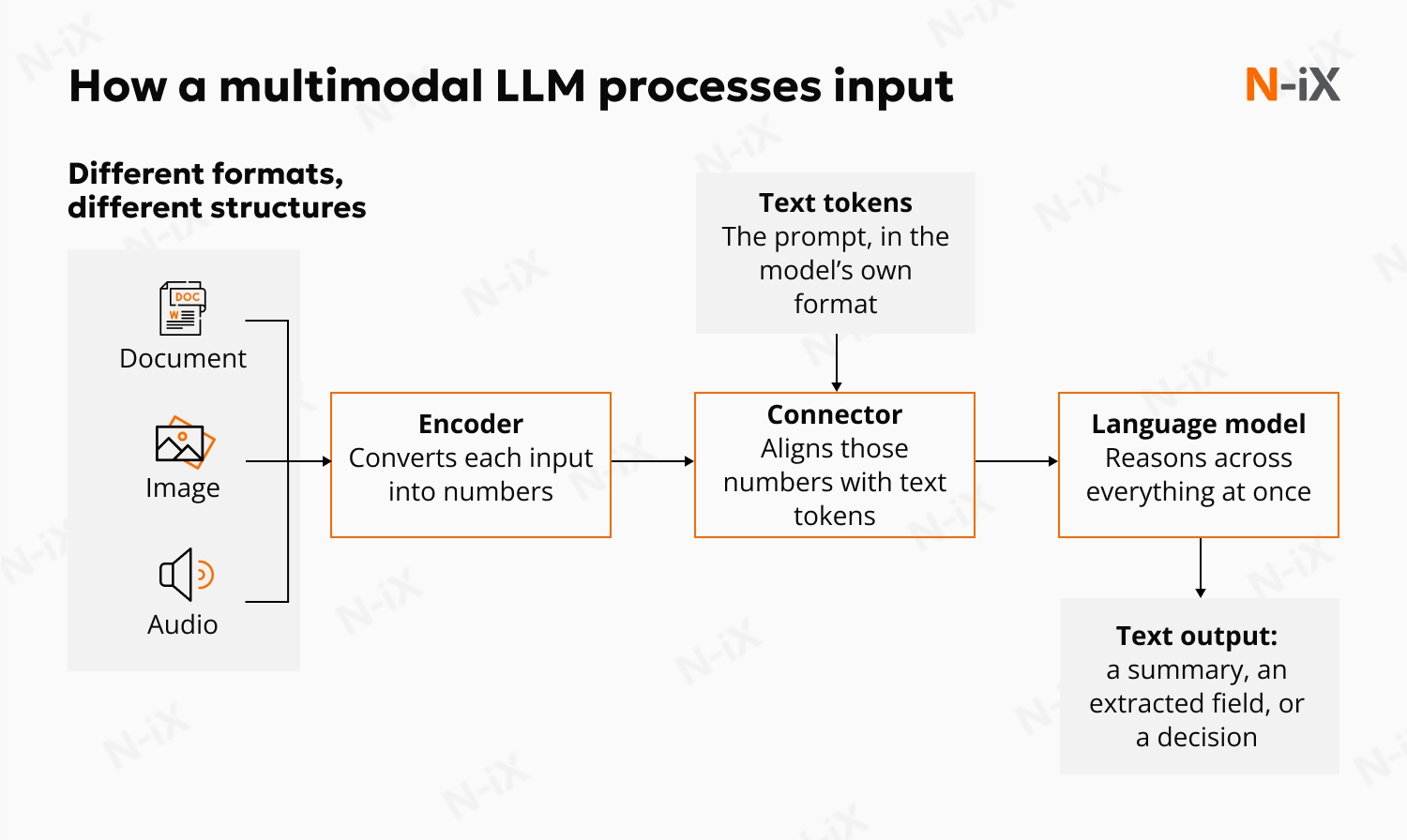
Modality encoders
An encoder compresses raw input into a list of numbers that captures what the input contains. A photograph becomes a few hundred numbers describing shapes, textures, and spatial relationships. Audio becomes numbers describing pitch, rhythm, and timing.
These encoders are rarely built from scratch. Most systems use one already trained on millions of image-caption pairs, so its output already roughly aligns with language. Image resolution sets how much detail survives this step.
Fusion and cross-attention
The language model reads text tokens. The encoder produces something else entirely. A connector translates between them, either by converting image features into tokens the model can read alongside words, or by feeding them into the model’s internal layers.
Attention is how the model decides which parts of an image matter for which words. For example, if asked what the red line on a chart shows, it weights image patches heavily and ignores the rest.
The language decoder
The model takes the combined input and produces the answer one word at a time, with each choice shaped by everything that came before. This is the same mechanism a text-only model uses, with image information part of the context.
Some systems also attach a generator that outputs images or audio. Most enterprise deployments stop at text, because the useful output is usually a summary, an extracted field, or a routing decision.
Advantages of implementing a multimodal LLM
The gains show up in places teams don’t always anticipate. Faster extraction is the most obvious and smallest advantage. The bigger returns come from configuration work that disappears, formats that no longer need special handling, and a faster review step because the system can explain itself.
Fewer moving parts in the pipeline
Template-based extraction needs a rule set per vendor, a separate reading step, and a maintenance task every time a layout changes. One model handling reading and interpretation together collapses that into a single component. Fewer parts means fewer places for the pipeline to break, and fewer people needed to keep it running.
New formats work without setup
Onboarding a new supplier used to mean collecting sample documents, running a mapping exercise, and testing before anything flowed. A system that reads unfamiliar layouts on the first pass removes that work entirely. The supplier sends an invoice, the system processes it, and nobody opens a configuration screen.
Context survives across the whole page
Older pipelines read a page as separate zones, so a handwritten note in the margin lost its connection to the field it modified. Reading the page as one image keeps those relationships intact. A crossed-out figure with a correction beside it gets interpreted the way a person would read it.
Language coverage without separate configuration
Multilingual document processing traditionally meant a separate model, dictionary, or rule set per language, each requiring its own maintenance. The same model handles documents in several languages without a switch being flipped. That matters most for organizations operating across markets, where the document mix changes by country.
Review speeds up alongside extraction
A confidence score tells a reviewer that something is uncertain without saying why. A system that explains what it read, and where on the page it read it, turns review into verification. The reviewer checks a stated reason against the document instead of re-reading the whole thing to work out what went wrong.
What companies build with a multimodal LLM
The use cases that reach production share a pattern: a person was already looking at several formats at once and deciding something. Replacing that interpretation step is where the technology pays off. Four deployments account for most enterprise work today, and documents sit well ahead of the rest.

Extracting data from documents
A model reads layout and text together, so it handles a vendor template new to the system without a rule being written for it. That removes the per-supplier configuration older extraction systems depended on, which is why document work is where most multimodal generative AI deployments begin.
The documents that reach production first are the high-volume ones:
- Invoices and purchase orders;
- Insurance claims with supporting photographs;
- Contracts and their amendments;
- Onboarding and identity forms.
Resolving support tickets with mixed evidence
A single case arrives as a screenshot of an error, an email thread, and a recorded call describing what happened. The model reads all three, matches the issue against known fixes, and hands the agent a proposed resolution with the evidence attached.
Inspecting products on the line
Among the multimodal LLM examples running in production, visual inspection is the most measurable. A camera feed runs against a reference, and the language layer explains what it found and where the item should go, instead of returning a single binary verdict.
Classical Computer Vision already detects defects reliably on known patterns. The language layer earns its place on the edge cases: describing an irregularity nobody has cataloged, reading a batch code off the same frame, and routing the item based on both.
Searching image and video libraries
Media archives, product catalogs, and inspection footage become searchable by what they contain. The model describes and tags each asset on ingest, so a query like “damaged packaging, warehouse, night shift” returns results without anyone having labeled them that way.
Choosing the right model for the job
Model choice matters less than people expect at the encoder layer and more than they expect everywhere else. Hosting, data residency, document handling, and latency vary widely between options that score similarly on public benchmarks. The decision comes down to what the workload looks like, and whether the data can leave your region.
Which models are in use in 2026
The field splits three ways: proprietary models accessed by API, open-weight models you can host yourself, and small document-specific models. Public benchmark scores narrow the shortlist. Still, multimodal LLM evaluation against your own documents and images is what settles it. Here are the current popular models:
|
Model family |
Best suited for |
Hosting |
Watch for |
|
OpenAI GPT |
General enterprise workloads, handwriting, mixed document types |
API only |
Token consumption on high-resolution images |
|
Google Gemini |
Long video, large document sets, extended context |
API, with Vertex AI for residency control |
Tiling behavior on large images drives spend |
|
Anthropic Claude |
Document reasoning and structured extraction |
API, available through major clouds |
No open weights for self-hosting |
|
Qwen-VL, InternVL |
Self-hosted deployments where data stays in region |
On-premises or private cloud |
GPU capacity and operations sit with you |
|
Mistral Pixtral |
European deployments wanting an EU vendor with open weights |
On-premises or API |
Smaller ecosystem than the US options |
|
PaddleOCR-VL, MinerU, GLM-OCR |
High-volume structured document parsing |
On-premises, light hardware |
Extraction only, no reasoning over content |
When a multimodal system is the wrong tool
For high-volume structured documents, a dedicated extraction model beats a large general-purpose one on both accuracy and compute. The same holds for defect detection on known patterns, where classical computer vision is faster and easier to validate. Reaching for the largest available model is where most budgets go wrong.
By 2027, Gartner expects organizations to use small, task-specific models three times more than general-purpose large language models. The pattern behind that forecast is simple: a narrow model trained on one document type outperforms a general one on that type, runs on less hardware, and is easier to evaluate against a ground truth set.
What multimodal inference actually consumes
Multimodal LLM models convert each image into tokens before reading it, and a single full-resolution page can become several thousand tokens. That conversion happens before any output token exists, which is what surprises teams after launch.
Each image is divided into fixed-size blocks before the model reads it, and every block becomes a token. Vision-language models differ in how they size those blocks, so the same document can behave differently across platforms. Four things drive the final count:
- Resolution. The largest single factor. A page scanned at 300 DPI produces roughly four times as many blocks as the same page at 150, and extraction quality rarely differs enough to justify the gap;
- Pages per request. Sending a 40-page contract as one request tokenizes every page, even though the answer usually sits in two of them. Routing to the relevant pages first removes most of that;
- Conversation history. In a multi-turn session, earlier images stay in context and get counted again on every subsequent turn, so a long exchange pays for the same page repeatedly;
- Cropping against whole pages. Sending a region of interest instead of the full page removes margins, headers, and white space that consume blocks without carrying information.
None of this shows up in a pilot running on a handful of documents. It shows up in month two, when volume arrives. Instrument token consumption per document type before scaling, so you know what a thousand invoices consume against a thousand contracts. Those two numbers rarely match, and the difference determines which workloads are worth automating at all.
Running a multimodal LLM in production
Three things separate a working pilot from a system people trust. You need to know the output is right, protect against prompt injection and data leakage, and ensure deployment meets data residency and regulatory requirements. The model alone guarantees none of these.
Evaluating output quality
Accuracy alone tells you little when the output is open-ended text. A summary can be fluent, plausible, and wrong, and no error gets thrown. Evaluation has to compare against something, which means building a ground truth set from your own documents before anything goes live.
Closed questions with a known answer can be scored automatically. Open ones need a person, or a second model checking against the source. Both belong in the same test set, and the set gets rerun whenever the configuration changes.
The rerun follows the same four steps:
- Run the fixed test set through the new configuration;
- Compare field by field against the verified answers;
- Review a sample of the passes by hand, since scores hide specific failures;
- Record the result against the version that produced it.
Securing the inputs
A multimodal LLM reads instructions wherever it finds them, including inside the image. Text embedded in a document, visible or hidden in the pixels, can be treated as a command instead of content. The model has no way to tell the difference.
That matters most where documents arrive from outside the organization, which is most document workflows. Treat every incoming file as untrusted input, keep the model’s permissions narrow, and have a person approve anything that triggers an action with consequences.
Hosting, residency, and integration
Where the system runs decides what it can process. A hosted service sends pages outside your infrastructure, which the legal team will want documented. Open-weight models on your own hardware keep everything in place, and you take on running the GPUs and maintaining them.
Integration is where deployments stall. The output has to land somewhere: an ERP field, a case record, a document management system. Deciding that destination before the pilot starts is the difference between a demo and something the business uses daily.
Multimodal LLM development with N-iX
N-iX builds multimodal systems the same way we build anything else that runs in production, through APEX: assess the workload, pilot on one document type, expand across the business, and excel once the system runs past the baseline set at the start. The delivery is backed by 200 data and AI experts.
The decisions that matter come before the model does. Which documents actually need reading, what resolution they need, which model fits the workload, and where the system is allowed to run. Each one moves what the deployment consumes and what it can legally process. Getting them in that order is what separates a system people use from a demo that impressed everyone once.
The technology is capable enough for most enterprise document work today. The outcome depends on the evaluation set built from your own documents, the permissions you give the model, and the honesty to use a simpler tool when a simpler tool wins.
FAQ
What is the difference between a multimodal and a vision-language model?
A vision-language model handles images and text. A multimodal large language model is the broader category, covering audio, video, and structured data alongside both. In practice, the terms get used interchangeably because most enterprise deployments involve images and text only. The distinction matters when a use case needs audio or video, since not every model supports them.
Can a multimodal LLM replace OCR?
Sometimes. On clean, structured documents at volume, a dedicated extraction model is more accurate and far lighter to run. The multimodal model earns its place on handwriting, unfamiliar layouts, and documents that mix tables, diagrams, and free text. Many production systems run both, routing each document to whichever handles it better.
Are multimodal systems safe to use with sensitive documents?
It depends on where the model runs. A hosted API means pages leave your infrastructure, so the vendor agreement decides what happens to them and whether they are retained. Open-weight models hosted on your own hardware avoid that entirely. One risk applies either way: the model can read and follow instructions hidden inside an image.
Why does multimodal inference consume more than text-only inference?
Images become tokens before the model reads them, and a single page can convert into thousands. Resolution drives the count, so the same document consumes more at higher settings. Providers tokenize differently too, which means the same image can use a few hundred tokens on one platform and several thousand on another.
Have a question?
Speak to an expert