
Most AI tools used in clinical practice today look at one type of data at a time: a scan, a lab value, a heart-rate reading. However, a patient's real condition doesn't live in just one of these. It's spread across imaging, genomics, notes, and history that a single-input system never sees.
Multimodal AI in healthcare closes that gap. It combines imaging, genomics, clinical notes, and EHR data into a single model, closer to how a physician reads a chart. N-iX's healthcare AI consulting team designs and builds these systems for healthcare organizations, from data fusion architecture through clinical validation and compliance. This article covers what multimodal AI is, where it delivers results, and the challenges that decide whether a system reaches production.
Key takeaways
- Multimodal AI combines imaging, EHR data, labs, genomics, and clinical notes to give models a broader view of each patient.
- Early, joint, and late fusion offer different trade-offs in accuracy, engineering effort, data requirements, and tolerance for missing inputs.
- Healthcare use cases span diagnostic imaging, cancer treatment planning, critical care forecasting, neurodegenerative disease detection, and remote monitoring.
- Production success depends on integrating fragmented clinical data, handling incomplete records, embedding outputs into clinician workflows, and meeting security requirements.
- A focused pilot with clear clinical outcomes and real-world validation gives healthcare organizations a stronger basis for scaling multimodal AI across more workflows and data sources.
What is multimodal AI in healthcare?
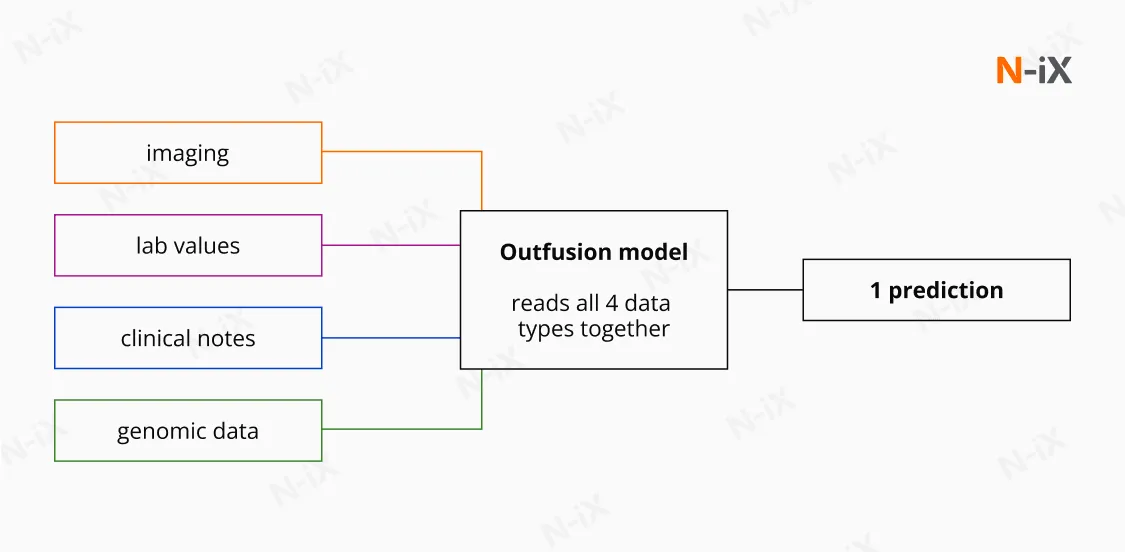
Multimodal AI is a system that reads multiple types of patient data at once: imaging, lab values, clinical notes, and genomic data. It combines these inputs to produce a single output. That mirrors how physicians already work. In a study of radiologists, 85% said clinical context was essential to reading a scan correctly [1]. A chest X-ray means one thing on its own. It means something else next to a patient's smoking history, recent labs, and prior scans.
Most AI tools in hospitals today don't do this. They're single-modality: one model, one data type, one narrow task. A model that reads mammograms only reads mammograms. It can't factor in a patient's family history or a prior biopsy result. Multimodal AI is built to close that gap.
How multimodal AI works: 3 fusion methods
The engineering term for combining data types is fusion. How and when a system fuses its inputs determines its cost, its data requirements, and how it handles the messy, incomplete records most hospitals have. There are three methods:
1. Early fusion
All data types are merged before a single model processes them. One study combined lab results, demographics, vital signs, and image-derived features into a single XGBoost model to detect cardiomegaly [2]. Early fusion is the simplest to build. Its main limitation: imaging data is far richer than a handful of lab values, so the model can end up weighing the scan far more heavily than the other inputs, even when they matter just as much.
Best for: Teams with limited data science resources, a smaller number of well-structured inputs, and a tight budget or timeline.
2. Joint fusion
Each data type is processed by its own model first. The system then combines their outputs and retrains the whole model together. Oncology uses this approach as its standard: it fuses pathology images with genomic data to predict cancer prognosis [3]. Joint fusion tends to outperform early fusion. It also needs more data and more engineering effort to build and maintain.
Best for: High-stakes clinical decisions where accuracy outweighs build cost: cancer diagnostics, treatment planning, and other cases where two data types genuinely interact, and a wrong prediction is expensive.
3. Late fusion
Separate models run independently on each data type, and only their final predictions are combined. CLIP, a widely used image-text model, is a late-fusion example: it can still classify an image even when no text is available for that patient at inference time [4]. Late fusion is the most forgiving of missing or incomplete data, which matters given how often hospital records have gaps. Its trade-off: it can't model how two data types interact, only how each one predicts the outcome on its own.
Best for: Organizations with inconsistent or incomplete records, multi-site deployments where each site collects different data, or systems that need to add or swap in a new data source later without retraining everything.
Read more about AI and ML in healthcare
Where multimodal AI moves the numbers: 5 measurable outcomes
|
Area |
Current limitation |
What multimodal AI adds |
Measured value |
|
Diagnostic accuracy |
A single-modality model reads one input, a scan, a lab panel on its own |
Fuses imaging, labs, vitals, and clinical notes into one prediction |
6–33% AUROC improvement across 10 chest pathologies, length-of-stay, and mortality prediction [5] |
|
Cancer prognosis and treatment planning |
Pathology, genomics, and clinical history typically get reviewed separately |
Joint fusion combines histopathology images with genomic markers |
Outperforms single-source models in predicting cancer prognosis and treatment response [3] |
|
Operational forecasting |
Staffing and bed-planning models often run on historical averages alone |
Combines real-time vitals, lab trends, and admission data |
Up to 20% AUROC improvement in length-of-stay prediction, up to 33% in 48-hour mortality prediction [5] |
|
Resilience to incomplete records |
A single-modality model can't produce a prediction when its one input is missing |
Late fusion architectures still generate a prediction from whatever data is available |
Demonstrated in CLIP-style models, which classify an image with zero text input at inference [4] |
|
Clinical alignment |
Single-input tools don't reflect how clinicians actually evaluate patients |
Combines the same data types physicians already use to form a diagnosis |
85% of radiologists rate clinical context as essential to reading a scan correctly [1] |
5 key use cases of multimodal AI in healthcare
The five examples below show where multimodal AI applications already deliver measurable results.
1. Diagnostic imaging fused with patient records
A CT scan read on its own can miss what a patient's history would explain. Stanford researchers built a single deep learning model for pulmonary embolism detection that fuses CT imaging with electronic health record data into one combined score [6].
Mayo Clinic is building on this same logic at scale. In 2025, it partnered with Microsoft Research and Cerebras to train foundation models on multimodal imaging (CT and MRI scans) alongside genomic sequencing data, starting with chest X-ray reporting [7].
2. Cancer treatment response prediction
Oncology teams increasingly combine radiology, pathology, and genomic data to predict how a tumor will respond to a specific treatment. A joint model that fuses pathology images with genomic markers has outperformed single-source approaches in predicting cancer prognosis. For a hospital or pharma partner, this changes the model's value. It stops answering whether a patient has cancer and starts pointing to which treatment is worth trying first.
3. Critical care and mortality forecasting
ICU teams need advance warning, ideally days before a crisis develops. MIT's HAIM framework tested over 14,000 models on more than 34,000 multimodal data samples from about 6,500 patients [5]. Combining imaging, lab results, vitals, and clinical notes improved 48-hour mortality prediction by up to 33% AUROC over single-source models. The same framework also improved length-of-stay forecasting.
4. Neurodegenerative disease diagnosis
Alzheimer's diagnosis has become one of the most active areas for fusion research, and for good reason: no single scan or test settles it on its own. Multiple studies combine MRI and PET imaging with cognitive assessment scores, demographics, and genetic markers to detect and stage the disease earlier than any single input allows [1]. The same fusion pattern now extends to Parkinson's and multiple sclerosis prediction.
5. Remote and continuous patient monitoring
A wearable device alone can't tell a care team whether a reading matters. A 2026 Scientific Reports study built a multimodal deep learning model that fuses accelerometer, gyroscope, and physiological sensor data into a single fall-risk score, going beyond flagging one abnormal reading at a time [8]. Pairing this fusion architecture with a patient's EHR history extends its use from acute monitoring to chronic disease management.
4 challenges of adopting multimodal AI in healthcare and how N-iX addresses them
Even well-designed multimodal AI models run into the same four obstacles on the way to production. N-iX addresses each one directly, as outlined below.
Data fragmentation across imaging, EHR, and lab systems
Imaging lives in a PACS system. Lab results sit in a separate database. Clinical notes are often still free text in an EHR that wasn't built to feed a Machine Learning model. Before any fusion architecture can run, someone has to get these systems talking to each other in a consistent format.
How N-iX addresses it:
- Mapping every data source to a shared clinical standard (HL7 FHIR) before model design starts;
- Building a single integration layer across imaging, EHR, and lab systems, replacing the one-off connections most hospitals accumulate over time;
- Choosing API-driven or event-based integration patterns based on what each legacy hospital system can actually support;
- Extending existing clinical systems with new capability when a full replacement costs more than it delivers, avoiding an unnecessary rebuild.
Incomplete data at the point of prediction
Many patient records are missing a scan, a lab test, or a complete history. A fusion architecture designed around a clean, complete dataset breaks the first time it meets a real patient record with gaps.
How N-iX addresses it:
- Selecting a fusion method—early, joint, or late—that matches how complete the target hospital's data actually is, using the real data profile as the deciding factor;
- Designing fallback logic so a missing modality reduces prediction confidence while the system still produces an output;
- Testing models against deliberately incomplete data during validation, alongside curated benchmark datasets;
- Building monitoring that flags when live data drifts from what the model was trained on.
Getting predictions into the clinician's actual workflow
A model that outputs a risk score in a separate dashboard rarely changes clinical behavior. If a radiologist or physician has to leave their normal system to check it, most won't.
How N-iX addresses it:
- Embedding model outputs directly into the EHR or PACS interface clinicians already use, so nothing extra sits outside their normal workflow;
- Designing outputs that show which data source drove a given prediction, so a clinician can judge whether to trust it;
- Running structured validation with clinical staff before full rollout, alongside the technical accuracy check;
- Building escalation logic so a flagged case reaches the right person quickly.
Security and compliance across multiple sensitive data types at once
A single-modality tool has one type of data to protect. A multimodal system handles imaging, genomic data, and clinical notes simultaneously, each with its own sensitivity and regulatory profile under HIPAA and GDPR.
How N-iX addresses it:
- Designing access control and encryption per data type from the architecture stage;
- Building audit logging that tracks which modality contributed to which prediction, for compliance review;
- Aligning data flows with HIPAA and GDPR requirements specific to each modality involved;
- Structuring data pipelines so sensitive fields can be isolated or masked without breaking the fusion model downstream.
How N-iX approaches multimodal AI in healthcare
Adopting multimodal AI in a hospital follows a pattern healthcare organizations already know from EHR rollouts and cloud migrations. Moving fast without a validation layer feels efficient at first. Unwinding it later costs more, especially once a system touches patient outcomes. N-iX applies its APEX framework (Assess, Pilot, Expand, eXcel) to prevent that unwinding.
- Assess starts with a specific question: does the target use case have a clear clinical or operational outcome, and is the hospital's existing data actually complete enough to support fusion? A use case that doesn't clear that bar is useful information on its own; it stops a client from building a system that would never hold up in production.
- Where the fit looks promising, Pilot comes next: a small, scoped rollout on one well-defined clinical question, built with defined checkpoints and clinician review from the start.
- Once a pilot's results hold up under real clinical use, N-iX moves to Expand, extending the fusion architecture to more data sources and more use cases, then eXcel, where multimodal AI becomes a standing part of how the client delivers care or runs operations.
This same discipline runs through N-iX's broader Pragmatic AI Software Engineering approach: prove a pattern on a real, bounded clinical case before scaling it across a hospital's architecture. A fusion architecture earns its rollout only when a pilot's results, based on real patient outcomes, justify it.
N-iX brings 24 of engineering experience and more than 200 engineers working in AI, ML, and data. Delivery leads on this team have run AI adoption projects across healthcare, biopharma, fintech, and other regulated industries. Each engagement starts the same way: mapping what a specific clinical workflow needs to run safely and where a clinician or certified system needs to check the output before acting on it.

FAQ
What is multimodal AI in healthcare?
Multimodal medical AI combines multiple types of patient data, imaging, lab results, genomic data, and clinical notes, into a single model output, closer to how a physician reviews a case. N-iX's healthcare AI consulting team builds these systems around the fusion method and data readiness a specific hospital actually has.
How does multimodal AI work?
Multimodal AI fuses several data types into one model, using early, joint, or late fusion depending on the use case. Each method trades off accuracy, build cost, and how well it handles missing data. N-iX's initial data readiness audit looks at exactly this: which fusion approach fits a hospital's actual data, and whether the accuracy gain is worth the added engineering effort.
What are the main challenges of implementing multimodal AI in healthcare?
The four recurring ones: fragmented data across imaging, EHR, and lab systems; incomplete patient records at prediction time; getting model outputs into a clinician's actual workflow; and securing multiple sensitive data types at once under HIPAA and GDPR. N-iX's engineering teams have addressed each of these across healthcare, biopharma, and other regulated-industry projects.
References
- Krones, F., Marikkar, U., Parsons, G., Szmul, A., & Mahdi, A. (2024). A review of multimodal machine learning approaches in healthcare. arXiv:2402.02460.
- Duvieusart, B., Krones, F., Parsons, G., Tarassenko, L., Papiez, B.W., & Mahdi, A. (2022). Multimodal cardiomegaly classification with image-derived digital biomarkers. University of Oxford.
- Chen, R.J., Lu, M.Y., Wang, J., et al. (2022). Pathomic Fusion: An integrated framework for fusing histopathology and genomic features for cancer diagnosis and prognosis. IEEE Transactions on Medical Imaging, 41(4), 757–770.
- Radford, A., Kim, J.W., Hallacy, C., et al. (2021). Learning transferable visual models from natural language supervision. Proceedings of the 38th International Conference on Machine Learning (ICML).
- Soenksen, L.R., Ma, Y., Zeng, C., et al. (2022). Integrated multimodal artificial intelligence framework for healthcare applications. NPJ Digital Medicine, 5, 149.
- Huang, S.-C., Pareek, A., Zamanian, R., Banerjee, I., & Lungren, M.P. (2020). Multimodal fusion with deep neural networks for leveraging CT imaging and electronic health record: A case-study in pulmonary embolism detection. Scientific Reports, 10, 22147.
- Mayo Clinic accelerates personalized medicine through foundation models with Microsoft Research and Cerebras Systems. (2025). Mayo Clinic News Network.
- Intelligent fall risk prediction and real-time warning system for elderly care based on multimodal deep learning and wearable sensor fusion. (2026). Scientific Reports.
Have a question?
Speak to an expert