
According to a 2025 Pegasystems survey of more than 500 IT decision-makers worldwide, enterprises lose over $370M a year on average when legacy systems don't get modernized in time. Much of that cost sits in systems that are old, poorly documented, and unsafe to modify without understanding what the code does first.
Application modernization covers the full scope of that problem, from infrastructure and data platforms to user experience. Legacy code modernization using AI addresses the part of it that sits at the center of almost every program: the code itself. It gives teams a faster way to read, document, test, and safely change old code that would otherwise sit untouched for months of manual reverse-engineering.
This guide covers what legacy code modernization using AI involves, where it delivers measurable value, the challenges enterprise teams commonly encounter, and how to approach modernization in a way that protects business logic throughout.
Executive summary
- Legacy code is hard to change because of architectural complexity, cyclic and tightly coupled dependencies, outdated libraries, and custom components. Documentation gaps across the application portfolio compound the issue.
- Reverse-engineering business logic takes about six weeks per 10,000 lines, so months of discovery can pass before modernization work begins.
- AI accelerates legacy code modernization by taking over the discovery work and the high-volume tasks that follow it: reconstruction, documentation, test generation, and incremental refactoring.
- Technical risk stays under control because utilizing AI for legacy code modernization works best as an iterative process. At N-iX, each software module and inventory item is assessed, documented, reviewed by a person, and approved before the work moves toward deployment.
- Our six-stage pipeline safeguards quality through three human checkpoints and an independent evaluator. They address the most common failure points, such as inaccurate AI-generated explanations and unvalidated tests, so no code reaches production on AI judgment alone.
- N-iX keeps costs predictable by setting AI budgets per team and per pipeline and tracking spend by stage, not as a single AI tooling total.
- Together, these controls result in faster business logic discovery, stronger control over execution, better cost visibility, and lower operational risk for N-iX clients.
- N-iX has completed 90+ modernization projects and scales AI through its APEX framework only after the pilot shows measured gains.
Why legacy code carries elevated risk for businesses
Legacy code becomes difficult to change when business rules remain in the system but the reasoning behind them has disappeared. A seemingly unnecessary condition may encode a tax rule, regional requirement, pricing exception, or workaround for an old dependency.
When that context exists only in the knowledge of a few engineers, modernization becomes a reconstruction exercise before it becomes an engineering one. Industry estimates quantify this gap directly: reverse-engineering business logic from unfamiliar legacy code takes approximately six weeks per 10,000 lines. For a mid-size enterprise application, this represents several months of discovery before any modernization work can begin. That discovery bottleneck is where AI can materially change the economics of legacy code modernization.
Where legacy code modernization using AI changes the equation
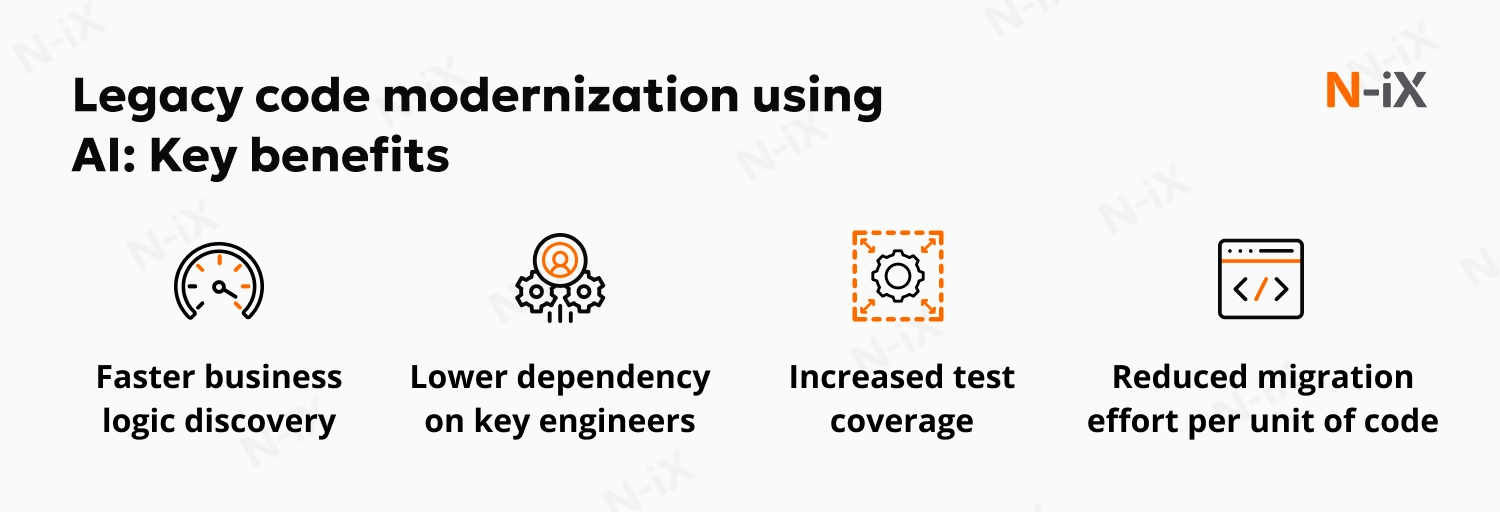
This is the area where AI delivers a measurable shift. A large language model can read code it has not previously encountered, including outdated or unusual syntax, and describe the underlying business logic in plain language. This capability can reduce weeks of manual reconstruction to a matter of hours.
The broader engineering market is already moving toward this model. Sonar's 2026 State of Code survey found that developers report 42% of committed code is AI-generated or assisted, while 60% of enterprise developers pair AI output with static analysis before release. In legacy modernization, the same principle needs stronger controls because an incorrect interpretation can propagate from reconstruction into architecture, tests, and refactoring.
More on measuring the delivery impact of AI-generated code: DORA metrics in software engineering
Legacy code modernization using AI: Our six-stage agentic pipeline
AI legacy code modernization only creates value if it is executed in a consistent order, with clear ownership at each point. Without that structure, AI accelerates the wrong parts of the process just as easily as the right ones, generating fast output that nobody has validated against the business logic it’s meant to preserve.
N-iX addresses this by applying AI through a fixed, multi-stage pipeline with defined ownership at each step. Each stage has a defined output, and three of the six stages end at a checkpoint where a person reviews that output before the pipeline continues.
Validation in this pipeline runs top-down. Business experts provide the high-level requirements for the system, and those requirements become the reference against which AI-generated output is checked. They also help confirm that the AI has understood the system’s functionality and dependencies correctly.
- Reconstruction. The Reconstruction Agent reads the legacy code, its dependencies, and runtime configuration, builds an inventory, and classifies the business rules it identifies before any new code gets written.
Human checkpoint: specification validation. The reconstructed business rules are confirmed correct before they inform any target design. - Design. The Target Architecture Agent drafts architecture decision records, API contracts, and non-functional requirements aligned to the validated logic from step one.
Human checkpoint: architecture approval. The target design is signed off before any code gets written against it.
With the target design confirmed, the pipeline moves from planning into execution.
- Test coverage. The Test Generation Agent locks in the existing logic by generating tests from the legacy system's current behavior, establishing a measurable baseline before any code changes.
- Refactoring. The Refactor and Modernize Agent ports the language, refactors patterns, and upgrades the framework in defined, incremental steps.
- Review and validation. The Review and QA Agent runs parity test checks, static analysis, and compliance checks, working alongside an independent evaluator that has no stake in the result passing and can block the change if any dimension fails.
Human checkpoint: quality sign-off. The modernized code is only released for deployment once this review is complete. - Deployment. The Deployment and Acceptance Agent takes over from here, typically through Infrastructure as Code, a shadow rollout, and smoke tests. This stage sits at the boundary of code modernization and broader application deployment.
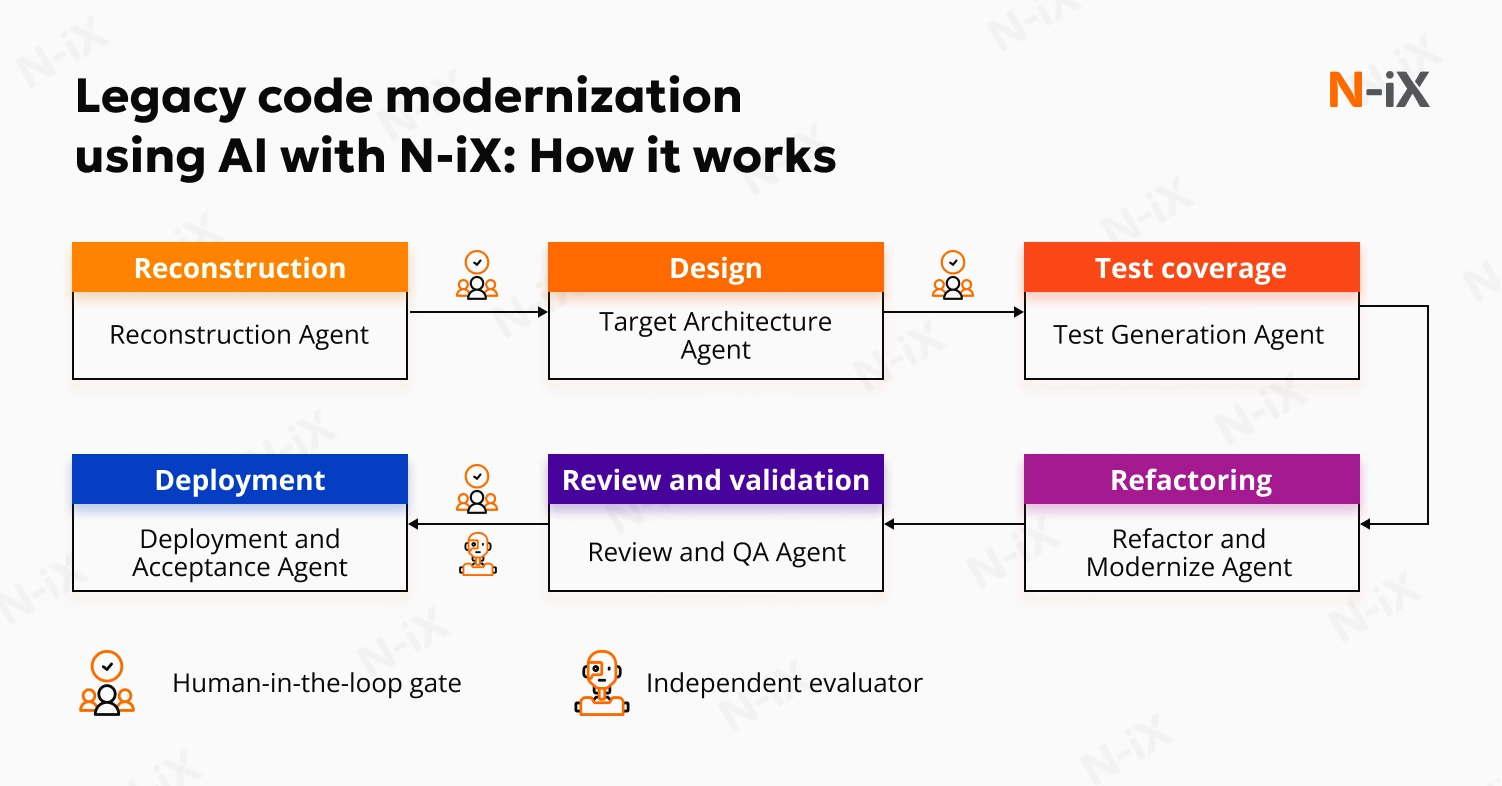
Throughout the pipeline, an Orchestrator Agent splits the work into discrete units and routes outputs between agents. Human approval is reserved for three checkpoints: specification validation, architecture approval, and quality sign-off. Between those checkpoints, agents work on high-volume, verifiable tasks, such as test generation and incremental refactoring, within boundaries the Orchestrator Agent enforces. Before the final stage, an independent evaluator conducts the cross-stage audit and blocks the change if any dimension fails. No piece of code reaches production based on AI judgment alone.
You might be interested in: Best application modernization companies helping businesses in 2026
The Human-AI-Human model: Dividing responsibility in legacy code modernization
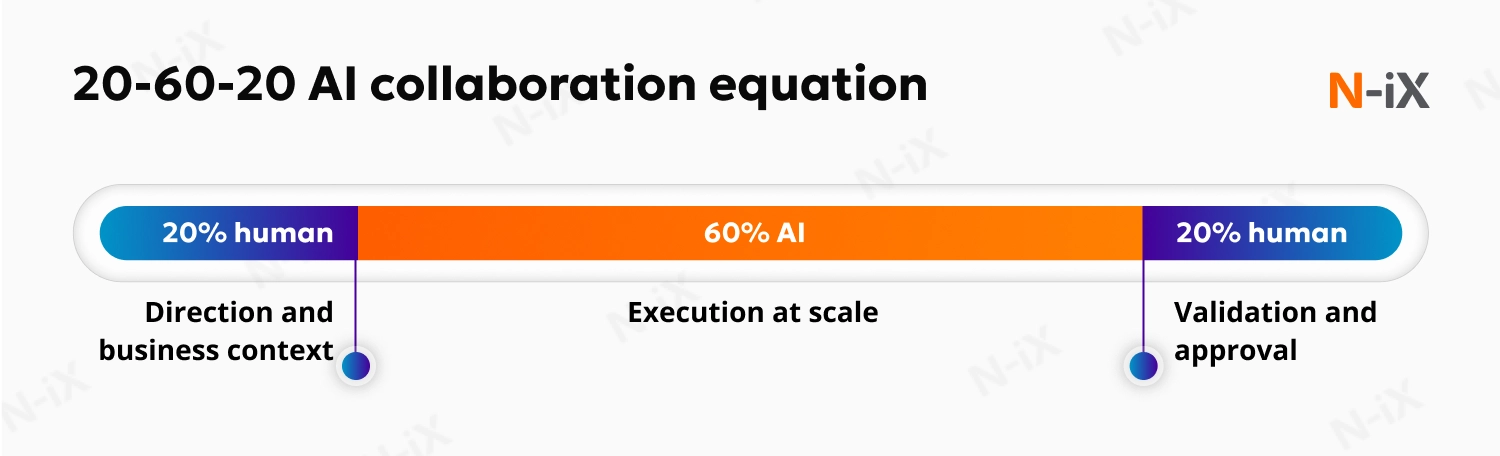
Many business leaders already know the 20-60-20 model as a way to divide work between people and AI: people set the direction, AI does most of the work, and people review the result. In legacy code modernization using AI, the same split applies with higher stakes, because the output is code that runs core operations. Within an AI-assisted modernization pipeline, responsibility is allocated as follows.
First 20%: people set the direction. AI performs well when it receives precise instructions and poorly when it has to infer intent. In a modernization program, this stage defines what the agents are asked to do and how their output will be judged: the scope, the business requirements, the acceptance criteria, and the AI model suited to each task. Specification validation also takes place here, so agents work from business rules that people have confirmed.
Middle 60%: AI does the heavy lifting. Agents carry out the high-volume work: inventory, reconstruction, documentation, test generation, and incremental refactoring. What they deliver is a first draft, not a finished result, so nothing moves forward on the basis of AI output alone.
Final 20%: people exercise judgment. Engineers and domain experts check the output for accuracy, for parity with the legacy system’s behavior, and for fit with the business rules. They also decide whether an unusual condition is a defect or an intentional rule. Architecture approval and quality sign-off belong here, because without this review, fast output becomes an unvalidated risk.
These proportions are not fixed. As instructions, templates, and accelerators are refined, AI can take on a larger share of the work, which is why N-iX expands AI usage through APEX only after the pilot shows measured gains. These figures are illustrative and do not represent measured results on N-iX projects.
Measuring the success of AI-assisted legacy code modernization
Knowing that AI tooling costs, for instance, $3,000 a month says little about whether the spend is justified. N-iX tracks what each pipeline stage delivers and what it costs. A baseline is set before the work begins, and five areas are monitored at every stage so results can be compared against that starting point:
- Execution metrics. They show how fast modernization is progressing, how delivery compares with the plan, and how closely actual effort matches the original estimates.
- Quality metrics. They cover defect counts, test results, and parity between the modernized code and the legacy system’s behavior.
- Observability. These metrics show the status of work at every stage, from reconstruction to deployment, so delays and issues are visible as they occur.
- Cost management. It breaks spend down by stage (requirements, testing, development, and deployment) rather than reporting a single AI tooling total.
- Efficiency. It identifies which stages consume the most resources and where there is room for optimization.
Together, these five areas show which stages deliver results and which fall short, so scope and budget can be adjusted while the work is still in progress.
Common challenges in AI legacy code modernization and how to address them
In the context of legacy code modernization, AI introduces distinct risks. Let’s explore the risks that surface most often, along with the expert tips that address each.
AI can describe code with confidence, regardless of accuracy
A model can explain unfamiliar legacy syntax fluently and still misrepresent the underlying logic, particularly with rare or outdated code patterns underrepresented in its training data. The output does not visibly differ between an accurate and an inaccurate explanation.
N-iX’s approach: Every reconstructed business rule passes through a human validation gate before informing the target design. Client stakeholders review the high-level view of the system first, and that validated picture is then used to check the dependencies and correctness of the later stages, keeping a human in the loop throughout. An independent evaluator, with no stake in the outcome, reviews the AI’s output separately, so inaccurate explanations are identified before they influence the new architecture.
Read more: Generative AI in application modernization: 5 impactful use cases
AI cannot distinguish a defect from an intentional business rule
Even when AI correctly identifies what a block of code does, it may lack the business context to determine why that behavior exists. A seemingly incorrect condition may encode a legal requirement, regional exception, or historical business rule.
N-iX’s approach: Every unusual pattern identified during reconstruction is directed to the client's domain experts for confirmation rather than resolved by AI assumption. Specification validation is one of the three fixed human checkpoints applied for this reason.
AI-generated tests can validate existing defects rather than flag them
Where a system has no prior test coverage, AI infers intended behavior from the code as it currently exists. If that behavior contains a defect, the resulting test may end up confirming it as correct.
N-iX’s approach: Generated tests are cross-checked against the documented business rules from reconstruction, alongside the code's current output. Discrepancies between the two get escalated for human review. Uncovered branches of the logic are highlighted for the same review, because an untested condition could be either a business rule or a defect. Domain experts validate them or extend the acceptance criteria with edge cases.
AI tooling costs can exceed budget projections
Gartner's 2026 predictions estimate that close to 40% of enterprises using consumption-priced AI coding tools will exceed budget by a factor of two or more by 2028. Token usage and licensing costs scale quickly once AI is applied across a large codebase.
N-iX’s approach: Token and licensing budgets are set per team and per pipeline, with alerts triggered on any breach. Every pipeline stage has observability with a cost monitor, so spend is visible per stage as the work proceeds. The model applied at each stage is sized to the task rather than defaulted to the highest-capability option throughout. Scope is adjusted to remain within budget as the work proceeds.
Full autonomy introduces disproportionate risk
Agent autonomy is most useful where outputs are high-volume, reversible, and objectively testable. Decisions affecting authentication, system boundaries, deployment scope, or other difficult-to-reverse areas require a different control model.
N-iX’s approach: Certain categories of decisions remain under human ownership regardless of pipeline maturity, particularly those affecting authentication, scope, and the isolation model. Agents are applied to high-volume, verifiable tasks. Decisions that are difficult to reverse remain with people.
Related: Application modernization challenges and how to overcome them
Continuous legacy code modernization using AI: From one-off project to ongoing practice
Legacy code modernization using AI does not have to end with the final release. After the main program, AI agents can keep analyzing the system, flag components that are becoming outdated, identify potential vulnerabilities, and recommend improvements. This turns modernization from a one-time project into a continuous process, where technical debt is addressed as it appears instead of accumulating for the next large program.
The same control model applies here. Proposed updates do not reach production automatically: a person reviews and approves each one, and the agents’ recommendations pass through the same validation and quality checks as the original work.
Why should you choose N-iX for legacy code modernization using AI?
N-iX brings a track record of 90+ completed modernization projects, with software modernization now making up more than half of all N-iX’s engagements. Across that work, N-iX applies a Pragmatic AI approach: gains are measured on production code before AI adoption is scaled.
- Purpose-built tooling for modernization. Generic AI tools learn from clean, documented code, the opposite of what most legacy codebases contain. N-iX pairs the N-iX Agentic Kit with proprietary accelerators, including N-eXplain, N-eXact, and N-eXamine, built specifically for legacy reconstruction, migration, and data quality validation.
- A framework that gates AI scaling on evidence. N-iX applies AI through its proprietary APEX framework (Assess, Pilot, Expand, eXcel), which requires measured gains in the pilot phase before any workflow scales further. Proof comes before rollout, not after.
- Human ownership built into the pipeline. Every N-iX’s AI-assisted modernization pipeline includes fixed checkpoints where a person reviews AI output before work continues. These checks include specification validation, architecture approval, and final quality sign-off.
- Scale to match enterprise codebases. A team of more than 2,400 tech experts delivers legacy code modernization across industries including financial services, insurance, and telecom, where regulatory and compliance requirements make validated, auditable code changes non-negotiable.
- Measured results, not assumptions. N-iX sets a baseline before any broad AI rollout, so gains can be separated from normal variation. Delivery is tracked through DORA metrics and AI-specific signals such as review-queue depth, drawn from the client’s existing git, CI, and code review data. N-iX Lighthouse, a governance platform for DORA and AI metric control and reporting, keeps those results visible to leadership as the work scales.
Explore how we modernized legacy applications before: N-iX case studies
FAQ
Can AI modernize legacy code without human oversight?
AI can operate with greater autonomy on reversible, objectively testable tasks such as documentation generation, code inventory, and some forms of test generation. Changes affecting business rules, authentication, architecture boundaries, compliance logic, or production release should retain explicit human approval.
Which legacy systems benefit most from AI-assisted code modernization?
Systems with the largest gap between business value and documentation tend to benefit most: applications still running core operations, but with no clear owner, no updated documentation, and no test coverage. The less documented a system is, the more time AI reconstruction saves relative to a manual approach.
Is AI-assisted legacy code modernization safe for regulated industries?
AI-assisted modernization can be used in regulated environments when the workflow preserves traceability from the original business rule through generated specifications, architecture decisions, tests, code changes, and approval records. The critical requirement is the ability to show what changed, why it changed, who approved it, and how behavioral equivalence was verified.
What should an organization prepare before an AI-enabled legacy code modernization program begins?
The organization needs to provide access to the source code, its dependencies, and the runtime configuration, along with domain experts who can confirm business rules at the validation checkpoints. It also helps to choose one representative workload for a pilot and to make delivery, quality, and cost data available, so a baseline can be set before the work begins. Missing documentation and tests are not blockers, since reconstruction and test generation are designed to fill those gaps, but the less of either exists, the more validation the plan should include.
How long does a legacy code modernization program using AI typically take?
Codebase size alone does not determine the timeline. Dependency density, test coverage, documentation quality, language and framework age, regulatory constraints, and the number of business rules requiring domain-expert validation can have greater impact. A focused pilot on one representative workload is typically used to establish modernization velocity before forecasting the full program.
Have a question?
Speak to an expert