
The pitch for agentic AI app modernization sounds appealing. More importantly, it's already delivering measurable modernization gains that we at N-iX see in our projects. Using agentic kits in the modernization process cuts reconstruction from 2 weeks to a few days, reduces refactoring from 2-4 hours to 30 minutes, and helps build up to 80% test coverage even when none existed. But that only happens if these agents are built for specific workflows under supervision from real engineers.
In this article, we'll cover how agentic AI application modernization is different from other AI involvement, why it matters for businesses, where agent autonomy can work, and how N-iX services, including AI agent development and others, can help you reach modernization goals.
Key takeaways
Business impact of agentic modernization: N-iX experience
- Agentic AI can accelerate application modernization delivery by 20–30%. For repeatable refactoring tasks, execution time decreased from 2-4 hours to approximately 30 minutes.
- Portfolio-scale modernization becomes more manageable. In an ongoing N-iX engagement involving 150 applications, agents assist with portfolio assessment, business logic extraction, and migration of selected applications.
- Automated tests provide essential feedback for AI agents. N-iX internal benchmarks report test coverage increasing from 0% to about 80% within a few days. However, passing tests does not guarantee that changes preserve business behavior.
Technical prerequisites for using AI modernization agents successfully:
- Agent autonomy depends on well-defined tasks and verifiable outcomes. Clear boundaries, sufficient system context, automated tests, and measurable acceptance criteria determine where agents can operate effectively.
- Legacy system complexity limits autonomy. Undocumented business rules, tightly coupled dependencies, and architectural decisions require additional validation and human judgment.
Implementation priorities:
- Start with bounded, repeatable modernization tasks. Decompose the work into small, testable changes before introducing autonomous execution or parallel agent workflows.
- Build human oversight into agentic workflows. N-iX's approach uses six specialized agents, three human approval checkpoints, and an independent evaluator to assess outputs and control progression through modernization stages.
Three approaches to using AI in app modernization
When applying AI in application modernization, the engineers can either:
- Use Generative AI in modernization to do AI-assisted tasks;
- Use AI tools for building predefined workflows;
- Use AI agents for executing specific tasks within set boundaries.
Each approach offers a different level of control over the next step.
| Approach | Who controls the next step | Example |
| AI-assisted modernization | Engineer | Generative AI explains legacy code, drafts documentation, or generates tests that the engineer reviews, corrects if necessary, and applies. |
| Modernization with predefined AI workflows | Software logic | A fixed sequence triggers testing, validation, or transformation steps automatically. |
| Agentic AI modernization | AI agent within defined guardrails | The AI agent inspects a failed build, adjusts the code, reruns checks, and decides the next action based on the result. |
These approaches can coexist within the same modernization project. AI agents have the most autonomy in deciding the next step in app modernization. So engineers should be strict about defining the tasks, conditions, and logic agents use to complete them safely. Here's why this approach can benefit businesses. Here are a few business benefits of an agentic approach to app modernization.
Why businesses should consider agentic AI app modernization
Agentic AI can make modernization economically viable for applications that are expensive to assess, document, test, or refactor manually. From our internal benchmarks, applying agents to application modernization can speed up the following tasks:
- Reconstruction: From about two weeks to days or even hours;
- Refactoring: From 2–4 hours to around 30 minutes for repeatable tasks;
- Test coverage: From 0% to about 80% within days.
At the project level, it means about 20–30% acceleration across modernization delivery. The value lies in faster discovery, safer transformation, and a lower cost of modernizing complex legacy estates. Here's how agentic AI modernization looks at N-iX.
How N-iX uses AI agents for app modernization
N-iX runs modernization through six specialized agents. Each agent handles one stage, coordinated by an orchestrator that splits the work into slices, routes artifacts between stages, and enforces every human checkpoint.
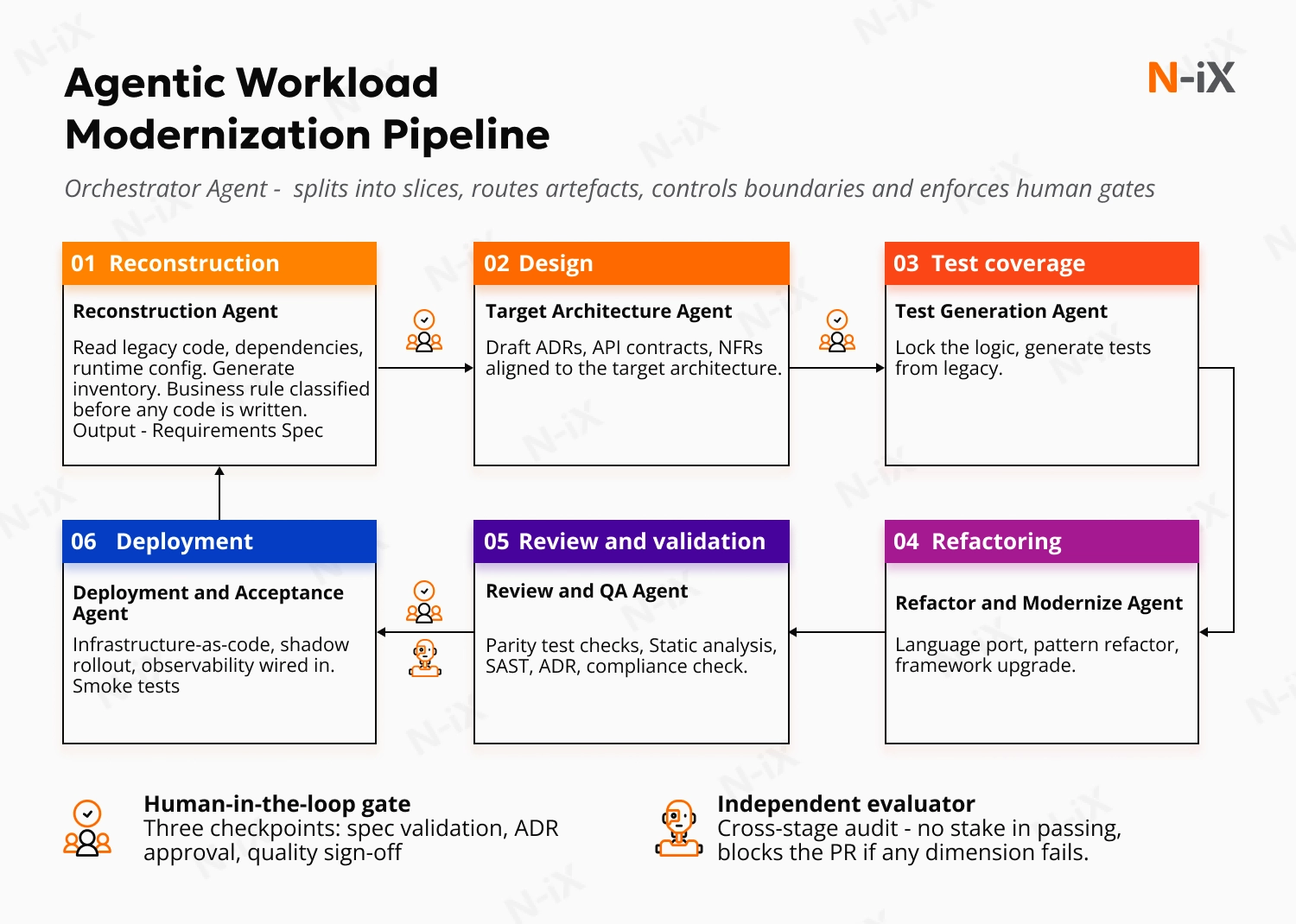
Two controls run on top of all six stages:
- Three core human checkpoints govern specification validation, architecture approval, and release readiness. Additional reviews can be introduced for security-critical changes, data migrations, and other high-risk transformations.
- A separate evaluation layer checks agent outputs against predefined acceptance criteria, including test results, code quality, security findings, and specification compliance. Failed checks trigger remediation or human review, while repository and CI/CD policies prevent unapproved changes from progressing.
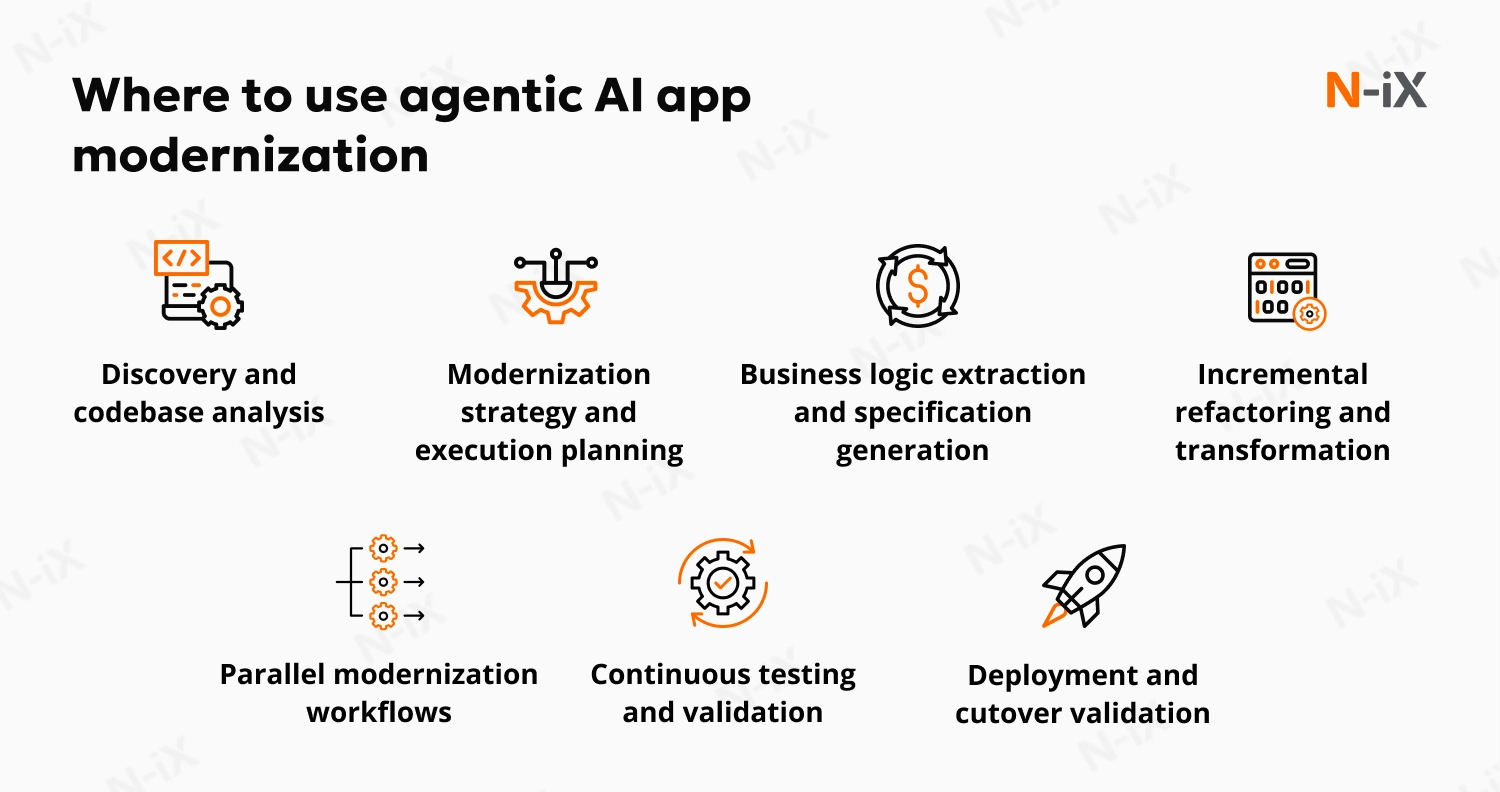
It lets us build agents that do repetitive, verifiable work, while keeping people making the decisions that require judgment. Here are a few examples where agentic AI app modernization can be applied across the modernization lifecycle.
Where to use agentic AI app modernization
During modernization, AI agents compress specific high-volume activities within it, such as:
Discovery and codebase analysis
Legacy systems often have incomplete documentation and hidden dependencies. AI agents can analyze repositories at scale to build a working view of the application, including:
- Components and dependencies;
- APIs and integration points;
- Data access patterns;
- Outdated libraries and technical debt;
- Likely locations of business logic.
Why use agents here: They reduce the manual effort required to build an application inventory and help teams identify dependencies and technical risks earlier. AWS, for example, now uses agentic analysis for portfolio-scale dependency mapping, modernization readiness, and technical-debt discovery [1].
If you have several agents, explore how to coordinate autonomous systems using AI agent orchestration
Modernization strategy and execution planning
Following discovery, engineers assess which applications should be upgraded, refactored, rearchitected, replaced, or retired. AI agents can support this process by:
- Estimating dependencies;
- Identifying migration constraints;
- Comparing technical options;
- Preparing modernization work packages.
Why use agents here: They accelerate the evaluation of modernization options across large application portfolios, helping teams identify dependencies, prioritize applications, and make better-informed investment decisions before committing engineering resources.
Business logic extraction and specification generation
Once the application is mapped, AI agents can reconstruct documented and undocumented behavior into draft specifications, dependency maps, and characterization tests. They can:
- Extract business rules from code and configuration;
- Generate functional specifications and requirements;
- Create characterization tests to capture current behavior;
- Trace requirements back to source files and execution paths;
- Flag inconsistent logic, unusual dependencies, and edge cases.
The reliability of generated specifications depends on the available source code, runtime evidence, and integration data. Domain experts must validate the extracted rules and decide which behaviors should be preserved, changed, or removed during modernization.
Why use agents here: They reduce manual reverse-engineering effort and accelerate the creation of traceable specifications and tests. AWS Transform, for example, generates development-ready requirements with traceability back to legacy source code [2].
Incremental refactoring and transformation
AI agents are well suited to bounded modernization tasks where each change can be checked immediately. They can:
- Refactor or upgrade a defined component;
- Compile and test the changed code;
- Inspect failures and revise the implementation;
- Repeat the cycle until predefined checks pass;
- Submit the result for review or approval.
Agents work well for repetitive tasks such as framework upgrades, language migration, dependency remediation, and refactoring. However, the changes should remain small, testable, and reversible, as passing tests alone cannot guarantee correctness.
For database and integration modernization, agents can generate migration scripts, map schema dependencies, and check compatibility. Engineers must verify data integrity, transaction behavior, and recovery procedures before production changes.
Why use agents here: They reduce the engineering effort spent on repetitive code changes and failure diagnosis, allowing teams to progress through large volumes of modernization work more efficiently.
Our article on context engineering for AI agents explains what agents need from enterprise systems to operate reliably.
Parallel modernization workflows
For large applications or portfolios, multiple agents can work on separate modernization tasks at the same time. This requires clear boundaries between workstreams, including:
- Isolated branches or workspaces;
- Defined API and schema contracts;
- Controlled dependency changes;
- Explicit integration points.
Keep in mind that wo agent-generated changes can pass their own tests and still conflict when combined, especially around shared APIs, schemas, libraries, or configuration.
Why use agents here: Independent workstreams can progress simultaneously, reducing elapsed time across large modernization portfolios. The actual throughput gain depends on the coordination and integration effort required.
Find out more about how this pattern works in our article on AI consolidation for enterprise applications
Continuous testing and validation
As modernization progresses, AI agents can continuously check whether changes preserve expected behavior. They can:
- Run regression and integration tests;
- Validate APIs and dependencies after changes;
- Check code quality and security rules;
- Update tests and technical documentation as the system evolves.
When agents generate both code and tests, the two may share the same incorrect assumptions about legacy behavior. Modernization teams should therefore validate transformed code against independent evidence, including approved business rules, existing regression tests, representative production scenarios, and comparisons with legacy system outputs.
Why use agents here: Validation results provide feedback that agents can use to diagnose failures and revise implementations within defined limits. This supports shorter correction cycles during incremental modernization.
Read on: A practical guide to building multi-agent AI
Deployment and cutover validation
AI agents can assist with release preparation, deployment checks, rollback planning, and production monitoring. Critical cutovers still require human approval, particularly when changes affect transactions, data integrity, or service availability. Phased rollouts help teams assess real-world behavior before completing the transition.
Why use agents here: They accelerate the analysis of deployment issues and operational signals, helping teams identify unexpected behavior earlier during phased rollouts and respond before completing the cutover.
Many important decisions do not provide such a simple signal. This is where agentic AI app modernization should be considered with caution.
What engineers shouldn't delegate to AI agents during modernization
Agents work best where success can be measured against clear technical signals. Human judgment remains critical when decisions depend on business context, architecture, or poorly standardized systems.
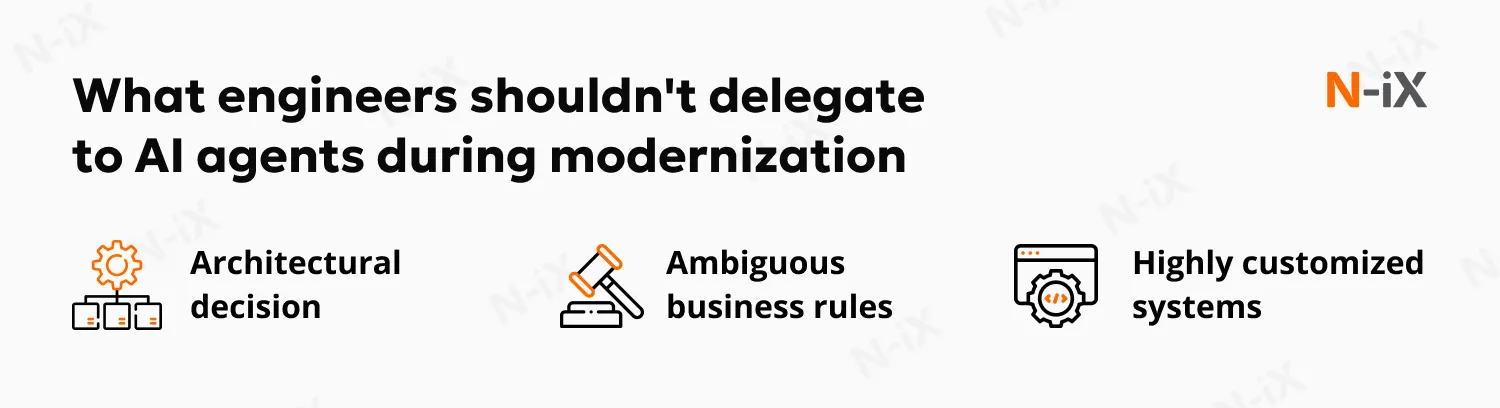
Architectural decisions
Agents can map dependencies and suggest service boundaries. Architects still need to decide which design best fits ownership, security, data consistency, operating costs, and future product needs.
Ambiguous business rules
Legacy applications contain years of accumulated behavior. Legacy code shows what the system does, but not always what the business still wants. While agents can extract rules from code, documentation, and system history, domain experts must decide which behaviors to preserve, change, or remove.
Highly customized systems
Agents perform better with standard frameworks, repeatable migration patterns, and strong test coverage. Proprietary or tightly coupled systems usually require smaller changes and more frequent expert review.
The implication is practical: autonomy should be designed task by task, rather than treated as an all-or-nothing capability. Here's how we at N-iX approach agentic modernization.
Explore the application modernization challenges & how to overcome them
The results of agentic AI app modernization from real projects
In one of our ongoing engagements, we helped the client consolidate a portfolio of roughly 150 applications from a single low-code platform. Our experts implemented AI agents to support portfolio assessment, extract business logic, and migrate selected applications to the client's infrastructure.
Another N-iX project is focused on consolidating a fragmented set of third-party applications onto unified cloud infrastructure for an enterprise transportation client. We helped reduce maintenance costs by 30% by decreasing the number of separate systems the client's team needed to license, patch, and support.
These engagements demonstrate N-iX's experience with portfolio-scale application consolidation and modernization, including using AI agents for selected assessment and migration activities.
Wrap-up
Agentic AI app modernization can significantly accelerate legacy system transformation, provided agents operate within clear boundaries and their work can be verified. The greatest value comes from automating repetitive tasks while keeping architecture, business decisions, and quality control in expert hands.
At N-iX, we already apply this approach to complex modernization projects, combining specialized AI agents, automated validation, and human oversight. Whether you're modernizing a single legacy application or an entire portfolio, explore our services to see how we can help you move faster while managing technical risks.
FAQ
How can you tell whether an agentic modernization system is genuinely autonomous?
You should look at who determines the next action. If application code controls every step, the system is primarily a workflow. In an agentic system, the model has some discretion to choose its next action based on intermediate results. A useful evaluation should include failed builds, unexpected dependencies, and incomplete information.
Does a passing test suite mean an agent-generated change is correct?
It provides evidence, but only for the behavior covered by those tests. Security, performance, concurrency, data integrity, production configuration, and undocumented requirements may require additional checks. Higher-risk changes also need appropriate human review.
What application modernization tasks should stay under human control?
Long-term architecture decisions, interpretation of ambiguous business rules, material changes to critical logic, and production cutover require accountable human ownership. Agents can gather evidence, propose options, and execute bounded technical work around those decisions.
Is agentic AI app modernization the same as making applications agent-ready?
The terms are related but different. In agentic AI app modernization, agents perform tasks tied to application upgrades and optimization. Agent readiness means changing applications so agents can securely access their data and business capabilities at runtime.
The two overlap because clearer interfaces, explicit specifications, stronger tests, and better observability support both.
References:
- Continuous tech debt analysis and remediation | AWS Transform
- AWS Transform: From migration to continuous modernization | AWS
Have a question?
Speak to an expert


