
 ChatGPT
 Perplexity
 Claude
 Gemini
 Grok
Grok
Modern businesses need to accelerate their pace of development to keep up with the industry leaders and stay on top of their game. Yet, many enterprises struggle to find and acquire top talent with diverse technical expertise. For this reason, nearshoring to CEE and Northern Europe has become a stronger trend. Cultural alignment, business and market understanding, agility, and diverse technological expertise foster interest in these outsourcing destinations.
In this article, let's review the three promising IT outsourcing destinations for team extension: Latvia, Estonia, and Lithuania. You'll find a general overview of the IT outsourcing industry in the Baltic states, followed by a detailed outlook of each country and key reasons why you should hire developers in Estonia, Latvia, and Lithuania.
IT outsourcing in Baltic states
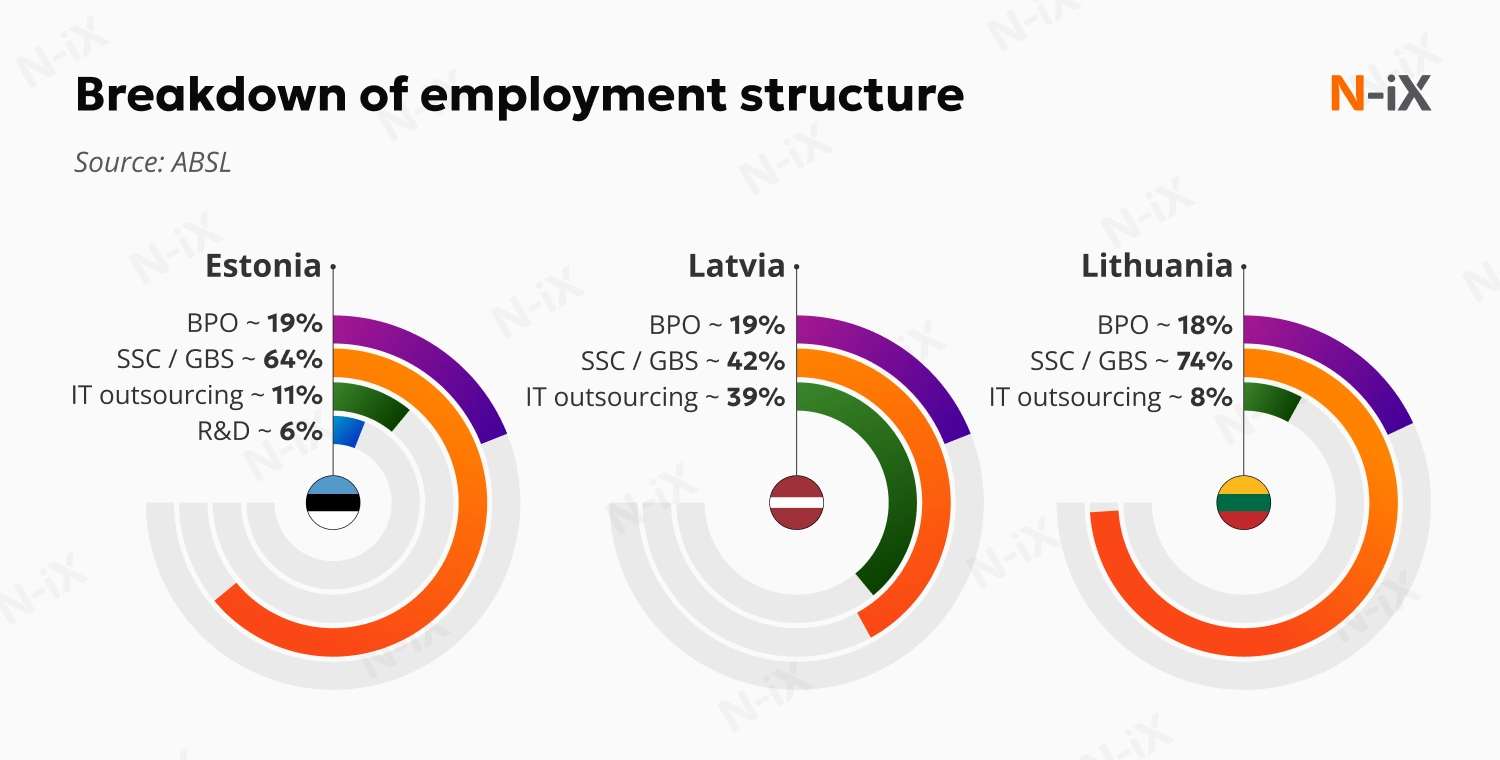
Baltic states are considered one of Europe's most economically stable IT outsourcing destinations. Estonia, Latvia, and Lithuania boast high levels of digitalization and effective legislation that ensures data security and smooth business operations. The companies in the region are known for high-quality nearshore and offshore development services.
The region is also recognized thanks to its numerous product companies, startups, and vendors specializing in outsourcing global business services.
However, along with the benefits, Baltic countries can offer, there are also some significant risks and challenges. Let's learn more about Latvia, Estonia, and Lithuania's IT market development and business environment to help you find a reliable IT outsourcing partner.
Read more: Top IT outsourcing destinations of Eastern Europe: Market report
IT outsourcing in Latvia
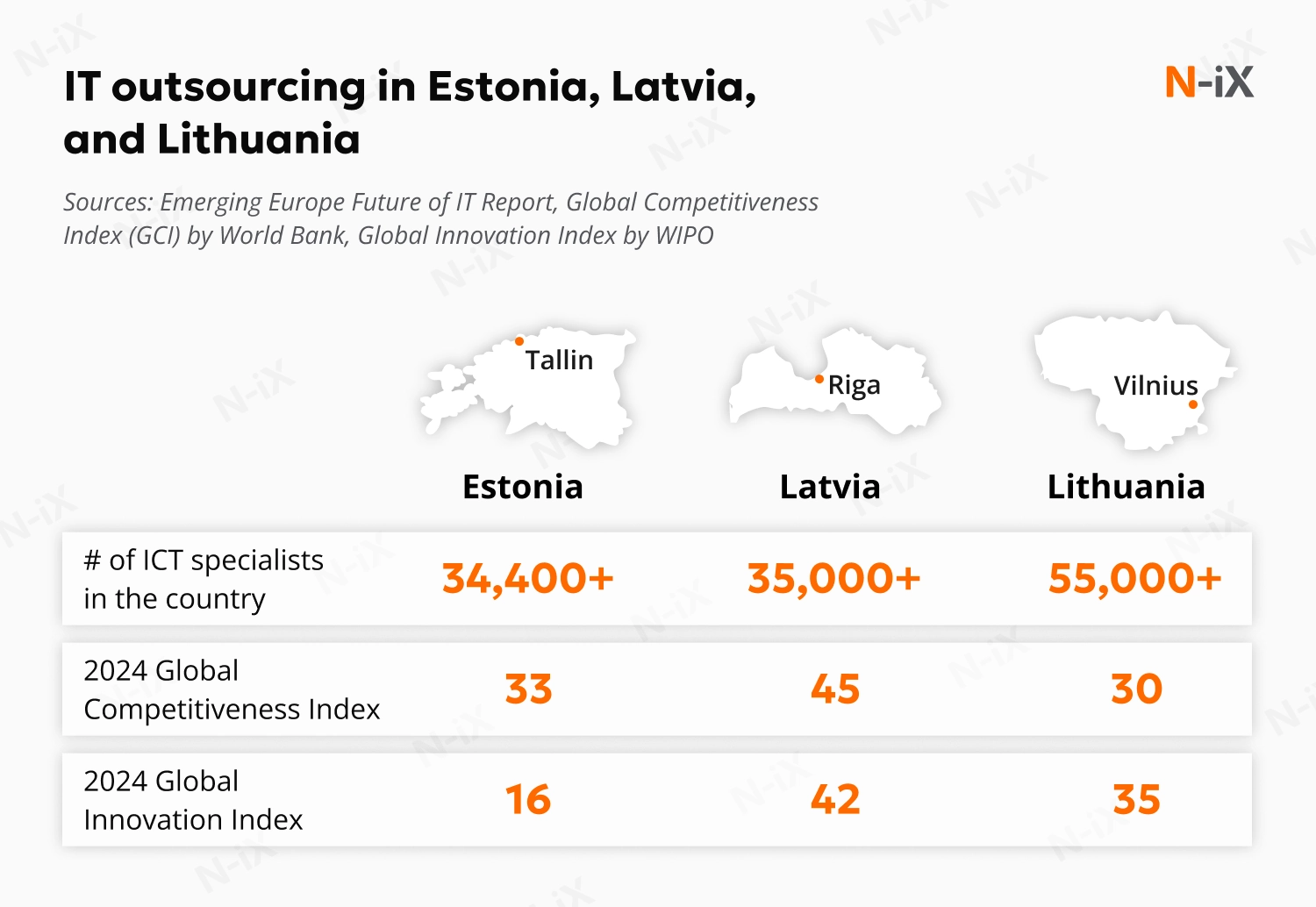
What are the key reasons to go for IT outsourcing in Latvia? Out of 1.9M people populating the country, more than 35,000 IT specialists work in software development companies in the Latvian ICT sector. Also, around 1,110 computer science students graduate from local universities annually, thus stimulating industry growth and the number of software developers in Latvia.
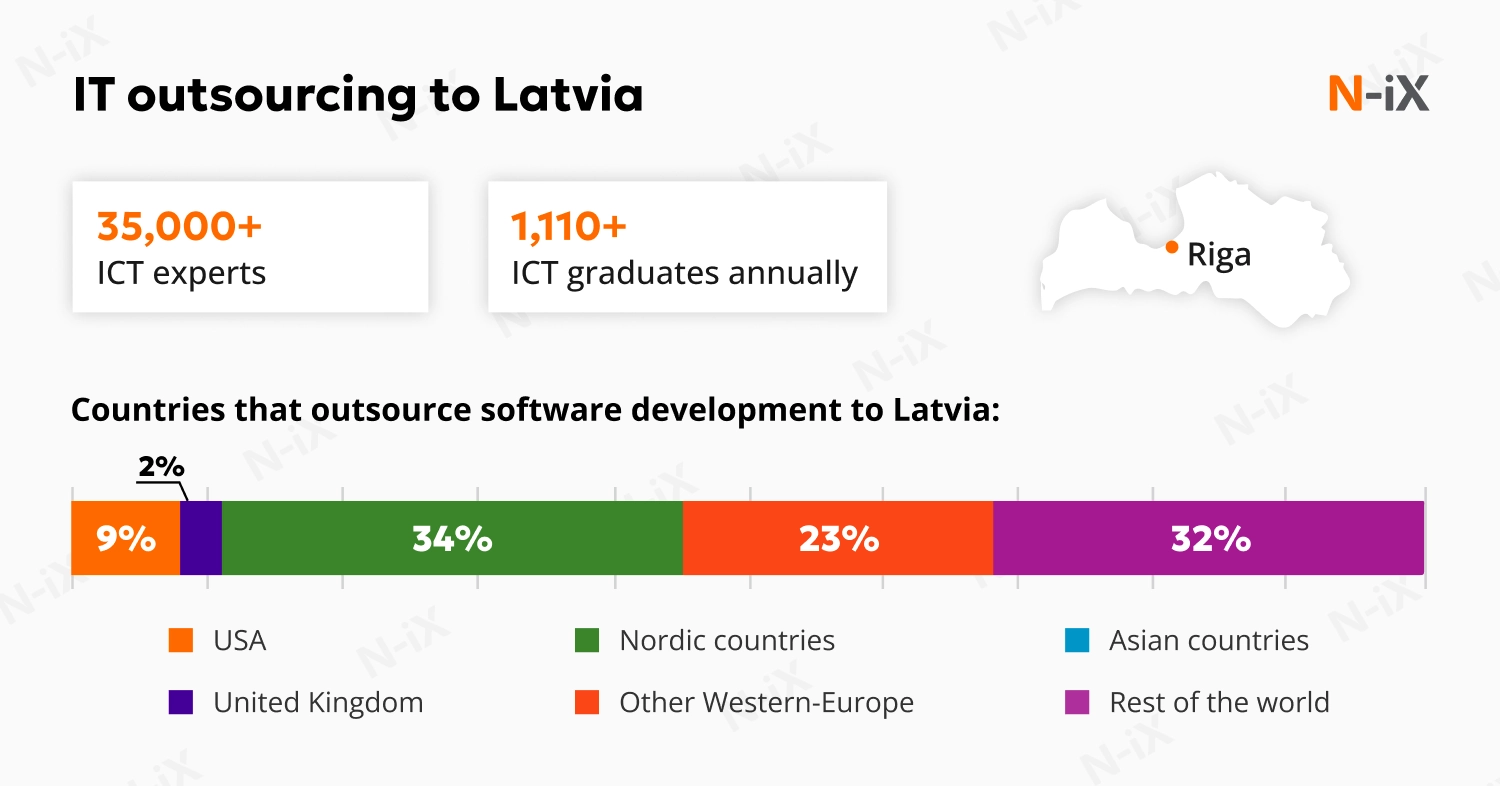
The evolution of IT outsourcing in Latvia has led to the birth of such large IT service providers in the country as Tieto, Evolution, Accenture Latvia, and Lattelecom Technology. Moreover, international companies like IBM, PwC, Accenture, KPMG, Siemens, and ABB have already established their regional centers in Latvia. In addition, Latvian software companies with less talent also capitalize on their expertise, offering custom outsourcing services.
Software development in Latvia
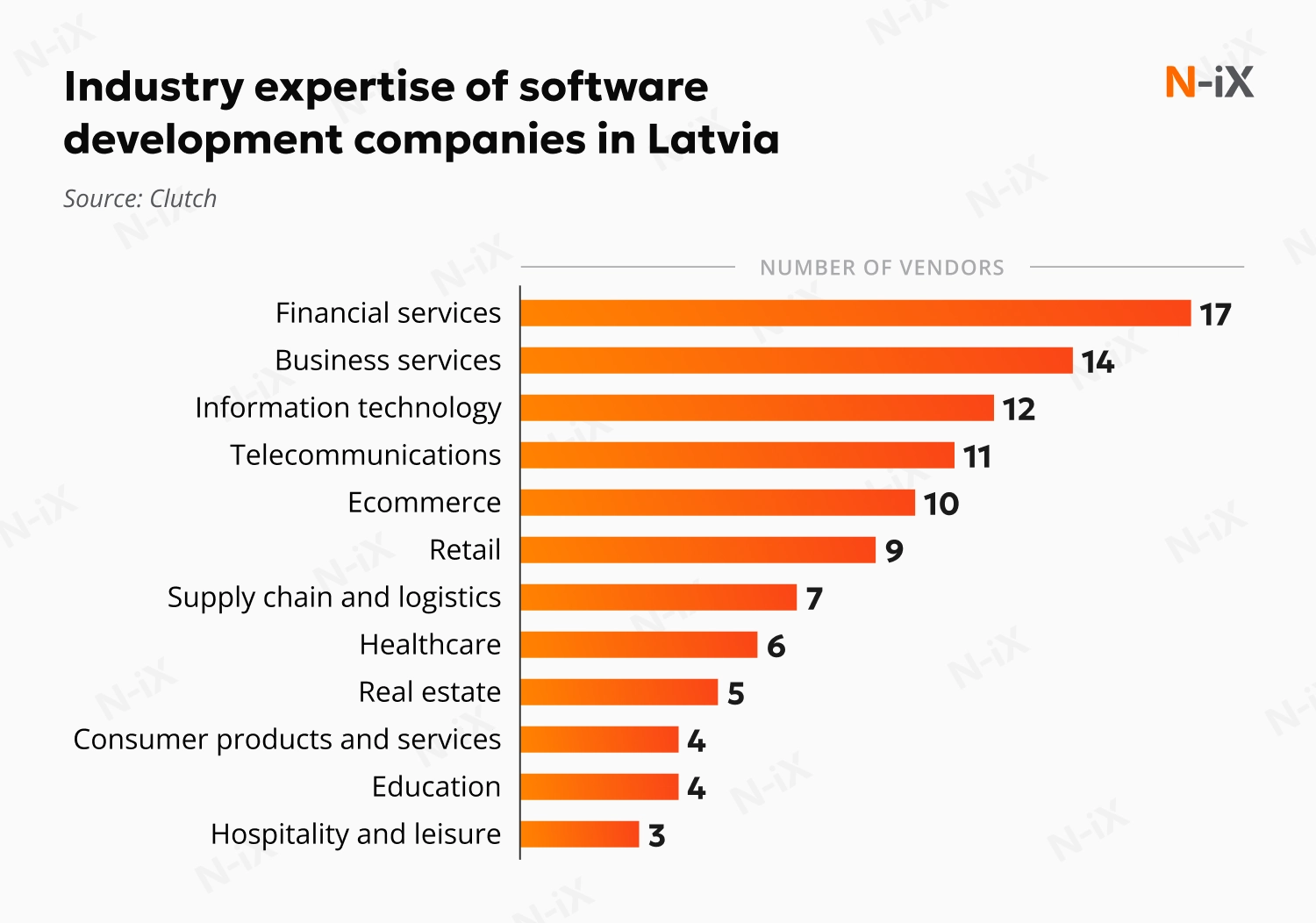
Latvia has the lowest number of IT outsourcing or software development providers. Clutch lists slightly more than 50 Latvian software companies, with the majority being small firms with less than 50 employees. As for the domain expertise of these companies, the leaders are the financial services, business services, information technology, telecommunications, and ecommerce industries.
With fewer resources and a smaller tech talent pool, IT outsourcing in Latvia is still one of the top destinations in Northern Europe. But what makes software development in Latvia so attractive?
Business environment in Latvia
Latvia's business environment growth and economic stability are driven by increasing shares of fast broadband subscriptions, the implementation of several governmental measures, and improved delivery of public services. According to the Global Services Location Index in 2023, the country is ranked 20th in terms of financial attractiveness, skills and availability, and state of the business environment. Also, the country has the 42nd position in the 2024 Global Innovation Index according to indicators like infrastructure development, technological readiness, business sophistication, and innovation. The Latvian government is planning to reduce administrative burdens, expand e-government services, and work on attracting investment to Latvian software companies to create new jobs and increase business competitiveness.
Risks and challenges
Let's explore some of the reasons why IT outsourcing in Latvia may present challenges for businesses. Even though more and more Latvians are going online and using e-government services, around 45.3% of the population still has a low level of digital skills adoption, according to the Digital Skills & Jobs Platform. In addition, R&D investments in the Latvian business sector are lower than the EU average and well behind other European benchmarks.
Keep reading: How to partner with the best developers in Eastern Europe?
IT outsourcing in Estonia
Estonia is the smallest of all three countries in terms of population—it is home to 1.3M people only. According to the State of European Tech, the ICT sector in Estonia employs more than 34,400 ICT specialists. In addition, a little over 1,300 people graduate with degrees in computer science every year. As stated by the Estonian Investment Agency, as of 2024, the ICT industry comprises 5% of the country's GDP. Two major cities contribute the most to the development of the Estonian IT industry—Tallinn taking the lead (67.5%) and Tartu as a runner-up (12.5%).
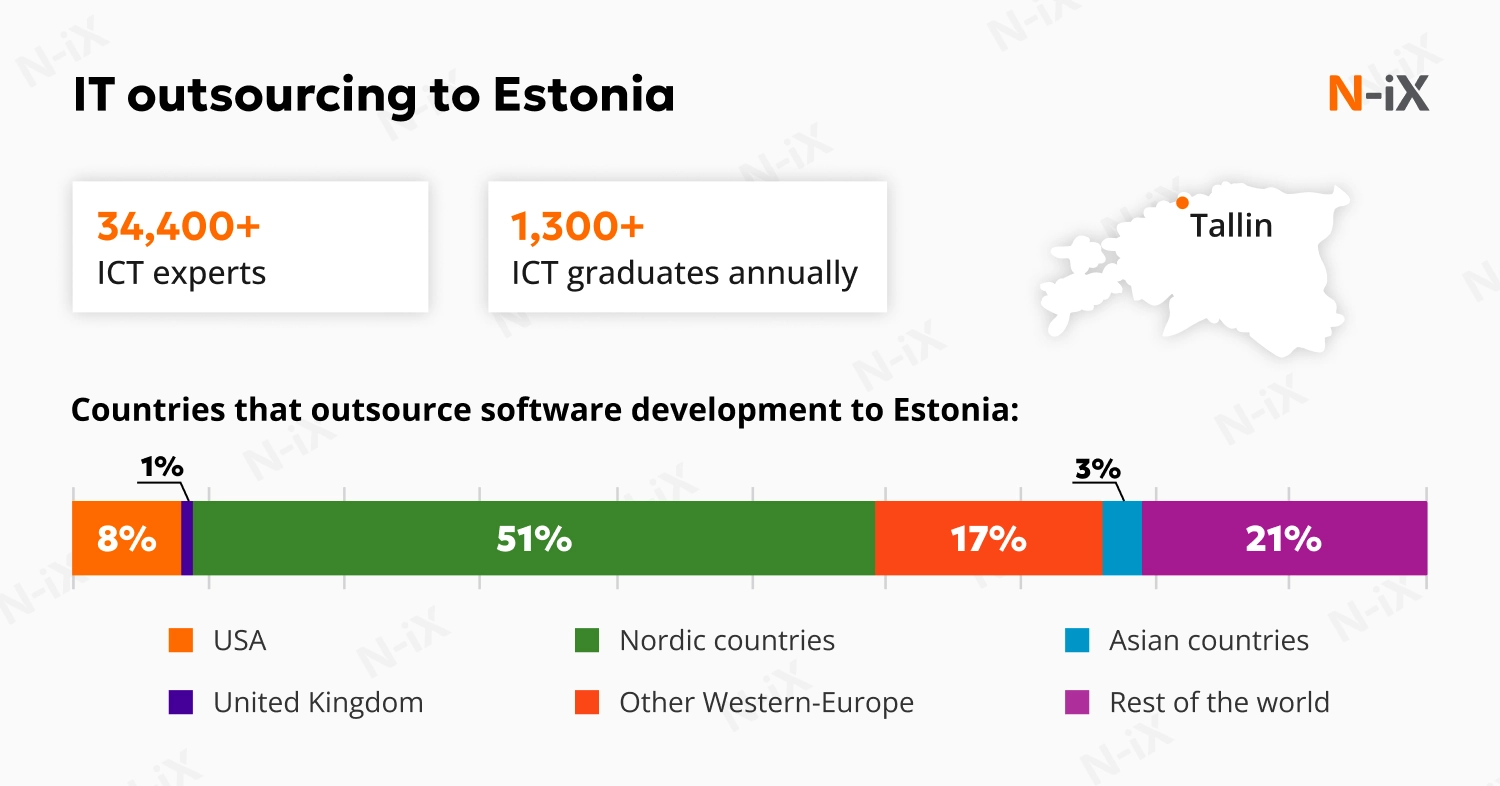
The Estonian IT industry is well-developed due to numerous startups and a favorable business climate for establishing Estonia outsourcing hubs. The country is known as the birthplace of Skype, TransferWise, Pipedrive, Cloutex, Click & Grow, Grabcad, Erply, Fortumo, and Lingvist, among others. Moreover, the country is home to many foreign companies that have opened their R&D centers there. They include global companies like Microsoft, SAP, Acronis, and Parallels.
Software development in Estonia
The Department of Critical Information Infrastructure Protection (CIIP) in Estonia evaluates the security of information systems and carries out regular risk assessments. According to the National Cyber Security Index (NCSI), in 2025, Estonia was ranked 3rd worldwide (among 112 countries). This means that local enterprises have strong, formally defined ICT security policies.
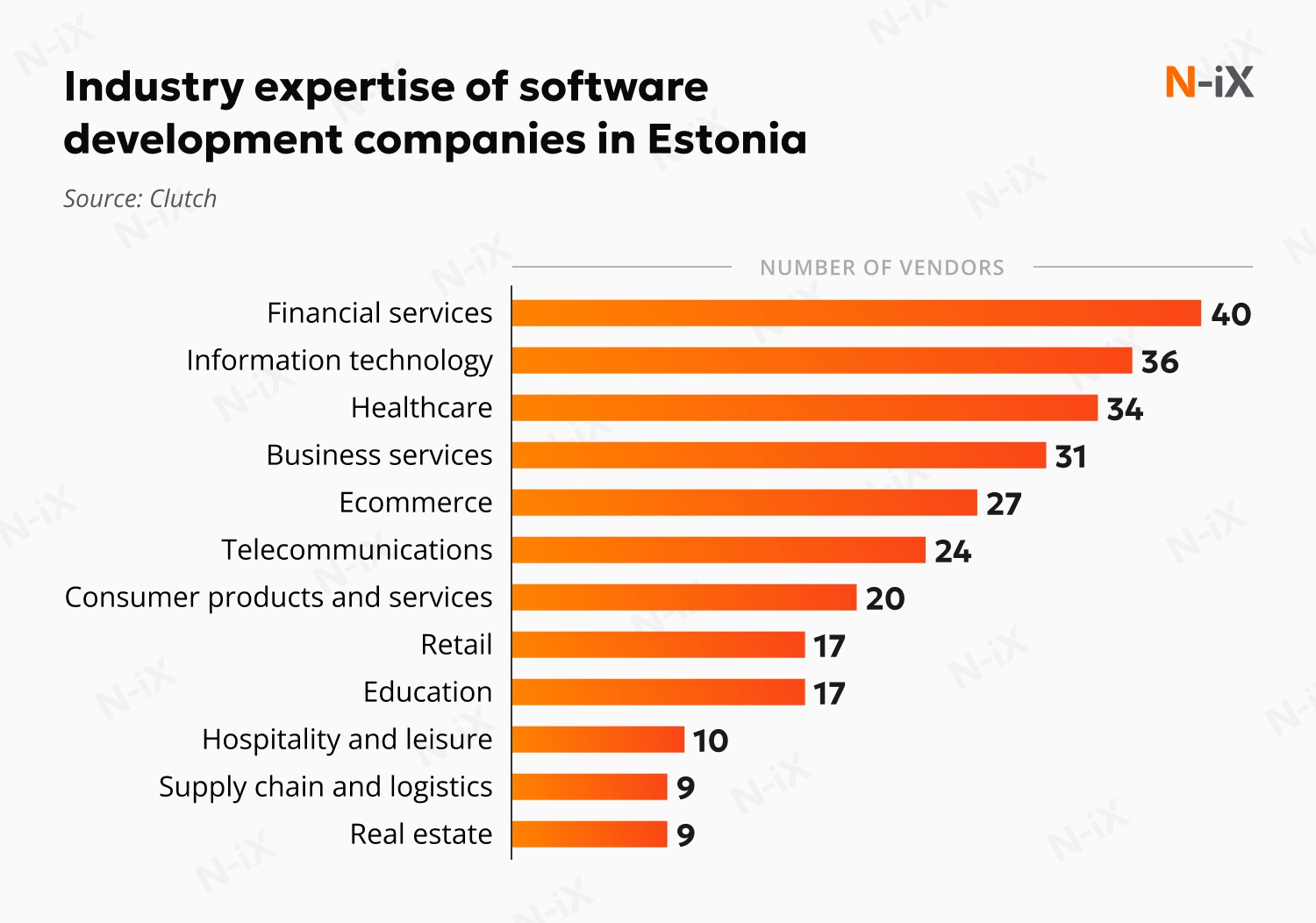
Clutch lists around 200 software development companies in Estonia, most of which employ less than 50 specialists. Most Estonian outsourcing companies specialize in financial services, information technology, healthcare, business services, ecommerce, telecommunications, as well as consumer products and services industries. If you have decided on IT outsourcing in Estonia, there are plenty of vendors to choose from.
Business environment
Estonia is a frontrunner in the Baltic region in terms of applying modern IT solutions, including a wide range of state e-services, e-banking, nationwide ID cards, and a digital signature legally equal to a handwritten signature. The country is ranked 33rd in the 2024 World Competitiveness Index. Another reason to go for software development in Estonia is that the country is not only implementing e-government solutions but is also conscious of its cybersecurity. The country hosts the cybersecurity center of NATO and the IT agency of the European Union. What's more, the governmental agency Enterprise Estonia aims to increase Estonian companies' productivity by up to 80%. It promotes Estonian entrepreneurship and regional policy and offers consultation, training, cooperation opportunities, and financial support to entrepreneurs, research institutions, public and nonprofit sectors.
Another reason to go for IT outsourcing in Estonia is that the country is one of the most politically stable states in the CEE region, being a member of the Eurozone, WTO, NATO, and OECD. A few years prior, the country also launched the Estonian Entrepreneurship Growth Strategy, which is the most important strategy related to the development of the country's economy for the next five years. It focuses on increasing productivity, stimulating entrepreneurship, and encouraging innovation within the state.
Get a complete overview of Central and Eastern European tech markets!
Success!
Risks and challenges
Estonia has one of the best-performing labor markets in the European Union, but its declining working-age population is a real challenge. The Estonian labor market is characterized by its flexibility and low unemployment rates. These factors favor the proper growth of software development companies in Estonia. However, aging poses risks for businesses' profitability, competitiveness, and the country's long-term economic growth. Moreover, the scarcity of resources remains the most critical issue for the successful development of the Estonian IT industry.
Related: Going far and near to find software developers? Explore Eastern Europe
IT outsourcing in Lithuania
With its robust ICT sector and a growing pool of skilled professionals, IT outsourcing in Lithuania is an attractive choice for many businesses. Housing 2.8M people, Lithuania is the most populous country out of the three locations; therefore, it is the leader according to the number of ICT professionals. Around 55,000 specialists are employed in the ICT industry in Lithuania, with around 1,760 future experts graduating every year. Such global companies as Google, AIG, Nasdaq, Uber, IBM, Wix, HP, Virtustream, and Unity have already opened their R&D and IT development centers in this country. On the whole, IT companies in Lithuania have received substantial investment over the past years, which stimulated the growth and development of the IT sector.
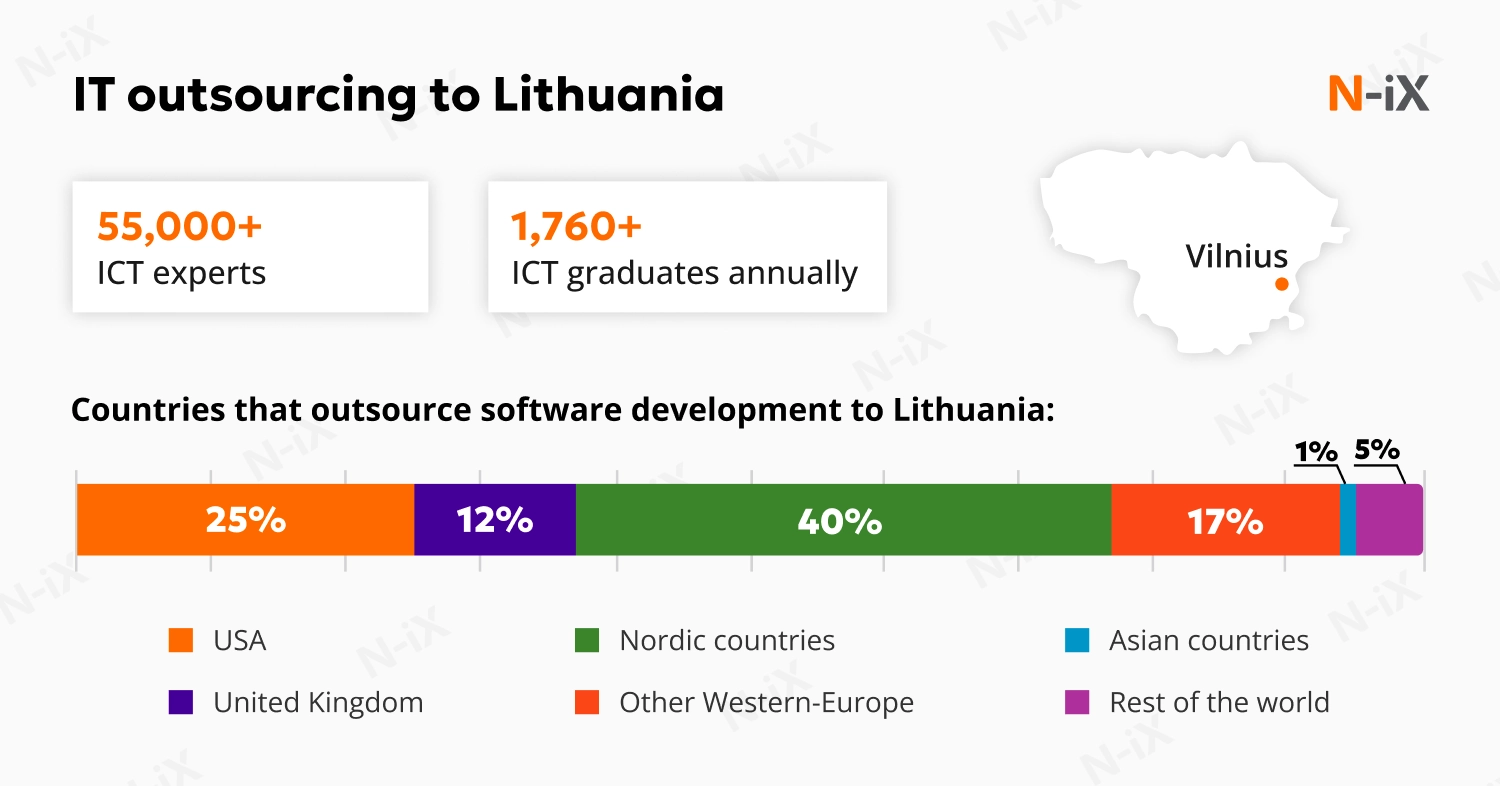
Dozens of regular tech events, such as the Innovations conference, Global Game Jam in Lithuania, Software Development Conference, Silicon Valley Comes to Baltics event, and International Open Data Hackathon, take place in Lithuania. Some of them attracted thousands of participants and over 100 international speakers.
Software development in Lithuania
IT outsourcing in Lithuania is an excellent market for getting the most out of your software development. Apart from a decent tech talent pool, the country has some reputable IT outsourcing vendors. According to Clutch, there are over 140 outsourcing and software development companies in Lithuania.
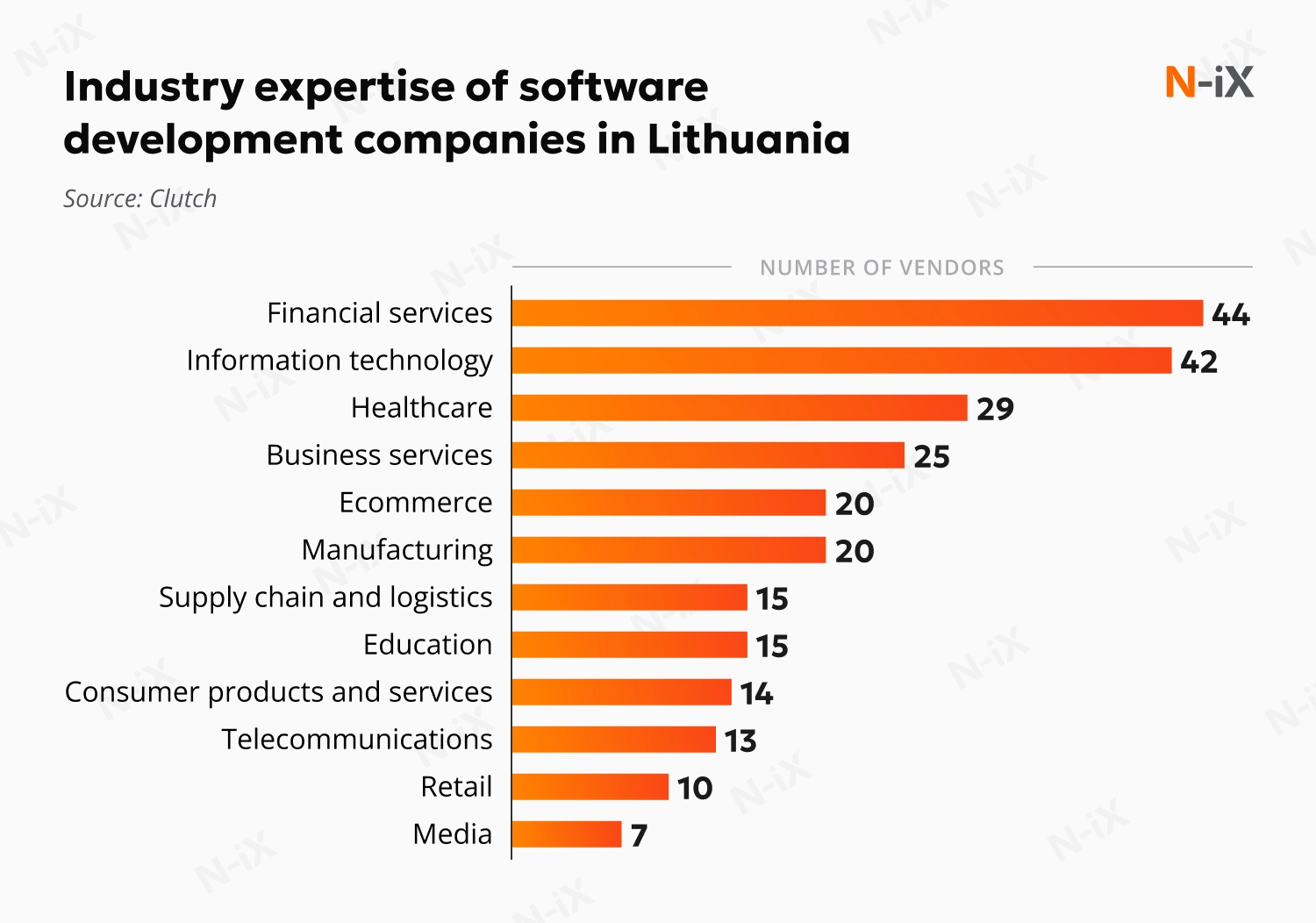
Software companies in the country have versatile domain expertise. Among the most popular industries that choose IT outsourcing in Lithuania are financial services, information technology, healthcare, business services, ecommerce, manufacturing, as well as supply chain and logistics.
Business environment
The Lithuanian government plans to develop a high-speed broadband communication infrastructure in line with its Programme on the Information Society Development. Lithuania has also launched a program to increase the availability of e-services and enhance their quality by adopting digital technologies. No wonder the country occupies 35th place in the Global Innovation Index. Moreover, Lithuanian IT education witnessed a significant increase in government funding for IT studies, stimulating rapid growth among students choosing IT as their first field of study and proceeding with employment in software companies in Lithuania.
Risks and challenges
It's still worth mentioning that dozens of skilled professionals leave the country to be employed abroad. The skills shortage in Lithuanian outsourcing software companies continues to be high and becomes a primary bottleneck for Lithuania's growth. Although software development companies in Lithuania have been steadily embracing the opportunities offered by various digital technologies, their progress has been slower than in previous years.
The Digital Agenda Strategy recognizes that addressing this issue remains crucial to support digital transformation in banking and other industries. It sets out some necessary steps to reinforce investment in human capital. By implementing this, the country is expected to boost the quality of teaching, improve the employability of the low-skilled, and promote adult and work-based learning. The strategy sets an objective to attract more young people to choose IT and related majors and professions to ensure the acquisition of digital skills when learning.
Bonus section for the Nordic businesses: Why go for nearshoring to Latvia, Estonia, or Lithuania?
Nearshoring to Latvia, Estonia, and Lithuania is one of the most attractive options for Nordic companies. And here’s why. Beyond the competitive advantages of cost-effectiveness, technological expertise, and economic stability, cultural alignment plays a significant role in fostering successful partnerships.
The historical and cultural ties between the Nordic countries and the Baltic region create a strong foundation for seamless collaboration. These similarities help enhance communication, ensuring that projects run smoothly with minimal barriers. The cultural affinity between Nordic and Baltic tech professionals is reflected in key aspects like decision-making processes, work ethics, and long-term goals.
Hofstede Insights' cultural dimension analysis reveals that both the Nordic countries and the Baltics share a low power distance, which indicates a preference for decentralized decision-making and more egalitarian work environments. This is particularly beneficial for businesses that value close collaboration and efficient team dynamics. Additionally, both regions exhibit a high long-term orientation, meaning that professionals in the Baltic states are equally committed to delivering high-quality, sustainable results. This aligns well with Nordic enterprises' focus on long-term success and project commitment. Now let’s review the strengths of each country in the context of nearshoring.
Nearshoring to Estonia
Estonia leads as a digital society pioneer, offering vast expertise in secure digital infrastructure and e-governance solutions. Therefore, nearshoring to Estonia is the right choice for companies looking to leverage advanced cybersecurity solutions, implement scalable digital systems.
Nearshoring to Latvia
Latvia excels in data engineering, with a substantial number of developers skilled in Big Data and analytics. By nearshoring to Latvia, you can harness the country's strong capabilities in data-related projects, making it an ideal choice for developing complex data solutions and analytics platforms.
Nearshoring to Lithuania
For businesses seeking expertise in cutting-edge financial technology, Lithuania offers a perfect environment with its high concentration of licensed fintech companies. Therefore, fintech businesses that choose nearshoring to Lithuania can implement high-performing solutions within a strong regulatory environment.
Wrap-up
Overall, the launch of e-programs, ease of doing business, high cybersecurity, and low corruption rates foster IT industry development in the Baltic countries. Nevertheless, the pace of software development market growth and digital technology adoption in Lithuania, Estonia, and Latvia is still moderate. The shortage of skilled IT specialists becomes a significant bottleneck for this region. Thus, finding and scaling a team is a real challenge. Instead, many companies consider CEE IT outsourcing destinations to establish long-term cooperation. Such destinations can become a win-win option regarding the availability of IT professionals and technological expertise.
FAQ
How can businesses ensure effective collaboration when nearshoring to Latvia, Estonia, or Lithuania?
Building a transparent relationship with clear communication channels is key. Leverage advanced communication tools to facilitate real-time collaboration and ensure that your outsourcing partner understands your business culture and goals.
What is the impact of local regulations on outsourcing in the Baltic region?
The Baltic states have a stable regulatory environment that aligns with EU standards, ensuring compliance in data protection and intellectual property. However, businesses should stay informed about local tax laws and labor regulations to avoid potential compliance issues.
Can the Baltic region support projects aimed at innovation?
Yes, the Baltic states are home to thriving innovation ecosystems, particularly in sectors like fintech and digital services. With strong government support for startups and a skilled talent pool, the region is well-equipped to handle projects that require the use of the latest technologies.