
Key takeaways
- DevOps measures delivery speed and reliability. FinOps measures the business value of technology spend.
- The two depend on each other. FinOps needs engineers to act on cost data, and DevOps gains business context for prioritization.
- FinOps now covers SaaS, licensing, and AI spend alongside public cloud.
- Clear ownership of each cost decision does more for results than any single tool.
- Cost guardrails work best inside the delivery platform, where engineers already work.
- Unit economics gives engineering, finance, and leadership a shared set of metrics they can all act on.
- N-iX pairs 24 years of engineering delivery and more than 400 cloud experts with its APEX framework to build cost accountability into your delivery pipelines.
DevOps changed how quickly companies ship software. Many teams that once released every quarter now deploy several times a day, and their infrastructure scales just as fast. Cloud bills grew just as quickly, and more of that spend now goes to waste. Flexera’s State of the Cloud 2026 report puts wasted cloud spend at 29%, marking the first increase in five years [1].
That figure is one reason leadership teams now weigh FinOps vs DevOps priorities side by side. DevOps teams govern how fast and reliably software reaches production. FinOps tracks what the infrastructure behind those releases costs and what it returns. Mature FinOps practices now report into technology leadership, close to the decisions that drive spend.
This guide shows you where FinOps and DevOps differ, how to combine them in one operating model, and how to gauge your own maturity.
What is FinOps?
The FinOps Foundation defines FinOps as an operational framework and cultural practice that maximizes the business value of technology. It relies on timely, data-driven decisions and shared financial accountability across engineering, finance, and business teams.
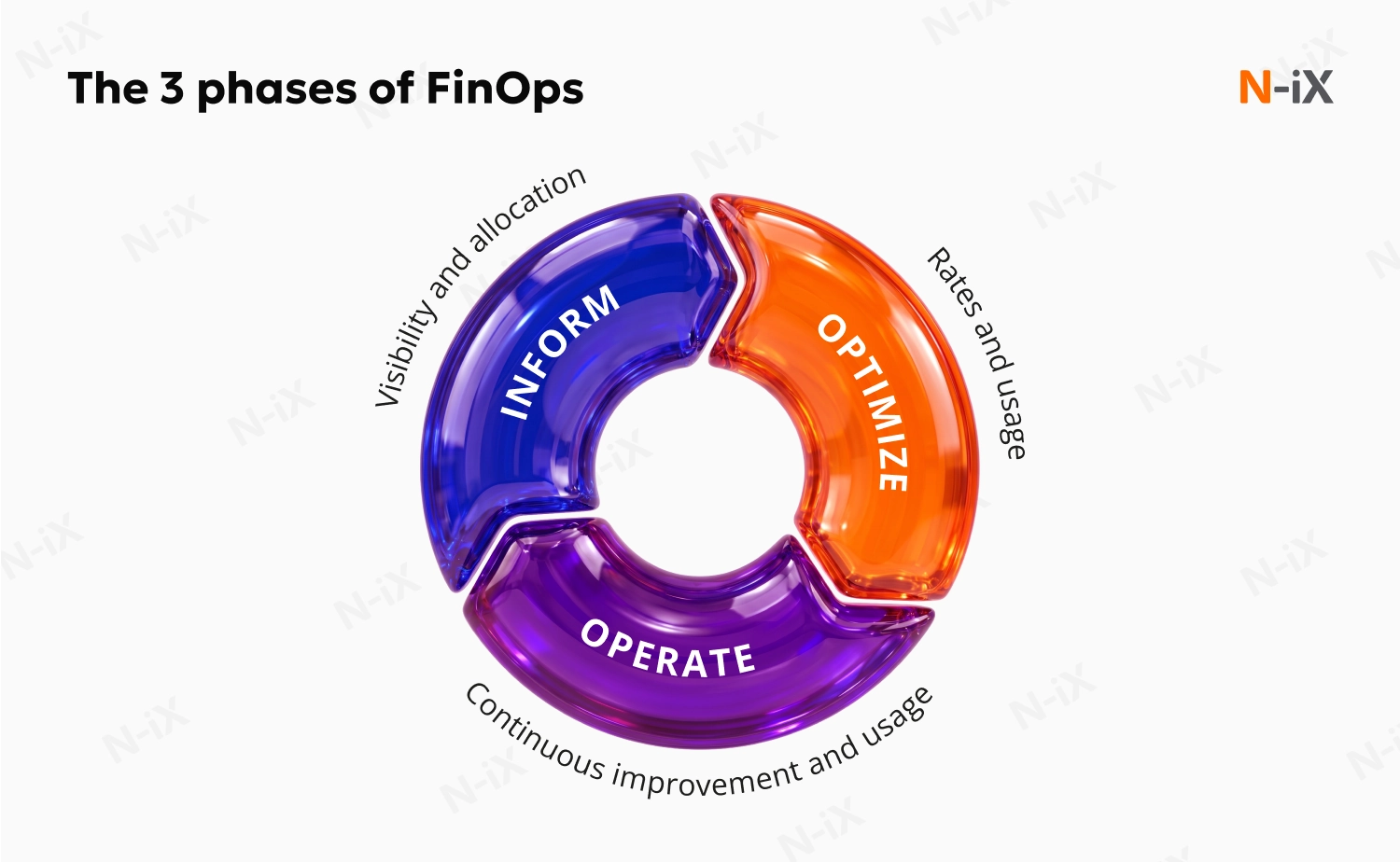
FinOps teams put that definition to work through a repeating cycle of three phases:
- Inform: Allocating spend to teams, products, and customers so everyone sees what they consume.
- Optimize: Adjusting rates and usage through rightsizing, commitments, and cleanup of idle resources.
- Operate: Building cost decisions into budgets, forecasts, and daily engineering routines.
The scope has also widened. According to the State of FinOps 2026, 90% of FinOps teams now manage SaaS spend and 64% control software licensing [2]. The same report shows FinOps moving closer to engineering. Today, 78% of FinOps teams report to the CTO or CIO, while only 8% report to the CFO.
So in most organizations with a FinOps practice, FinOps and DevOps now answer to the same executive. Before comparing DevOps vs FinOps side by side, it helps to define the second half of the pair.
Explore our guide to FinOps best practices
What is DevOps?
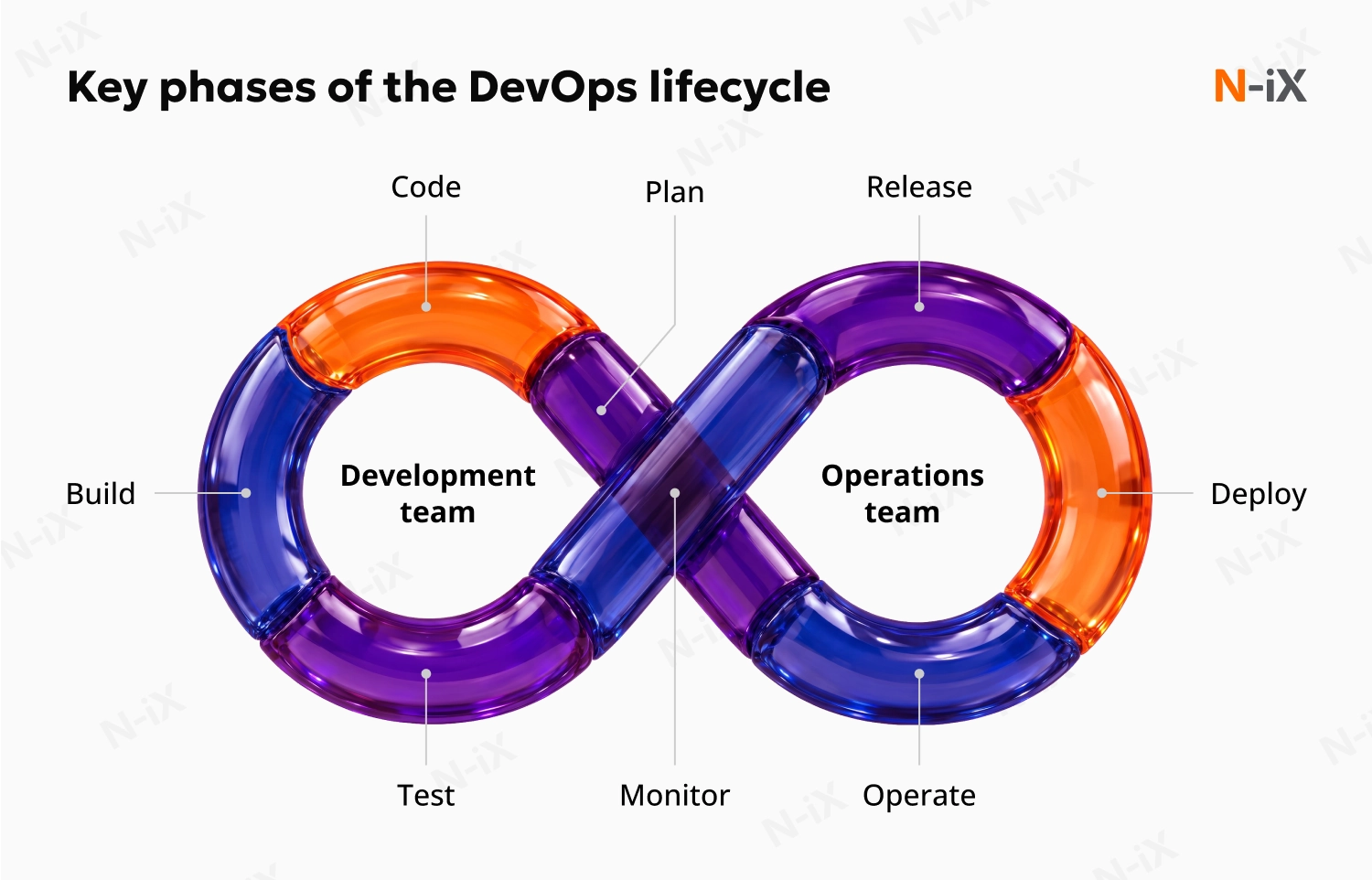
DevOps combines culture and automation to ship software quickly and reliably. Developers and operations engineers share ownership of production, supported by CI/CD pipelines, Infrastructure as Code, and observability.
Most teams measure DevOps performance with DORA’s five software delivery metrics. Three of them track throughput, namely change lead time, deployment frequency, and failed deployment recovery time. The other two, change failure rate and deployment rework rate, track instability. None of the five mentions cost, and that gap sits at the center of the FinOps vs DevOps comparison.
As organizations grow, many run DevOps through platform engineering. A dedicated platform team builds an internal developer platform, a self-service layer where engineers create environments, pipelines, and infrastructure from approved templates. These templates, often called golden paths, carry the company's standards so teams don’t have to rebuild them. Because most deployments pass through the platform, it is also the most practical place to close the cost gap.
FinOps vs DevOps: Key differences at a glance
Both disciplines grew from the same idea that the people who build systems should share accountability for what those systems deliver and what they cost. They apply it to different outcomes, as the table shows.
|
Dimension |
DevOps |
FinOps |
|
Core question |
How do we ship faster and more reliably? |
What business value does each dollar of spend return? |
|
Primary metrics |
DORA metrics |
Allocated spend, unit cost, forecast accuracy, effective savings rate |
|
Typical sponsor |
CTO or VP of Engineering |
CTO or CIO, with finance involved |
|
Decision cadence |
Sprints and releases |
Weekly anomaly checks, monthly reviews, quarterly forecasts |
|
Main tooling |
CI/CD, Infrastructure as Code, observability, internal platforms |
Cost allocation, anomaly detection, commitment management |
|
What it needs from the other |
Cost context to prioritize work |
Engineering teams who can act on the data |
The last row explains why the two disciplines work best together. In DevOps vs FinOps cost optimization, each side holds different levers. FinOps controls rates through commitments and discounts. Engineering controls usage through architecture, scaling rules, and cleanup. Commitments bought before rightsizing lock in waste for the full term, so savings stay small until both sets of levers move together.

How to run DevFinOps as one operating model
Organizations that stop framing it as FinOps vs DevOps tend to build the same five practices, often grouped under the name DevFinOps. In N-iX FinOps engagements, the order below holds up best. Teams that start with tooling usually come back to ownership a few months later.
1. Define who owns each cost decision
Dashboards show where cloud spend is going, but someone still has to act on this information. Each recurring cost decision needs one accountable owner. A simple RACI table makes the split explicit.
|
Decision |
FinOps |
DevOps |
Product engineering |
Finance |
|
Commitments (Savings Plans, reservations) |
R |
C |
I |
A |
|
Rightsizing and cleanup |
C |
A |
R |
I |
|
Architecture trade-offs |
C |
R |
A |
I |
|
Budget variance response |
R |
I |
A |
C |
|
AI model and infrastructure choice |
C |
R |
A |
I |
R = responsible, A = accountable, C = consulted, I = informed
2. Build cost guardrails into the platform
Internal platforms already decide how most teams provision infrastructure, so they are the natural home for cost controls. Three controls cover most of the ground:
- Cost-aware defaults in golden paths, such as instance families, autoscaling limits, and storage tiers;
- Policy as code checks in CI/CD that flag untagged or oversized resources before merge;
- Cost estimates on Infrastructure as Code pull requests, so reviewers see the monthly impact of a change.
N-iX’s expert tip: Start every new cost policy in warning mode for two or three sprints. Our DevOps engineers use that window to tune thresholds with the owning teams. Once false positives drop, switch the rule to block the merge or require an approval.
3. Make unit economics the shared language
A bill that grows 30% while revenue grows 60% is a healthy sign. Total spend alone hides that. Unit metrics express spend in terms both the business and engineering already use, and the following three make good starting points:
- Cost per transaction, for architecture decisions;
- Cost per customer or tenant, for pricing and gross margin;
- Cost per environment, for sizing CI/CD and test infrastructure.
Placed next to DORA metrics on one dashboard, these numbers turn the FinOps vs DevOps debate into a single conversation about speed and efficiency.
4. Treat cost anomalies like incidents
DevOps teams already know how to run an incident, and the same routine works for a spend spike. Route each cost alert to the owning team, with severity based on dollar impact. Keep a short runbook for common causes, such as a test cluster left running. Close with a blameless review that tightens the relevant guardrail.
Read more: Top 8 SRE best practices for reliable delivery in 2026
5. Bring AI workloads into the same model
AI spend changes faster than spend on traditional workloads. GPU capacity is expensive, and token costs shift whenever a prompt, model, or usage pattern changes. FinOps teams have adjusted quickly. The State of FinOps 2026 found that 98% of them now manage AI spend, up from 63% in 2025 [2].
The cost profile is also moving toward production. Gartner forecasts that inference will account for $23.3B of AI-optimized IaaS spending in 2026, overtaking training at $19B [3]. Inference runs continuously and scales with users, so it needs the same ownership and guardrails as any other production workload.
Give every model endpoint an owner, set token and GPU budgets in the platform, and add cost per AI request to your unit metrics. When our AI engineers start a pilot, they track cost per request alongside latency and accuracy from the first week.
The same logic runs through our APEX framework for AI adoption. Its four phases (Assess, Pilot, Expand, eXcel) each have to show measurable results before the next one begins. Tracking cost from the first pilot week means every expansion decision rests on both value and spend.
Keep reading: Managing AI costs with FinOps
How mature is your DevFinOps practice?
Organizations usually adopt these practices one at a time. The four levels below help you see where your company stands today and what to tackle next. Each comes with signature metrics you can use to track progress.
Level 1: Separate
The finance team reviews cloud costs once a month, after the money is spent. Engineering teams see little of that data, so the main metric is total spend against budget. The next move is to tag resources and allocate spend to the teams that own them.
Level 2: Visible
Each team can see its own costs, and the share of allocated spend becomes the metric to watch. With ownership in place, you can introduce unit cost metrics that tie spend to transactions, customers, or environments.
Level 3: Embedded
Cost checks run in CI/CD pipelines, and unit cost sits on the same dashboard as DORA metrics. Progress shows up in the unit cost trend and in the share of deployments that pass cost policy. From here, the next step is to automate rightsizing and anomaly response.
Level 4: Automated
Guardrails and optimization run by default across every workload, AI included. Forecast variance and cost per AI request become the metrics that matter. Work at this level centers on refining targets as the business changes.
Each level up also gives you a clearer basis for trade-offs. Revenue-critical launches and time-boxed experiments can justify extra spend for speed. Steady-state workloads, which run the same way month after month, are where efficiency targets belong. If you agree on these rules in advance, choices that once felt like FinOps vs DevOps become routine items in a regular planning meeting.

How N-iX can help you align FinOps and DevOps
With 24 years of engineering delivery experience, N-iX can help you move up this ladder from wherever you start. Here is what we bring to every engagement:
- Engineering scale across clouds. More than 2,400 technology experts, including over 400 cloud engineers and 70 DevOps specialists with expertise in AWS, Azure, and Google Cloud.
- Hyperscaler partnerships. N-iX is an AWS Premier Tier Services Partner with AWS DevOps and AWS Migration and Modernization Competencies, a Microsoft Solutions Partner for Azure Infrastructure, and a Google Cloud Platform Partner.
- Cost reviews grounded in the Well-Architected Framework. As an AWS Well-Architected Partner, we assess workloads against the cost optimization pillar together with reliability, security, and performance. That way, cost reductions are less likely to come at the expense of reliability.
- Both sides of the relationship in one team. Our engineers cover every area where FinOps vs DevOps responsibilities overlap, from pipeline guardrails and Infrastructure as Code to cost allocation and commitment planning.
- Measured outcomes. We have reduced infrastructure costs by up to 50% for a large energy supplier and operational costs by 10x for an online fashion retailer.
If delivery speed and cloud spend are growing at different rates in your organization, talk to N-iX about running both through one operating model.
References
- State of the Cloud 2026 report—Flexera
- State of FinOps 2026 Report—FinOps Foundation
- Gartner Forecasts Worldwide AI-Optimized IaaS Spending to Grow 96% Through 2026—Gartner
FAQ
Is FinOps part of DevOps?
They are separate disciplines with overlapping practices. DevOps focuses on delivery speed and reliability, and FinOps on the value of technology spend. Both usually report to the CTO or CIO and work best as one operating model.
Who owns DevOps vs FinOps cost optimization decisions?
Ownership depends on the lever. FinOps and finance usually own rate decisions, such as commitments and discounts. Engineering teams own usage decisions, including architecture, scaling, and cleanup, because they control the systems that generate the spend.
Which should a company adopt first, FinOps or DevOps?
In most cases, DevOps comes first, because FinOps depends on what it provides: automated provisioning, consistent tagging, and usage data that engineers can act on. The gap between the two can be short, though. Basic FinOps habits, such as tagging resources and showing each team its spend, cost little to start. Introduce them early, since cost allocation is much harder to retrofit later.
Do we need a dedicated FinOps team?
It depends on how much you spend and how many teams are doing the spending. While cloud costs are modest, one FinOps lead working with a cost champion in each engineering team is usually enough. As spend spreads across products, clouds, and AI workloads, a small central team becomes worth the investment. It sets standards, runs commitment planning, and gives engineering teams the data to manage their own costs.
How does FinOps apply to AI workloads?
FinOps applies the same allocation, budgeting, and anomaly practices to GPU and token spend. The main addition is unit metrics, such as cost per AI request. Tracking them from the first pilot makes later scaling decisions much easier.
Have a question?
Speak to an expert


