
 ChatGPT
 Perplexity
 Claude
 Gemini
 Grok
Grok
India has been the dominant destination for IT outsourcing services for over thirty years. That comes from a large talent pool, sustained institutional investment, and cost efficiency. The country's tech industry is on track to reach $300B in annual revenue in 2026, representing roughly 10% of the national GDP, reports NASSCOM. Moreover, India holds approximately 17.58% of the global software outsourcing market: nearly one-fifth of all offshore software services delivered worldwide.
What has changed is the nature of the work. India's outsourcing ecosystem has shifted from back-office support to high-end R&D and AI-driven innovation. Companies that hire dedicated developers in India today gain access to talent spanning advanced engineering, AI, and complex product development. For organizations looking to scale engineering capacity, IT outsourcing to India offers a concentration of advantages that is difficult to find elsewhere.
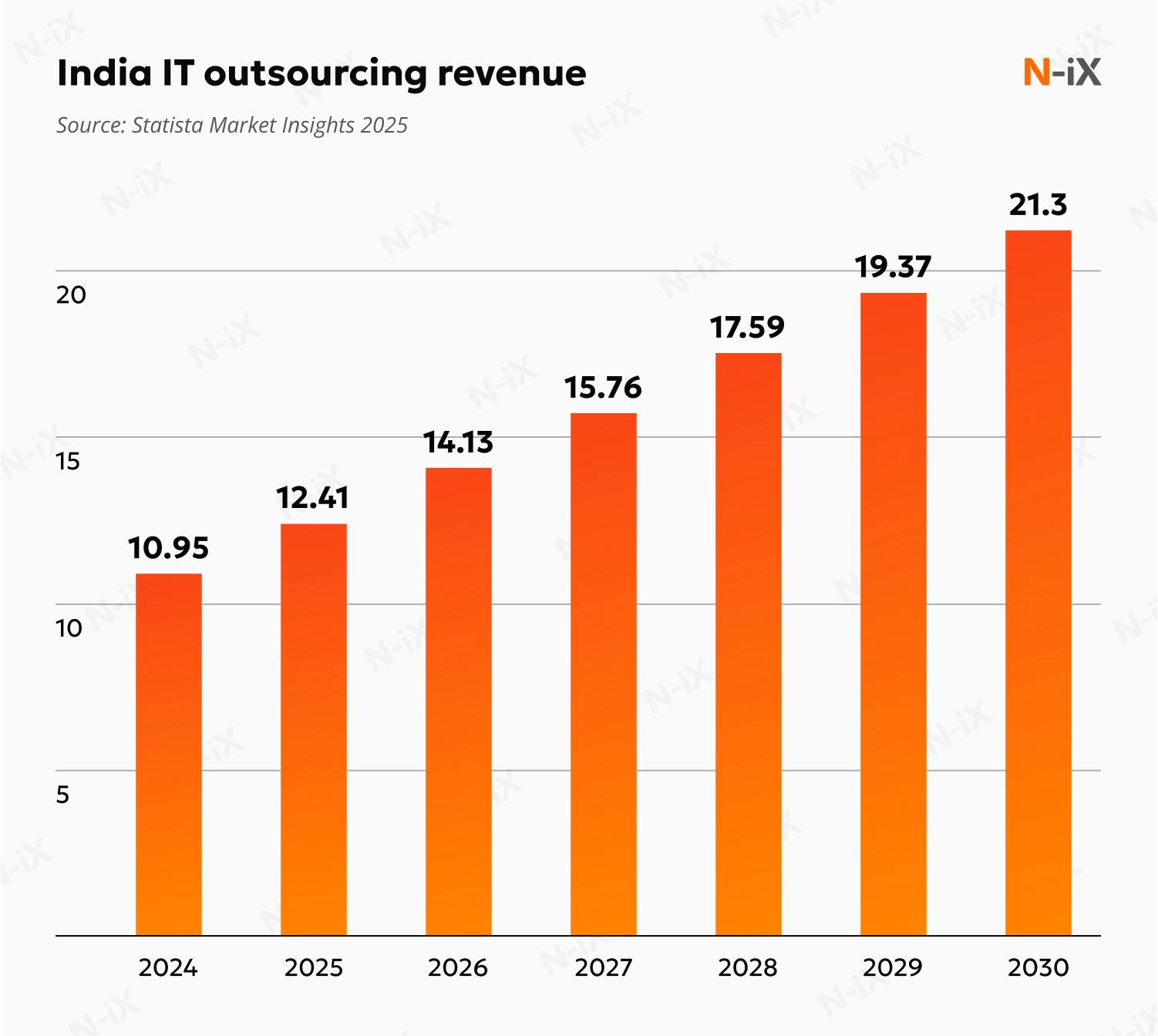
A snapshot of India’s IT market
When organizations evaluate India as an outsourcing destination, the first instinct is often to focus on cost. The more durable benefits of outsourcing to India are structural. India's IT outsourcing proposition rests on three pillars: talent scale, vendor maturity, and a well-developed technology infrastructure.
India ranked 38th in the WIPO Global Innovation Index 2025, first among all economies in Central and Southern Asia, and first globally for ICT services exports. It holds a third position globally in domestic market scale and a fourth place in late-stage venture capital activity. These rankings point to a technology economy that is generating and commercializing innovation.
The government's posture further reinforces this. In 2025, India approved a Research, Development, and Innovation (RDI) scheme with a total outlay of $10.6B over six years to advance technology. The Digital India initiative continues to fund the expansion of digital infrastructure, including data centers, connectivity, and cloud adoption programs.
India's position in key global indices in 2025
|
Global Innovation Index 2025 (WIPO) |
38th globally; 1st in Central and Southern Asia |
|
ICT services exports (GII 2025) |
1st globally |
|
Frontier technology readiness (UNCTAD 2025) |
36th globally; 3rd in R&D |
|
Patent applications (WIPO) |
6th globally |
|
Late-stage venture capital (GII 2025) |
4th globally |
|
Network Readiness Index 2025 (Portulans Institute) |
5th in APAC |
|
Government AI Readiness Index 2025 (Oxford Insights) |
1st in Central and Southern Asia |
Economic and business environment: India's edge beyond cost
India's economy is projected to grow at 6.4% in 2026, the fastest rate among the world's four largest economies. IT spending is expected to reach $176.3B that year, driven by data center build-out and AI-related software investment. After several years of rising prices, inflation is stabilizing, with India's central bank projecting it to fall to around 2% in 2026.
For long-term planning, what matters most is predictability. India offers a stable business environment, an established legal framework for commercial contracts, and a three-decade track record of consistent offshore delivery. The combination of cost advantage and institutional stability is what separates India from markets that offer competitive pricing but carry higher political or economic volatility risk.
Large tech talent pool: The location’s defining advantage
India's developer population stands at approximately 5.8M, the second-largest in the world and, according to current projections, likely to overtake that of the United States within this decade. Universities across the country produce roughly 1.5M engineering graduates annually, with a total of 18M STEM graduates projected by 2027. The Indian Institutes of Technology are globally recognized institutions, with IIT Bombay, IIT Delhi, and IIT Madras consistently ranking among the world's leading engineering schools.
Specialization depth is also notable. Deloitte-NASSCOM research estimates India’s AI talent base at 600,000-650,000 tech professionals. This AI workforce is projected to exceed 1.25M by 2027, more than doubling within the decade. These specialists focus predominantly on Machine Learning, Data Science, and AI engineering. NASSCOM’s cloud‑skills studies have shown that there were about 600,000 cloud professionals in India in 2021. The cloud talent pool was predicted to reach 1.4-1.5M professionals by 2025. Cloud architects, DevOps engineers, and security specialists make up a clearly defined share of this workforce.
India has one of the world’s largest English‑speaking populations and ranks 10th in Asia on the EF English Proficiency Index. It also produces over 61,760 ICT graduates annually, ranking second globally. In addition, Indian IT professionals outperform their peers in HR, finance, and administration in English proficiency. Together, these factors position India's IT workforce as a confident, capable player in global markets.
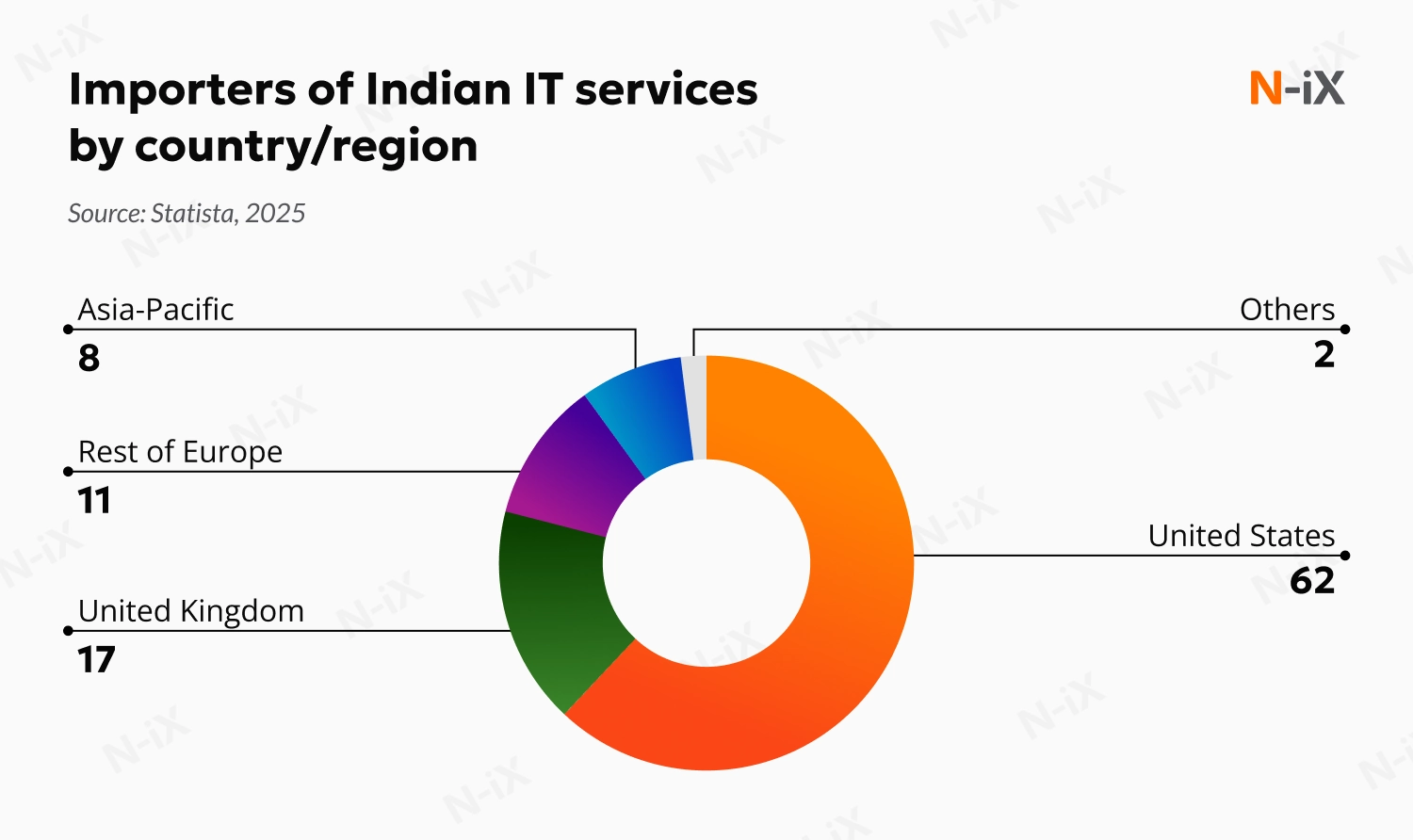
Key technology hubs across India
The geography of IT outsourcing to India spans both mature technology hubs and a growing number of emerging cities, steadily building delivery capacity.
Bengaluru is widely recognized as the center of India’s technology industry. It accounts for more than 40% of Karnataka’s IT exports, which in turn represent over 43% of India’s total IT exports. Around one‑third of India’s IT workforce is based in Bengaluru. The city is also home to roughly 40% of the country's engineering R&D talent. Bengaluru's tech talent pool includes approximately 2.5 million software developers. It is also home to around 600,000 AI/ML professionals. Furthermore, 50% of India's total AI/ML talent pool is based in Karnataka. Bengaluru has also emerged as India’s GCC capital, hosting 34% of the country’s Global Capability Centers. Major global firms have their engineering and R&D centers here. These include Google, Microsoft, Amazon, SAP, Goldman Sachs, Infosys, TCS, and Wipro. Bengaluru has the largest concentration of AI, Data Science, fintech, and cloud teams of any Indian city.
Hyderabad ranks second in India for IT exports, generating $32.2B in 2024. Its IT workforce of 946,000 professionals is growing at 11.2% annually. Hyderabad is home to over 300 Global Capability Centers, representing 20% of India's total. Major tenants include Microsoft, Amazon, Google, Facebook, Apple, and Qualcomm. AI and cybersecurity specialists are well represented in the local talent pool.
Pune is Western India's primary technology hub. It has a fast-growing IT workforce and an active ecosystem of AI, Data Science, and analytics startups. The city has over 130 engineering colleges, including COEP Technological University, MIT World Peace University, and Vishwakarma Institute of Technology. These institutions provide a strong pipeline of computer science and AI graduates. Major IT parks include Rajiv Gandhi Infotech Park in Hinjewadi and Magarpatta City. Pune is well-suited for hiring junior and mid-level engineering specialists.
Chennai is India's third-largest software exporter and IT hub, ranking behind only Bengaluru and Hyderabad in national IT export contributions. It is widely recognized as the anchor of India’s SaaS ecosystem, home to leading product companies and a dense concentration of SaaS startups.
Delhi NCR, encompassing Gurugram and Noida, serves as a premier corporate and fintech hub for global technology, consulting, and financial giants. As a major hub for Global Capability Centers (GCCs), the region hosts extensive delivery operations for leaders such as Microsoft and TCS. The region has a particularly dominant presence in the BFSI and data analytics sectors.
Read more: Outsourcing software development: Full guide
IT outsourcing to India: How it compares to other offshore markets
India's primary competitors in the global offshore software market are Eastern Europe (Poland, Romania, Ukraine) and Southeast Asia (Vietnam, the Philippines). Latin America (Mexico, Colombia, Brazil) also competes, particularly for work in the US time zone. Each has a legitimate use case; none matches India across all relevant dimensions simultaneously.
Eastern Europe offers better time zone alignment with both the US and Europe, comparable English proficiency at the senior level, and strong technical education systems. Talent pools are more specialized, and pricing reflects the seniority and quality of the available engineers.
Southeast Asian markets, particularly Vietnam and the Philippines, offer competitive rates. However, they have smaller tech talent pools, comparatively lower English proficiency (except in the Philippines), and less mature outsourcing ecosystems for complex software delivery.
Latin American markets offer genuine time-zone advantages for US-based clients, but also have smaller absolute talent pools and lower average English proficiency.
India's main practical disadvantage is the time zone. At GMT+5:30, it sits 10.5 hours ahead of US Eastern Time. This falls outside the window for natural real-time collaboration. Organizations that manage it well establish daily overlap periods and adopt disciplined async communication. Many vendors have adapted their working hours specifically to accommodate US and European clients.
Continue reading: Where to outsource software development: tech talent pool, billing rates, expertise
What engagement models are available for IT outsourcing to India?
Businesses considering IT outsourcing to India typically choose among three main models of cooperation. Each model differs in the level of client involvement, vendor responsibility, and scope of work delivered. Selecting the right model depends on project complexity, internal capacity, and the degree of control the client wishes to retain.
Staff Augmentation is a cooperation model in which a client extends their existing team with additional qualified professionals sourced through a vendor. Under this arrangement, your tech vendor manages administrative functions, including HR, payroll, compliance, and onboarding. As a result, the engineers report to you and follow existing internal processes. In practice, you retain full control over task assignment, workflows, and delivery management. Team size can be adjusted at any point based on project requirements.
Managed Team
The Managed Team model is a separate, dedicated development unit. This model distributes operational responsibilities between the client and the vendor. A dedicated project manager from the Indian partner oversees daily coordination, sprint planning, and team performance. The client, in turn, remains responsible for product vision, roadmap decisions, and milestone acceptance. Progress is communicated through structured reporting at agreed intervals. This model reduces the client's management overhead while maintaining strategic control.
Custom Solution Development
Custom Solution Development is a model in which the vendor takes full responsibility for the entire delivery lifecycle. This includes solution architecture, engineering, quality assurance, deployment, and post-launch maintenance. The client defines business objectives, acceptance criteria, and technical constraints. The vendor manages team composition, methodology, and execution. Such engagements typically begin with a Product Discovery phase to validate requirements before development starts.
What criteria define a reliable IT outsourcing partner in India?
The scale of India's vendor market is both an advantage and a challenge. Over 7,400 software development companies are listed on Clutch, representing the segment most active in international delivery. Therefore, identifying the right partner requires deliberate evaluation criteria, not just shortlisting by price.
1. Start with the domain and delivery fit
Domain alignment is more important than generic capability claims. Instead of accepting “we work with enterprises” at face value, ask vendors for case studies in your specific industry that spell out the problem context, the architecture and engineering approach, and measurable business outcomes. Firms that have delivered repeatedly in your vertical (for example, card‑processing platforms in BFSI, or claims systems in insurance) are usually a safer choice than technically strong generalists learning your domain from scratch.
2. Check quality, security, and compliance baselines
For US and European enterprise clients, certifications such as ISO 9001 (quality management) and ISO 27001 (information security management) are now baseline expectations rather than differentiators. Industry‑specific controls add another layer of assurance: for example, PCI DSS for payment processing or strong HIPAA alignment and privacy extensions like ISO 27701 for healthcare and other sensitive personal‑data workloads. Any credible Indian vendor working with regulated clients should be able to provide current certificates and audit dates, not just logos in a deck.
3. Probe operating model and time zone handling
India’s standard time is UTC+5:30, which means a typical 10.5‑hour offset from US Eastern Time. Your potential tech vendor should be able to explain how they structure overlapping hours with your product owners, how they manage asynchronous hand‑offs, and how escalation paths work outside your core business day. If they cannot walk you through meeting cadences, on‑call coverage, and ownership for production incidents across time zones, that gap will almost certainly show up as friction in delivery.
4. Validate AI and emerging‑tech expertise
India's market has qualified specialists in AI, generative AI, and cloud-native architecture, though capability levels vary. Some firms have built genuine expertise in these areas, while others have added them to their service offering more recently. Using technical interviews, architecture reviews, and work‑sample or coding assessments for senior candidates is reasonable before you commit to a partner on AI, cloud, or data‑platform projects.
5. Use contracts to anchor IP and data protections
India has been a WTO member and TRIPS signatory since 1995, and has progressively updated its IP laws and enforcement mechanisms to align with TRIPS standards. The Digital Personal Data Protection Act, 2023, now defines obligations for entities processing digital personal data, including duties around security safeguards, breach notification, and data‑subject rights. Your contract should still make these protections explicit by specifying IP ownership and licensing, data‑residency and transfer terms, confidentiality, security, and compliance obligations, and governing law and dispute jurisdiction in clear language. For cross‑border work, this level of specificity is standard practice and gives you a basis for oversight and recourse.
Why choose N-iX for IT outsourcing to India?
- N-iX is a global technology partner specializing in pragmatic AI software engineering with over 23 years of experience and more than 2,400 tech professionals across 25 countries. With more than 160 active clients, including Fortune 500 companies and industry-leading enterprises, N-iX brings proven delivery capabilities to every engagement.
- N-iX operates a dedicated development center in Bengaluru, India's primary technology hub. This location provides direct access to one of the world's largest concentrations of software engineering talent. Combined with a recruitment database of over 500,000 vetted profiles and a team of 70 dedicated recruiters, N-iX is able to fill most positions within three to four weeks.
- Talent selection follows a structured evaluation process that assesses both technical proficiency and professional competence. This ensures that engineers brought onto client projects meet a consistently high standard before engagement begins. The internal talent pool includes over 400 cloud experts, 200 data specialists, over 150 QA professionals, and 70 DevOps experts, among other specialists.
- Engineers undergo structured onboarding, ongoing training, and competency tracking, supported by dedicated HR and talent management. This enables reliable scaling from small, focused teams to development centers of 100 or more engineers, without compromising delivery quality.
- N-iX has proven experience building and managing large engineering teams in India, with engagements ranging from five-person units to full-scale dedicated development centers. Delivery practices are transparent and consistent across all team sizes and project types.
- Regarding security and compliance, N-iX adheres to internationally recognized standards, including ISO 27001, SOC 2, and GDPR. Secure development environments and rigorous data protection measures are maintained across all engagements, making N-iX a dependable partner for enterprises operating under strict regulatory and security requirements.
FAQ
What is IT outsourcing to India?
IT outsourcing to India means contracting software development, engineering, or technology services to India-based vendors. Engagements range from individual specialist placements to full product development delegation.
Why do companies choose to outsource IT to India?
Outsourcing IT to India provides access to the world's second-largest developer population. No comparable market matches India's combination of talent scale, vendor maturity, and cost efficiency. A stable legal framework and a three-decade track record of offshore delivery add further confidence.
What are the main benefits of outsourcing to India?
The primary benefits of outsourcing to India are an extensive talent pool, cost efficiency, and vendors’ maturity. India's developer population stands at approximately 5.8M. Its AI tech talent pool alone is estimated at 600,000 to 650,000 professionals.
What certifications should an IT outsourcing partner in India hold?
ISO 9001 and ISO 27001 are baseline expectations for vendors serving US and European enterprise clients. Industry-specific certifications add further assurance. PCI DSS applies to payment processing. HIPAA alignment and ISO 27701 are relevant for healthcare and sensitive data workloads.
How long does it take to build a team through IT outsourcing to India?
Most positions can be filled within three to four weeks with an established vendor like N-iX. One practical benefit of outsourcing to India is access to vendors with large internal candidate databases. Dedicated recruitment teams accelerate hiring significantly compared to open-market sourcing.
Which Indian cities are best for IT outsourcing?
The obvious starting point is Bengaluru: the largest AI, data, and cloud talent pool in the country. In AI and cybersecurity, Hyderabad is close behind in the former and ahead in the latter. SaaS is concentrated in Chennai, more than in any other city in India. Delhi NCR dominates in fintech and BFSI. For data science and analytics, Pune is the main hub in Western India.
Sources:
- NASSCOM, 2025. The tech industry in India likely to reach milestone $300Bn revenue in FY2026: Nasscom annual strategic review 2025
- SQ Magazine, 2025. Software Development Outsourcing Statistics 2026: Cost, Talent & Tech
- WIPO, 2025. India ranking in the Global Innovation Index 2025
- PIB Delhi, 2025. Department of Science and Technology- Year Ender 2025
- Digital India, 2026. About us
- United Nations, 2025. The Technology and Innovation Report 2025: Inclusive Artificial Intelligence for Development
- WIPO, 2025. Patents highlights
- Portulans Institute, 2025. Network Readiness Index
- Oxford Insights, 2025. Government AI Readiness Index 2025
- IMF, 2025. India
- Gartner, 2025. Gartner Forecasts India IT Spending to Exceed $176 Billion in 2026
- The Statesman, 2025. RBI slashes India’s inflation forecast to 2 pc for 2025-26
- Stackforce, 2026. Software Developer Salary in India in 2026: A Complete Breakdown
- CNBC-TV18, 2024. India Will Be The Largest Developer Community By 2027: GitHub Global CEO Thomas Dohmke Exclusive
- Forbes India, 2025. Why are so many of India's 1.5 million fresh engineers every year unemployable?
- India Today, 2025. India is projected to produce 18 million STEM graduates by 2027
- Careers 360, 2026. QS World Ranking 2025 for Indian Engineering Colleges - Top Universities in India
- NASSCOM Community, 2024. Advancing India’s AI Skills: Interventions and Programmes Needed
- NASSCOM, 2021. Demand for cloud professionals to touch 2 mn by 2025: Nasscom report
- EF EPI, 2025. Global Ranking of Countries and Regions 2025
- Stanford University Human-Centered Artificial Intelligence, 2025. The 2025 AI Index Report
- EF EPI, 2025. India Global Ranking
- NewsFirst Prime, 2023. Bengaluru's contribution in IT exports: $85 billion
- Bamgalore Mirror, 2026. Karnataka leads India’s IT exports
- 3one4 Capital, 2025. Bengaluru Innovation Report 2025
- Karat, 2025. GCC growth is turning Bangalore into one of the world’s elite tech hubs
- Datamites, 2025. Why Hyderabad is India’s Quiet Tech Capital You Haven’t Heard About
- Deccan Herald, 2026. Telangana IT exports hit Rs. 3.13 Lakh crore amid services sector surge
- Shiksha, 2026. Best Engineering Colleges in Pune: Fees, Admission 2026, Courses
Have a question?
Speak to an expert