ChatGPT
 Perplexity
 Claude
 Gemini
 Grok
Grok
As the demand for cloud services and solutions grows, AWS, Azure, and GCP are competing for the title of the best cloud provider. The unprecedented value brought by cloud technologies, such as cost optimization, improved operational efficiency, or robust data security, compels enterprises and SMBs to strengthen their cloud strategies. However, this wide range of benefits comes with the challenge of choosing the right cloud provider for your business.
So, to help you make a well-informed decision, we have prepared a detailed cloud comparison summary of AWS vs Azure vs GCP. Let’s look at all three cloud providers side-by-side to see where they stand out.
AWS vs Azure vs GCP: Who owns the game?
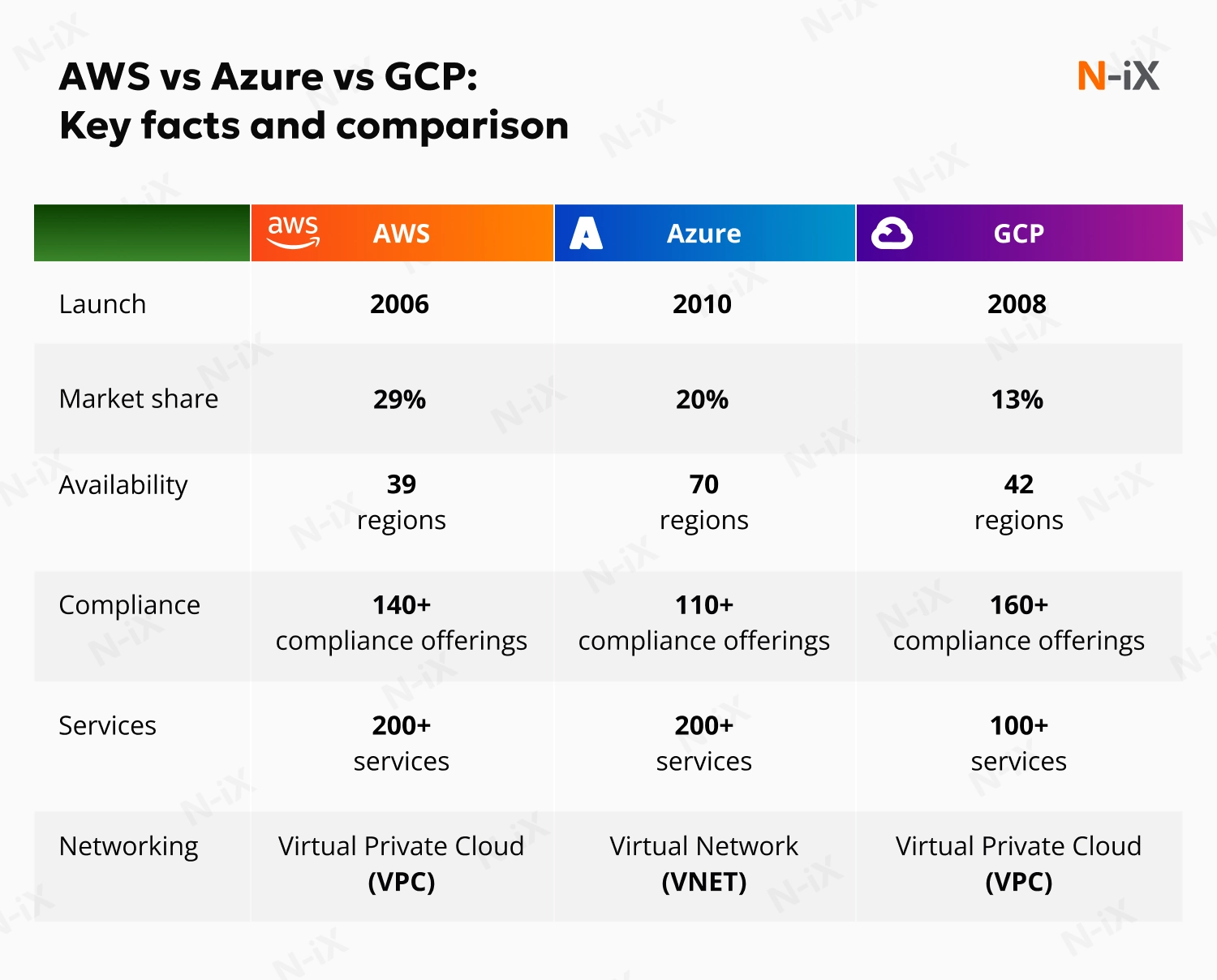
Over 100 cloud service providers exist, but AWS has been the global market leader for many years. According to the report by Synergy Research Group for 2025, it holds 29% of the market share, followed by Microsoft Azure at 20% and Google at 13%. Since its first launch in 2004, AWS has become a dominant cloud platform among startups, SMBs, and enterprises. GCP and Azure entered the market a few years later and have gradually grown in popularity.
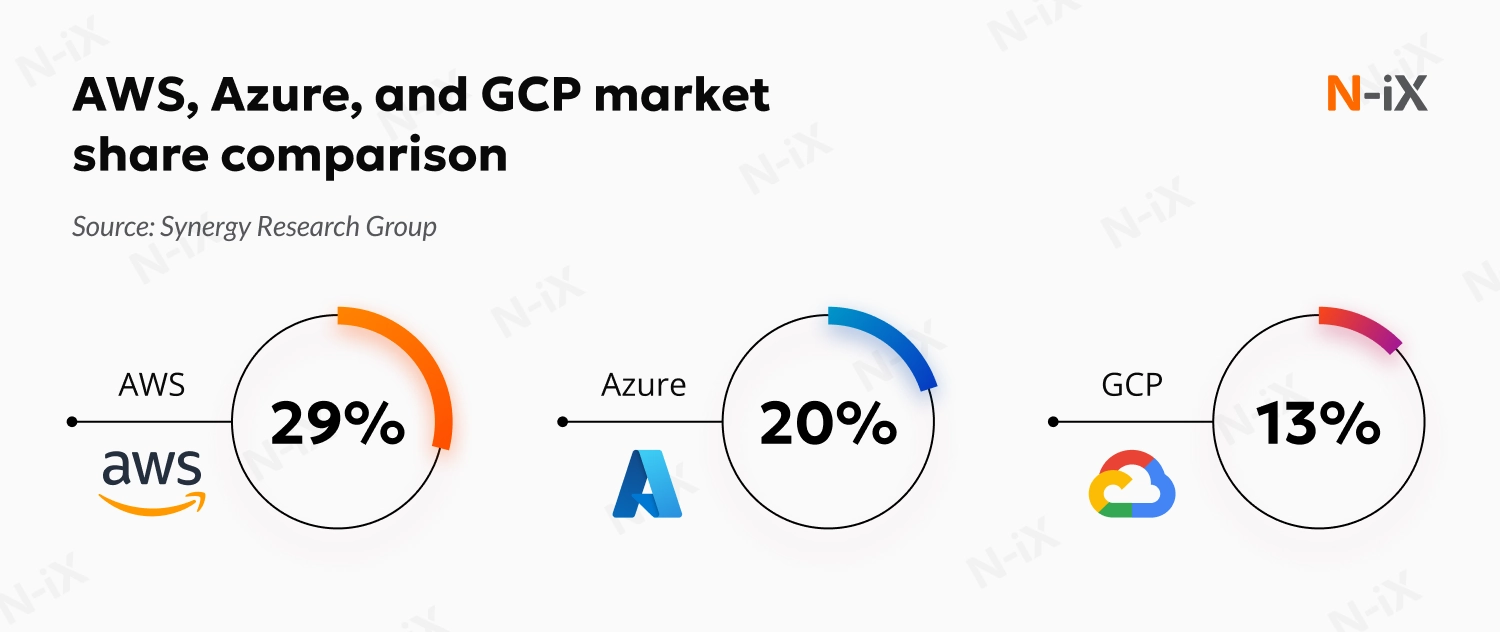
AWS has a clear edge over Azure and Google Cloud regarding market share. However, the same cannot be said about profitability and cloud growth rate. When comparing AWS vs Azure vs GCP in 2025, Microsoft Azure has the highest revenue base of $281.7B [1], while GCP has achieved the top result in growth rate—34% [2]. This momentum continued as GCP introduced major enhancements to its AI and data platform, driving adoption across enterprise analytics and AI workloads.
The multi-cloud approach to infrastructure should also be mentioned when comparing AWS vs Azure vs GCP. It is a preferred option by many companies that want to avoid vendor lock-in and ensure adequate data backup. HG Insights reveals that 67.7% of organizations following a multi-cloud strategy pair AWS with GCP. Another 38.6% prefer combining AWS with Azure. [3]
GCP vs AWS vs Azure service comparison
We now move on to the differences between AWS vs Azure vs GCP regarding their key usage statistics and offered services. Let’s start with a more detailed look at AWS consulting.
AWS: The most widely used cloud platform in the world
According to Amazon, over 240 fully featured AWS services are used by more than 4M businesses worldwide, making AWS the leader in the AWS vs GCP vs Azure debate. [4] This is in no small part due to the comprehensive geographical coverage offered by Amazon, spanning 39 regions and over 550 points of presence that cover 245 countries and territories.
AWS has numerous use cases across data analytics, Machine Learning, and the Internet of Things. Its services are widely used by SMBs and large enterprises, with the adoption levels reaching 90% among Fortune 100 companies. [5]
AWS development supports organizations across various industries, such as healthcare, media, finance, manufacturing, real estate, education, and more. According to Datainfometrix, the most prominent AWS customers based on generated revenue include:
- Airbnb: $95.99B
- Johnson & Johnson: $88.8B
- Pfizer: $63.6B
- Netflix: $53.6B
- Capital One: $38.7B
- McDonald’s: $25.9B
- Adobe: $21.5B
- Kellogg’s: $13.1B
- Twitch: $3B
- The Body Shop: $2.1B
Azure: Putting pressure on the competition
After its launch in 2010, Azure has always presented stiff competition for AWS as the go-to choice among enterprises. As of 2026, it offers over 200 services used by more than 550K businesses worldwide. Moreover, it offers a broad geographical coverage spanning over 70 regions.
Regarding adoption rates, Azure closely competes with AWS, but AWS maintains a lead among SMBs. According to Flexera’s 2025 State of the Cloud report, 53% of SMBs are using AWS, and 29% are using Azure. [6]
One of the AWS vs Azure vs GCP core differences is Azure’s extensive integration with Microsoft services and solutions. As a technology and business services company, Microsoft understands what enterprises need, considering its products have been used in offices for decades. Azure is at the apparent advantage when choosing among AWS vs Azure vs GCP for migrating from other Microsoft products, such as on-premises SharePoint, or integrating with existing Windows deployments.
Azure also offers industry-specific solutions to help businesses innovate, make data-driven decisions, and increase efficiency. Based on the annual contract size, the largest Azure users are:
- Microsoft: $211.91B
- Samsung: $211.8B
- Walgreens: $139.5B
- Tesla: $81.5B
- Boeing: $76.6B
- HP Inc.: $56.6B
- Macy’s: $24.5B
- Adobe: $15.79B
- Spotify: $13.2B
- LinkedIn: $8.05B
GCP: Rapid growth fueled by innovation
GCP was released in 2008, making it one of the most well-established options when comparing AWS vs Azure vs GCP. Initially, it targeted midsize companies. However, after Thomas Kurian became the new CEO, GCP shifted its strategy toward attracting large corporations by offering industry-specific cloud solutions. As of 2026, GCP offers over 100 services used by more than 1.3M businesses worldwide. [7]
Comparing AWS vs GCP vs Azure services in terms of popularity among enterprises puts Google Cloud Platform behind its competitors. Nevertheless, it has shown steady growth in recent years. This is confirmed by Flexera's State of the Cloud report, which showed that Google adoption rates among enterprises reached 46% in 2025. [6]
When it comes to GCP’s biggest clients based on company revenue, the top 10 include:
- Walmart: $648B
- CVS Health: $358B
- Intel: $53.1B
- Coca-Cola: $47.1B
- Marriott International: $24.7B
- Bloomberg: $12.2B
- eBay: $10.1B
- Nielsen: $3.5B
- Twitch: $3B
- Katonic: $1M
Which platform to choose: AWS vs Azure vs GCP comparison
In case you are still on the fence about choosing between Azure vs AWS vs GCP, here are some specific advantages of each one.
Why choose AWS for cloud migration?
- Market leader: AWS is considered the pioneer in cloud computing and holds the largest market share. This leadership position often translates to a broad and mature service portfolio.
- Global reach: When comparing AWS vs Azure vs GCP services, regional availability is a key factor to consider. AWS has a vast global network of data centers spread across multiple geographic regions, allowing for low-latency access to services worldwide.
- Service variety: AWS offers a comprehensive set of services spanning computing, storage, databases, Machine Learning, Internet of Things, and more. This diversity can accommodate a wide range of use cases.
- Ecosystem: AWS has a rich ecosystem of third-party integrations, tools, and a vibrant community. This makes it easy to find solutions and support.
- Security and compliance: AWS provides robust security features and compliance certifications, making it suitable for industries with strict regulatory requirements, such as healthcare and finance.
- Cost management: AWS offers various cost optimization and management tools, including AWS Cost Explorer and AWS Trusted Advisor.
Why choose Azure for cloud migration?
- Hybrid cloud: Azure is known for its strong hybrid cloud capabilities that can help significantly optimize expenses. It seamlessly integrates with on-premises environments, making it suitable for organizations with a mix of cloud and on-premises infrastructure.
- Enterprise focus: Azure has a strong presence in the enterprise market and is well-integrated with Microsoft's suite of products, including Windows Server, Active Directory, and Office 365.
- AI and Machine Learning: Azure offers robust AI and Machine Learning services, making it an excellent choice for organizations looking to harness the power of AI in their applications.
- Windows workloads: Azure is the winner of the Azure vs GCP vs AWS debate for organizations that rely heavily on Windows-based workloads and applications.
- Developer tools: Azure migration provides a rich set of developer tools and services, including Azure DevOps and Visual Studio integration, making it developer-friendly.
- Global data centers: Azure has a growing number of data centers worldwide, enabling organizations to deploy resources close to their target audience.
Why choose GCP for cloud migration?
- Networking and edge computing: GCP offers a high-performance global network and strongly focuses on edge computing, making it suitable for hosting and developing applications that require low latency and high bandwidth.
- Data analytics and Machine Learning: In the context of AWS vs Azure vs GCP features, Google Cloud excels in data analytics and Machine Learning with services like BigQuery, TensorFlow, and Dataflow. It's a preferred choice for data-driven organizations.
- Open source embrace: Google is strongly committed to open-source technologies, reflected in GCP's support for popular open-source tools and libraries.
- Big Data: With GCP migration, you gain access to various Big Data services, such as Bigtable, Dataflow, and Dataprep, making it a popular choice for organizations dealing with large datasets.
- Sustainability: Google has made significant commitments to sustainability and renewable energy, making migration to GCP an environmentally responsible choice.
- Kubernetes and containers: GCP was an early adopter of Kubernetes, offering robust container management solutions like Google Kubernetes Engine (GKE).

Need help making an AWS vs Azure vs GCP services comparison? Take advantage of N-iX expertise
N-iX is a global software engineering company with a strong portfolio of cloud projects across various industries, including telecom, fintech, healthcare, retail, and more. N-iX has built successful partnerships with Lebara, Gogo, Fluke, and other leading companies, helping them leverage the benefits of AWS, Azure, and GCP.
With over 400 cloud experts on board, we are fully prepared to help you choose between GCP vs Azure vs AWS, develop cloud-native apps, or move your existing applications to the cloud. From cloud readiness assessment and strategy development to infrastructure setup, architecture redesign, migration, and maintenance, our specialists will support you at any stage of your cloud journey.
- N-iX is an AWS Premier Tier Partner, a Microsoft Solutions Partner, and a Google Cloud Partner, offering unprecedented expertise in all three cloud platforms;
- N-iX is compliant with PCI DSS, ISO 9001, ISO 27001, GDPR, and other data protection standards;
- Our expertise in cloud computing includes cloud-native development, on-premises-to-cloud migration, cloud-to-cloud migration, as well as multi-cloud and hybrid cloud management;
- We offer professional DevOps services, including cloud adoption (architecture, migration, optimization), building and streamlining CI/CD processes, security issues detection/prevention (DDoS and intrusion), firewall as a service, and more.
References
1. Annual Report 2025—Microsoft
2. Google Cloud Q3 revenue surges 34% as backlog hits $155 billion—Constellation Research
3. The AWS Ecosystem in 2025—HG Insights
4. AWS Market Share 2025: Insights into the Buyer Landscape—HG Insights
5. Say Hello to 103 New AWS Competency, Service Delivery, Service Ready, and MSP Partners Added in February—AWS
6. 2025 State of the Cloud Report—Flexera
7. Companies using Google Cloud Platform by Google LLC in 2025—Landbase
Have a question?
Speak to an expert