
 ChatGPT
 Perplexity
 Claude
 Gemini
 Grok
Grok
Attackers have changed how they access cloud environments. Google Cloud reports that vulnerability exploitation became the leading initial access method in GCP, rising from 2.9% to 44.5% of observed incidents in a single half-year [1]. The same shift shows up industry-wide. Verizon's 2026 Report found that exploitation of vulnerabilities surpassed stolen credentials as the top initial access vector for the first time in the report's history [2]. Attackers are moving faster. So, companies need to set up efficient cloud vulnerability management (CVM) to counter them.
But how do you identify and manage cloud risks? What are the best practices for addressing vulnerabilities and protecting the cloud? Our cloud experts share their practical methods in this guide to help you manage your cloud environments securely.
Executive summary
- Vulnerability exploitation has become the top way attackers enter cloud environments.
- CVM differs from traditional vulnerability management as resources are short-lived and split between provider and customer responsibility, so it must run continuously.
- Misconfiguration and weak identity management remain the most common sources of exposure, with shadow AI a fast-growing third.
- An effective CVM is based on eight practices: measurement, risk-based prioritization, continuous scanning, shifting checks earlier in the development process, penetration testing, integrated tooling, proactive patching, and clear ownership.
- AI cuts both ways, helping attackers exploit new flaws faster while creating new exposure through unapproved AI tools.
What is cloud vulnerability management?
Cloud vulnerability management is the ongoing process of finding, classifying, prioritizing, and fixing security weaknesses across public, private, hybrid, and multicloud environments. Cloud teams examine the assets and their weaknesses, sort by type and severity, decide which matter most, fix them, then check the fix worked before starting again. This cycle is continuous: identify, classify, prioritize, remediate, verify, monitor.
In practice, it differs from traditional vulnerability management. Two things make vulnerability management in cloud computing a little more complicated.
Why does the process have to run continuously?
A cloud environment changes constantly: a container spins up to handle traffic and disappears an hour later, a serverless function runs for seconds, auto-scaling adds and removes instances without anyone approving each change. A scan schedule built for on-premises use misses most of what actually ran between scans. This is the main reason to run management continuously.
Why is responsibility split between the provider and the customer?
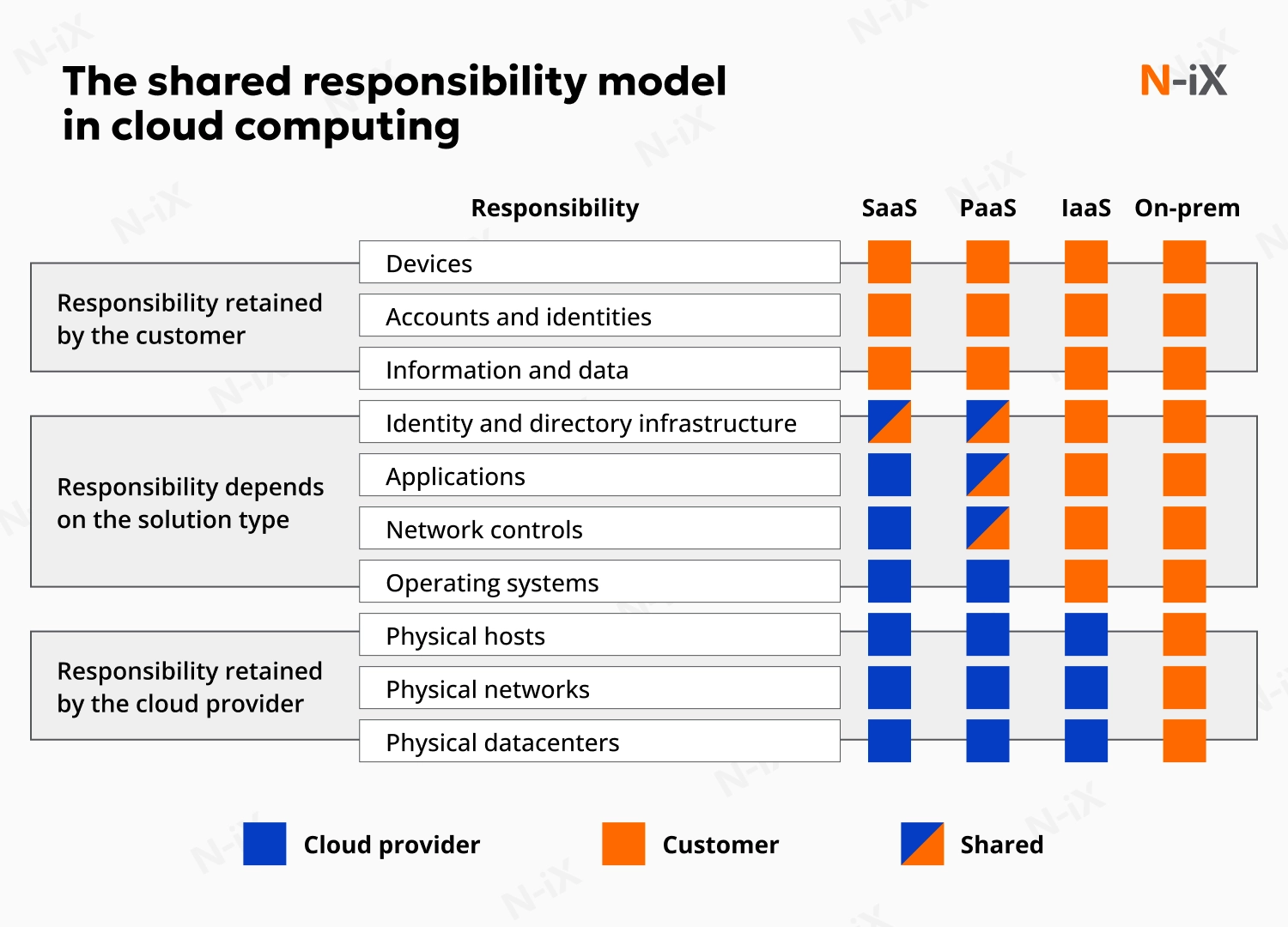
Cloud providers secure the infrastructure underlying their services: data centers, hardware, and network backbones. Customers stay responsible for everything built on top: identity settings, encryption, open ports, and patched containers. Most incidents trace back to that customer-owned layer, not the provider. That split is what makes vulnerability management in the cloud different from on-premises VMs: the target has moved to the layer only the customer controls. Google Cloud's threat intelligence team made this point in its report, noting that the incidents it investigated centered on the customer side rather than any breach of the platform itself [1].
Common types of vulnerabilities in cloud environments
The list of common cloud weaknesses has not changed much through the years, but the balance has shifted. In 2025, Google Cloud saw a real change in attacker behavior. Early in the year, weak credentials and misconfigurations caused most breaches. By the second half of 2025, attackers increasingly exploited unpatched, internet-facing software, as automated defenses made older tricks harder to pull off [1]. Misconfiguration has not gone away. It has simply stopped being the only door worth checking.
- Misconfigurations remain the most familiar entry point: a storage bucket left open, a security group allowing traffic from anywhere, logging quietly turned off. An automated scanner can find these without any real skill required.
- Weak identity and access management is close behind. Excessive permissions, unreviewed service accounts, and missing multi-factor authentication all allow an attacker to move deeper into the system after the initial break-in. The State of Cloud and AI Security survey found that insecure identities and overly broad access ranked as the top concern among security professionals, ahead of every other risk category [3].
- Shadow IT, and increasingly shadow AI, is tooling adopted without review. The 2026 DBIR found that regular use of AI tools jumped to 45% of employees, up from 15% the year before, with two-thirds relying on personal accounts rather than company-approved ones [2]. Each of those unmonitored AI tools is a possible path for company data to leave the organization, since security teams have no visibility into what gets pasted into them or how the output is stored.
- Insecure APIs expose data and business logic when authentication, authorization, or rate limits have gaps.
- Unencrypted data, whether stored or in transit between services, turns a single unauthorized access into a complete loss.
- Poor visibility covers forgotten storage locations and assets nobody remembers creating. It is hard to protect something that is not on any list.
- Zero-day vulnerabilities have no available patch when first found, leaving detection and containment as the only defense until a fix ships.
- Insider threats come from employees who already have legitimate access, whether the misuse is deliberate or an honest mistake.
- Network weaknesses, such as exposed management interfaces or flat networks with no separation between systems, allow a small entry point to spread further than it should.
Top 8 cloud vulnerability management best practices
An effective cloud vulnerability management must address all these types of weaknesses simultaneously to provide consistent, ongoing protection. Our N-iX engineers share the practices they apply on client projects to help you configure and constantly monitor cloud environments. Following these eight steps enables continuous visibility, faster fixes, and an audit trail that meets compliance.
1. Set clear KPIs first
How success is measured should be decided before any tooling is put in place, since the metric chosen changes how the team works. The right KPIs keep the effort focused on reducing actual risk and giving leadership a clear way to see whether it is working.
Mean time to remediate (MTTR) is the metric most security initiatives start with, but on its own, it can look fine even when a real issue persists. When a vulnerable container is replaced by a new one, the tracked "age" of that vulnerability resets to zero, even though the same weakness remains. This is why cloud environments also need mean open vulnerability age (MOVA), which tracks how old currently open vulnerabilities actually are, giving a more honest picture than MTTR alone.
A useful KPI set covers four areas: speed, backlog, risk, and health. They are reflected in this table:
|
Area |
Metric |
What it shows |
|
Speed |
Mean time to remediate (MTTR) |
How fast a found vulnerability gets fixed |
|
Mean time to detect (MTTD) |
How long a weakness stays unnoticed |
|
|
Backlog |
Remediation rate |
Share of findings closed in a given period |
|
SLA compliance rate |
Share fixed within the agreed deadline |
|
|
Risk |
Open CISA KEV count |
Known-exploited vulnerabilities still open |
|
Exploitable critical open % |
The genuinely dangerous share left unfixed |
|
|
Health |
Mean open vulnerability age (MOVA) |
Age of currently open findings, harder to game than MTTR |
|
Scan and asset coverage |
Share of the environment actually being checked |
2. Prioritize by exploitability
Not every critically rated vulnerability requires the same urgency, and treating them all the same wastes limited time on the wrong fixes. A mature approach combines the Common Vulnerability Scoring System (CVSS) severity score with real exploit data. Two useful signals are whether the flaw is on the CISA Known Exploited Vulnerabilities list and its score under the Exploit Prediction Scoring System. It also helps to check whether the environment enables exploitation, whether the asset is accessible from the internet, and whether it stores sensitive data. Attack path analysis pulls these factors together and narrows a long list down to the small set of weaknesses that could actually be used against the organization.
This shift matters more each year. Attackers now use AI to shrink the time between a vulnerability's disclosure and its first real-world use from months to hours [2]. Only 26% of critical vulnerabilities on the CISA KEV list were fully fixed during 2025, down from 38% the year before [2].
3. Scan continuously, and choose agentless or agent-based coverage
Cloud security scanning needs to run continuously to keep pace with change and cover virtual machines, containers, and serverless functions. External scans check the environment the way an outside attacker would. Internal scans assume an attacker is already inside. Both should run together.
One decision worth making on purpose is whether to use agentless or agent-based scanning. Agentless tools read data straight from the cloud provider's control plane, covering short-lived resources without installation and scaling easily as the environment grows. Agent-based tools install software on each host and show deeper runtime detail, at the cost of extra setup. Most mature cloud vulnerability management strategies include both: agentless for broad coverage and agents for deeper detail. Coverage now also needs to reach AI and machine learning workloads, including model endpoints. As a Pragmatic AI Software Engineering company, N-iX often uses AI-powered scanners to accelerate issue finding. Thus, our cloud security experts can quickly surface the vulnerabilities that matter most.

4. Move security checks earlier into the build process
Catching a weakness before it reaches production costs far less than fixing it afterward. This is why scanning belongs in the CI/CD pipeline itself, checking infrastructure as code templates and container images before anything ships. The same pipeline should automatically generate a software bill of materials (SBOM) during the build, giving the team a real dependency list.
This also applies to third-party and open-source code. That last point matters more than it might seem: third-party involvement in breaches reached 48% in the 2026 DBIR [2], a reminder of how much code the organization did not write itself.
5. Confirm findings with penetration testing
Automated scanning is good at spotting known patterns and less reliable at two things: producing false positives and missing logic flaws that no scanner was written to catch. Penetration testing closes both gaps, confirming which findings can actually be exploited in context and uncovering issues no scanner was looking for. N-iX penetration testing engineers simulate realistic attacks against a client's actual environment and hand back a prioritized report of findings.
Find your partner among the top penetration testing companies globally
6. Choose tools that connect to your security stack
A vulnerability scanner that does not connect to the rest of the security stack tends to become a tool someone checks occasionally. Scanners should connect to the SIEM (security information and event management system), to configuration management, and to the ticketing system engineering already uses, such as Jira or ServiceNow.
It also helps to know where a tool sits in the broader category map. CSPM (cloud security posture management) tools focus on configuration risk. CWPP (cloud workload protection platform) tools focus on runtime risk. CNAPP (cloud-native application protection platform) tools combine both, plus identity context, in one place. Bringing these together closes the blind spots that show up when separate tools are stitched together after the fact.
7. Patch quickly, with a faster path for urgent fixes
Patching means applying the update a vendor releases to fix a known vulnerability in software or infrastructure. It stays the practical core of cloud vulnerability management. Proactive patching includes automated deployment of routine patches, sequencing fixes by risk, development of an emergency path for vulnerabilities under active attack, and a rollback plan in case a patch causes problems. None of this requires new technology, just consistency, as patch times are getting slower across the industry [2].
8. Make clear ownership
A vulnerability management process can fail when it is unclear who owns a fix, and cloud environments create more unclear cases than on-premises setups. One common example is a container that gets replaced by a fresh copy of the same image before anyone patches it. It is often unclear whose job the fix was. That kind of ownership gap needs to be settled ahead of time, not worked out mid-incident. Clear ownership across development, operations, and security stops fixes from getting missed between teams.
The same ownership gap applies to shadow AI. An AI tool that employees start using without approval goes unmonitored, so no one is checking what data it can see or how it is secured. That makes it an ungoverned risk in the same way an unmanaged cloud account would be. Someone needs to own which AI tools are approved, how their use is monitored, and how access is removed when needed. N-iX engineers typically address this by mapping which AI tools are already in use across teams, setting clear rules on what data can and cannot be shared with them, and routing approved tools through the same access reviews as any other cloud service.

How N-iX helps with cloud-based vulnerability management
Building a mature cloud vulnerability management process takes more than a scanning tool. It requires discipline and cross-cloud expertise to turn scan results into fixes. N-iX helps organizations design and run programs that fit their existing infrastructure.
N-iX is a global technology partner for Pragmatic AI Software Engineering, with over 2,400 experts and 24 years of experience delivering software, cloud, data, AI, and security services. Here is what working with N-iX on cloud security vulnerability management looks like in practice:
- Risk-based scanning and prioritization: AI-automated, agentless, and agent-based scanning tied to CVSS, EPSS, and CISA KEV data;
- Penetration testing: Validating scanner findings and surfacing what automated tools miss;
- DevSecOps services: IaC and CI/CD pipeline scanning, SBOM generation, and dependency checks;
- Cloud security assessment: Shared responsibility gap analysis and configuration review across multicloud environments;
- Cloud partnerships: AWS Premier Tier, Microsoft Solutions Partner, and Google Cloud Platform Partner status across hyperscalers;
- Compliance alignment: Practices aligned with PCI DSS, ISO 27001, ISO 9001, and GDPR;
- AI adoption, including in vulnerability management:Backed by our AWS AI Services Competency, N-iX helps organizations adopt AI responsibly across their operations, including AI-powered scanning and prioritization within their own vulnerability management practices.
Whether your organization needs an embedded security team, specialist support for a single engagement, or end-to-end vulnerability management, N-iX adapts the model to how your team already works.
FAQ
What is cloud vulnerability management?
Cloud vulnerability management (CVM) is a continuous process of finding, classifying, prioritizing, and fixing security weaknesses across public, private, hybrid, and multicloud environments.
How does cloud-based vulnerability management differ from the traditional, on-premises version?
Cloud resources are short-lived and split between the provider and the customer under the shared responsibility model, so the process must run continuously and focus on the parts the customer controls: identities, configurations, data, and workloads.
What are the most common cloud vulnerabilities today?
Misconfigurations and weak identity management lead the list, followed by insecure APIs, unencrypted data, poor visibility, shadow IT and shadow AI, zero-days, insider threats, and network weaknesses.
What is the difference between agentless and agent-based scanning?
Agentless scanning reads data from the cloud provider's control plane and covers short-lived resources with no installation needed. Agent-based scanning installs software on the host and shows deeper runtime detail where that visibility is genuinely needed.
How does vulnerability management relate to CSPM, CWPP, and CNAPP?
CSPM focuses on configuration risk, CWPP focuses on runtime workload risk, and CNAPP combines both along with identity context in one place, giving a program the context it needs to prioritize well.
Who is responsible for fixing cloud vulnerabilities under the shared responsibility model?
The provider secures the underlying infrastructure. The customer remains responsible for configurations, identities, data protection, and the workloads built on top of them, which is where most cloud incidents actually start.
References
- Google Cloud – Cloud Threat Horizons Report, H1 2026.
- Verizon – 2026 Data Breach Investigations Report.
- Cloud Security Alliance – State of Cloud and AI Security 2025.
Have a question?
Speak to an expert


