ChatGPT
 Perplexity
 Claude
 Gemini
 Grok
Grok
According to CNCF's latest report, 58% of DevOps professionals use cloud-native technologies, including container orchestration, cloud monitoring, and serverless computing [4]. Cloud DevOps discipline has become the operational backbone of enterprise software delivery. Yet as cloud estates expand and AI workloads add new layers of cost and governance complexity, cloud infrastructure is becoming increasingly challenging to manage effectively.
How can DevOps help with cloud scaling? And when is the right time to involve external expertise to achieve optimal results? In this article, N-iX experts answer both questions. We explain what combining DevOps and cloud skills offers the organization, the responsibilities of such specialists, and how to recognize the right moment to engage an external partner.
What is cloud DevOps?
Merging cloud and DevOps practices enables automated software development and delivery on cloud infrastructure. Before DevOps became the standard for cloud operations, shipping a software update was slow, manual, and risk-prone. Now this is a repeatable, automated pipeline: from the first line of code to the moment a feature reaches the end user, every step is tracked, tested, and reversible.
The market reflects how central this practice has become. The global cloud-based DevOps market is forecast to reach $18.99B by the end of 2026, growing at a 26.1% CAGR through 2031 [1]. The strongest demand is concentrated in CI/CD automation, Infrastructure as Code, and automated testing, with adoption accelerating across finance, healthcare, and retail [1]. Cloud-native DevOps has become the mechanism through which a business turns ideas into working software, quickly, safely, and at scale.
What cloud DevOps delivers for your organization
Cloud and DevOps practices create value that goes beyond the engineering team. Let's review the main business benefits it delivers across the organization.
Faster, more predictable software delivery
Automated CI/CD pipelines remove bottlenecks caused by manual errors and rigid release schedules, enabling continuous, low-risk deployments. For the business, this means shorter feedback loops, faster product iteration, and a tighter cycle between customer insight and working software. Teams that have reached delivery maturity ship features in hours rather than weeks, presenting a measurable competitive advantage over time.
Cloud spend that reflects actual business value
Without active cloud governance, infrastructure costs tend to grow faster than the business value they deliver. Cloud-native DevOps addresses this directly. When infrastructure is defined and managed as code using tools like Terraform and Ansible, every resource becomes auditable and traceable to a business outcome. The result is infrastructure spend that reflects actual usage rather than accumulated overprovision.
Security that moves at the speed of delivery
DevOps enables integrating cloud security into every stage of the delivery pipeline. This approach, known as DevSecOps, means automated vulnerability scanning, secrets management, and compliance enforcement run in the background on every deployment. Adherence to GDPR, SOC 2, ISO 27001, and sector-specific regulations is maintained continuously rather than through periodic audits.
Operational resilience
Organizations with mature DevOps cloud practices detect and resolve incidents faster and with less manual intervention. Real-time observability across systems means issues are identified before they affect users, improving the mean time to recovery (MTTR). Platform engineering extends this further. By building internal developer platforms powered by AI-assisted automation, organizations give every product team self-service access to infrastructure without requiring deep operational expertise. This reduces friction in the delivery process across the organization.
An AI-ready foundation
According to Perforce, 70% of organizations say DevOps maturity directly impacts the success of AI initiatives, as mature delivery teams integrate AI more effectively across the SDLC [5]. Cloud DevOps provides the automated, observable, and well-governed foundation that AI workloads require to run reliably. Enterprises that have already built this discipline are significantly better positioned to move AI from experimentation into production-grade deployment.
Read more: Generative AI in DevOps: Practical use cases and solutions to common challenges
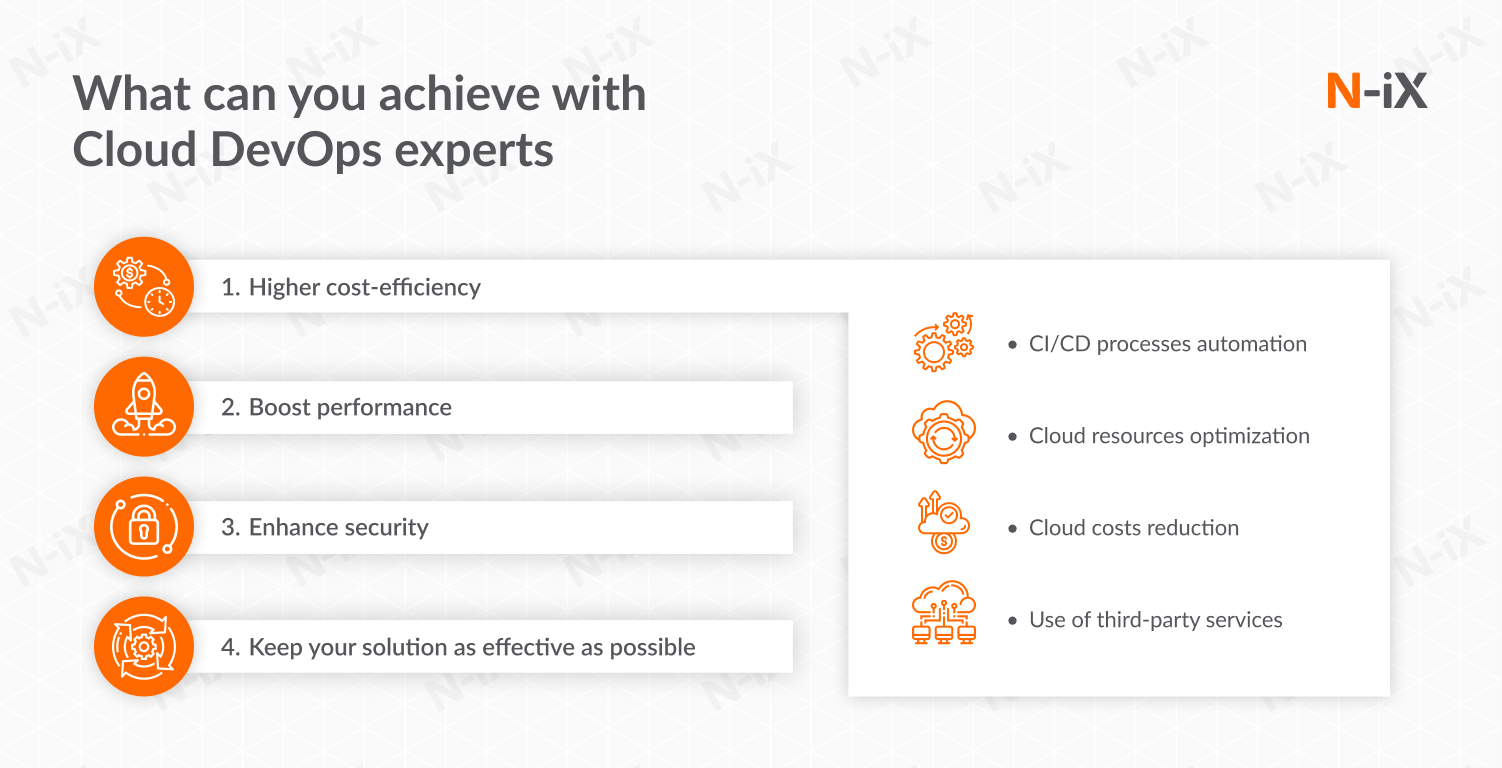
What a cloud DevOps expert does in your organization
Understanding the day-to-day activities of cloud and DevOps experts helps business leaders make informed decisions about where and how to engage them. Let's review their primary responsibilities:
- Designing and maintaining delivery pipelines. A cloud DevOps engineer builds and operates the CI/CD pipelines that move code from development to production automatically. Every deployment is tested, controlled, and reversible, eliminating delays caused by manual processes.
- Automating infrastructure with code. Using Infrastructure as Code, experts define the entire cloud environment programmatically. Every server, network configuration, and service is version-controlled and auditable. This eliminates environment drift and reduces the risk of inconsistent deployments across development, staging, and production.
- Managing containerized workloads. DevOps engineers configure and operate Kubernetes clusters that control how applications are deployed, scaled, and kept available. This is the operational layer that makes microservices architectures work reliably in production, and it requires ongoing adjustment as workloads grow and change.
- Embedding security into the pipeline. Through DevSecOps practices, cloud development engineers run automated security scans, manage access controls, and enforce compliance policies at every stage of the delivery process. Security becomes a property of the system rather than a checkpoint at the end.
- Building and running observability systems. A DevOps cloud engineer can configure monitoring, alerting, and logging stacks using tools such as Prometheus, Grafana, and Datadog. This gives the organization real-time visibility into system health across all cloud environments. Increasingly, this layer incorporates AI-assisted anomaly detection that surfaces issues before they escalate.
- Governing cloud costs. A cloud delivery engineer continuously audits resource usage, applies FinOps disciplines, automates rightsizing, and eliminates idle infrastructure. This keeps spending aligned with actual business activity rather than with provisioned capacity.
- Building internal developer platforms. Senior DevOps engineers design and operate internal platforms that give product teams self-service access to infrastructure, GitOps workflows, and deployment tooling. The goal is to multiply engineering productivity across the organization without requiring every team to develop deep operational expertise.
When to bring in external cloud DevOps expertise
Engaging external expertise is a business decision shaped by organizational needs and delivery goals. This typically makes sense when specific challenges or capacity demands arise. Our cloud consultants share six common scenarios that illustrate when enterprises benefit most from outsourced support.
1. Accelerating cloud migration
Moving enterprise workloads to AWS, Azure, or GCP requires careful coordination across live systems, proven migration frameworks, and deep automation expertise. External expertise brings proven migration frameworks and automation tooling, including Terraform, Kubernetes, and CI/CD pipelines, that compress timelines and reduce the risk of disruption to live services.
One of N-iX's clients planned the large cloud migration to innovate the report system and accelerate time-to-market. This leading European telecom company partnered with us to avoid vendor lock-in and other common migration challenges. N-iX led a multi-cloud transition across AWS and Azure, built fully automated CI/CD pipelines on both platforms, and migrated the workloads to Azure Kubernetes Service. An Azure-based data lake replaced the existing BI system, reducing report delays from 3-4 hours to near real-time.
Read the full case study: Faster time-to-market with full-scale digital transformation in telecom
2. Scaling delivery capacity quickly
High-growth businesses regularly reach a point where product velocity is constrained by delivery capacity. Skills shortage also plays a crucial role in it. The workforce deficit is consistently cited as one of the primary challenges to cloud-based DevOps adoption [1]. DevOps outsourcing vendors can join an existing team rapidly, without a lengthy hiring process. They bring immediate capacity to build out platform engineering capabilities, implement GitOps workflows, and establish internal developer platforms within weeks instead of months.
3. Modernizing legacy infrastructure
Enterprises with legacy infrastructure and manual operations choose outsourcing DevOps to modernize without disrupting ongoing operations. External experts help adopt containerization with Docker and Kubernetes, infrastructure-as-code with Terraform, and security automation through DevSecOps tooling in a structured way.
For one of N-iX's clients, modernizing legacy infrastructure had become the top business goal for growth. This global IoT service provider needed to migrate its on-premises infrastructure of the SaaS platform to the cloud and automate its delivery pipeline. N-iX cloud-native engineers rebuilt this architecture in Kubernetes to make it cloud-agnostic and deployable across AWS, Azure, or local environments without modification. We also built CI/CD pipelines for GitLab from scratch and implemented a full observability stack with Prometheus, Grafana, and Elasticsearch. The outcome was reduced infrastructure costs, faster deployments, and real-time visibility into cloud resource usage.
Read the full case study: Optimizing costs and operations for enterprise-grade IoT service provider
4. Controlling rising infrastructure costs
In 2026, wasted cloud spend has risen to 29%, the first increase in five years, driven by the complexity introduced by AI workloads and new IaaS and PaaS pricing models [2]. Without dedicated expertise and tooling, organizations can take weeks to identify and eliminate idle or overprovisioned resources [3]. A cloud DevOps engineer can apply FinOps disciplines, automated rightsizing, and real-time cost visibility to quickly bring infrastructure spend under control and sustain that control as the environment evolves.

5. Resolving underperforming cloud environments
If not properly governed, cloud environments can degrade over time. Response times slow, deployments become less reliable, and availability issues start affecting user experience and business outcomes. External cloud development teams can help address these challenges. They conduct architecture reviews, configure observability tooling, optimize Kubernetes cluster configuration, and resolve misconfigurations and over-provisioning.
6. Building AI-ready infrastructure
As enterprises start developing and adopting AI, the underlying infrastructure increasingly determines how quickly those initiatives reach production. Cloud DevOps experts with experience in AI-ready architecture, including scalable data pipelines, containerized ML workloads, and AIOps integration, accelerate the path from AI investment to working implementation.
How to choose the right partner for cloud and DevOps operations
Not all vendors are equal in technical expertise, service coverage, or delivery approach. When evaluating potential partners, these are the areas where a credible provider should demonstrate consistent strength:
- Comprehensive cloud expertise. A reliable partner should hold official partnership tiers with cloud service providers. Additionally, the right vendor has a proven track record of delivery in multi-cloud and hybrid environments. They should also have hands-on experience with the specific workloads and technology stack your organization relies on, rather than generic cloud expertise.
- End-to-end delivery expertise. The right partner covers the entire delivery stack: from infrastructure provisioning to container orchestration and observability. A partner who specializes in only one layer will create gaps that your team will need to fill.
- DevSecOps by default. Security should be embedded into every stage of the engagement, not offered as an optional upgrade. Look for automated compliance practices covering GDPR, SOC 2, ISO 27001, and any industry-specific regulatory requirements, as well as experience with secrets management and supply chain security.
- Platform engineering and AI readiness. A vendor operating in the current market should be able to build internal developer platforms, implement GitOps workflows, and integrate AIOps and AI-assisted automation into the delivery pipeline. These capabilities indicate maturity beyond standard DevOps implementation.
- FinOps discipline built in. Cloud cost governance should be a standard part of product delivery. This means real-time visibility into resource usage, automated rightsizing, and a structured approach to cloud cost optimization available from the beginning of the engagement.
- Transparency and accountability. Cloud accounts, infrastructure code, and documentation should belong to your organization from day one. A trustworthy partner will provide clear IP terms, avoid proprietary lock-in, and commit to knowledge transfer to your in-house team.
- Proven track record. A credible partner can point to case studies with quantified results: improvements in deployment frequency, reductions in cloud spend, faster mean time to recovery, and shorter time-to-market. Look for partners who frame their results in business terms, not only in engineering activities.
Why implement DevOps for cloud operations with N-iX
Building a mature cloud-native DevOps practice takes time, specialized expertise, and a delivery approach that fits how your organization actually works. N-iX helps enterprises accelerate that journey, from cloud migration and infrastructure automation to platform engineering, DevSecOps, and FinOps optimization.

With 23 years of experience in the software development market, N-iX has successfully delivered DevOps and cloud projects across logistics, manufacturing, fintech, healthcare, telecom, and retail. Our team of over 70 DevOps experts has completed more than 50 DevOps implementation projects. As a certified AWS Premier Tier Services Partner, Microsoft Gold Certified Partner, and Google Cloud Platform Partner, N-iX brings verified multi-cloud expertise and a proven delivery framework to every engagement.
Whether your organization needs a cloud DevOps team, a specialist engineer for a defined project, or end-to-end managed cloud-based DevOps services, we adapt our engagement model to how you work.
References
- Data Insights Market — Cloud-based DevOps market's technological evolution: Trends and analysis 2026-2034
- Flexera — 2026 State of the Cloud Report
- Harness — FinOps in Focus 2025
- Cloud Native Computing Foundation (CNCF) — State of cloud native development Q3 2025
- Perforce — 2026 State of DevOps Report
Have a question?
Speak to an expert