
A quarter of US enterprises say AI has transformed the way they work, and engineering is one of the areas most affected. N-iX research shows AI writing code 4x faster, automating testing up to 5x faster, and speeding up documentation and search up to 7x. Yet when the board asks for ROI, many engineering leaders still have no defensible answer.
Most teams track activity, not outcomes: license utilization, lines of code generated, and suggestion acceptance rate. One N-iX client deployed 100 Copilot licenses and reached only 15% usage, because workflows never changed. Other teams are six months into adoption with individual output up while DORA metrics quietly decline. Review queues grow and incident rates climb. Without a pre-AI baseline, nobody can prove whether performance improved.
In this guide, Yaroslav Mota, Head of AI and Engineering Excellence at N-iX, presents the APEX methodology. It replaces vanity metrics with four outcome measures: throughput, AI adoption %, speed, and quality. He explains the two-week baseline assessment that scores around 60 SDLC practices and exposes “AI opportunity debt.” He then walks through the four phases: Assess, Pilot, Expand, and eXcel. The guide includes N-iX results: 91% AI adoption with 27% higher velocity for a transportation company, 60% fewer bugs reaching production for a housing provider, and regression testing cut from two hours to five minutes.
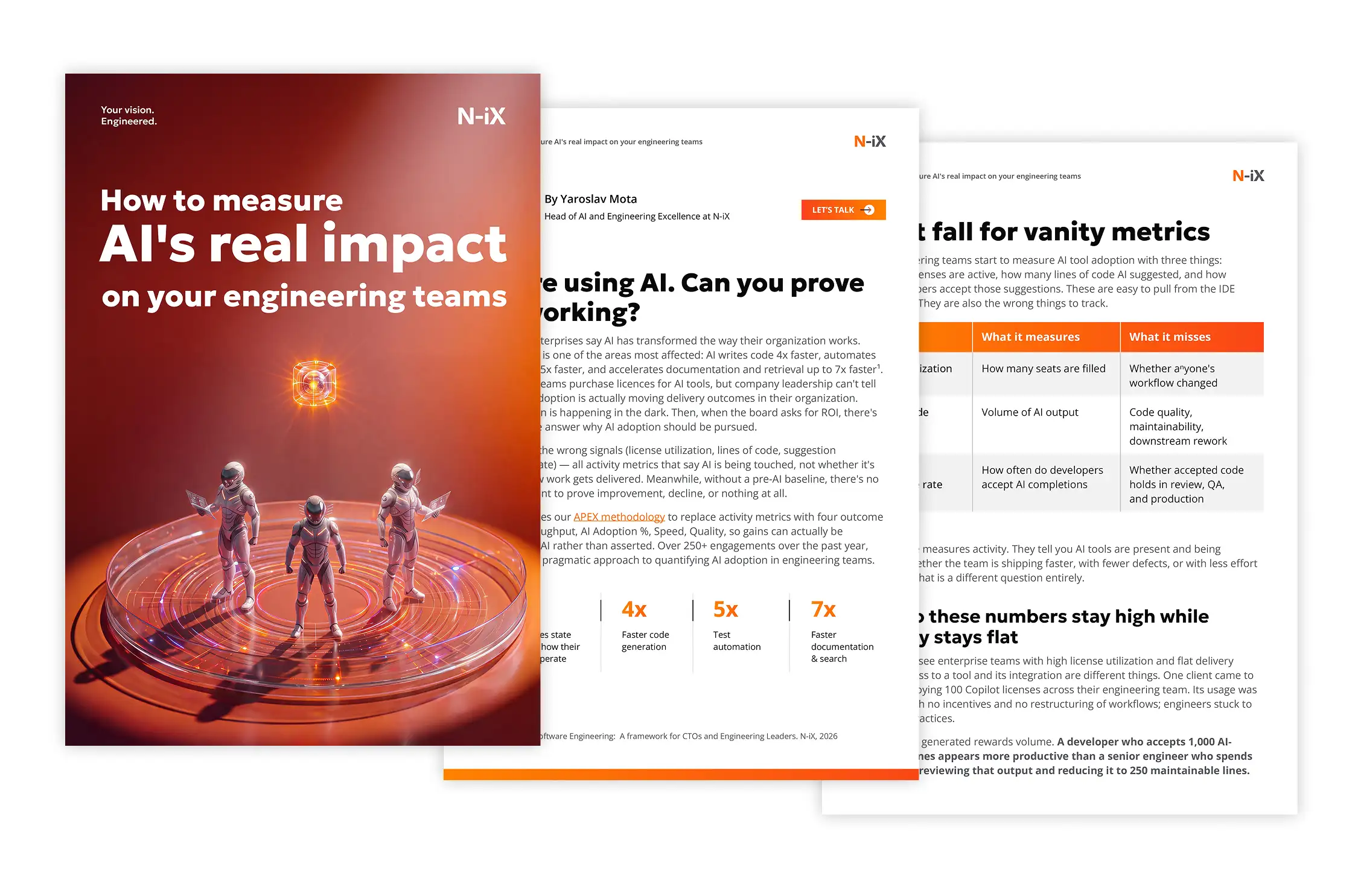
Discover how to set a baseline, track the right metrics, and prove what AI is doing for delivery in this guide!
Can you prove your AI tools are working when the board asks? Learn how!
AI writes code up to 4x faster, yet few leaders can link it to delivery. Explore four outcome metrics and a two-week baseline method in this guide!


