 ChatGPT
 Perplexity
 Claude
 Gemini
 Grok
Grok
European companies are increasingly choosing nearshore software development. According to the IDC 2025 research, 42% of large European enterprises plan to transition from offshore to nearshore IT services within the next 18 months. In Western Europe, 27% are actively adopting nearshoring strategies. The nearshore model combines quality engineering capacity at competitive rates with geographic proximity, aligned time zones, and easy travel access. IT staff augmentation in Romania is an excellent example of this approach. It offers Nordic, Western European, and UK organizations an alternative to both costly domestic expansion and the coordination friction of distant offshore locations.
In this article, we explore nearshore software development in Romania and its key strengths: technical talent depth, cost-quality balance, operational proximity, cultural dynamics, and practical strategies for partnership implementation.

What makes Romania's tech talent pool stand out?
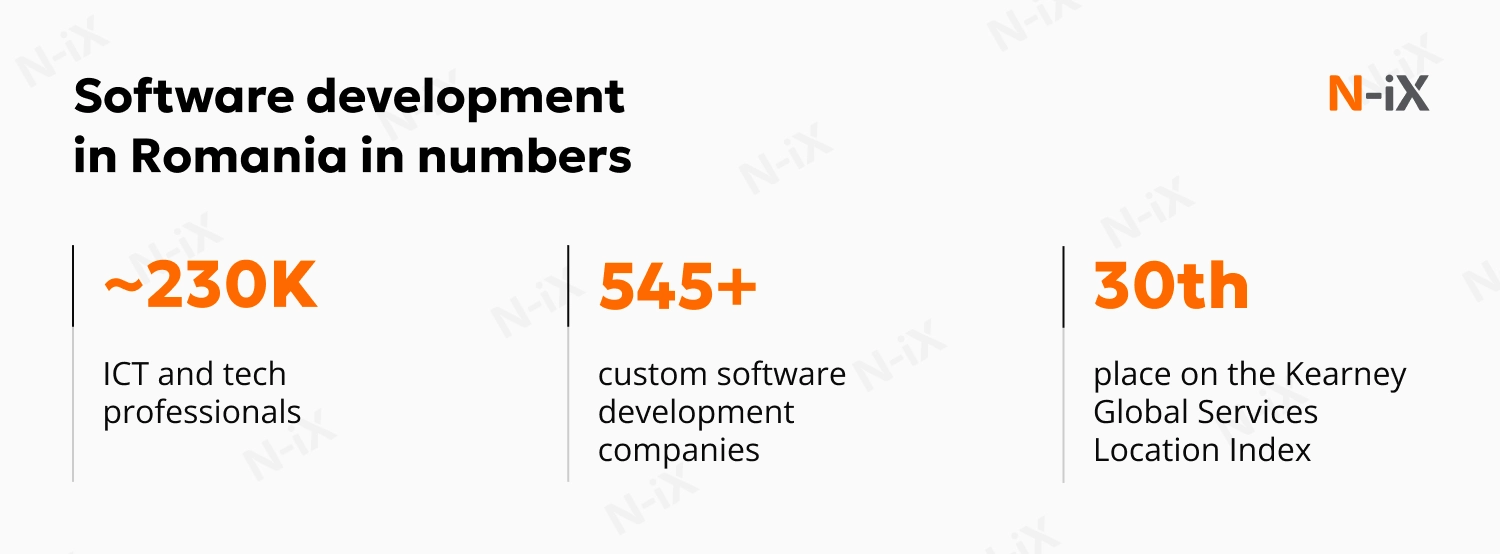
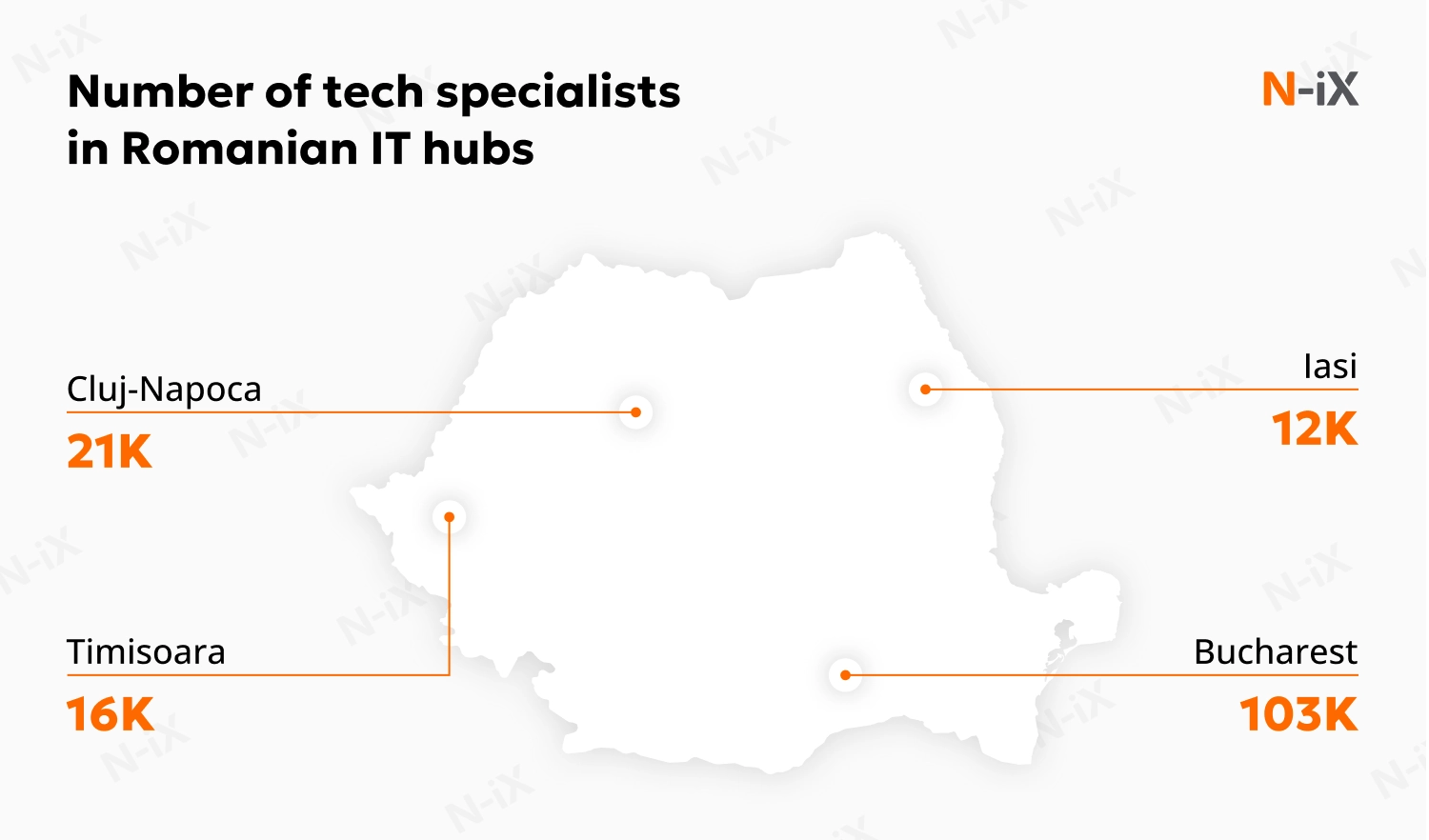
Romania's software development sector is characterized by diverse technical expertise and a mature workforce. According to Eurostat, Romania has over 200K software developers. These professionals span different career stages, including 38% under 34, reflecting a workforce that combines emerging talent with experienced engineers.
The country boasts 49 public and 8 private universities, along with a strong STEM tradition, ensuring a steady stream of qualified graduates. The Romanian ICT sector is expected to represent around 10% of GDP by 2030, according to an Eurostat estimate. Many global firms, including Accenture, Amazon, and Microsoft, already have sizeable operations there. When you nearshore software development to Romania, you'll have access to skilled engineers across multiple technology domains who can integrate into your team and support your development objectives.
To explore Romania's tech hubs and developer talent in more detail, read IT outsourcing to Romania: major hubs, tech talent pool, and more
Cost efficiency without compromising quality
From a value perspective, sourcing engineering talent in Romania tends to cost less than hiring in the UK, Nordic countries, or Western European markets, while maintaining a high level of quality. Romania also performs well in global quality benchmarks, ranking 11th on Topcoder for developer performance. Companies benefit from both technical proficiency and cost efficiency in a single location. The resulting savings can be redirected toward quality assurance processes, expanded testing protocols, or faster product delivery.
How close is Romania to major European markets?
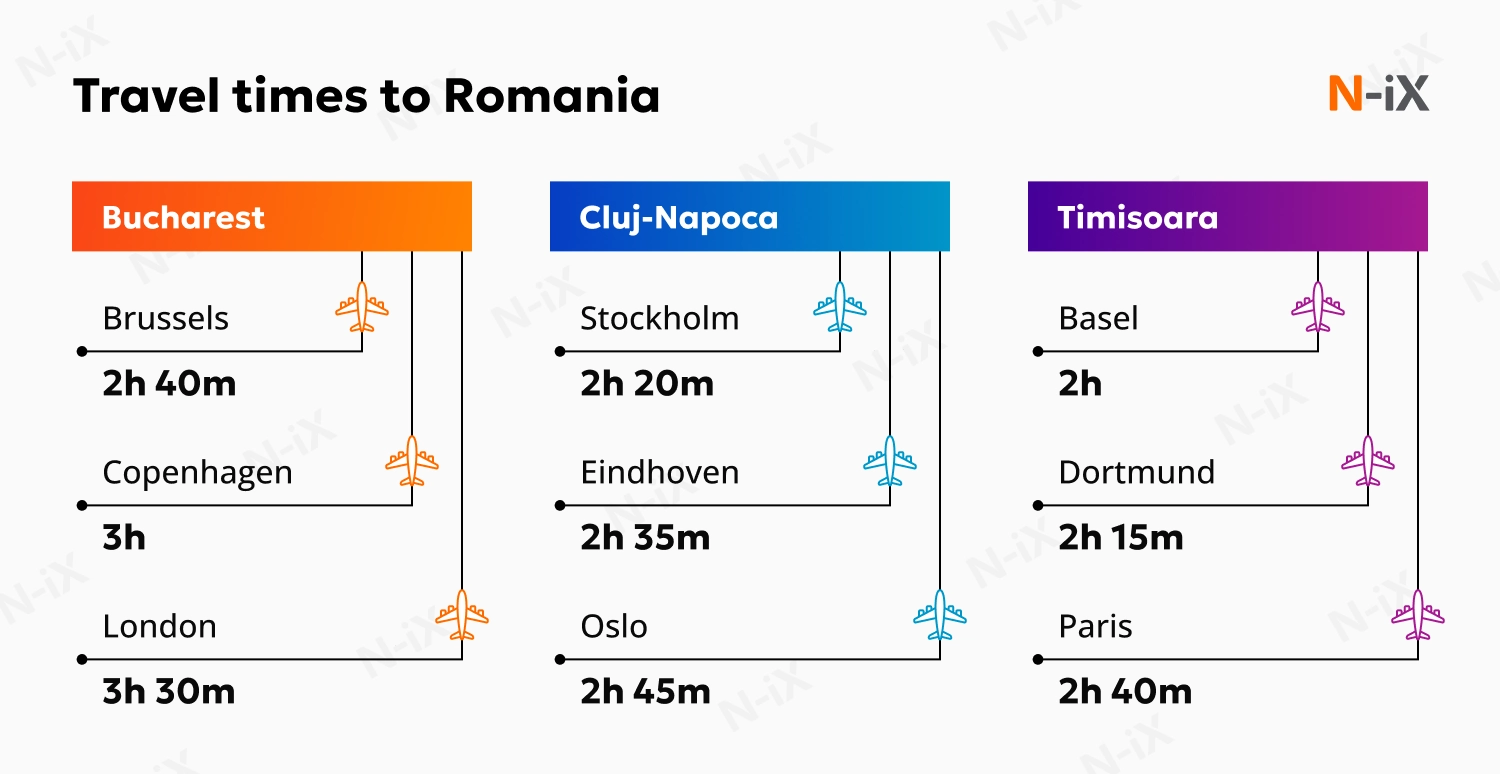
One of the significant advantages of nearshoring rather than offshoring is that you minimize friction in collaboration. Romania shares the same time zone (or differs by just one hour) with many Western and Central European countries, including the UK for part of the year, so real‑time communication and daily stand‑ups align easily. Geographically, Romania is well connected by flights to capitals across Europe. When you nearshore software development to Romania, on-site visits and team gatherings require just 2-3 hours of travel.
Do cultural differences affect Romanian nearshoring partnerships?
Cultural awareness strengthens nearshoring partnerships. Understanding Romania's distinct work culture can turn potential differences into project advantages.
Complementary strengths in practice
Romanian teams bring characteristics that can complement Western European management styles, according to the Hofstede cultural index:
Structured execution and accountability
Romanian professionals typically work well within clear hierarchies and defined reporting lines. For distributed teams, this translates to reliable execution of delegated tasks without constant oversight. When Western European product owners set direction, Romanian teams excel at disciplined implementation.
Team cohesion and loyalty
Romania's collectivist culture fosters strong team bonds and lower turnover rates. Developers often remain with projects long-term, reducing the knowledge loss common in high-turnover markets. This stability proves valuable for complex, multi-year initiatives.
Process rigor and risk management
High uncertainty avoidance manifests as thorough documentation, careful testing, and adherence to established procedures. Such a systematic approach helps Romanian teams identify edge cases and potential issues early. This is especially valuable for finance, healthcare, and other regulated sectors.
Practical integration strategies
Companies that nearshore software development to Romania can bridge these differences through straightforward practices:
- Clear frameworks upfront: Define roles, decision rights, and escalation paths explicitly during the project kickoff.
- Regular synchronization: Schedule consistent check-ins to align on priorities and provide feedback.
- Documentation standards: Establish shared practices for requirements, code comments, and knowledge transfer.
- Cultural exchange: Brief both sides on working style differences; awareness prevents misinterpretation.
Read more: Partner with a software development team in Romania
Favourable business and regulatory conditions
Romania offers a business environment that supports IT and R&D operations. For instance, there are tax‑incentive regimes for innovation and R&D activities (e.g., 0 % profit tax for R&D), which help reduce the cost of product engineering centres. Being an EU member (since 2007), the country follows EU legal frameworks. That means compliance, data protection, and IP‑protection align with what you expect in European markets. From a strategic point of view, this means you can operate your nearshore team as a part of your broader product engineering or digital‑transformation strategy, rather than treating it purely as a low‑cost commodity.
Get a complete overview of the 2024 software development market in Romania!
Success!
How does Romanian nearshoring accelerate product delivery?
With all the above in place, you gain speed advantages. Shorter time zone difference, same continent travel, high‑quality talent, and the ability to adjust teams fast mean you can move faster. For companies developing complex software solutions, where multiple technical components need frequent iteration and rapid response to market demands, that agility becomes a strategic differentiator.
How to maximise value when you nearshore software development to Romania
Here are practical steps you can take to get the most out of a nearshore centre in Romania:
- Define clear strategic objectives: Before engaging, define what you want the nearshore team to do. Is it feature development, full product engineering, R&D, or support services? Determine how it integrates with your headquarters and establish clear business objectives.
- Evaluate partners with multi-market experience: Consider working with global software development companies that have proven Romanian delivery capabilities alongside operations in other European markets. Partners like N-iX offer established infrastructure, talent pipelines, quality frameworks, and experience managing distributed teams across cultural contexts. This significantly reduces your setup timeline and operational complexity compared to building from scratch.
- Align operations and secure the right talent: Integrate your Agile/DevOps practices, code quality standards, tooling, and project communication with the Romanian team from day one. Work with your partner to build a balanced team mix of senior engineers for technical leadership and mid-level professionals for execution and cost-effectiveness. Early alignment on processes and team composition prevents friction later.
- Govern for outcomes and build domain expertise: Move beyond simple cost metrics to measure time to market, defect rates, system reliability, and alignment with your product roadmap. As you scale, invest in training and domain knowledge transfer so your nearshore team becomes strategic contributors with genuine ownership, not just delivery resources executing tasks.
- Stay agile and scale strategically: Regularly review your team composition and adjust skillsets as your product roadmap evolves. Whether expanding into AI, cloud-native architecture, or new technical domains, maintain flexibility to revise capabilities and grow the partnership in response to changing business needs.

Wrap-up
Romania nearshore software development delivers what European companies need most: high-caliber engineering talent at competitive rates, operational proximity that enables real-time collaboration, and the regulatory stability of an EU member state. For Nordic, UK, and broader European organizations scaling software capabilities, Romania represents one of the most strategically sound nearshoring destinations available today.
N-iX removes the barriers to effective nearshore software development in Romania. N-iX operates in Romania with proven delivery methodologies refined over 23 years, serving global enterprises. With more than 2,400 engineering professionals across 25 countries and expertise spanning cloud, AI, data analytics, and embedded systems, N-iX delivers Fortune 500-grade capabilities to nearshore engagements.
Have a question?
Speak to an expert