
 ChatGPT
 Perplexity
 Claude
 Gemini
 Grok
Grok
Did you know that one patient can generate up to 80 megabytes of information over the course of a year? The healthcare industry deals with an enormous amount of data from administrative logs, electronic health records, clinical trials, and other sources. Another challenge is that all this data is often unstructured and comes from various sources. Therefore, implementing healthcare business intelligence (BI) solutions is so important now.
Healthcare business intelligence addresses these constraints by integrating data across systems, standardizing metrics, and enabling real-time insights for clinical, operational, and financial decisions. It establishes a structured data foundation, aligns reporting with measurable outcomes, and supports use cases such as patient monitoring, resource optimization, and revenue cycle management. With the right architecture and implementation approach, organizations move from retrospective reporting to proactive decision-making. Let’s examine what healthcare business intelligence is, how it works, where it delivers measurable value, and how to implement it in practice.
Key takeaways
- Healthcare BI integrates clinical, operational, and financial data into a unified analytical layer
- It enables earlier clinical intervention and more precise resource allocation
- Most failures come from inconsistent metrics and fragmented data
- Real-time and predictive analytics are replacing retrospective reporting
- Implementation requires a unified data model and governance
What is healthcare business intelligence?
Healthcare business intelligence is the discipline of collecting, integrating, modeling, and analyzing data generated across healthcare systems to support clinical, operational, and financial decision-making. It connects data from electronic health records (EHRs), laboratory systems, billing platforms, insurance claims, and medical devices into a unified analytical environment. Without this layer, healthcare organizations operate with fragmented views of patients, processes, and costs, which directly affects both care quality and financial control.
What makes healthcare BI materially different from general business intelligence is the nature of the data and the consequences of decisions made on top of it. Clinical data is heterogeneous, often unstructured, and distributed across systems that were not designed to interoperate. At the same time, decisions based on this data influence patient outcomes, regulatory compliance, and operational risk. As a result, healthcare BI is less about dashboards and more about building a controlled, reliable data foundation that can support consistent interpretation across departments.
Healthcare BI is implemented as a multi-layered architecture:
- Data integration layer: consolidates data from EHRs, imaging systems, IoT devices, and administrative platforms using interoperability standards such as HL7 and FHIR
- Data platform layer: stores structured and historical data in a cloud warehouse or lakehouse, enabling longitudinal analysis across patients and operations
- Semantic layer: defines consistent business and clinical metrics, ensuring that indicators such as readmission rates or cost per patient are calculated uniformly
- Analytics layer: delivers dashboards, reports, and advanced analytics that support both real-time monitoring and strategic decision-making
A critical distinction lies in how healthcare BI shifts organizations from fragmented reporting toward a unified, continuously updated analytical view of operations and care delivery.
The table below highlights the difference between organizations operating with healthcare BI and those relying on traditional, non-integrated data practices:
|
Dimension |
Without healthcare BI |
With healthcare BI |
|
Data access |
Siloed across departments and systems |
Unified across clinical, operational, and financial domains |
|
Decision-making |
Delayed, based on static reports |
Timely, supported by real-time or near real-time insights |
|
Clinical visibility |
Limited view of patient history and outcomes |
Comprehensive patient-level and population-level insights |
|
Operational control |
Reactive resource planning |
Proactive optimization of staffing, beds, and workflows |
|
Financial management |
Fragmented cost tracking and billing insights |
End-to-end visibility into revenue cycle and cost drivers |
|
Data consistency |
Conflicting metrics across teams |
Standardized KPIs and definitions across the organization |
|
Compliance and governance |
Manual tracking, higher risk of gaps |
Embedded governance with traceability and auditability |
|
Outcome measurement |
Difficult to link actions to results |
Clear linkage between decisions, processes, and outcomes |
How healthcare BI improves performance
Enhancing clinical outcomes and patient safety
The most immediate value appears in clinical environments, where incomplete or delayed information increases the probability of adverse events. BI platforms consolidate patient histories, diagnostics, and real-time monitoring data into a single analytical context, allowing earlier identification of deterioration and more precise interventions.
Beyond acute scenarios, BI supports a deeper understanding of treatment effectiveness. Clinical teams can analyze how outcomes vary across patient profiles, treatment combinations, and care pathways. This enables more targeted interventions and reduces reliance on generalized treatment models. Embedded clinical decision support systems further reduce risk by identifying contraindications, dosage inconsistencies, and gaps in care continuity before they translate into errors.
Optimizing operational efficiency
Healthcare operations are constrained by physical capacity, staffing limitations, and time-sensitive demand. BI introduces a system-wide view of these constraints, making operational bottlenecks visible and quantifiable.
The same principle applies to workforce management. Instead of static staffing models, BI supports dynamic allocation based on real-time and historical demand. This reduces periods of underutilization while preventing overload during peak demand. Over time, this directly affects staff retention and operational stability.
Supply chain management becomes more predictable as well. Inventory consumption, supplier performance, and procurement cycles can be analyzed continuously, reducing the risk of shortages for critical supplies and limiting excess stock that ties up capital.
Strengthening financial performance
Financial performance in healthcare is often constrained by limited transparency across revenue and cost structures. BI addresses this by connecting financial data with clinical and operational activities, making it possible to trace how resources are used and where inefficiencies occur.
Revenue cycle management becomes more controlled when billing, claims processing, and reimbursement workflows are analyzed end-to-end. Organizations can identify delayed claims, under-coded services, and denial patterns that reduce revenue.
Fraud detection is another area where BI delivers measurable impact. By analyzing large volumes of claims data, analytics platforms can identify anomalies that would not be detectable through manual review. This is particularly relevant in systems with high transaction volumes and complex reimbursement models.
Supporting the healthcare workforce
Clinical capacity is often constrained not by the number of professionals but by how much of their time is consumed by administrative work. BI systems reduce this burden by integrating data capture, reporting, and coordination into existing workflows.
Documentation is a clear example. Clinicians frequently complete records outside working hours due to fragmented systems and manual processes. BI platforms, especially when combined with automation, reduce this overhead by structuring data flows and minimizing repetitive tasks.
At the same time, BI enhances decision support. Instead of manually retrieving data from multiple systems, clinicians access consolidated, context-aware insights that support diagnosis and treatment planning. This changes how data is used in practice. It becomes embedded in clinical workflows rather than reviewed retrospectively.
Enabling population health and long-term planning
At a broader level, BI enables analysis beyond individual patients, supporting population-level insights and long-term planning. By aggregating data across regions, demographics, and care settings, healthcare systems can identify trends that inform preventive strategies and resource allocation.
This includes tracking disease prevalence, identifying high-risk populations, and evaluating the effectiveness of interventions over time. Public health organizations use these insights to respond to emerging risks earlier and design targeted programs.
For providers, the same data supports strategic decisions such as expanding service lines, investing in new facilities, or reallocating resources across departments. These decisions are based on observed demand and outcomes rather than assumptions.
Explore the topic: IoT in healthcare: An expert guide to use cases, benefits, and more
What healthcare business intelligence solves
Healthcare business intelligence solves a structural data problem that affects nearly every part of care delivery. Most healthcare organizations already have large volumes of clinical, operational, and financial data. The issue is that this data is usually dispersed across EHRs, diagnostic systems, billing platforms, staffing tools, and departmental spreadsheets. As long as these systems remain disconnected, teams work with partial views, delayed reports, and inconsistent metrics. BI addresses that gap by turning fragmented data into a unified analytical layer that supports faster, more accurate decisions.
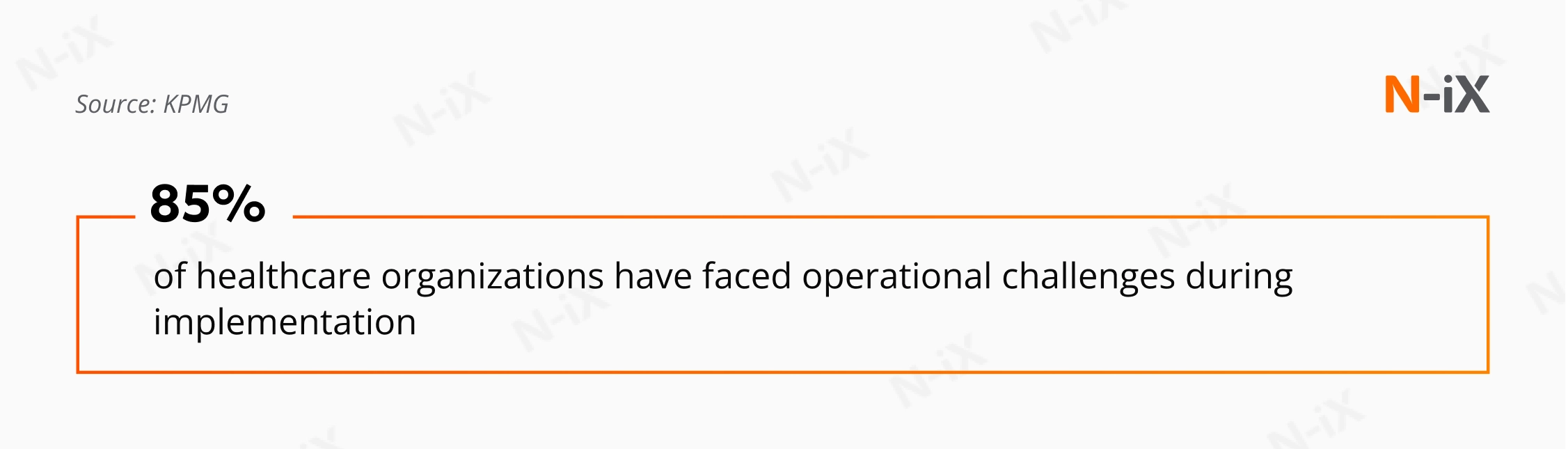
At the same time, implementation remains complex. According to KPMG, 85% of healthcare organizations face operational challenges when adopting AI and analytics, with 62% citing data quality as the primary constraint. This highlights that the core issue is not access to data, but the ability to structure and use it consistently.
Clinical decision support
Clinical environments generate high volumes of time-sensitive data, but the availability of data does not automatically improve care. What matters is whether relevant signals are surfaced early enough, in a usable format, and within the clinician’s workflow. Healthcare BI solves this by consolidating patient-level information and identifying patterns that would be difficult to detect through manual review alone.
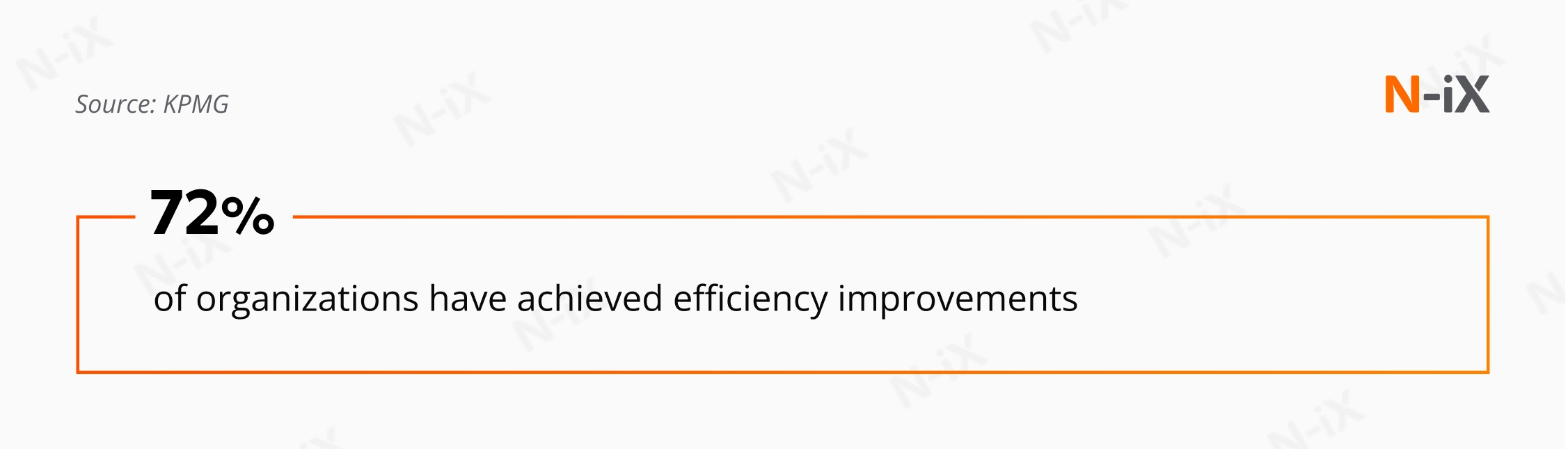
This shift toward data-driven care is already reflected in broader industry trends. KPMG reports [1] that 72% of healthcare organizations have achieved efficiency improvements through the adoption of AI and analytics, while 39% report measurable financial improvements.
This is particularly important in cases where patient deterioration develops gradually but requires rapid intervention once thresholds are crossed. ICU dashboards, early warning systems, and analytics-based monitoring tools help clinical teams detect deviations in vital signs, lab values, and treatment responses before they become critical.
BI strengthens clinical decision support in several ways:
- combining patient history, diagnostics, and real-time monitoring data in one view;
- identifying risk indicators earlier, including sepsis, readmission probability, and treatment complications;
- standardizing outcome analysis across patient groups and treatment pathways;
- reducing avoidable clinical variation by showing which interventions deliver better results.
Hospital operations optimization
Hospitals operate under constant pressure to balance demand, staffing, and physical capacity. Delays in one part of the system quickly affect the rest: admissions slow down discharges, bed turnover affects emergency department flow, and staffing mismatches reduce throughput even when clinical demand is predictable. Healthcare BI solves these operational inefficiencies by making resource bottlenecks measurable.
Instead of relying on periodic summaries, managers can track operational indicators continuously and adjust workflows based on current and historical demand patterns. This changes hospital operations from reactive coordination to active capacity management.
Key operational use cases include:
- bed utilization analysis across units and care settings;
- emergency department flow monitoring;
- discharge and transfer coordination;
- staffing allocation based on patient volumes and acuity;
- supply and inventory planning tied to service demand.
This is one of the strongest use cases for healthcare BI because it connects operational decisions directly to both patient experience and cost efficiency. A more precise view of patient flow reduces congestion, improves resource use, and creates more predictable service delivery.
Financial performance and cost control
Healthcare finance is often affected by fragmentation in the same way as clinical operations. Billing, claims, reimbursements, and service costs are tracked across multiple systems, which makes it difficult to understand where revenue is delayed, where margins are compressed, and where waste accumulates. Healthcare BI solves this by linking financial metrics to operational and clinical activity.
This enables organizations to move beyond retrospective accounting and toward active financial management. Instead of asking where costs increased after the fact, BI helps identify which workflows, departments, or patient pathways are driving inefficiency in real time.
The strongest financial applications include:
- revenue cycle monitoring from intake to reimbursement;
- denied claims and under-coding analysis;
- payer mix and reimbursement trend analysis;
- service-line profitability tracking;
- fraud and anomaly detection in claims data;
- cost-per-patient and cost-per-episode analysis.
This level of visibility is essential because small inefficiencies repeated at scale create material losses. Delayed claims processing, inconsistent coding, and poor coordination between clinical and billing systems all produce revenue leakage that is difficult to isolate without analytics. When implemented properly, healthcare BI allows finance functions to measure performance with greater precision and connect financial outcomes to actual operational drivers.
Organizations that successfully scale AI and analytics capabilities see a direct financial impact. According to McKinsey, leading companies already attribute up to 20% of their EBIT to AI-driven initiatives, demonstrating the scale of value that structured data and analytics can deliver.
Population health management
Healthcare BI also solves a broader planning problem: the inability to understand health trends across patient populations in a timely and actionable way. Individual patient records may be complete enough for treatment decisions, but they are rarely sufficient for identifying patterns across chronic disease groups, preventive care gaps, or emerging risks within specific communities.
BI supports population health management by aggregating data across demographics, diagnoses, care settings, and time periods. This allows healthcare organizations to identify which patient groups are most at risk, where interventions are underperforming, and how resources should be targeted.
Core use cases include:
- chronic disease tracking across diabetes, cardiovascular disease, oncology, and other high-burden conditions;
- identification of high-risk populations based on utilization and outcomes data;
- preventive care targeting, including screening gaps and missed follow-ups;
- trend monitoring for disease incidence and treatment outcomes;
- evaluation of public health and care management initiatives.
This is particularly valuable in systems managing large and diverse patient populations, where reactive treatment models are expensive and often clinically insufficient. BI makes it possible to identify patterns earlier and intervene before conditions worsen or utilization increases unnecessarily.
Healthcare industry lacks alignment between data, decisions, and outcomes. Business intelligence is what closes that gap.
Technology trends shaping healthcare BI
Healthcare business intelligence is shifting toward continuous, decision-oriented analytics embedded directly into care delivery and operations. The focus is moving from retrospective reporting to real-time, context-aware insight that supports immediate action.
- AI-driven predictive analytics: Predictive models identify patient risks, readmission probability, and demand patterns before they materialize, enabling earlier and more targeted interventions. Their impact depends on consistent data models and governance, as unreliable inputs quickly translate into incorrect clinical or operational decisions.
- Real-time streaming data (IoT, wearables): Continuous data from bedside monitors, wearable devices, and remote care platforms enables near real-time visibility into patient status and system performance. This reduces response time in acute scenarios and improves monitoring of chronic conditions beyond episodic clinical visits.
- Data fabric and interoperability layers: Data fabric architectures connect EHRs, lab systems, and operational platforms without full centralization, allowing unified access across distributed environments. This reduces integration complexity while ensuring consistent governance, lineage, and access control across systems.
- Embedded analytics in clinical workflows: Insights are delivered directly within EHRs and operational tools, eliminating the need to switch between systems. This improves adoption and ensures that analytics informs decisions at the exact point of care or resource allocation.
How to implement healthcare business intelligence
Implementing healthcare business intelligence requires restructuring how data is collected, interpreted, and used across clinical, operational, and financial domains. The primary objective is to replace fragmented reporting with a consistent analytical model that supports measurable decisions. At N-iX, implementation is structured around establishing data reliability first, then enabling incremental delivery of insights tied to real use cases.
Step 1: Audit the current data landscape
N-iX begins with a detailed assessment of existing systems and data flows across the organization. This includes EHR platforms, laboratory systems, imaging solutions, billing systems, and any operational tools used for scheduling or resource management. The goal is to identify how data is generated, where it is stored, how it is transformed, and how it is currently used in reporting. The result of this phase is a clear data architecture map and a prioritized list of integration and quality issues that must be resolved before analytics can be trusted.
Step 2: Define measurable outcomes
The next step is to define concrete outcomes that the BI system must support. These outcomes are tied to specific operational or clinical improvements and must be measurable over time. Typical examples include:
- reducing 30-day readmission rates by a defined percentage;
- improving bed occupancy and turnover efficiency;
- reducing emergency department wait times;
- increasing claim acceptance rates or reducing billing delays.
Each objective is translated into a set of KPIs with clear calculation logic and data dependencies. This ensures that every analytical component built later has a direct link to a business or clinical outcome, rather than serving as a standalone reporting feature.
Step 3: Build a unified data model
Once outcomes are defined, N-iX designs a data model that integrates clinical, operational, and financial data into a single analytical structure. This is one of the most critical steps, as inconsistencies at this level propagate across all reporting and analytics.
The work involves:
- standardizing definitions of entities such as patients, encounters, treatments, and costs;
- aligning data from multiple systems into a consistent schema;
- implementing a semantic layer that defines how KPIs are calculated and interpreted;
- ensuring that historical and real-time data can be analyzed together.
This model is typically implemented within a cloud data warehouse or lakehouse, where data pipelines (ETL/ELT) continuously ingest and transform data from source systems. The objective is not only integration but also consistency, so that all departments rely on the same logic when analyzing performance.
Step 4: Deliver dashboards iteratively
With a stable data foundation in place, N-iX delivers BI dashboards in controlled iterations rather than as a single large release. Each iteration focuses on a specific use case with immediate impact, such as patient flow management, ICU monitoring, or revenue cycle visibility.
Dashboards are designed to support decision-making rather than visualization alone. This means prioritizing clarity, relevance of metrics, and alignment with workflows where decisions are made. Over time, additional use cases are added, expanding the analytical coverage without disrupting the existing system.
Step 5: Establish governance and ownership
A BI system cannot scale without clear governance. N-iX defines data ownership across domains, ensuring that responsibility for data quality, metric definitions, and access control is clearly assigned.
Governance includes: defining data stewards, implementing access policies based on roles and compliance requirements, tracking data lineage and establishing processes for updating and validating KPIs as business needs evolve.
Compliance is integrated into this layer, particularly for regulations such as HIPAA and GDPR, which require strict control over data access and usage. Governance frameworks ensure that as the BI system grows, it remains consistent, auditable, and aligned with regulatory requirements.
How N-iX approaches healthcare business intelligence
In business intelligence within the healthcare sector, partnering with a team that possesses both technological prowess and profound industry insights is paramount. N-iX is your reliable technology partner with a rich legacy spanning over two decades across diverse industries and a global team of 2,400+ professionals in 25 countries. Here's why N-iX stands as the optimal choice for implementing healthcare business intelligence:
With a robust history of successful collaborations with industry leaders such as Weinmann Emergency, Brighter, Think Research, Cure Forward, and other companies, our track record speaks volumes about our commitment to quality, reliability, and unwavering trustworthiness.
N-iX works with healthcare organizations to design and implement business intelligence platforms that connect data with measurable outcomes across clinical care, operations, and finance. If you are looking to move from fragmented reporting to a structured, outcome-driven BI system, our team can help define and deliver the approach that fits your environment.
FAQ
How is business intelligence used in healthcare?
Business intelligence is used to support clinical decisions, optimize hospital operations, and improve financial performance. It helps clinicians detect patient risks earlier, allows operations teams to manage capacity and staffing more effectively, and gives finance teams visibility into revenue cycles and cost drivers. These insights are typically delivered through dashboards and embedded analytics integrated into existing systems. The key value lies in connecting data across domains so that decisions can be evaluated against measurable outcomes.
What are examples of healthcare BI use cases?
Healthcare BI is applied across a range of scenarios, including patient monitoring, hospital workflow optimization, and claims analysis. For example, analytics can identify early signs of patient deterioration, track bed occupancy and patient flow, or detect inefficiencies in billing and reimbursement processes. It is also used for population health management, where aggregated data helps identify high-risk patient groups and improve preventive care. These use cases are connected by the ability to translate data into actionable insight.
What tools are used in healthcare business intelligence?
Healthcare BI typically relies on a combination of data platforms, integration tools, and visualization solutions. This includes cloud data warehouses or lakehouses for storage, ETL/ELT pipelines for data integration, and tools such as Power BI or Tableau for reporting and analytics. In healthcare environments, these tools are often complemented by interoperability standards like FHIR and governance frameworks to ensure compliance. N-iX provides Power BI consulting services and others for enterprises.
How long does it take to implement healthcare BI?
Implementation timelines vary depending on the complexity of existing systems, data quality, and scope of use cases. Initial results can often be delivered within a few weeks by focusing on high-impact areas such as patient flow or financial reporting. However, building a scalable and reliable BI system typically requires several months to establish a unified data model and governance framework. At N-iX, delivery is structured in iterations to ensure early value while building toward long-term stability.
What are the main challenges in implementing healthcare BI?
The most common challenges include fragmented data across systems, inconsistent metric definitions, and limited data governance. Many organizations also struggle with aligning clinical, operational, and financial perspectives within a single analytical model. Without addressing these issues, BI tools tend to produce conflicting insights that users do not trust. Overcoming these challenges requires a structured approach to data integration, standardization, and ownership.
References
- The data-driven enterprise of 2025 - McKinsey
- Business Intelligence and Reporting Executive Survey - KPMG
Have a question?
Speak to an expert