ChatGPT
 Perplexity
 Claude
 Gemini
 Grok
Grok
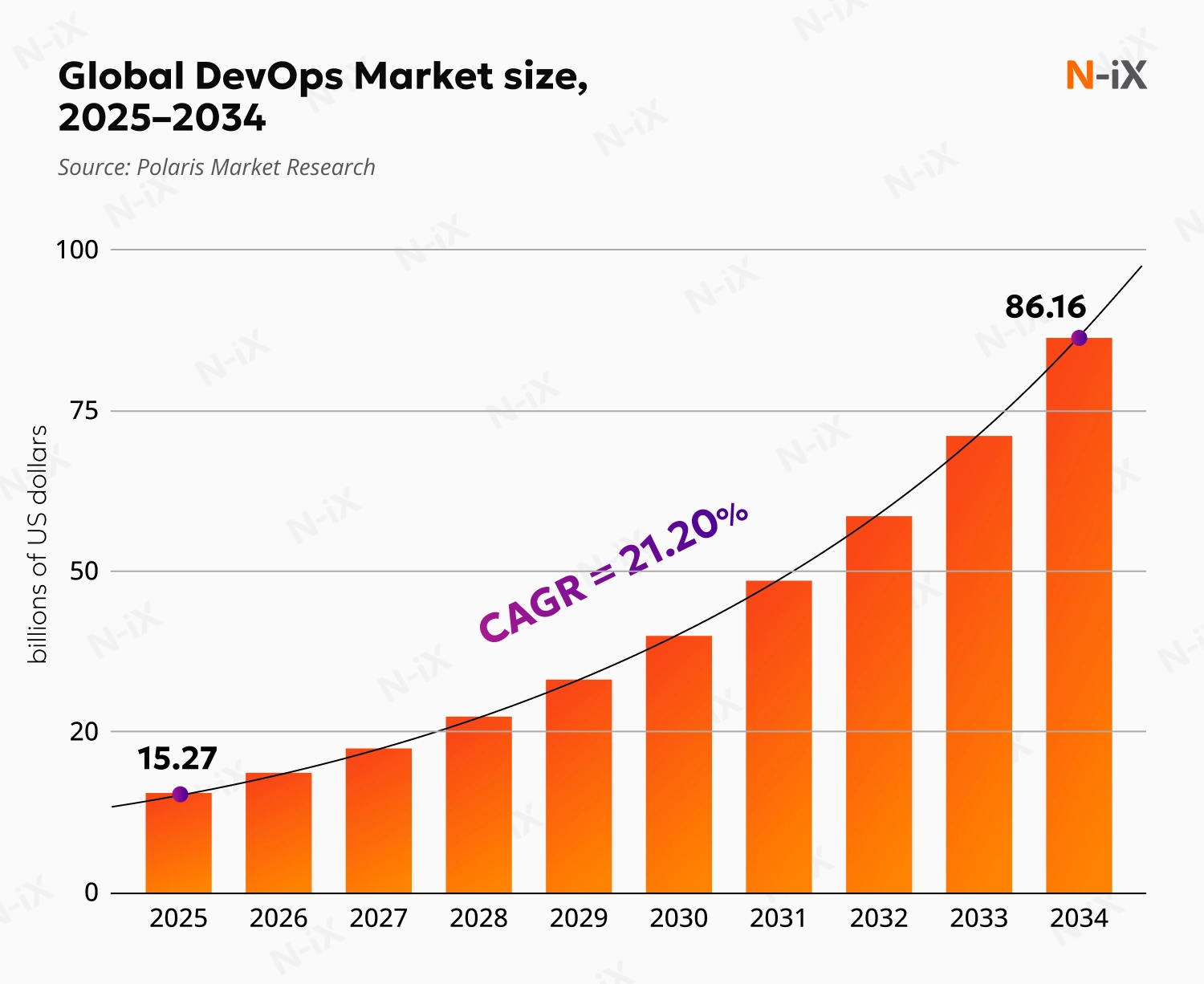
The software delivery process is constantly accelerating, and DevOps plays a key role in it. Thus, the DevOps market is growing fast, expected to reach $86.16B by 2034 [1]. AI is one of the key drivers behind this growth, helping businesses automate processes, get faster feedback, and boost agility.
However, despite AI, other technologies are also driving changes. So, what are the key DevOps trends to watch in 2026? And where should organizations invest to keep up with competition in 2026? Our DevOps experts are sharing insights in this article.
8 major DevOps trends for 2026
In 2026, DevOps will be powered by AI-driven tools and advanced automation. Let's review key trends that enable teams to work smarter and accelerate development processes.
1. AIOps adoption
AIOps, the growing DevOps trend of applying AI to IT operations, will continue to grow. In 2025, the global AIOps market was valued at $16.42B and is expected to reach $36.6B in 2030 [2]. AI/ML augments every stage of the DevOps lifecycle and automates processes using a wide range of tools and technologies.
Integration of Generative AI tools enhances platforms by improving anomaly detection, enabling predictive analytics, automating testing, and remediation without human intervention. Large language models (LLMs) can accurately identify root causes when provided with contextual data, potentially leading to significant improvements in Mean Time to Detect (MTTD) and Mean Time to Resolve (MTTR). Machine learning algorithms automatically generate test scenarios in response to code updates, significantly reducing reliance on manual test development. This automation accelerates the CI/CD process and helps deliver more reliable releases faster.
Read more: DataOps vs DevOps: what's the difference?
2. DevSecOps: Deepening integration of security and DevOps
DevSecOps, one of the crucial DevOps trends, helps identify and mitigate high-risk issues across the DevOps system by combining application development, operations, infrastructure-as-code, and cybersecurity within the CI/CD pipeline. The primary focus is automating and monitoring security throughout the software development lifecycle. AI tools help accelerate automation and streamline secure product delivery. The global DevSecOps report 2025 stated that 63.3% of security professionals reported that AI has become a helpful copilot for writing more secure code and automating application security testing [3].
Integration of security and DevOps is expected to deepen, addressing several key areas for improvement. These include providing security training for software developers and DevOps personnel, establishing consistent, central policies for integrating security into DevOps, supporting security teams in pursuing cloud security training and certifications, and assigning developers the task of implementing security practices. The same report shows that 27.27% of security engineers see better integration of development workflows as a primary focus in 2026 [3].
Learn more: Top 8 cloud security trends to protect your business in 2026
3. Serverless and cloud-native DevOps
In 2026, managed DevOps teams are putting even more emphasis on serverless computing and cloud-native design. With the serverless model, developers can focus on writing and improving code, while the cloud provider handles infrastructure concerns. Let's take a closer look at this approach.
One of the top DevOps market trends is the rise of serverless CI/CD, which enables teams to deploy applications with minimal setup. Popular platforms, such as AWS Lambda, Azure Functions, and Google Cloud Functions, automatically handle scaling and resource management.
Choose the right CI/CD tools for your pipeline—get the white paper!
Success!
Today's serverless solutions are closely connected to event-driven architectures (EDA). Applications can instantly respond to various triggers, such as incoming requests or database updates. This ensures resources are used efficiently and that systems can scale up or down as needed, reducing overhead.
At the same time, cloud-native tools like Kubernetes, Docker, and Prometheus are making it easier to manage microservices and containers in distributed environments. These technologies improve flexibility and system resilience, supporting applications that need to evolve quickly.
Learn more: 12 biggest cloud computing trends for 2026
4. Implementation of MLOps in DevOps
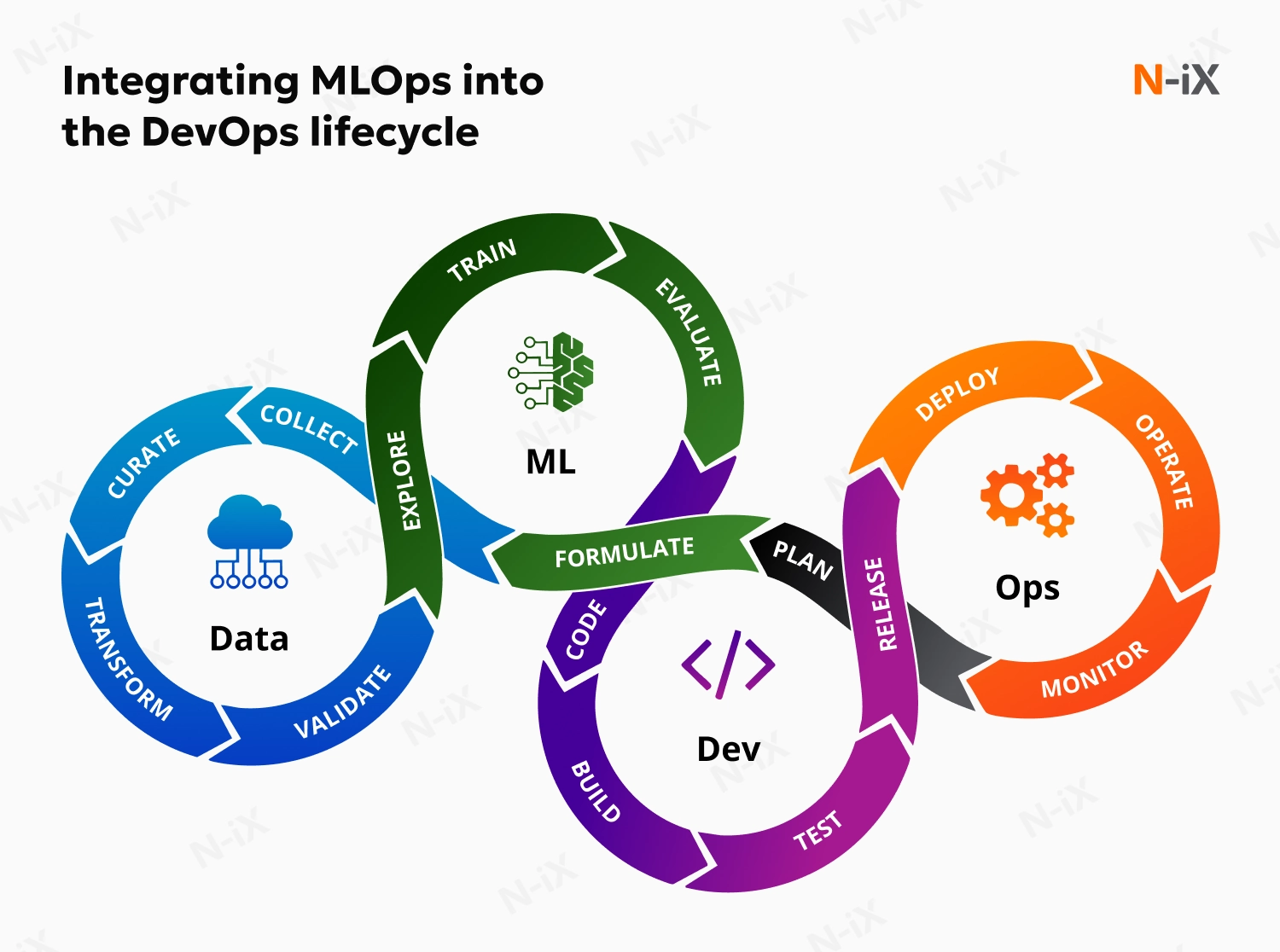
MLOps is one of the main DevOps automation trends, which aims to address the challenges of deploying and managing ML models in production. MLOps extends its reach beyond IT operations into diverse spheres, such as enterprise search and broader business contexts, and involves collaboration among teams, including data scientists and data engineers.
MLOps grapples with unique challenges, including data quantity and quality, model retraining, and the need for extensive tooling and infrastructure. The stakes are high, as the unpredictable performance of ML models can raise ethical concerns and necessitate complex post-deployment stages.
As organizations increasingly adopt AI and ML, the need for a well-defined MLOps framework becomes apparent. Businesses must evaluate their readiness, considering factors such as business needs, data availability, and technical resources.
Read more: TechOps vs DevOps: key differences
5. Application of GitOps in DevOps
GitOps, one of the DevOps latest trends, is an approach, distinct from previous methodologies in its core principles and practical benefits. It extends well-established DevSecOps practices, such as version control, collaboration, compliance, and CI/CD, to infrastructure automation. GitOps applies these principles to various forms of infrastructure, including VMs and containers, making it particularly effective for teams managing Kubernetes-based infrastructure.
What sets GitOps apart from other DevOps trends is its developer-centric orientation, in which infrastructure management seamlessly integrates with the same version control system used for application development. This fosters centralized collaboration and leverages Git's inherent capabilities. GitOps offers practical advantages, including enhanced efficiency, improved security, better developer experience, reduced costs, and faster deployments.
Organizations achieve improved coordination, fewer errors, and faster issue resolution by unifying infrastructure and application development lifecycles within a single tool. Moreover, GitOps facilitates the adoption of containers and microservices while ensuring consistency across all infrastructure components.
The future of GitOps includes deeper integration with DevSecOps workflows, enabling application and infrastructure management through a unified process. This integration will provide valuable insights for tailoring infrastructure configurations based on application behavior and vice versa.
6. A shift from DevOps to DevEx
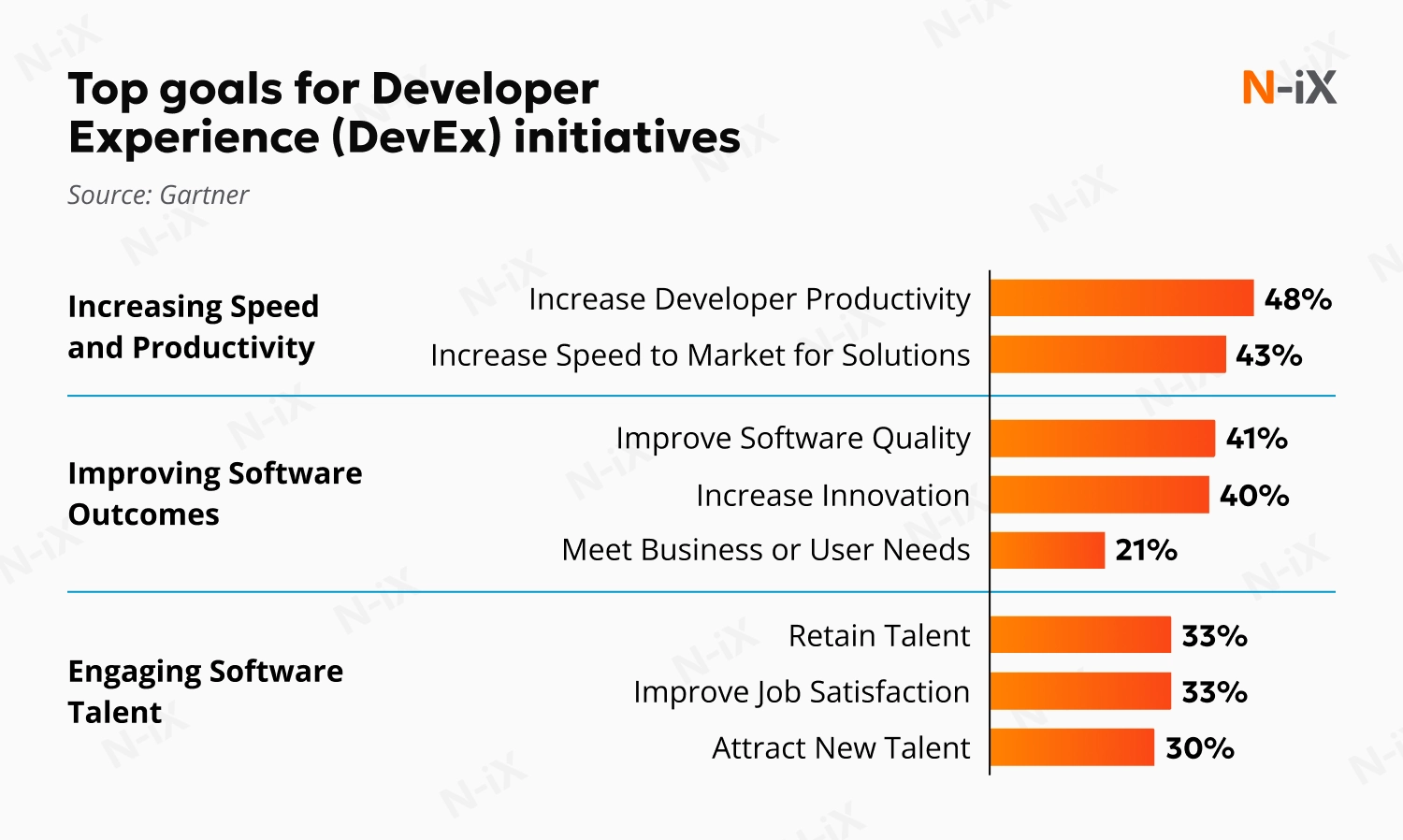
The DevEx approach is one of the latest DevOps trends, prioritizing developer experience by providing seamless platforms, efficient workflows, and a collaborative culture. It is boosting productivity and improving software and customer experiences. With automation and low-code tools on the horizon, DevEx may even reshape the workforce, freeing up skilled engineers for advanced innovations. According to Gartner's forecast, organizations that focus on improving DevEx are expected to achieve twice the developer retention rate by 2027 compared to those that do not make similar investments [4].
When developers have the tools and environment they need to be productive, they can create better software faster, ultimately leading to better business outcomes. This shift calls for a deeper integration between the internal tech teams responsible for DevEx and the overall business strategy. Imagine developers understanding and actively contributing to business goals, and leaders prioritizing technology investments that empower developers. This alignment ensures that technology advancements directly support broader business objectives, maximizing the value of both DevEx and overall business strategy.
7. Platform engineering integration
Platform engineering will be one of the key DevOps trends in 2026 and beyond, as organizations increasingly build Internal Developer Platforms (IDPs) to streamline delivery pipelines. IDPs centralize the tools, services, and workflows that developers need to manage their environments, deploy applications, and automate repetitive tasks. By creating customized platforms, businesses can enhance developer productivity, improve security, and reduce friction in the development pipeline.
IDPs will also enable organizations to maintain consistency across development teams while ensuring that security and compliance requirements are met. As platform engineering matures, organizations will continue to focus on building scalable, resilient platforms that cater to the needs of their internal teams.
8. Proactive approach to observability
Observability is a major DevOps trend as organizations seek deeper visibility into increasingly complex and distributed systems. Unlike traditional monitoring, observability allows teams to analyze metrics, logs, and traces in real time, helping them quickly identify and resolve issues.
In 2026, this practice moves to the next level with observability 2.0. Powered by AI and ML, DevOps engineers can now analyze massive streams of data, surface hidden patterns, and predict potential failures. Intelligent tools integrate directly into CI/CD pipelines to provide engineers with actionable insights on system health and performance. This proactive approach helps maintain reliability, streamline releases, and deliver smoother user experiences.
With the evolving rise of multi-cloud and hybrid environments, observability will also evolve to handle the complexities of managing distributed systems at scale, providing deeper visibility and faster issue resolution across all layers of the application stack.

Why choose N-iX as your DevOps consultant?
Adopting new technologies and adapting them within your organization can be challenging. A trusted DevOps consultant can accelerate the transformation and achieve higher ROI faster. At N-iX, we help enterprises streamline software delivery processes and adopt the right technologies according to their needs.
With 23 years of experience in the software development market, N-iX helped to build successful projects across diverse industries, including logistics, manufacturing, fintech, healthcare, retail, and more. Our team of over 70 DevOps experts has completed more than 50 DevOps implementation projects. As a certified AWS Premier Tier Services Partner, Microsoft Gold Certified Partner, and Google Cloud Platform Partner, N-iX is well-equipped to help organizations embrace the latest trends in DevOps and drive their digital transformation.
References
- Polaris Market Research - DevOps Market Growth Drivers, and Forecast by 2034
- Mordor Intelligence - AIOps Platform Market Size
- Black Duck - The global state of DevSecOps in 2025
- Gartner - Developer Experience (DevEx) as a Key Driver of Productivity
Have a question?
Speak to an expert