
 ChatGPT
 Perplexity
 Claude
 Gemini
 Grok
Grok
What if executive teams delay decisions because the same KPI produces different results across reports? This situation points to a familiar enterprise risk: Business Intelligence (BI) expands faster than the analytical structure that keeps metrics consistent and comparable. Data remains available, and dashboards remain active, but confidence in the numbers weakens as logic fragments across teams and tools.
A data warehouse for Business Intelligence provides that stabilization layer. It centralizes analytical logic, preserves historical context, and ensures that metrics remain aligned as the organization scales. Organizations that address this step deliberately, often through data warehouse consulting, regain consistency without expanding reporting complexity.
At N-iX, we see this approach reduce reconciliation cycles, shorten decision timelines, and restore confidence in enterprise reporting without unnecessarily expanding scope. Based on hands-on delivery experience, we will examine how data warehouses support BI in real enterprise environments. In this article, you'll learn:
- What is the role of a data warehouse in maintaining consistency in BI
- How data warehouse Business Intelligence work with centralized modeling and governed access
- Why BI without a data warehouse leads to reconciliation overhead and metric drift
- When BI environments require a data warehouse to remain reliable
- How data warehouses enable advanced analytics and AI
What does a data warehouse mean in the BI context?
In the context of Business Intelligence, a data warehouse is a centralized analytical repository built to support consistent, repeatable, and explainable analysis across the organization. Its role is not limited to storing data. Data warehouse Business Intelligence establishes the conditions under which BI can remain stable as data volumes, users, and analytical demands increase.
A data warehouse built for BI is organized around analytical use rather than operational activity. It consolidates data from multiple source systems and reshapes it to support cross-functional analysis over time. This design allows metrics to remain comparable across reporting periods and organizational boundaries, which is a core requirement for performance tracking, forecasting, and strategic analysis.
Several characteristics distinguish a data warehouse that effectively supports Business Intelligence:
- It organizes data by business subjects such as revenue, customers, or operations, rather than by application workflows.
- It integrates data from multiple systems into standardized structures and definitions.
- It preserves historical data to enable trend analysis and longitudinal reporting.
- It maintains data stability so analytical results remain reproducible over time.
Data lake vs data warehouse—discover which solution is right for you!
Success!
Key reasons why data warehouse and BI perform better together
A data warehouse Business Intelligence reinforce each other as they address different analytical responsibilities and prevent structural failure. The warehouse establishes order in data before analysis begins. BI builds on that order to interpret, aggregate, and communicate results. When these responsibilities remain distinct yet connected, analytical work stays coherent instead of fragmenting across tools and teams.
1. Consistent metric definitions across the organization
The operational systems encode data according to local process logic. Customer status, revenue timing, and cost attribution often differ by system and context. The data warehouse resolves these differences upstream by enforcing shared definitions and transformation rules. BI tools then operate on datasets where meaning is already aligned, which limits metric drift and prevents silent redefinition inside reports. Over time, this stability keeps analytical results comparable across departments and reporting periods.
This pattern is common in large BI environments. In one engagement with a Fortune 500 industrial supply company, we extended an existing data warehouse and consolidated more than 100 data sources. It results in enabling BI to move from fragmented reporting toward unified cost analysis and forecasting. The shift supported predictive analytics while reducing operational overhead, without increasing BI complexity at the reporting layer.
2. Separation of analytical and transactional workloads
Analytical queries place fundamentally different demands on infrastructure than transactional operations. They scan large datasets, aggregate across dimensions, and compare historical states. Data warehouses are designed to absorb this workload pattern without affecting operational performance. BI benefits from predictable query behavior, while transactional systems remain focused on accuracy and availability.
3. Centralized data quality control
Data quality issues tend to multiply when corrections are applied downstream in reports and dashboards. A data warehouse concentrates validation, standardization, and reconciliation in a single layer. Identifiers are aligned, inconsistencies resolved, and quality rules applied before data reaches BI tools. Data warehouse Business Intelligence approach reduces duplication of corrective logic and ensures that analytical outputs reflect data that has passed defined quality thresholds.
4. Preservation of historical context
Operational systems often retain limited history or overwrite records as processes change. Data warehouses preserve time-variant snapshots that allow analysis across long horizons. BI gains access to trends, patterns, and structural shifts that cannot be reconstructed reliably from current-state data alone. Historical continuity supports analysis grounded in context rather than isolated reporting windows.
5. A stable foundation for analytical expansion
When BI relies on a well-governed data warehouse, additional analytical use cases build on the same curated foundation. Forecasting, advanced analytics, and AI-driven analysis leverage shared datasets rather than creating parallel pipelines. This reduces fragmentation as the analytical scope expands. The result is a system where BI remains consistent even as analytical demand increases.
In a recent engagement, N-iX worked with a global managed cloud services provider to stabilize BI at scale. By consolidating more than 70 operational data sources into a unified cloud data warehouse and replacing manual BI workflows, we eliminated reporting bottlenecks, reduced infrastructure costs, and restored consistency in monthly performance reporting. The outcome was not more dashboards, but a BI foundation that scaled without increasing reconciliation effort.

How do data warehouse and Business Intelligence work together?
The process begins with data ingestion from operational and external systems, including transactional databases, CRM and ERP platforms, product systems, and third-party data feeds. These sources differ in structure, update frequency, and semantic meaning. Data pipelines extract this information and apply alignment logic before it becomes available for analysis. Depending on architectural choices, transformations may occur before loading into the warehouse or after raw data is stored and processed centrally. In both cases, the objective remains the same: reconcile structural differences early and reduce ambiguity before analysis begins.
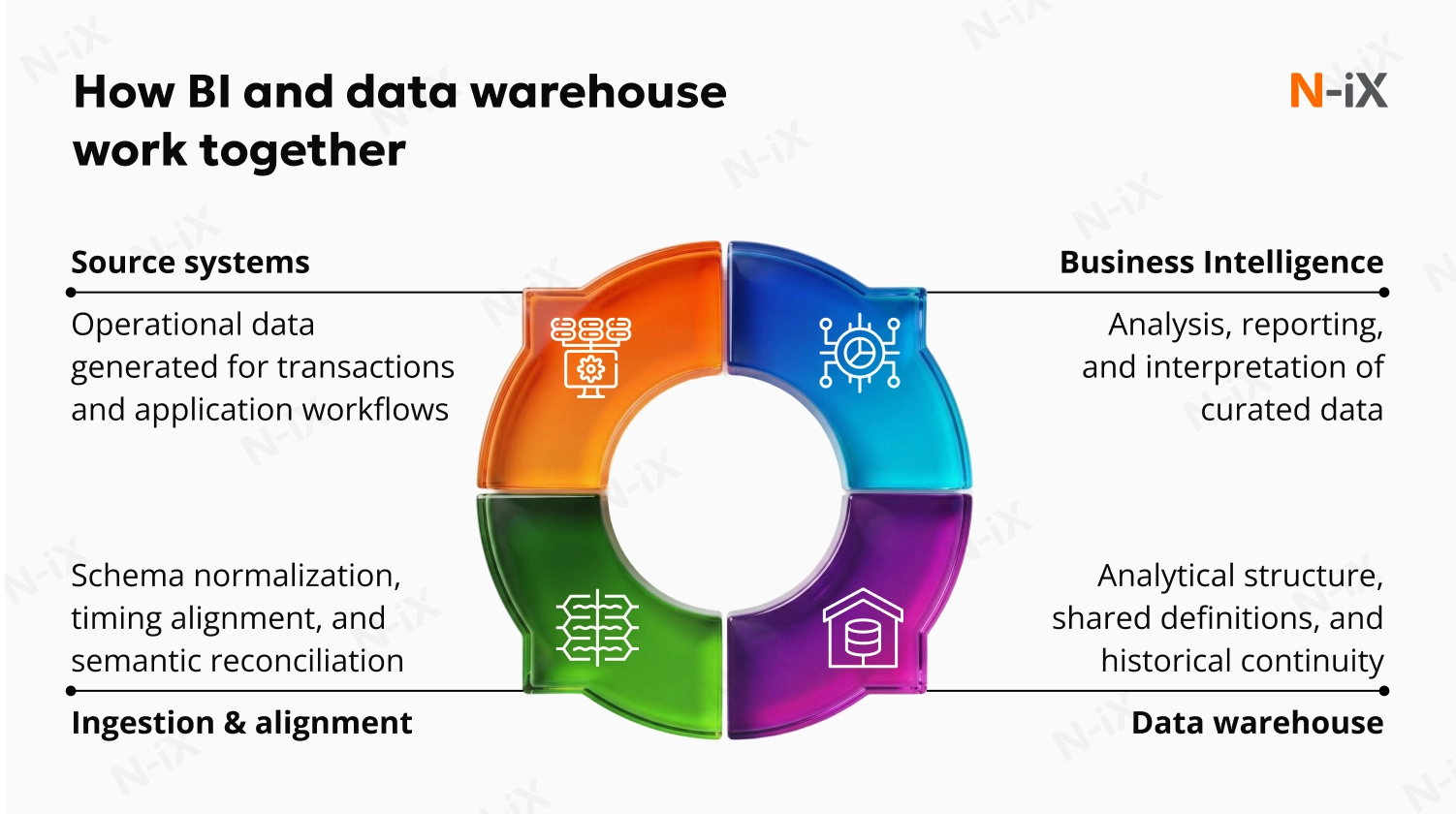
To keep this flow predictable, responsibilities are typically separated across a few stages:
- Source systems generate operational data optimized for transactions and application workflows.
- Ingestion pipelines collect and align data, resolving schema and timing inconsistencies.
- The data warehouse applies analytical structure, shared definitions, and historical continuity.
- BI tools consume curated data for analysis, reporting, and interpretation.
Analytical structuring inside the data warehouse
Once ingested, data is organized inside the warehouse according to analytical rather than operational principles. Information is structured around business subjects and modeled to support aggregation, comparison, and historical analysis. Fact tables capture measurable events, while dimension tables provide descriptive context. This modeling layer determines how metrics behave across time, categories, and organizational boundaries. Data marts may be introduced to optimize access for specific analytical domains, but they inherit definitions from the central warehouse rather than introducing independent logic.
Data warehouses are designed to support analytical query patterns that differ from transactional access. Queries often scan large datasets, aggregate values across dimensions, and compare historical periods. The warehouse infrastructure absorbs these workloads without affecting operational systems. This separation allows analytical complexity to increase without constraining day-to-day business processes. Data warehouse BI tools benefit from predictable performance and consistent data structures, which simplify analysis and reduce reliance on tool-specific workarounds.
Business Intelligence as the consumption layer
Business Intelligence tools connect to the warehouse to explore, aggregate, and present curated data. At this stage, analytical logic is consumed rather than defined. Reports, dashboards, and analytical views rely on warehouse models and approved calculations. This approach limits the spread of duplicated logic across tools and users. BI focuses on interpretation, comparison, and communication of results rather than compensating for structural inconsistencies in the data.
To make this interaction explicit, the division of responsibility between the Business Intelligence data warehouse can be summarized as follows:
|
Layer |
Primary responsibility |
What it prevents |
|
Data ingestion & warehouse |
Data alignment, historical preservation, metric definition |
Conflicting KPIs, silent logic drift |
|
Analytical modeling |
Cross-domain consistency, time-based comparability |
Local reinterpretation of metrics |
|
BI consumption |
Analysis, visualization, interpretation |
Reimplementation of business logic |
A key outcome of this integration is controlled accessibility. Complex analytical datasets are exposed to users in forms that preserve meaning while remaining usable. BI tools translate warehouse models into interfaces that support exploration without altering underlying definitions. This balance allows broader access to analytical insight while maintaining consistency across analyses. Over time, this reduces reconciliation effort and supports reuse of analytical outputs across planning, reporting, and review cycles.
How is a data warehouse related to Business Intelligence?
The relationship between a data warehouse and Business Intelligence becomes concrete where analytical methods meet prepared data. Each BI capability relies on the warehouse to stabilize meaning, preserve history, and make analysis repeatable. The sections below describe how data warehouse Business Intelligence dependency plays out across core BI practices.
Data visualization
Data visualization depends on a data warehouse to supply datasets where definitions, joins, and aggregations are already resolved. Charts and dashboards draw from warehouse models that encode shared logic, which prevents visual outputs from embedding hidden assumptions. This allows visual analysis to remain consistent across tools, teams, and reporting periods, even as data volumes increase.
Statistical analysis
Statistical analysis relies on a data warehouse to provide aligned dimensions and preserved historical records. Measures such as trends, variance, and correlations require data that behaves consistently across time and categories. The warehouse enforces this consistency so analytical results can be reproduced and validated without reinterpreting inputs.
Data mining
Data mining benefits from a data warehouse because integrated and standardized datasets reduce structural noise. Pattern discovery, segmentation, and anomaly detection depend on aligned identifiers, time dimensions, and reference data. The warehouse consolidates these elements, allowing analytical techniques to focus on meaningful relationships rather than source-level discrepancies.
Data querying
Data querying works through a data warehouse by relying on analytical schemas designed for aggregation and comparison. Queries executed through BI tools assume predictable joins, filters, and calculations. The warehouse enforces these behaviors, which keep ad-hoc analysis reliable even when queries span large datasets and long time horizons.
Performance metrics
Performance metrics depend on a data warehouse to fix calculation logic upstream. Metrics such as revenue, margin, retention, or utilization draw credibility from definitions that remain stable across reporting cycles. By centralizing these calculations, the warehouse prevents metric drift and reduces reconciliation effort across analytical outputs.
Data storytelling draw
Data storytelling draws value from a data warehouse by relying on preserved context and historical continuity. Narratives built around performance changes and outcomes require data that retains its meaning over time. The Business Intelligence in data warehouse supports this continuity, allowing stories to reflect progression and cause rather than isolated snapshots.
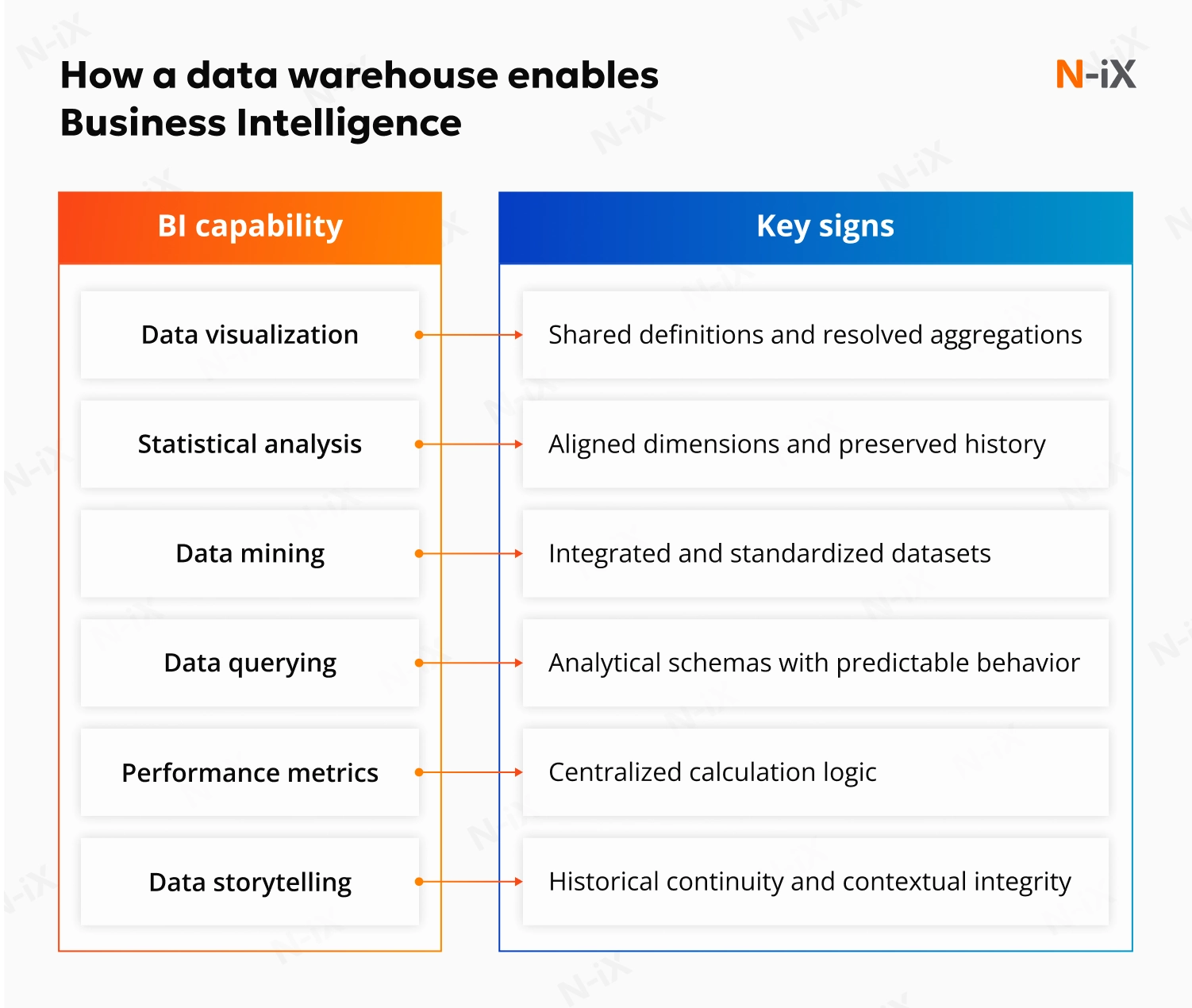
Business Intelligence and data warehouse capabilities represent the core analytical functions delivered by modern data analytics solutions. As analytical needs expand, additional tools and techniques can be introduced to support more complex use cases. Extending this analytical stack in a controlled way typically requires hands-on experience with BI platforms and data warehouse architectures to ensure new capabilities integrate without compromising consistency or maintainability.
Leverage BI data warehouse confidently with N-iX
When metrics must remain comparable across quarters, not just across teams, BI starts to depend on structural discipline rather than reporting flexibility. When BI reconciliation consumes more time than analysis, the analytical process signals strain at its foundation. When historical context carries more weight than real-time snapshots, short-lived reporting logic no longer holds. When BI queries begin to affect operational systems, analytical workloads have outgrown their original boundaries. When advanced analytics or AI initiatives depend on governed, reusable data, informal pipelines become a constraint.
Addressing these issues requires experience with how data warehouse Business Intelligence behaves under real enterprise conditions. At this point, stakeholders start looking for a partner with deep data engineering and analytics experience.
N-iX focuses on stabilizing BI at the architectural level by aligning data warehousing, analytical modeling, and BI consumption. Our role is to design, build, and evolve BI and data warehousing environments that remain stable under growth and scrutiny. We focus on analytical models that preserve comparability across reporting cycles, ingestion pipelines that reduce ambiguity early, and BI integrations that prevent logic from leaking into dashboards and spreadsheets. If you are assessing whether your current BI setup can support the next stage of growth, reach out to N-iX.

Extra perspective: Future-proofing BI with a data warehouse for AI
Future-proofing Business Intelligence for AI is primarily a data architecture problem, not a tooling problem. As analytical workloads extend into machine learning and generative use cases, BI depends on data that is governed, historically stable, and analytically coherent across domains. A modern data warehouse, increasingly implemented as a logical warehouse or lakehouse, provides the control layer where analytical meaning is formalized, metadata is managed, and data remains reusable as requirements evolve. Without this foundation, AI initiatives amplify inconsistencies rather than insight.
In an AI-enabled BI environment, the data warehouse functions as the system of record for analytical facts. It anchors advanced models to validated datasets, supports retrieval-based AI by supplying structured organizational context, and enables automation of ingestion, modeling, and governance through metadata. This alignment allows BI and AI to scale together on a shared analytical base, maintaining trust, auditability, and comparability as analytical depth and complexity increase.
FAQ
What is a data warehouse in Business Intelligence?
A data warehouse for Business Intelligence is a centralized analytical system that consolidates historical, structured data from multiple business systems into a consistent, query-ready format. Its purpose is to provide stable, trusted data for reporting, analysis, and executive decision-making.
Which modern data warehouses support BI?
Modern data warehouses that support BI are designed for analytical workloads, scalable querying, and tight integration with reporting tools. Common choices include Snowflake, Google BigQuery, Amazon Redshift, and Azure Synapse Analytics, all of which provide columnar storage, elastic compute, and native BI connectivity. Platforms such as Databricks extend this model with a lakehouse architecture that supports BI alongside advanced analytics.
How does data modeling in a data warehouse affect BI outcomes?
Data modeling determines how raw data is translated into meaningful business metrics for BI. Well-designed models align definitions across finance, sales, operations, and product teams. Poor modeling leads to inconsistent KPIs and conflicting interpretations of performance. In an enterprise BI data warehouse, data modeling is a strategic activity that directly impacts decision quality.
Have a question?
Speak to an expert