ChatGPT
 Perplexity
 Claude
 Gemini
 Grok
Grok
The ability to process and use large amounts of data has become crucial for businesses that want to stay competitive. This is where data governance comes in, as it provides the tools, standards, and methodologies that help effectively collect, store, analyze, apply, and provide proper access to data. As its value becomes more apparent, more enterprises are willing to invest in data governance. The associated market size reached $4.7B in 2025 and is expected to reach $16.9B by 2032.
However, working with data is not that simple, and to ensure you obtain the desired results, an effective data governance strategy is required. So, what are the steps involved, and what best practices can be applied to design working data governance strategies? Let’s find out.
What is a data governance strategy (and why do you need it)
A data governance strategy is a framework that ensures your organization’s data is consistently usable, understandable, and protected. It sets the foundation for how data will be managed across the entire organization, defining clear policies and responsibilities for data handling. This includes:
- Assigning accountability for implementing data policies and processes,
- Defining standards for sharing and processing data,
- Establishing naming conventions and storage protocols for data,
- Setting measurements to ensure clean, usable data.
By aligning people, processes, and technology, a data governance strategy fosters a consistent approach to data management. It ensures that every individual involved in managing data is clear about their responsibilities and the standards that need to be met. Through this, it secures data integrity by maintaining accuracy, accessibility, and usability.
Why is data governance essential?
A well-executed data governance strategy is essential for the following reasons:
- Ensures data accessibility: Makes data easy to find and use across the organization.
- Maintains data consistency: Standardizes data, making it easier to analyze and support informed decisions.
- Guarantees data accuracy: Keeps data up-to-date and relevant, ensuring integrity for analytics.
- Enhances data security: Protects sensitive data at every stage, ensuring compliance and safeguarding privacy.
With effective governance, organizations can leverage data science tools, improve decision-making, and enhance security and compliance programs.
The 7 steps of designing an effective enterprise data governance strategy
Developing a working strategy without knowing which steps to take can cause all sorts of issues, such as incurring additional expenses, not meeting your enterprise's specific requirements, or even the complete failure of your data initiatives. Therefore, let’s explore the standard steps for designing a clear, reliable strategy for your business.
1. Identifying and prioritizing existing data
The first step is to learn as much as you can about the data you have. This process consists of several activities that you should complete:
- Data classification: distributing both structured and unstructured data into corresponding categories.
- Data inventorization: recording all data resources and relevant metadata (the data about other data).
- Data and knowledge curation: using data catalogs and metadata management to arrange and manage datasets.
2. Choosing the storage option for metadata
One of the most common issues that makes the need for data governance apparent is difficulties in sharing and reusing metadata collected by different departments. The use of separate databases for managing metadata, a common practice in many enterprises, leads to siloed data with limited accessibility. Therefore, it is crucial to choose an efficient storage option, such as a data lake or data warehouse, to centralize all metadata collected across the organization. Choosing the right storage solution will tick all the necessary boxes in terms of metadata management, namely:
- Collecting metadata from multiple platforms;
- Effective reusing of metadata;
- Governance and stewardship;
- Clear insights into data history.
3. Preparing and storing metadata
This rather time-consuming step in developing a data governance strategy involves reformatting, correcting, and combining raw metadata datasets into data catalogs. It primarily consists of three activities:
- Cleansing and validation to standardize data and hide sensitive information;
- Transforming values and formats to make data easily understandable across the entire enterprise;
- Building data dictionary and business glossary templates to manage the number of uploaded data assets.
4. Developing a data governance model
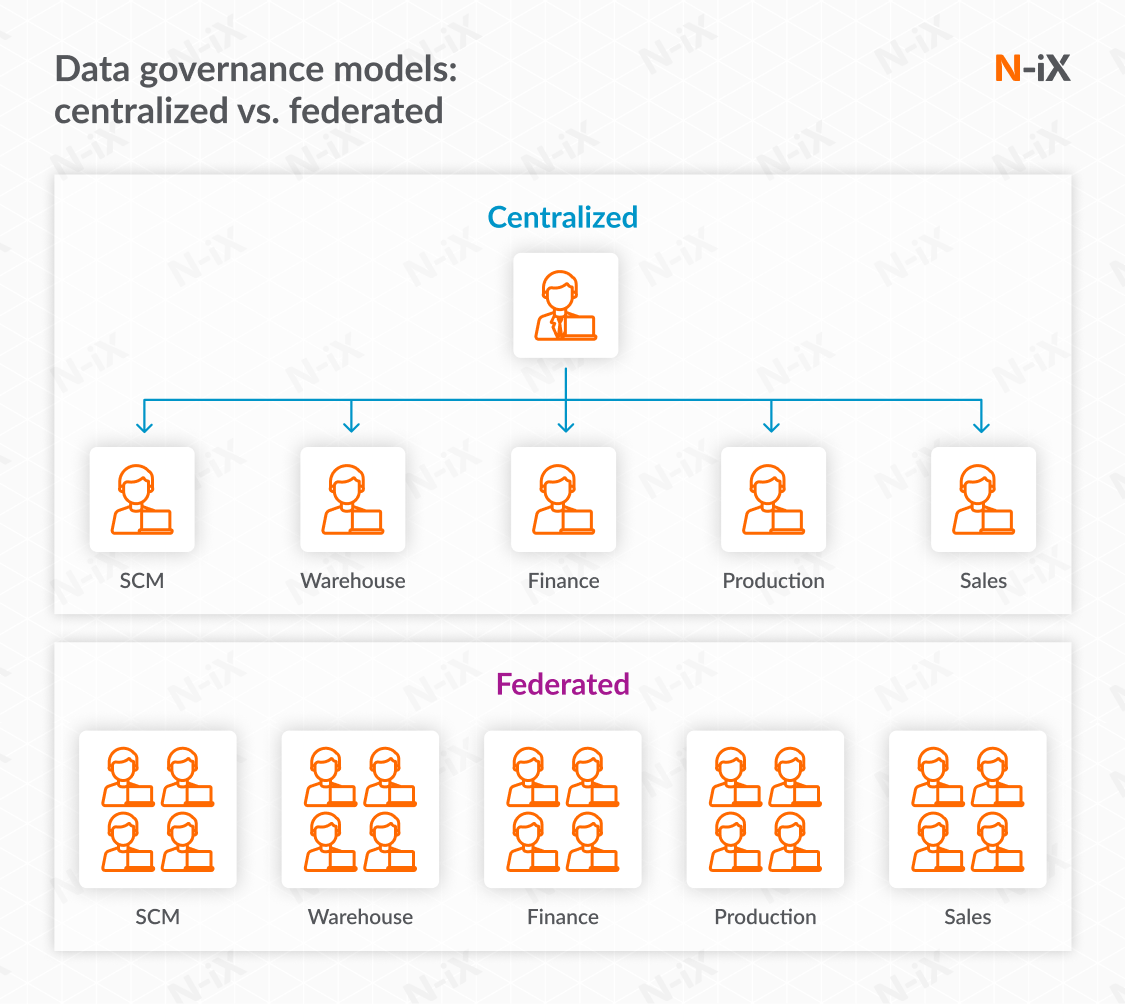
Assessing your needs and choosing the model that best suits your enterprise is an important stage in designing data governance strategies. Although there are some variations, data governance models can be generally separated into two categories:
- Centralized – authority over data is given to a single group (or even a single person) that determines the rules and distributes accesses.
- Federated (or decentralized) – authority over data is distributed among several groups of people, allowing departments with different needs to work effectively using the same assets.
5. Establishing a distribution process
Data governance works only if the people follow its policies. Therefore, a good enterprise data governance strategy should also include practices that help embed these policies into employees' normal workflows. These include, but are not limited to, establishing effective onboarding, conducting regular policy trainings, and encouraging knowledge sharing.
6. Mitigating risks
Knowing and preparing for potential risks is the best way to mitigate them. Data is always at risk of compromise, whether from external malicious attacks or careless behavior by internal users. Mitigating these risks can be achieved with:
- Ensuring that all users have as little access to data as possible in order to perform their tasks;
- Ensuring that all data is stored in secure locations with the necessary cybersecurity measures.
7. Continuously adapting the data strategy and governance
Business needs change constantly in response to market conditions, and data governance strategies must account for that. Enterprises must constantly monitor their governance processes and adjust them as new challenges appear. For example, the rise of machine learning requires a specialized approach to AI data governance to manage risks such as model bias and to ensure ethical data use.
At N-iX, for example, all of these steps are included during our Product Discovery, where we help our clients validate their idea, test the product’s market viability, and prepare it for implementation.

Read also the in-depth guide about agentic AI governance
Challenges in data governance implementation and how N-iX can address them
In implementing a data governance strategy, organizations often face several challenges that can hinder success. Here's how N-iX can help address them:
Data silos
Data is often stored in isolated systems across departments, making it difficult to access, integrate, and govern effectively. N-iX can help implement data integration solutions that break down silos, ensuring seamless data flow across departments and systems, enhancing accessibility and consistency.
Inconsistent data quality
Data quality can vary significantly across different departments and systems, making it hard to trust the data for decision-making. N-iX uses automated data quality tools and AI-driven solutions to standardize, cleanse, and maintain high-quality data across the organization, ensuring that all data is reliable and consistent.
Demands for unstructured data
Growing volumes of unstructured data (e.g., videos, documents, emails) are difficult to manage with legacy governance systems. N-iX implements cutting-edge AI and Machine Learning solutions for better categorization, analysis, and security of unstructured data. Our advanced governance frameworks are designed to manage the complexities of diverse data types while maintaining compliance and security.
Data governance in cloud and hybrid environments
Managing data governance in multi-cloud or hybrid environments, where data is spread across different platforms, adds complexity. N-iX provides expertise in cloud and hybrid environments, ensuring that governance policies and tools are effectively integrated across diverse cloud platforms, maintaining consistent data security, accessibility, and compliance.
Lack of skilled personnel
Organizations may struggle to find and retain the skilled personnel necessary to manage and execute a comprehensive data governance strategy. N-iX offers data governance expertise through teams of experts who can either assist with or fully manage data governance initiatives, ensuring that businesses have access to the right skills without the burden of recruitment and training.
How to make your data governance strategy work: tips and best practices
Now that we have explored the steps involved, let’s look at several tips and best practices that will help you make your strategy as effective as possible.
1. Set clear goals that you want to achieve
For any strategy to be effective, it must include the goals that you want to achieve in the long run. It must also include the actionable steps and a roadmap of how you will achieve them. An enterprise data governance strategy is no different. Whether you want to accelerate data processing, reduce data management expenses, or streamline cross-team collaboration, all of this must be outlined in your strategy.
2. Include a small-scale sample project at the beginning
Data strategy and governance transformation can be complicated and time-consuming. Starting off with such a project may be a daunting task, leading to errors, unforeseen challenges, and changes in requirements. Therefore, instead of beginning with a full-scale data governance implementation, it is highly recommended to start with a small-scale project that is a lot easier to manage. This can be, for example, assessing and improving the process of collecting or storing data by a single department.
3. Assign a data steward or build a data governance office
A governance strategy should outline a person (data steward) or a team (data governance office) to define and ensure clear data ownership across your organization. This entity will be solely responsible for managing and distributing data access, making managerial decisions, and ensuring that all teams remain informed of established policies. It will eliminate the risk of using incorrect or altered data and help boost the productivity of all teams. In fact, having a dedicated data steward was one of the keys to establishing effective data governance during N-iX’s collaboration with cleverbridge, a leading e-commerce solution and service provider. As a result of our cooperation, cleverbridge was able to:
- Increase customer reach by expanding their service offering;
- Boost information security of the solution they offer to customers;
- Improve their decision-making process with customer insights.
Read more: Driving growth in e-commerce with a comprehensive data analytics solution
4. Acquire assistance from an experienced data governance consultant
Setting out on a data strategy and governance journey with little to no prior experience can be quite difficult. Fortunately, there are experienced Tech consulting companies that can not only help you design a working data governance strategy but also provide the necessary experts for the job or even handle the implementation for you.
At N-iX, for example, data governance is included in our extensive data expertise. With over 200 data experts, we help leading global enterprises such as Fluke, Lebara, or AVL, in developing data solutions that help them achieve their strategic business goals.
5. Pick the right set of tools
Picking the right tools for the job is as important as doing the job itself. There are many data governance tools out there, dedicated to specific tasks such as metadata collection, cross-team communication, and managing data in the cloud. Fortunately, even if you have limited experience with these technologies, a reliable tech consulting partner will assess the specifics of your business and help you pick the tools that match your needs.

6. Ensure compliance with data protection standards
Making sure that all of your information remains protected is one of the most important aspects of any data strategy consulting journey. Hence, ensuring compliance with established data protection regulations, such as HIPAA, GDPR, or PCI DSS, should be your top priority.
Why N-iX is the right partner for developing a working data governance strategy?
If you are looking for a reliable tech partner to assist you with your data initiatives, you cannot go wrong with N-iX. Here are a few facts to convince you:
- Experience: N-iX has over 24 years of experience providing data, cloud, embedded & IoT, and other software development services.
- Expertise: Having successfully delivered more than 60 data projects to date, N-iX has extensive expertise in Data Governance, Data Analytics, AI and Machine learning, Big Data, and more.
- Reach: With over 2,400 professionals in 25 countries across Europe and the Americas, N-iX serves leading global enterprises and Fortune 500 companies worldwide.
- Recognition: N-iX is a well-known name in the tech industry, having received multiple awards and recognitions, such as an ISG-recognized Rising star in data engineering or a spot in the Global Outsourcing 100 list by IAOP.
Wrapping up
As the amount of data collected by organizations grows, it becomes increasingly important to have the means to manage and use it effectively. This is where data governance shines, but to make it work, you need to design an effective strategy first. Luckily, by following the steps, leveraging best practices, and seeking assistance from an experienced data governance services provider, developing a strategy to help you achieve your goals can be straightforward.

FAQ
What is a data governance strategy?
A modern data governance strategy is a flexible approach that ensures data is accessible, secure, and compliant with regulations. It leverages automation and AI for data management and integrates governance practices across IT, business units, and compliance teams. Designed for scalability, it supports data-driven decision-making and adapts to evolving data environments.
What makes a data governance strategy successful?
A successful data governance strategy requires clear leadership, alignment across departments, and integration with the company’s overall business objectives. It should address data security, quality, and accessibility, while ensuring compliance with regulatory standards. Furthermore, it must be adaptable to evolving business needs and scalable to handle increasing data complexity.
What is the biggest barrier to successful data governance implementation?
The biggest barrier is often cultural resistance within the organization. Employees may be reluctant to change established processes or workflows, which can delay or hinder the adoption of data governance practices. Overcoming this requires clear communication, change management efforts, and leadership alignment.
What are the main steps of data governance?
The main steps of a data governance strategy include:
- Assessing data needs: Understand the organization’s data challenges and establish key goals.
- Establishing a governance framework: Define the roles, responsibilities, policies, and standards.
- Data classification and management: Implement systems to classify, manage, and protect data.
- Technology and tool implementation: Deploy tools to manage data access, security, and analytics.
- Monitoring and continuous improvement: Regularly review and refine the governance practices.
Have a question?
Speak to an expert