
 ChatGPT
 Perplexity
 Claude
 Gemini
 Grok
Grok
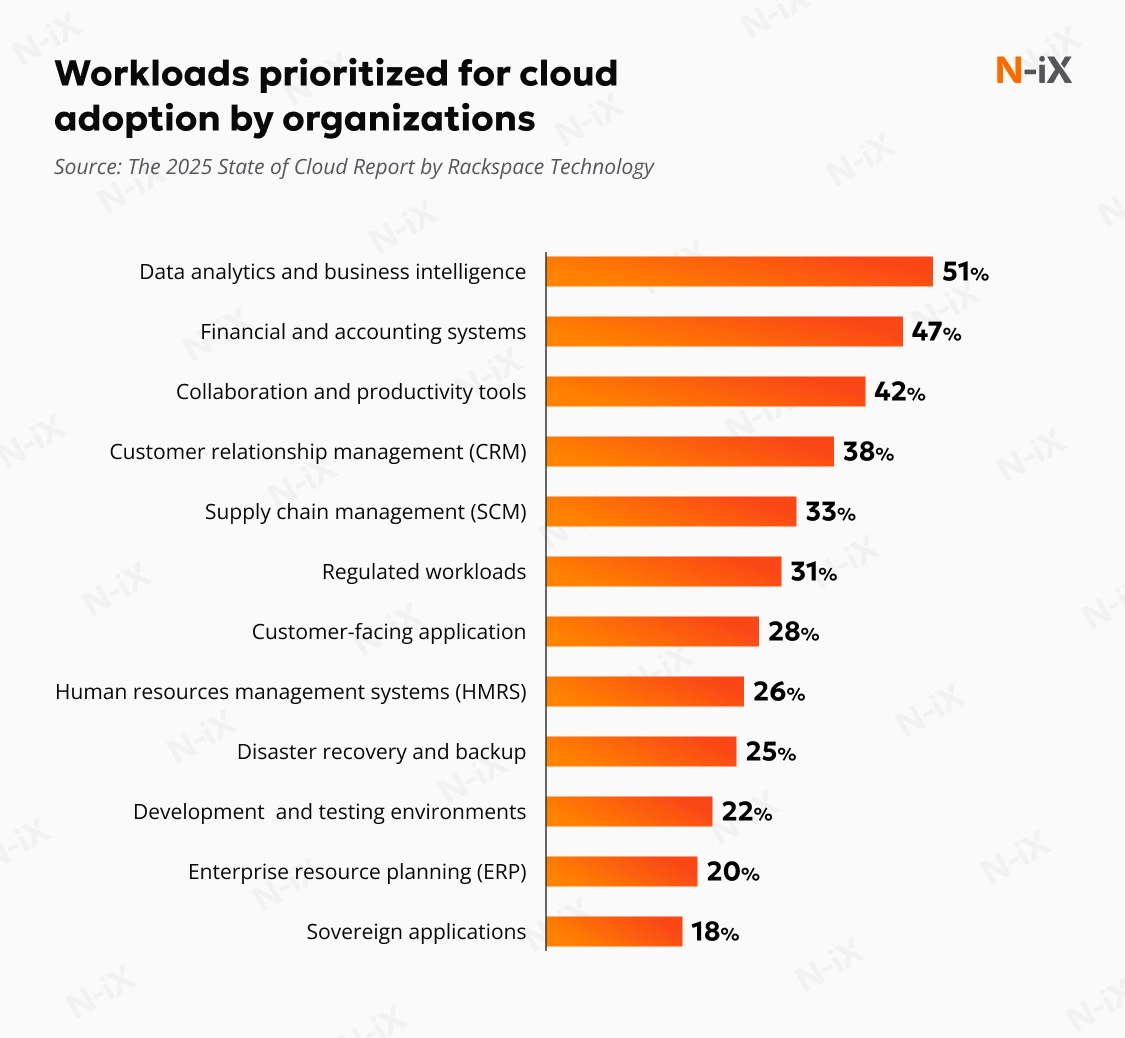
Data analytics is becoming a key driver of cloud adoption for enterprises. According to the State of Cloud Report 2025 by Rackspace, 51% of organizations consider data analytics and business intelligence as the most critical workloads for moving to the cloud. At the heart of this shift is predictive analytics, which benefits the most of cloud computing scalability, elastic storage, and automated data processing.
So, how does cloud-based predictive analytics work? Why are more organizations adopting it now? And what does it take to integrate it effectively? Our cloud experts share the answers and tips in this article.
How does predictive analytics work in the cloud?
Traditional on-premises analytics platforms are typically constrained by fixed infrastructure, long provisioning cycles, and limited scalability. Cloud-based PA addresses these challenges. Computing loads and storage scale dynamically based on workload demand. Advanced analytics services can be provisioned in minutes rather than months. Teams can experiment with new data sources, algorithms, and model configurations without long procurement cycles or infrastructure lock-in.
Read more: Cloud BI vs traditional BI: Evolving enterprise analytics with cloud computing
Integration is another key difference. Cloud platforms connect predictive analytics directly to data lakes, streaming pipelines, and operational systems. This makes it easier to generate predictions close to where data is generated and to embed results into day-to-day decision-making.
Key components of predictive analytics in the cloud
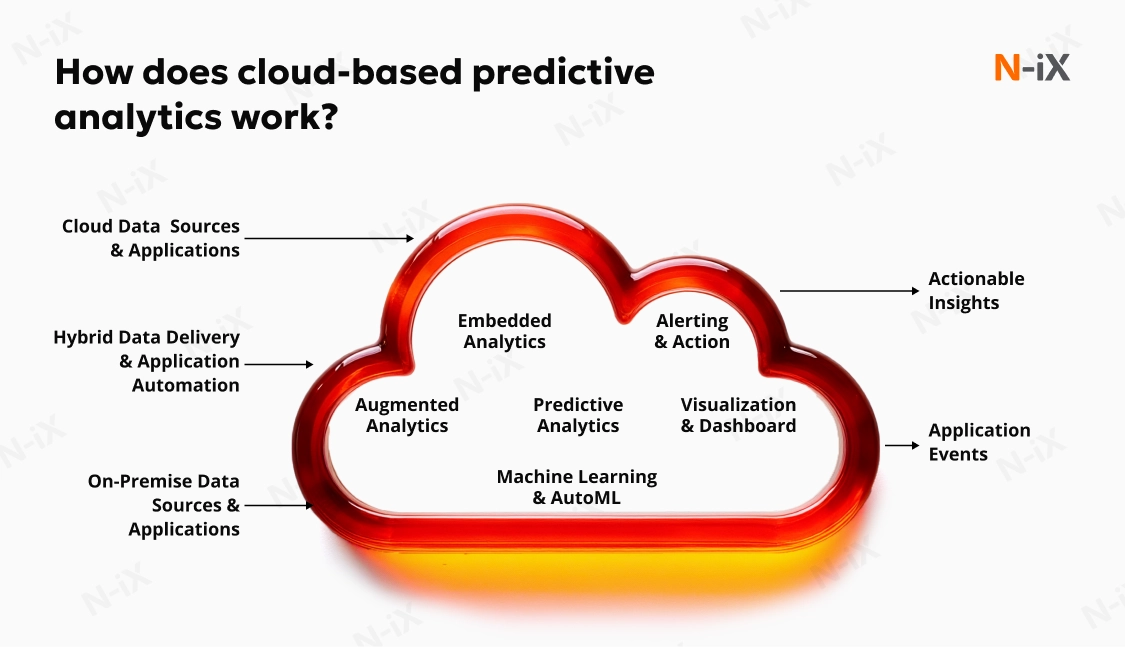
A typical cloud-based predictive analytics architecture includes several tightly integrated layers that leverage the flexibility of the modern “Lakehouse” approach:
- Data ingestion and storage: Cloud-native data lakes and warehouses store volumes of structured and unstructured data. Some data is sent to the cloud at set intervals, such as daily or hourly. Other data arrives continuously as events occur. The cloud stores both types together so they can be analyzed and used to make predictions.
- Data processing and feature engineering: Before data is used for predictions, it passes through automated ETL (Extract, Transform, Load) pipelines that standardize and prepare it for analytics. Cloud-based ETL tools run these processes at scale, producing consistent inputs for predictive workloads and supporting reuse across multiple scenarios.
- Model development and training: Managed cloud machine learning services provide frameworks, libraries, and scalable compute for training predictive algorithms. Data engineering teams can train models on large datasets without requiring deep technical expertise or managing the underlying infrastructure.
- Model deployment and inference: Trained models are deployed as APIs or embedded into applications. Cloud platforms support both real-time and batch inference, adjusting to specific latency and bandwidth requirements. This ensures that the final predictions are delivered efficiently to the end-user or business system.
- Monitoring and governance: Cloud-based tools enable monitoring model performance, data drift, and operational reliability. Automated monitoring is critical for maintaining trust in predictions and meeting regulatory expectations.
Why choose cloud computing for predictive analytics?
Cloud-based business analytics adoption is driven by a combination of technical and business considerations. The benefits go beyond infrastructure efficiency and directly affect how organizations operate:
- Scalability and elasticity enable predictive workloads to scale up or down in response to demand. This is particularly important for model training, which often requires intensive computing for limited periods. Instead of investing in permanent capacity, organizations pay for resources only when they are needed.
- Faster access to insights improves decision-making. Cloud platforms reduce the gap between data availability and model execution. New data can be added quickly, and models can be retrained more often as conditions change.
- Managed infrastructure reduces operational overhead by shifting platform maintenance to the cloud provider. This enables internal teams to focus on analytics logic, data quality, and core business rather than platform maintenance.
- Advanced analytics capabilities are integrated into cloud services. Cloud facilitates automated machine learning, integrated data preparation, and built-in monitoring. Automation and simplified dashboards and tools significantly shorten development cycles and reduce dependence on internal resources.
- Global accessibility and collaboration support distributed teams. Integrated predictive analytics environments can be accessed securely from multiple regions, making them suitable for organizations with international operations and hybrid delivery models.
How are cloud-based predictive analytics used across industries?
Cloud predictive analytics provides tools and technologies that turn complex data into actionable insights. Automation and simplified interfaces reduce manual effort and remove the need for rigid infrastructure. Let’s review how data analytics enables consistent decision-making across industries:
Financial services
Banks and financial institutions use predictive analytics to assess credit risk, detect fraud, forecast liquidity, and manage portfolios. Cloud environments allow them to process large volumes of transactional data, retrain risk models frequently, and respond quickly to market volatility. Secure cloud architectures also support regulatory reporting and auditability when designed correctly.
Healthcare
In medical organizations, predictive analytics cloud services are often used to identify risks early. Models help estimate patient demand, predict readmissions, and assess treatment outcomes. Cloud platforms enable the aggregation of data from electronic health records, medical devices, and operational systems. This supports population-level analysis while maintaining strict access controls and compliance requirements.
Retail and manufacturing
Retailers and manufacturers rely on predictive analytics to forecast demand, optimize inventory, and plan production. Cloud-based predictive analytics helps integrate historical sales data, supply chain signals, and many external factors such as seasonality. Manufacturers also apply PA to sensor data to anticipate equipment issues before failures disrupt operations.
Marketing and customer management
Marketing and customer-focused teams use predictive analytics to estimate churn, forecast lifetime value, and personalize engagement strategies. Cloud platforms make it easier to unify customer data across channels and deploy predictive insights directly into CRM and marketing automation systems.
Cloud and IT operations management
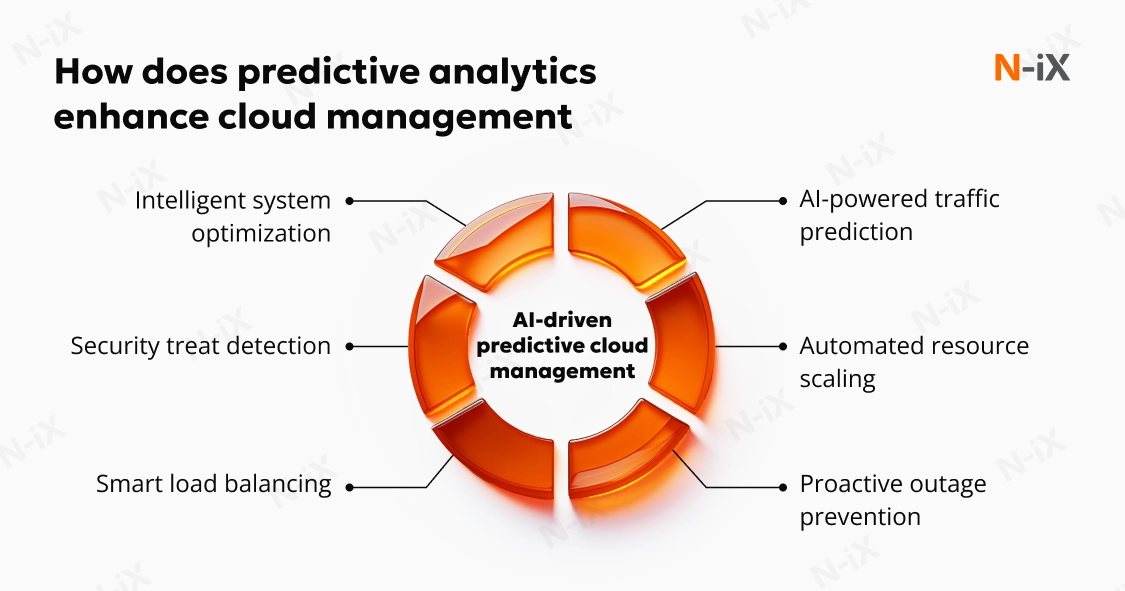
Predictive analytics is increasingly applied to cloud and IT operations themselves. By analyzing infrastructure metrics and usage patterns, organizations can predict capacity needs, detect anomalies, and optimize cloud costs. This supports more proactive cloud governance and operational planning.
Leading cloud-based analytics platforms
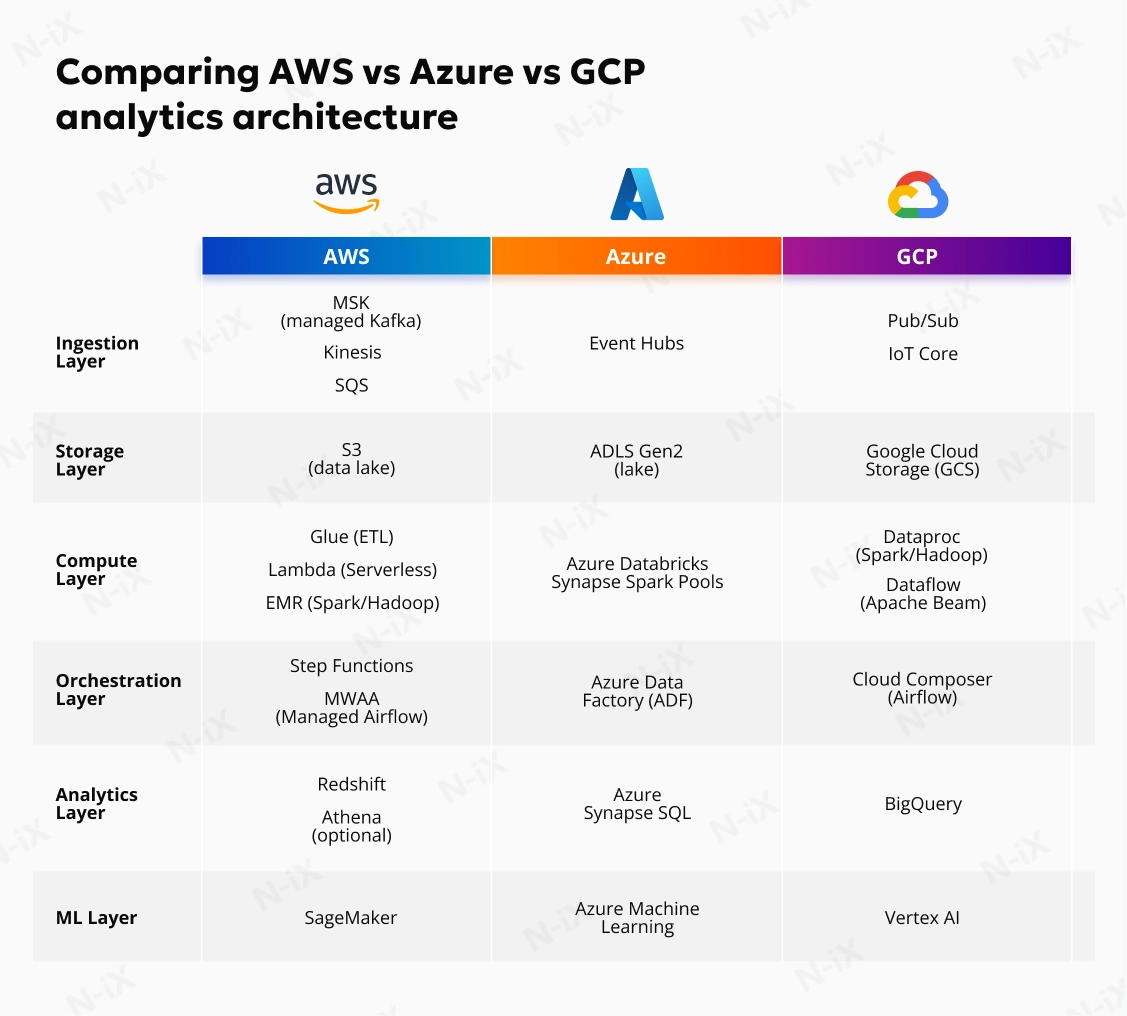
Cloud analytics platforms from hyperscalers provide powerful tools for building and deploying predictive analytics models. Our cloud analytics break down AWS vs Azure vs GCP offerings below:
AWS covers the entire predictive analytics lifecycle, with SageMaker for machine learning, Forecast for time-series predictions, and QuickSight for business insights. Its integrated ecosystem is ideal for large-scale computing and data storage efficiency.
Azure combines predictive analytics with enterprise systems, offering Azure Machine Learning for model development and Synapse for data warehousing. With Azure's user-friendly interfaces and seamless integration, organizations can use it for enterprise-grade governance.
GCP focuses on large-scale data processing, with BigQuery ML for SQL-based modeling and Vertex AI for model training and monitoring. It is suited for analytics-heavy workloads such as anomaly detection and personalization.
Learn more: How to choose the best cloud for handling AI workloads: A comprehensive guide
Addressing challenges of predictive analytics in the cloud
Despite many benefits, cloud-based predictive analytics is also challenging to implement and maintain. Organizations in various industries face similar obstacles that affect accuracy, increase costs, or delay deployment. Based on delivery experience, N-iX data experts identified frequent problems and offer tips for overcoming them.
Uncontrolled cloud costs
Analytics workloads can scale rapidly, especially during training and testing. Without visibility and control, cloud consumption grows unpredictably. Cost issues often appear after models are already in use.
N-iX recommendation:
Align predictive analytics with cloud FinOps to balance performance needs with budget discipline. FinOps practices help optimize costs, running only when necessary and ensuring inputs meet the required criteria.
Security, compliance, and trust in predictions
Predictive analytics often uses sensitive data. Concerns around access control, regulatory compliance, and model transparency can delay adoption. If predictions cannot be explained or audited, trust declines quickly.
N-iX recommendation:
Use cloud-native security practices like identity management, encryption, and audit logging to embed security into analytics workflows. Also, implement automated anonymization during the data cleansing process using a REGEX-based pipeline. REGEX (Regular Expressions) helps match text patterns to company-specific rules, ensuring sensitive data is properly anonymized using cloud-native serverless functions.
Skill gap
Cloud-based predictive analytics requires expertise in data analytics, machine learning, DevSecOps, and cloud platforms. Organizations may lack these skills internally, which slows adoption and increases the risk of delivery failure.
N-iX recommendation:
Partner with a cloud and data advisory that offers analytics and cloud engineering expertise. An experienced partner can help design scalable architectures, select appropriate services, and establish reliable SDLC lifecycle management. This reduces dependency on internal skills and accelerates adoption.
Why choose N-iX as your cloud analytics consultant?
Building predictive analytics in the cloud requires experience in data engineering, AI/ML, and cloud platforms. With over 23 years of experience, N‑iX supports cloud analytics initiatives and helps organizations design, deploy, and integrate insights into real business workflows.
N-X brings together more than 400 cloud engineers and over 200 data specialists. In the past five years, our teams have delivered 150+ cloud projects, including predictive analytics and AI-driven solutions tailored to specific operational and regulatory requirements. N-X is a Solutions Partner in the Microsoft AI Cloud Partner Program, holds Visual Intelligence Expertise within Google Cloud Partner Advantage, and maintains Premier Tier Services status in the AWS Partner Network. We also comply with ISO 27001, ISO 9001:2015, SOC 2, GDPR, and PCI DSS standards, helping clients protect sensitive data throughout the full analytics lifecycle.
Contact us and get support across data engineering, model deployment, and cloud integration from top N-iX experts.
Have a question?
Speak to an expert