
Key takeaways
- Since June 2026, OpenAI’s proprietary GPT models have been generally available on Amazon Bedrock, so enterprises now choose between platforms as much as between models.
- OpenAI’s own platform gets new models, features, and previews first, while Bedrock offers multiple model providers under AWS security, billing, and governance controls.
- At global inference, OpenAI models cost the same per token on both platforms, so cost differences come from add-on services, agent overhead, and existing cloud commitments.
- The same model can have different features, service tiers, and release dates on each platform, so check the model card before you commit.
- Azure OpenAI is a third route to the same GPT models, operated by Microsoft and best suited to organizations that already run on Azure.
Until 2026, an enterprise that wanted to use proprietary GPT models had to work outside its AWS environment. That meant a separate contract, API keys, and data controls for the security team to review. In June 2026, GPT-5.5 became generally available on Amazon Bedrock, and the GPT-6 family followed in September. For companies with a mature AWS setup, model access is no longer the hard part.
The open question N-iX experts meet during AI consulting engagements is where those models should run and under what terms. AWS Bedrock vs OpenAI now comes down to data residency, feature availability, release timing, and which cloud commitment absorbs the spend. Leadership teams spend most of their evaluation time on these points, long after the model shortlist is settled.
This guide compares the two platforms across models, data control, agent tooling, and cost. It also explains where Azure OpenAI fits and offers a framework for choosing.
Quick overview: AWS Bedrock vs OpenAI at a glance
|
Dimension |
Amazon Bedrock |
OpenAI (direct) |
|
Model catalog |
Over 100 foundation models from about 20 providers, including Amazon, Anthropic, OpenAI, Meta, and DeepSeek |
OpenAI models |
|
Newest models and features |
New OpenAI models arrive close to launch; some features follow later |
Available first |
|
Agent tooling |
AgentCore, Knowledge Bases, Managed Agents (preview) |
Responses and Agents APIs, Agents SDK, Frontier |
|
Customization |
Fine-tuning, reinforcement fine-tuning, distillation, Custom Model Import |
Self-serve fine-tuning closed to new users |
|
Data retention |
Per-Region settings, including zero retention |
30-day abuse logs; zero retention on approval |
|
Data residency |
Region-level control |
10 regions; in-region processing in the US, EU, and UAE |
|
Compliance |
HIPAA-eligible, SOC, ISO, FedRAMP High in GovCloud |
SOC 2 Type 2, HIPAA BAA available |
|
Identity and networking |
IAM, PrivateLink, CloudTrail, KMS |
API keys, SAML SSO |
|
Billing |
AWS invoice; counts toward AWS commitments |
OpenAI contract and commitments |
|
Best for |
AWS-native teams, multi-model strategies, regulated workloads |
Teams that need the newest OpenAI capabilities first |
What is Amazon Bedrock?
Amazon Bedrock is AWS’s managed service for building generative AI applications on foundation models from multiple providers. Teams call every model through one set of controls, and all traffic stays within AWS identity, networking, and logging controls. The Bedrock pricing page lists about 20 model providers, including OpenAI, Anthropic, Meta, Mistral, and Amazon’s own Nova family [1].
Around the models, AWS has built the services that enterprises would otherwise assemble on their own:
- AgentCore, which runs, secures, and monitors AI agents in production;
- Knowledge Bases for retrieval-augmented generation (RAG) over company data;
- Guardrails for content filtering, PII redaction, and grounding checks;
- Fine-tuning, distillation, and Custom Model Import for teams that adapt models to their own tasks.
For a CTO, Bedrock’s main draw is consistency. One set of security controls, one bill, and one platform cover every model the company uses.
Read also: What are open-weight AI models and how to use them safely in 2026
What is OpenAI’s enterprise offering?
OpenAI builds the GPT models and offers enterprises direct access to them. It has also built a platform around those models, and enterprises usually adopt it in three layers:
- The API platform, with the Responses and Agents APIs and the Agents SDK for custom applications;
- ChatGPT Enterprise, the workforce product for employees;
- Frontier, an enterprise platform for deploying and managing agents, launched in February 2026.
This structure explains why a Bedrock vs OpenAI comparison can feel uneven. OpenAI’s API is one product among several, while Bedrock is a platform layer in its own right. This guide compares OpenAI’s API and agent tooling with Bedrock’s full stack.
What changed in 2026: OpenAI models on Amazon Bedrock
From Bedrock’s launch in 2023 until mid-2025, the two options were distinctly separated. GPT models were available only through OpenAI and Microsoft, while Bedrock offered models from Anthropic, Meta, Mistral, Amazon, and other providers. That separation ended in stages over the past 14 months.
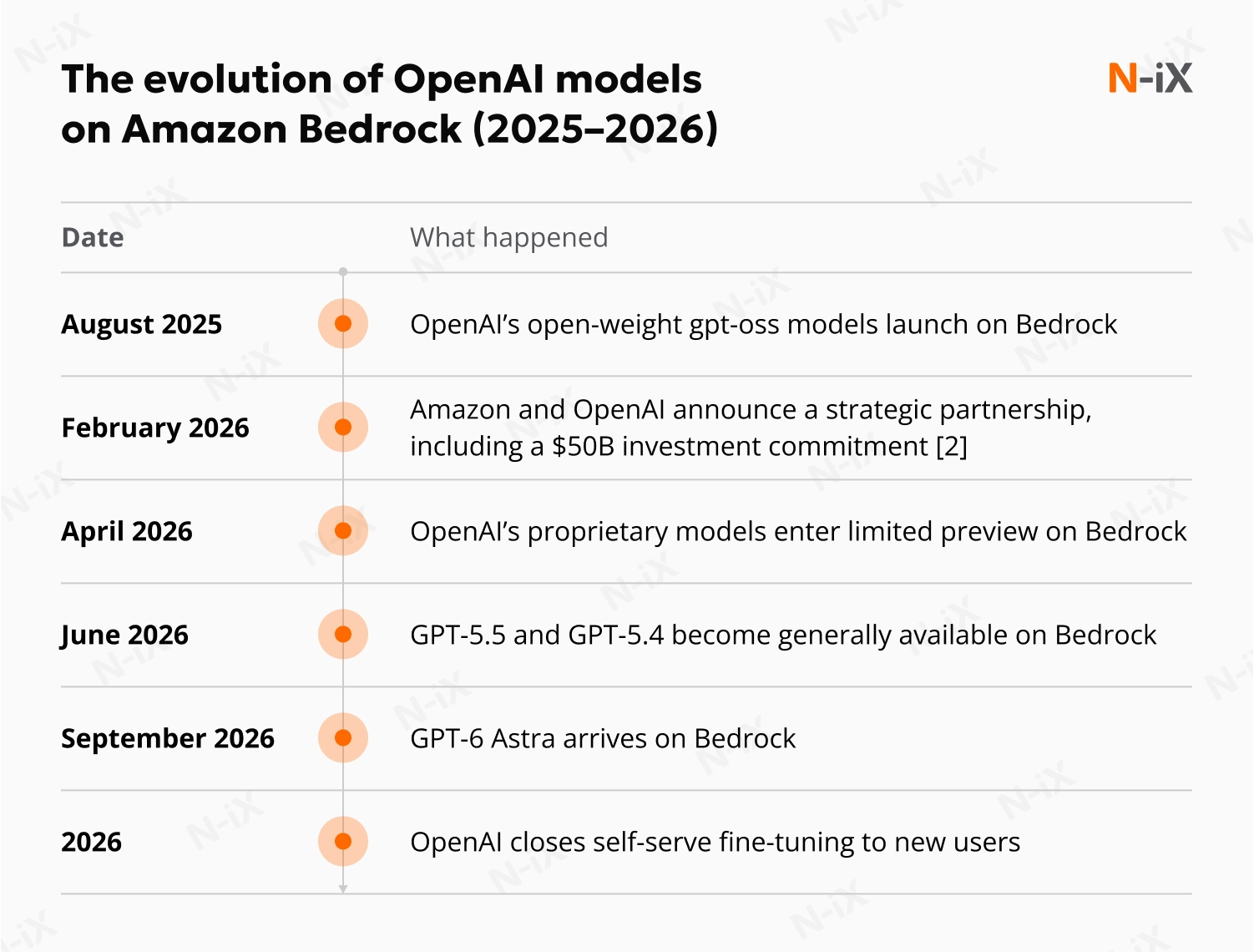
Model access no longer separates the two options. An AWS-native company can run GPT models without a second vendor contract, so the AWS Bedrock vs OpenAI decision moves to platform features, data terms, and commercial fit.
AWS Bedrock vs OpenAI: 5 evaluation criteria for enterprises
The overview table summarizes where the platforms differ. The five criteria below are where most enterprise evaluations narrow to one platform. Each has trade-offs that a simple feature comparison misses, such as a capability that exists on the platform but not for the specific model you plan to use.
Model choice and access to frontier models
Bedrock’s key strength is breadth. One team can route coding tasks to Claude, customer chat to GPT, and bulk classification to a low-cost open-weight model through the same API. Enterprise usage is already spread this way. In 2025, Anthropic held 40% of the enterprise LLM API market and OpenAI 27%, according to Menlo Ventures [3].
OpenAI’s platform leads on depth and timing, with new models, API features, and previews appearing there first. While choosing Amazon Bedrock vs OpenAI, this is the clearest dividing line. Teams whose products depend on the newest GPT capabilities tend to keep a direct OpenAI relationship.
Feature parity across platforms
A model’s name tells you less than its model card. Each platform wraps the same GPT model in its own features and service tiers.
GPT-6 Astra on Bedrock is a good example. Its model card shows that Guardrails work only through the Converse API, and intelligent prompt routing is unavailable. The model also lacks Bedrock’s Flex, Priority, and Reserved tiers, while OpenAI offers it with an Ultrafast option.
A tip from N-iX’s AI engineers:
List the features your use case depends on, such as guardrails, prompt caching, or batch processing, or a specific service tier. Check each one against the model card for the exact version you plan to deploy. Platform-wide feature pages describe the best case across all models.
Data privacy, residency, and compliance
Both platforms keep customer API data out of model training by default. The differences lie in who holds the data, for how long, and where it is processed.
Bedrock enables you to restrict model providers’ access to customer prompts or outputs. AWS added per-Region data retention settings in 2026, including zero retention [4]. Some models require a review mode in which AWS keeps data for up to 30 days. Bedrock is HIPAA-eligible and holds FedRAMP High authorization in AWS GovCloud (US-West) [5].
OpenAI keeps abuse-monitoring logs for up to 30 days, and zero data retention requires its approval. Data residency covers 10 regions, though only the US, EU, and UAE process inference in-region. For regulated workloads, these details often decide the outcome of an AWS Bedrock vs OpenAI evaluation.
Read more: Data sovereignty for enterprise AI and cloud
Agents, retrieval, and application tooling
Agent infrastructure is where both companies are investing the most. Bedrock’s AgentCore covers runtime, memory, identity, a tool gateway, and observability for agents built with any framework. AWS is also previewing Bedrock Managed Agents powered by OpenAI, which runs OpenAI’s agent harness on AgentCore.
OpenAI’s Responses and Agents APIs, Agents SDK, and Frontier offer developers the shortest path to OpenAI-native agent features. Bedrock’s tooling works across model providers, which suits teams that plan to mix models inside one agent workflow.
Customization and integration with your stack
Customization options are shifting toward Bedrock. OpenAI has closed self-serve fine-tuning to new users, and Bedrock extended reinforcement fine-tuning to open-weight models such as GPT-OSS and Qwen [6].
Integration takes less effort than many teams expect. Bedrock supports OpenAI-compatible APIs, so applications built with the OpenAI SDK can call GPT models on Bedrock with a new endpoint and key. AWS teams keep their IAM roles, PrivateLink connections, and CloudTrail logging as they are.
AWS Bedrock vs OpenAI pricing: Side-by-side comparison
List prices are where the two platforms differ least. With global cross-region inference, OpenAI models on Bedrock cost the same per token as on OpenAI’s API. Both platforms charge about 10% more for regional processing on newer models. The cost decision therefore turns on pricing mechanics, add-on services, and commitments.
Pricing models compared
Both platforms sell capacity in similar shapes, with different names and availability by model.
|
Pricing option |
Amazon Bedrock |
OpenAI (direct) |
|
Standard (on-demand) |
Pay per token |
Pay per token |
|
Batch |
50% discount on supported models |
50% discount |
|
Flex (slower, lower cost) |
50% discount |
50% discount |
|
Priority / Fast |
75% premium |
2x the standard rate |
|
Reserved capacity |
Reserved Tier, Provisioned Throughput |
Scale Tier, Reserved Capacity |
|
Regional processing |
About 10% premium |
About 10% premium for newer models |
At the time of writing, per the Amazon Bedrock and OpenAI pricing pages. Tier availability varies by model.
A rate-limit quota caps how much traffic you may send. Guaranteed throughput comes only with reserved capacity, so workloads with strict latency targets need a reservation or a fallback model. Usage forecasting, a core part of AI cloud cost optimization, helps size those reservations before you commit.
Pricing snapshot
Verified October 21, 2026. Standard tier, USD per 1M tokens (input / output).
|
Model |
OpenAI direct |
Amazon Bedrock (global inference) |
|
GPT-6 Astra |
$10 / $50 |
$10 / $50 |
|
GPT-6.1 Sol |
$2 / $10 |
$2 / $10 |
|
GPT-6 Luna |
$0.10 / $0.50 |
$0.10 / $0.50 |
|
Claude Sonnet 5.5 |
Not offered |
$2 / $10 |
Model prices change several times a year, so check the official pricing pages before budgeting.
The hidden cost drivers
In most AWS Bedrock vs OpenAI evaluations N-iX runs, tokens make up only part of the production bill. The rest comes from items that seldom appear in a price list, including:
- Platform services. Bedrock bills Knowledge Bases, Guardrails, and logging separately. OpenAI charges separately for built-in tools such as file search and web search.
- Agent overhead. Agents resend context, call tools, and retry steps, so one request can consume several times the visible tokens.
- Evaluation and monitoring. Regression tests, quality scoring, and tracing run continuously in production.
- Commitments. Bedrock spend counts toward AWS commitments, and OpenAI spend draws down an OpenAI agreement. An underused commitment changes the effective price.
Explore our in-depth guide to agent token usage optimization
Where does Azure OpenAI fit in?
Azure OpenAI appears on almost every enterprise shortlist. It runs the same OpenAI models, with Microsoft as the operator, the contract holder, and the owner of the controls. For organizations already investing in Azure, it turns AWS Bedrock vs OpenAI into a three-way choice.
What is Azure OpenAI?
Azure OpenAI is OpenAI’s model lineup hosted and sold by Microsoft, now branded as Azure OpenAI in Foundry Models. Customers sign with Microsoft, authenticate through Entra ID, receive Microsoft’s SLAs and content filtering, and pay on their Azure invoice. Microsoft Foundry also offers other model families, including Anthropic’s Claude.
Until April 2026, Azure was the exclusive cloud for OpenAI’s API products. The amended Microsoft-OpenAI agreement lets OpenAI sell through any cloud, while Azure stays its primary partner and gets products first [7].
AWS Bedrock vs Azure OpenAI vs OpenAI direct
The three routes lead to the same GPT models. What changes is who runs them, how quickly new releases arrive, and which controls come with them.
- OpenAI direct. OpenAI runs the service and ships new models at launch. Data residency covers 10 regions, reserved capacity comes through Scale Tier, and billing sits on an OpenAI contract.
- Azure OpenAI. Microsoft supports it and usually gets new OpenAI models first. It offers Global, Data Zone, and Regional deployments, PTUs for reserved capacity, Entra ID access, and Azure billing.
- OpenAI on Amazon Bedrock. It is available on AWS, with new models arriving at or shortly after launch. It adds IAM access, in-Region inference, and AWS billing, plus about 20 other model providers on the same API.
When Azure OpenAI is the right choice
For teams weighing Azure OpenAI vs AWS Bedrock, existing infrastructure usually settles the matter. Azure OpenAI tends to fit organizations that:
- Run most workloads and data platforms on Azure;
- Have Azure consumption commitments with room for AI spend;
- Manage identity through Entra ID and Microsoft 365;
- Need EU Data Zone deployments under Microsoft’s compliance coverage.
Companies with a mixed footprint often use two routes as part of a broader multi-cloud strategy, with each workload placed close to its data.
Explore more: Azure vs AWS for AI: Which cloud fits your workloads
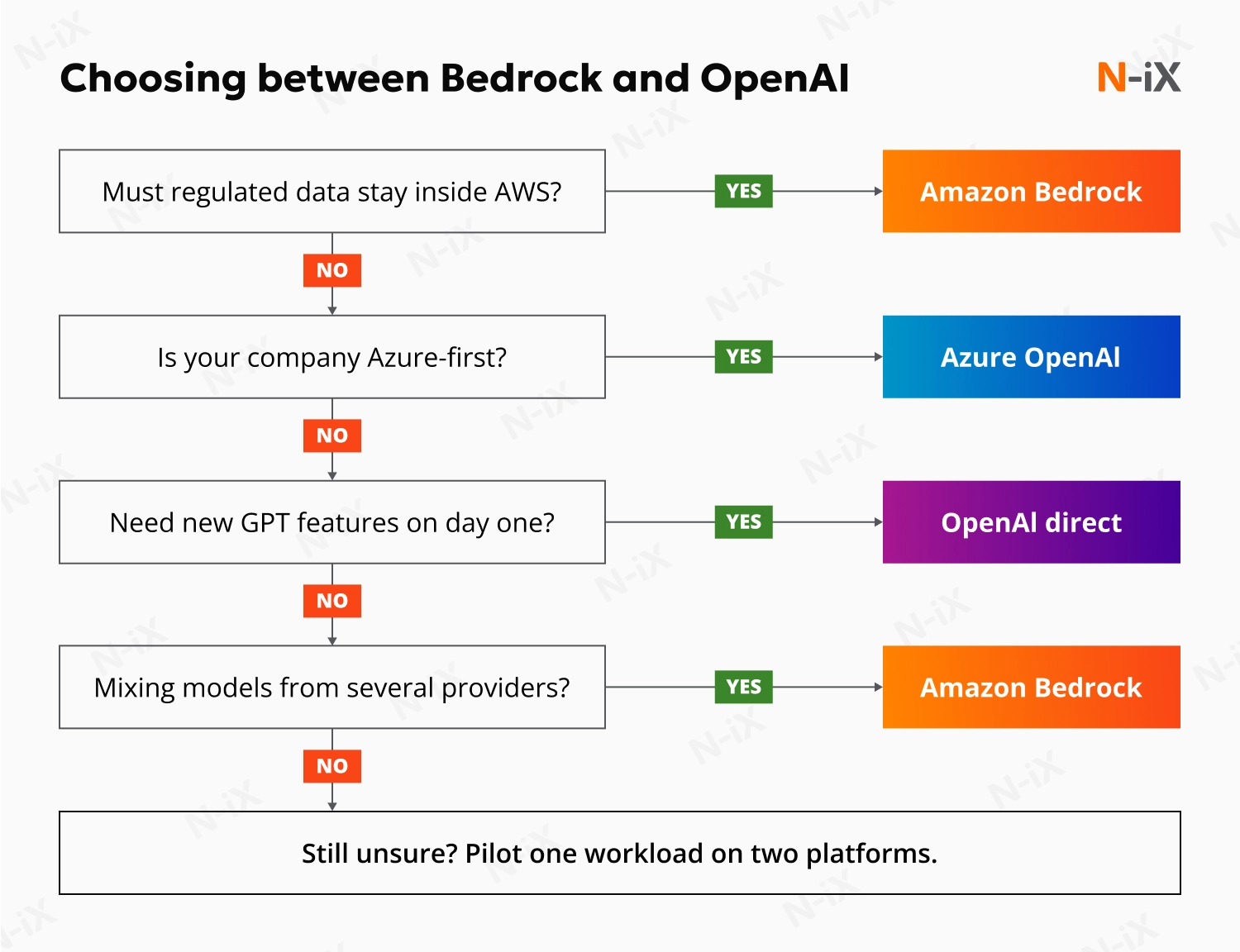
How to choose between AWS Bedrock vs OpenAI
A platform comparison becomes useful once it is tied to your use case. The scenarios below reflect the patterns we see most often in enterprise evaluations.
Match your situation to the right route
Find the scenario closest to yours, and the likely starting point follows.
AWS-native with regulated data? Start with Amazon Bedrock, where data stays inside your existing AWS controls and audit trails.
Product built around the newest GPT features? Keep a direct OpenAI relationship for day-one access to releases and previews.
Microsoft-centric infrastructure and identity? Azure OpenAI is the natural route, for the reasons covered above.
Planning to mix models from several providers? Use Amazon Bedrock or a cross-platform gateway, so one control layer covers every model.
AI assistants for the workforce as the main goal? Pair ChatGPT Enterprise for everyday writing, research, and analysis with Bedrock for the custom applications your teams build.
US public sector or FedRAMP High? Look at Bedrock in GovCloud or Azure Government, and confirm your model is authorized there.
5 questions to answer before you sign
When deciding between AWS Bedrock vs OpenAI, most enterprises encounter five core questions. Where an answer touches contract terms, get it in writing.
- Where must data be stored and processed? Match each workload’s residency needs to the regions supported for your chosen model.
- Which features does the use case need? Check the model card on each platform.
- Which commitment will absorb the spend? Underused AWS, Azure, or OpenAI commitments change the effective price.
- How fast do you need new releases? Products built on the newest GPT capabilities need day-one access.
- What is the exit plan? Decide how you would move a workload if pricing, terms, or quality change.
5 steps to adopt Amazon Bedrock or OpenAI
Whichever route you pick, the adoption path looks similar. Each step should prove its value before the next one starts, so the final decision stays open to revision while evidence builds up.
1. Audit workloads, data, and commitments
Catalog your existing and planned AI use cases. Classify each by data sensitivity, residency, latency targets, and volume, then map them against current AWS, Azure, and OpenAI agreements. This step alone often settles the platform for the most sensitive workloads.
Pitfall to avoid: Treating the whole portfolio as one decision. A support chatbot and a claims-processing pipeline can belong on different platforms.
2. Build an evaluation harness before choosing
Assemble a golden dataset of 100 to 300 real tasks with expected outputs, scored on quality, latency, and cost per task. Run the same model on every candidate platform. Our AI engineers build this harness first in every platform evaluation, because it gets reused for each model upgrade.
Pitfall to avoid: Choosing on public leaderboards, which say little about your documents, tone, or edge cases.
3. Put a portability layer in front of the models
An AI gateway or shared client library gives every application one interface to all models. Bedrock’s OpenAI-compatible APIs help here, since the same SDK calls can target either platform. Version prompts alongside code, and pick agent frameworks that support multiple model providers.
Pitfall to avoid: Building core business logic on proprietary agent features before a pilot proves them.
4. Pilot one bounded workload, then dual-run
Pick a workload with clear success metrics and contained risk, such as internal document search. Run it in shadow mode next to the current setup and compare outputs on live traffic. Agree on rollback criteria before the pilot starts.
Pitfall to avoid: Moving prompts across unchanged. Parameters, tool formats, and system prompt handling can differ between platforms.
5. Scale with FinOps and governance built in
Once the pilot meets its targets, expand one workload at a time. Route simple tasks to low-cost models and save frontier models for complex reasoning. Cost allocation, guardrails, quota monitoring, and audit trails belong in the first production release.
Pitfall to avoid: Adding cost controls after the first unexpected invoice. Our guide to agentic AI governance covers which controls to set up early.

Why should you choose N-iX for your Bedrock or OpenAI implementation?
Choosing between platforms is easier with a partner that builds on all of them. Here is what N-iX brings to every cloud and AI engagement:
- Partnerships on every route. N-iX is an AWS Premier Tier Services Partner with the AWS AI Services Competency, an OpenAI Select Partner, and a Microsoft Solutions Partner for Data & AI.
- Generative AI on AWS. Our Strategic Collaboration Agreement with AWS focuses on generative AI adoption, backed by over 180 AWS-certified professionals.
- Engineering scale. Over 24 years in software engineering, more than 2,400 technology experts, and over 200 AI and ML specialists on board.
- A gated AI adoption method. The APEX framework moves AI adoption through Assess, Pilot, Expand, and eXcel phases, and each phase must show results before the next begins.
- Security standards. Delivery is certified under ISO 27001 and ISO 9001.
References
- Amazon Bedrock pricing—AWS
- OpenAI and Amazon announce strategic partnership—OpenAI
- 2025: The State of Generative AI in the Enterprise—Menlo Ventures
- Data retention - Amazon Bedrock—AWS
- Amazon Bedrock Security and Privacy—AWS
- Amazon Bedrock reinforcement fine-tuning adds support for open-weight models with OpenAI-compatible APIs—AWS
- The next phase of the Microsoft OpenAI partnership—OpenAI
FAQ
Can I use OpenAI’s GPT models on Amazon Bedrock?
Yes. OpenAI's proprietary models have been generally available on Bedrock since June 2026, including the GPT-5.5, GPT-5.6, and GPT-6 families. Feature and tier support can differ from OpenAI’s own platform, so check the model card for each version.
Is Amazon Bedrock cheaper than OpenAI?
In most AWS Bedrock vs OpenAI pricing comparisons, token rates for OpenAI models are identical at global inference. Bedrock can cost less overall when spend counts toward an AWS commitment or when lower-cost models handle part of the work.
What’s the difference between Azure OpenAI and OpenAI?
OpenAI sells its models directly through its own API and products. Azure OpenAI offers the same models hosted by Microsoft, with Microsoft’s contract, SLAs, Entra ID authentication, and Azure billing. OpenAI direct and Azure get new models at launch; Bedrock typically follows within days.
Do Bedrock or OpenAI use my data to train their models?
By default, neither uses API data for training. Bedrock keeps prompts away from model providers and offers zero-retention settings. OpenAI keeps abuse-monitoring logs for up to 30 days unless your organization is approved for zero data retention.
Can I switch from OpenAI to Bedrock without rewriting my application?
For GPT models, mostly yes. Bedrock supports OpenAI-compatible APIs, so many applications need only a new endpoint and credentials. Moving to a different model family takes more work, since prompts and tool definitions need retesting.
Which platform is better for building AI agents?
In a Bedrock vs OpenAI comparison for agents, the answer depends on your model strategy. OpenAI’s tools give the fastest access to new GPT agent features. Bedrock’s AgentCore runs agents built with any framework and model under AWS security controls.
Have a question?
Speak to an expert


