
European AI market seems to be a crowded one. Every other day Google, Facebook, Amazon, IBM, and other giants acquire promising startups, open new R&D centers, or announce cooperation with yet another university in Europe. Still, if you are searching for the software development centers in Europe that specialize in machine learning and cognitive solutions, the information is scarce and fragmented.
First , online sources focus on startups and scientific institutions like the German Research Center for Artificial Intelligence (German abbreviation DFKI). Yes, there are numerous high-potential startups doing various kinds of machine learning and AI research in Europe, but if you need an enterprise-level vendor of the AI-enabled solutions, you can have a hard time finding one. Usually, there are just scattered bits of information that cannot give a comprehensive overview.
Second , machine learning is a very broad expertise that has numerous applications such as:
- Autonomous systems.
- Customer interaction and customer support.
- Business intelligence and data mining.
- Natural language processing (NLP).
- Cybersecurity and fraud detection.
- Computer vision.

It is often hard to isolate vendors that have experience in particular AI software. Many firms promise their machine learning tools are essential for your business but do they bring real value in your particular case?
AI systems are costly and your company hardly needs all of these tools to successfully compete with its rivals. So if you need a real-time data science solution, you might not be interested in chatbots. In that case, it makes sense to search for vendors in the region where cognitive data science applications are most common.
Let’s have a look at five notable AI offshore development centers in Europe, their regional areas of specialization, and several notable companies and startups that deliver machine learning software in these regions. For pros and cons of the offshore software outsourcing , read this page .
01: Lviv, Ukraine. Offshore development center in Eastern Europe
Lviv is the biggest city in Western Ukraine and one of the largest IT hubs in the country. This region has huge potential for AI development with great technical schools, vibrant IT community, many tech startups, and high-profile enterprises.
Regional AI landscape
Several companies in the region deliver AI-enabled solutions. Key areas of specialization include chatbots, data mining, and omni-channel solutions for the retail industry. Ukrainian vendors deliver for European clients under GDPR and EU AI Act requirements, so local teams build compliance into how they work.
Featured company: N-iX
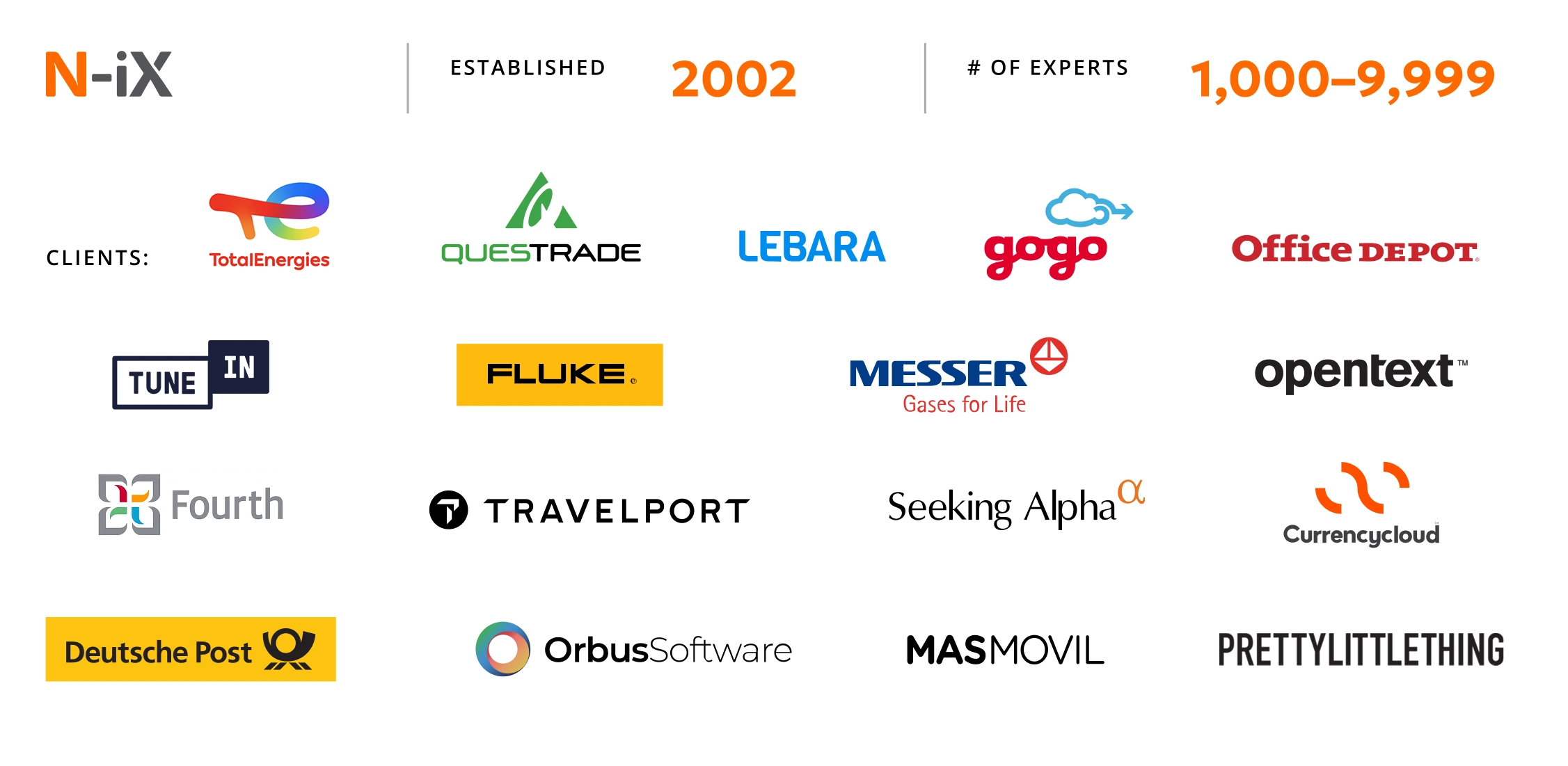
N-iX is a global software engineering company founded in Lviv in 2002, with delivery centers across Ukraine, Poland, and other European locations. It employs 2,400 specialists, including 200 data, AI, and Machine Learning experts.
The company builds AI systems for enterprises in finance, manufacturing, telecom, retail, and energy. That work covers data platform engineering, predictive analytics, computer vision, and generative AI, which is the range most companies are looking for when they evaluate offshore development centers in Europe.
N-iX assembles teams at short notice, for contained engagements and for long-running dedicated development programs alike, and takes projects past proof of concept and into production.
The company's AI expertise includes:
- Data platform engineering and analytics;
- Predictive analytics and ML;
- Computer vision;
- Generative AI, LLM integration, and RAG pipelines;
- MLOps and model monitoring in production.
02: London. Europe’s largest AI offshore development center
Google’s DeepMind was developed in the UK, so make no mistake, this country is at the forefront of the artificial intelligence research. London is also the biggest AI development center in Europe, as many interesting machine learning startups reside here.
Regional AI landscape
IT companies operating in this region generally target narrow machine learning disciplines rather than trying to pursue many. Key areas of machine learning development in London are process automation, cybersecurity, fraud detection, underwriting solutions, automated customer interactions, and more.
London’s obvious advantage is its proximity to powerful financial markets and some of the world’s best universities. At the same time, the prices here are the highest among all AI development centers in Europe.
Featured company: Faculty AI

Faculty AI is a London-based company that builds AI systems for enterprises and public sector organizations. Its work covers decision support, forecasting, and generative AI applications, with projects in healthcare, energy, consumer goods, and defense. It operates as an engineering partner, handling strategy, build, and deployment within a single engagement.
The company's AI expertise includes:
- Forecasting and decision support systems;
- Generative AI applications for enterprise workflows;
- AI deployment and monitoring in production.
03: Paris. Machine Learning and AI in France
Recently, money has been heavily flowing into French cognitive research and development. Some promising startups that specialize in machine learning evolved in the recent years, but this city has more to offer. Several well-established IT companies offer enterprise solutions with AI components.
Regional AI landscape
Paris offers giant talent pool and easy access to capital markets, which makes it one of the major European AI hubs. French companies that create machine learning systems mainly target process automation software, NLP, and virtual assistants.
On the downside, France is famous for its harsh labor laws that might be an obstacle for an enterprise looking for a suitable software development center in Europe.
Featured company: Atos
Atos is a French IT services group operating across Europe, with AI work concentrated in process automation, data analytics, and cloud-based AI deployment. It sells its own platforms alongside custom development, serving large enterprises and public sector clients in regulated sectors.
Atos offers the following software to its clients:
- Process automation and workflow orchestration;
- Data analytics modernization and AI platform services;
- Virtual assistants and automated customer interactions.
04: Berlin. AI with a German flair
Berlin is Germany's largest AI hub and one of the biggest in Europe, combining a dense startup scene with established enterprise vendors and a steady inflow of engineers from across the EU. Munich leads on industrial AI and Heidelberg on foundation models, but Berlin remains the center of commercial AI agent development in the country.
Regional AI landscape
Berlin's AI scene is shaped by its research institutions and its startup density. The Berlin Institute for the Foundations of Learning and Data and DFKI both maintain a presence in the city, and their output feeds a commercial market concentrated in conversational AI, computer vision, health AI, and enterprise automation.
German deployments run under the EU AI Act alongside GDPR and national data rules, so AI systems built here have documentation, human oversight, and audit requirements designed in. That raises the bar on engineering practice, and it makes German-built systems easier to roll out across other regulated European markets.
Featured company: Parloa
 Parloa is a Berlin-founded company building conversational AI for enterprise customer service. Its platform handles voice and chat interactions across contact centers, automating routine requests and routing the rest to human agents. The company works with enterprises in telecom, insurance, retail, and utilities, and has expanded into the US market.
The firm covers:
- Voice and chat AI agents for customer service;
- Automation of routine service requests;
- Integration with existing contact center systems.
05: Barcelona. Artificial intelligence in Southern Europe
Spain might not be at the vanguard of the European cognitive research, but several Spanish companies provide quality enterprise solutions with machine learning capabilities.
Regional AI landscape
Research, conducted by the Polytechnic University of Catalonia, hugely influences local AI market. Spanish companies that create machine learning and cognitive solutions specialize primarily in process automation.
On average, IT development in Spain is cheaper than in the UK, Germany, or France. At the same time, the AI community there is not as populated as offshore development centers in other major Western European IT hubs.
Featured company: Cognicor
CogniCor was founded in Barcelona and builds AI assistants for financial advisory firms. Its platform automates client onboarding, document processing, and the administrative work around advisor and client relationships. The company now serves wealth management firms in North America.
Its key capabilities are:
- AI assistants for client onboarding and servicing;
- Document processing and data extraction;
- Workflow automation for advisory teams.
Final thoughts
These five are not the only offshore development centers in Europe worth considering. The Nordics, Milan, Amsterdam, Bucharest, and Warsaw all host companies building enterprise AI, and the right choice depends on what you are building and which regulatory requirements apply.
The harder part of any AI project is keeping a system running in production after the pilot ends. That is worth asking about in every vendor conversation.
FAQ
Which European city is best for AI development?
It depends on what you are building. London has the deepest financial services and research concentration, Berlin the strongest commercial AI product scene, and Paris the largest pool for process automation and NLP. Lviv and other Eastern European hubs offer the largest engineering teams for building and running systems in production.
How does the EU AI Act affect AI development in Europe?
The EU AI Act sets documentation, transparency, and human oversight requirements based on a system's risk level. Most enterprise applications fall outside the high-risk category, but anything touching employment, credit, healthcare, or critical infrastructure faces stricter obligations. Build the audit trail and oversight design in from the start, since retrofitting both takes longer.
Should you work with an AI startup or an established development partner?
Startups bring depth in one narrow capability and move quickly, though they rarely carry the delivery capacity or compliance maturity enterprise programs need. Established partners bring teams that scale, documented processes, and security certifications. Contained experiments suit a startup. Systems that have to run in production and pass an audit usually need a partner.


