
 ChatGPT
 Perplexity
 Claude
 Gemini
 Grok
Grok
Scaling an engineering team in any saturated market can be slow, expensive, and competitive. However, outsourcing software development to Uruguay offers a mature alternative. The country’s tech economy has been delivering software to global enterprises for over two decades.
Uruguay's IT outsourcing services span the full delivery stack: from custom software development and QA to cloud engineering and AI implementation. Software and IT services account for nearly 3% of Uruguay's GDP, with over 80% of that output exported to the United States. On a per capita basis, Uruguay ranks third among software exporters worldwide and first in Latin America.
For businesses considering outsourcing software development to Uruguay in 2026, the country’s established track record, competitive advantage, and growing tech sector make it a strong contender.

Why choose Uruguay for software development outsourcing?
The rankings tell a consistent story: Uruguay leads Latin America in institutional stability, AI readiness, data protection, and economic output. It ranks fourth globally for policy stability (Global Innovation Index), first globally for ecommerce legislation (Network Readiness Index), and holds an EU Adequacy Decision recognizing its data protection laws as GDPR-equivalent. Taken together, these rankings position it as the region's lowest-risk, highest-capability environment for long-term software development partnerships.
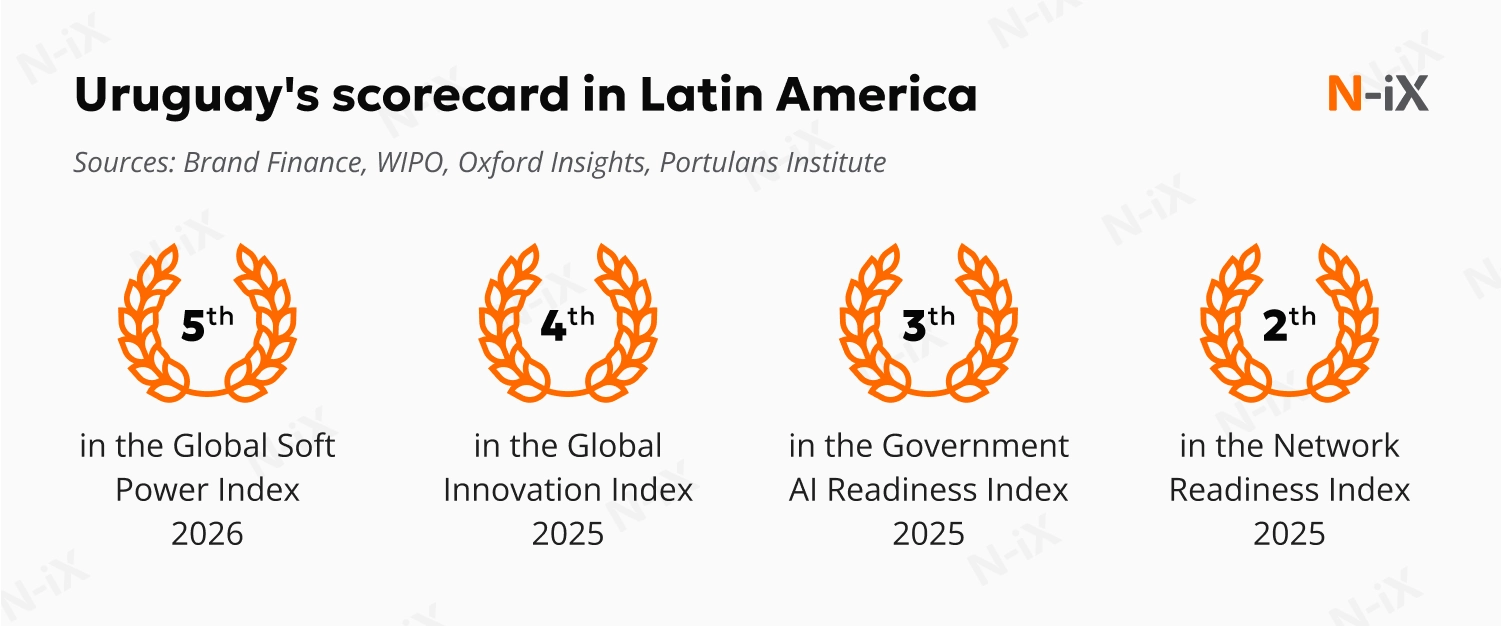
Uruguay ranks among the top five in Latin America across four major global indices: 5th on the Global Soft Power Index 2026, 4th on the Global Innovation Index 2025, 3rd on the Government AI Readiness Index 2025, and 2nd on the Network Readiness Index 2025.
Business climate
Uruguay's economy grew 2.5% in 2025, with GDP per capita projected to reach $26,040 in 2026, one of the highest in South America. Inflation declined steadily to 4.09% as of late 2025, following a peak near 10% in 2022. The cost of living runs 19.5% lower than in the United States, with rent averaging 64.4% less. This keeps engineering salaries competitive without the pricing volatility common in larger regional markets. For long-term outsourcing decisions, the underlying conditions matter most: low corruption, consistent rule of law, and stable governance across successive governments.
Infrastructure and innovation ecosystem
Uruguay ranks eighth globally and first in South America for fiber optic connectivity, with 84.4% penetration, according to the FTTH/B Global Ranking 2024. Internet penetration reached 93% as of early 2025, with the country connected to four submarine cable systems. For distributed engineering teams, consistent, high-speed connectivity is a baseline requirement for real-time collaboration, and Uruguay meets it more reliably than any other country in the region.
The digital infrastructure is backed by deliberate policy. Uruguay joined the Digital Nations group in 2018 as the only Latin American member—a network of leading digital governments focused on citizen-centered technology governance. Its national 2025 Digital Agenda, managed by the government's e-Government agency AGESIC, provides a long-term roadmap for continued investment in software, telecommunications, and digital public services.
Fiscal incentives
Under Decree No. 150/007, software exports are entirely exempt from income tax (IRAE), providing CTOs with a structural budget advantage that extends far beyond simple labor cost savings. This fiscal efficiency is protected by a legal framework that guarantees equal treatment for foreign investors and the unrestricted 100% repatriation of profits.
Read more: Colombia vs Uruguay for nearshore technology outsourcing
What does Uruguay's software development talent pool look like in 2026?
Uruguay has over 17,000 software developers and more than 220 software development companies. It also leads South America in IT skills density, with 64 professionals per 10,000 inhabitants. Uruguay also leads the region in AI skills density, with 2.3 professionals per 10,000 inhabitants, ahead of both Chile and Brazil. The academic pipeline is consistent: STEM graduates have comprised between 14.6% and 19% of total graduates from 2017 to 2022. The Universidad de la República and Universidad ORT Uruguay are the two primary institutions, together accounting for the largest share of IT graduates in the country (30% and 26% respectively).
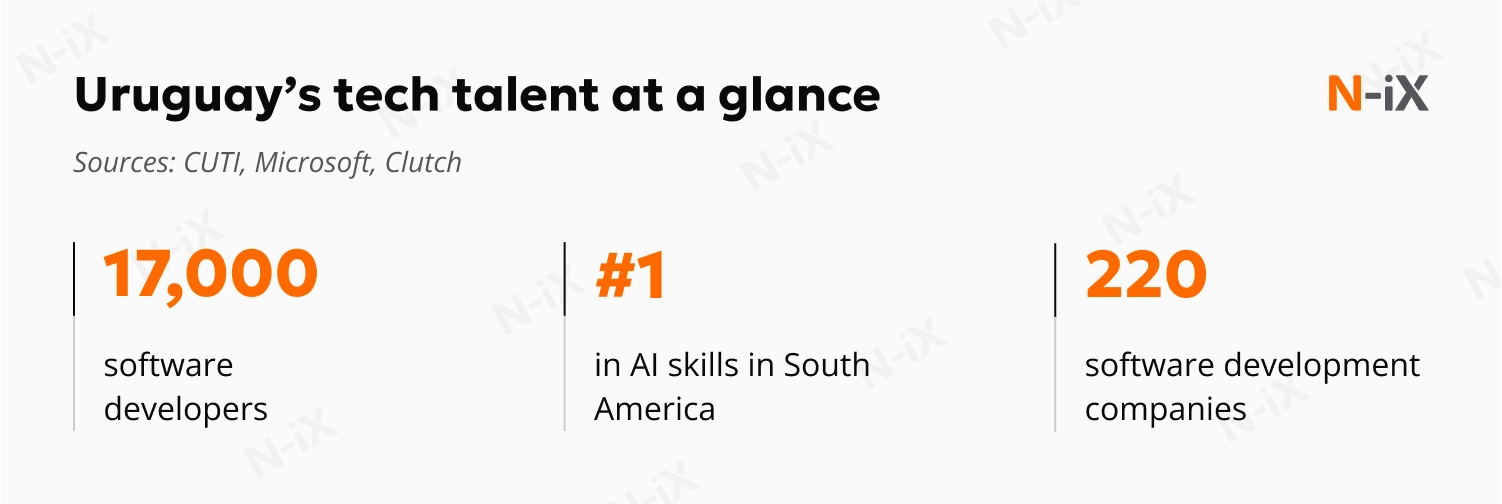
For US clients, English proficiency is a practical consideration that often determines the quality of communication within the team. Uruguay ranks 34th out of 123 countries on the EF English Proficiency Index 2025 (3rd in Latin America), with 94% of the tech workforce fluent in English and 51% also speaking Portuguese.
Mid-market enterprises and high-growth startups often require specialized expertise that is locally scarce, prompting them to consider Uruguay's technical maturity. Software development outsourcing in this region mitigates the risks of high turnover while maintaining strict alignment with North American cultural and temporal norms.
Where are Uruguay's software development hubs located?
Uruguay's software development activity is concentrated primarily in Montevideo, with secondary hubs emerging in Punta del Este and Canelones.
Montevideo is Uruguay’s primary software and technology hub, concentrating over half of the country’s IT companies and the highest density of IT professionals. The ecosystem centers on free trade zones such as Zonamerica and WTC Montevideo Free Zone, along with LATU’s technological park and surrounding innovation district, which cluster export‑oriented software firms, R&D labs, and university partnerships.
Punta del Este in Maldonado has emerged as a secondary tech hub, combining quality of life with a growing base of startups, remote engineers, and service firms. The region hosts high‑profile events such as the Punta Tech Meetup and is supported by the WTC Punta del Este Free Zone, which focuses on IT, BPO, and knowledge‑intensive services.
Canelones functions as an extension of the Montevideo metro labor market, with rising tech activity around the Pando Science and Technology Park and nearby industrial–technology zones. The department benefits from proximity to the capital and key infrastructure, including major transport links and data center and telecom investments that support software and IT services.
Which global technology companies opt for nearshore software development in Uruguay?
Uruguay hosts a significant concentration of multinational companies that use Montevideo as a nearshore hub for software development, cloud, and AI projects, and regional operations. Microsoft, Amazon, IBM, Sabre, Oracle NetSuite, Tata Consultancy Services, PwC, Globant, Mercado Libre, and Verifone all maintain operations in the country.
Microsoft has established two facilities in Montevideo: an AI and IoT Insider Lab and an AI Co-Innovation Lab, both the first of their kind in Latin America. Both are located within the LATU Technological Park and serve as regional centers for AI and IoT prototyping.
Sabre operates its Global Capability Center and Latin America regional headquarters in Montevideo, employing over 900 professionals across product development, data analytics, and customer support for clients in the travel industry worldwide.
TCS, IBM, and other major IT and BPO providers have built delivery centers in Uruguay to serve North American and European clients, drawing on the country's bilingual talent base and connectivity infrastructure.
The presence of these companies is a practical signal for companies evaluating nearshore software development in Uruguay. Markets that attract and retain global capability centers have demonstrated the talent depth, infrastructure reliability, and operating environment that long-term technology partnerships require.
How Uruguay compares to other nearshore markets
Uruguay leads Latin America in IT skills density. The country has 64 IT professionals per 10,000 inhabitants, the highest per capita concentration in the region. Argentina, Colombia, and Mexico have substantially larger absolute talent pools, but lower density ratios relative to population. For companies building smaller, senior-weighted teams rather than large delivery centers, density is a more relevant measure than headcount.
Argentina and Uruguay rank highest in the region for English proficiency. On the EF English Proficiency Index 2025, Argentina ranks 26th globally with a high proficiency rating. Uruguay follows at 34th with moderate-to-high proficiency. Colombia ranks considerably lower at 480 points, placing it in the low proficiency band. Mexico scores 440, in the very low proficiency band. For engagements requiring direct collaboration, Argentina and Uruguay are the strongest options on this metric.
All four markets offer meaningful time zone overlap with the United States. Uruguay and Argentina both use GMT-3, which places them two hours ahead of US Eastern Time. Colombia aligns directly with US Eastern Time (GMT-5), making it well-suited for real-time collaboration with East Coast teams. Mexico operates on GMT-6 to GMT-8, depending on the region, aligning with the US Central and Pacific time zones.
No single market leads on all three criteria. Argentina matches Uruguay's time zone and exceeds it in English proficiency, but carries currency and economic volatility risks that affect contract stability and salary benchmarking. Colombia offers direct EST alignment and a growing talent pool, but scores significantly lower on English proficiency. Mexico offers the largest talent base and strong US time-zone coverage, but ranks lowest in English proficiency among the four. Uruguay's differentiator is consistency: strong institutional stability, the region's highest IT density, and a regulatory environment that reduces compliance risk for both US and European clients.
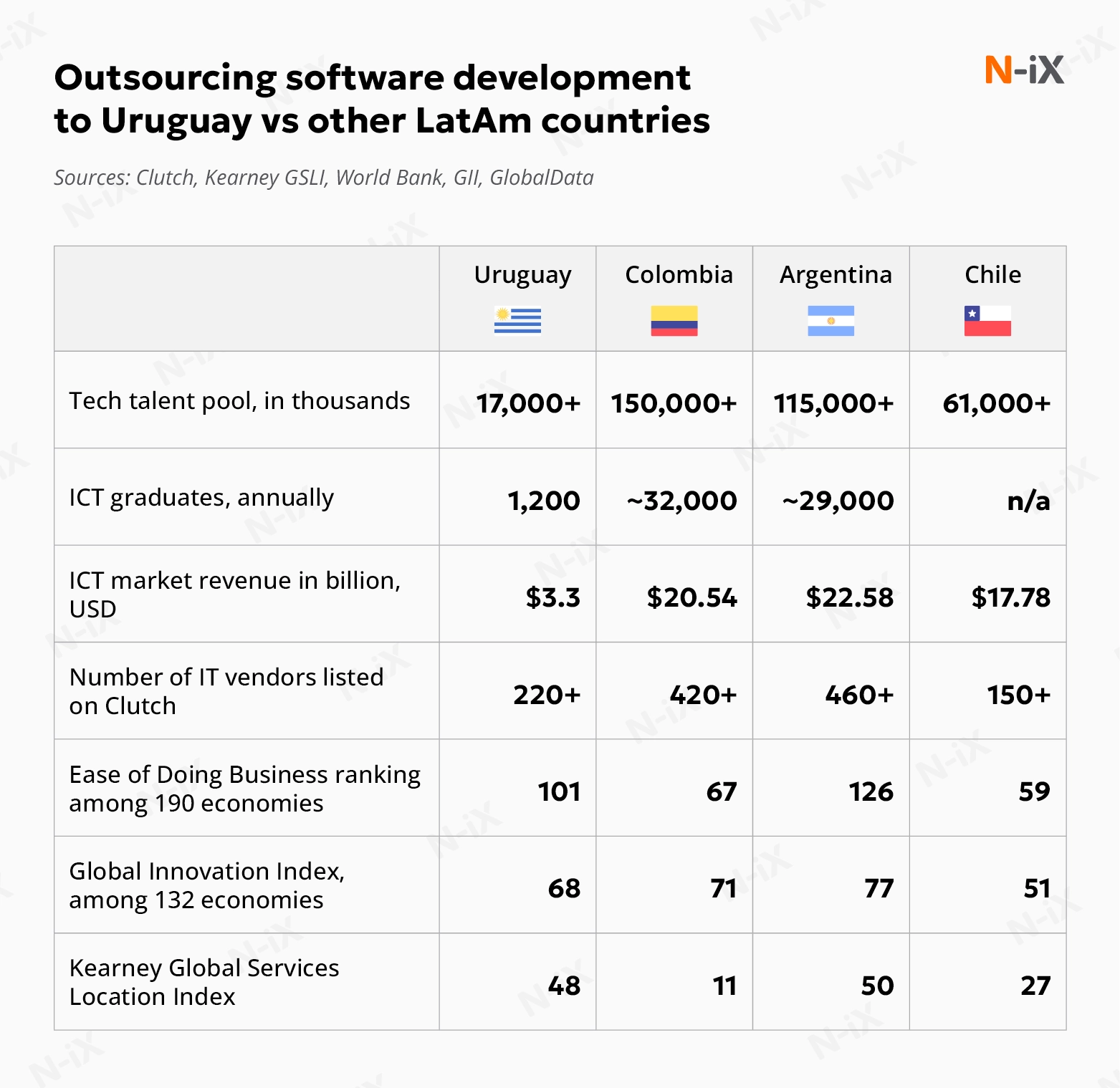
Larger markets lead in headcount. Uruguay leads in business environment, innovation capacity, and better conditions for the delivery of technology services than its size would suggest.
What engagement models are available when outsourcing software development to Uruguay?
Companies working with Uruguayan vendors typically structure engagements around four offshore development models, each suited to a different stage of product development or organizational need.
Staff Augmentation addresses immediate skill gaps without the timeline and cost of a full recruitment cycle. Individual engineers or specialists integrate directly into an existing team, working within established processes and reporting structures. This model works best for companies with a functioning engineering operation that need to scale specific capabilities quickly, whether for a product sprint, a technology migration, or an accelerated delivery period.
Managed Team transfers day-to-day operational oversight to the vendor while the client retains strategic direction. The vendor handles team composition, delivery management, and ongoing execution. This model suits organizations that want to maintain product focus without absorbing the coordination overhead of managing a distributed engineering team directly.
Custom Solution Development covers the full delivery lifecycle: from initial concept and architecture through to market launch and post-release support. The vendor takes end-to-end ownership of the engagement. This model is appropriate for companies building a net-new product or undertaking a significant platform rebuild, where internal bandwidth or expertise does not cover the full scope.
Technology Consulting provides expert evaluation, architectural guidance, and strategic planning before or during development. This is the right starting point for organizations that are still defining their technical approach, evaluating build-versus-buy decisions, or navigating a complex migration. It de-risks the engagement before significant development investment is committed.
The right model depends on where a company sits in its product lifecycle and how much internal delivery capacity it can bring to the engagement.
How to choose a software development company in Uruguay to partner with
When outsourcing software development to Uruguay, you'll find a well-established industry to work with: the country's Ministry of Labor and Social Security registered 549 ICT companies in 2023. Of these, over 220 are listed on Clutch, representing the segment most experienced in cross-border delivery. Still, the vetting process matters.
- Assess the company’s track record. Look beyond the number of projects listed. Examine vertical relevance and domain consistency. Ask for case studies that describe the problem, the technical approach, and the measurable outcome.
- Check technical standards. Look for vendors operating under ISO/IEC 9126 quality standards. Certification signals a structured approach to software quality, reliability, and maintainability. It reduces the risk of inheriting technical debt from a previous engagement.
- Match the delivery model. Assess whether the vendor's engagement model matches how your organization works. Ask how they handle sprint planning, incident escalation, and stakeholder communication. The answers reveal how much operational overhead you will absorb.
- Evaluate strategic fit. Distinguish between vendors that execute specifications and those that contribute to product thinking. A vendor with a product mindset will flag scope risks, propose alternatives, and take ownership of outcomes. A vendor focused purely on task execution will deliver what was asked, not necessarily what was needed.
- Check references from US or European clients. Request two or three references from engagements of comparable size and complexity. Pay attention to how the vendor handled delivery challenges. This is a more reliable indicator than an unqualified success story.
- Review the legal and contractual framework. Uruguay has strong IP protection laws and is a signatory to major international IP conventions. In 2024, the US and Uruguay signed a Memorandum of Understanding on Critical Technologies, reinforcing the bilateral framework for technology partnerships. Uruguay also holds an EU Adequacy Decision, simplifying GDPR compliance for European clients. Ensure the contract explicitly addresses IP ownership, data handling, and confidentiality obligations.

Why choose N-iX for outsourcing software development to Uruguay?
N-iX brings over 23 years of experience delivering software to clients across the US, Europe, and beyond. With 2,400+ experts across multiple delivery centers, including Uruguay, N-iX operates at a scale that most regional vendors cannot match. Its delivery center in Colombia provides direct knowledge of the Latin American market, combined with a rigorous hiring process that filters for technical depth and delivery experience at every seniority level.
N-iX has domain expertise across the verticals where Uruguay's talent pool is strongest: fintech, banking, AI and ML, IoT, and enterprise software. N-iX engagement models cover the full range: staff augmentation, managed team, and custom solution development. This gives clients the flexibility to start with a contained scope and scale as the partnership matures.
For businesses evaluating nearshoring to Uruguay, software development outsourcing with N-iX offers a direct path from vendor selection to delivery without the overhead of building a new relationship from scratch.
Sources:
- Uruguay XXI, 2024. ICT sector in Uruguay.
- ITA USDC, 2025. Uruguay - Information and Communication Technology.
- Access Partnership, 2022. A Digital Sprinters focus report.
- European Commission, 2012. Data protection adequacy for non-EU countries.
- Brand Finance, 2026. Global Soft Power Index 2026.
- WIPO, 2025. Uruguay Ranking in the Global InnovaWIPO, 2024. tion Index 2025.
- Oxford Insights, 2025. Government AI Readiness Index 2025.
- Portulans Institute, 2025. Countries – Network Readiness Index.
- IMF, 2025. IMF Executive Board Concludes 2025 Article IV Consultation with Uruguay.
- IMF, 2025. IMF DataMapper - Uruguay.
- Trading Economics, 2025. Uruguay Inflation Rate at 19-Month Low.
- Numbeo, 2025. Cost of Living Comparison Between United States and Uruguay.
- FTTH Council Europe, 2024. FTTH/B Global Ranking 2024.
- DataReportal, 2025. Digital 2025: Uruguay.
- TeleGeography, 2025. Uruguay-Submarine cables.
- GOV.UK, 2020. Digital Nations Charter.
- AGESIC, 2025. Agencia de Gobierno Electrónico y Sociedad de la Información y del Conocimiento.
- U.S. Department of State, 2023. 2023 Investment Climate Statements: Uruguay.
- Nearshore Americas, 2022. IT Exports Boom in Uruguay Despite Talent Shortage.
- Clutch, 2026. Top Software Developers in Uruguay.
- Microsoft, CUTI, 2023. Uruguay: Talent Report on the IT Sector.
- WIPO, 2024. Uruguay Ranking in the Global Innovation Index 2024.
- English First, 2025. Uruguay | EF English Proficiency Index
- WTC Montevideo Free Zone, 2025.
- LATU, 2025. The Technological Laboratory of Uruguay (LATU), is a non-state public law organization created in 1965 to provide services to the production chain.
- WTC Punta del Este Free Zone, 2025.
- Inter-American Development Bank, 2024. Uruguay Global II: Promoting Advanced Digital Skills for Internationalization.
- Nearshore Americas, 2024. Uruguay’s IT Sector: A Powerhouse of Growth
Have a question?
Speak to an expert