ChatGPT
 Perplexity
 Claude
 Gemini
 Grok
Grok
Why do companies outsource software development? Talent shortages are the primary driver of outsourcing decisions. According to a recent Indeed survey, 76% of enterprise leaders say the inability to find qualified local talent has negatively impacted their businesses. For many organizations, IT outsourcing is an operational necessity. When evaluating their options, most businesses face a core choice: nearshore vs offshore, and each model offers a different approach to solving the talent gap.
Outsourcing helps businesses:
- Access specialized skills unavailable locally
- Scale development teams quickly without lengthy hiring cycles
- Reduce time-to-market on software products
- Meet project deadlines despite domestic workforce gaps
- Tap into expertise in emerging technologies without building internal capability from scratch
The scale of adoption reflects this. Forecasts estimate that the global IT outsourcing market will grow at around 8–9% annually over the next decade (Market.us, 2024). Enterprises across North America, Western Europe, and beyond are increasingly treating external engineering teams as a core part of their delivery model rather than a temporary fix.
Outsourcing solves more than a talent shortage. It gives you access to specialized skills and lets you scale fast. Below, we compare nearshore vs. offshore outsourcing , covering the key advantages and trade-offs of each.

What is nearshore vs. offshore outsourcing?
Nearshore outsourcing means delegating software development or IT services to a team in a geographically close country, often one that shares a border or time zone. Examples include a US company hiring a Mexican team, or a Polish company working with Ukrainian developers.
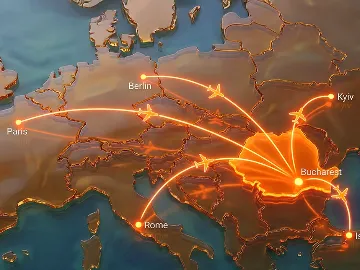
Offshore outsourcing means relocating business processes to a distant country, typically across hemispheres. Examples include American corporations hiring Romanian engineers or Canadian companies partnering with teams in the Philippines.
Both are forms of IT outsourcing and serve as alternatives when local tech talent is unavailable or too costly. The right model depends on your project requirements, team structure, and operational priorities, not on a single factor, such as geography or time zone.

You may also be interested in: Top nearshore software development companies with a strong portfolio
Talent availability: nearshore vs. offshore
Access to the right skills is the foundation of any successful outsourcing engagement. Both models expand your talent pool beyond local borders, but they differ significantly in scale and depth of specialization.
Nearshore talent pools are geographically limited. The entire Baltic region, for example, holds approximately 130,000 tech professionals — far fewer than Ukraine (300,000) or Poland (400,000) alone ( Statista, 2023). For companies seeking niche expertise or planning significant team growth, nearshore options may not offer enough depth.
Offshore destinations offer significantly larger and more diverse talent pools. India alone has approximately 21.9 million developers, making it the world's largest source of software engineering talent (GitHub Octoverse Report, 2025). Eastern European hubs such as Ukraine, Poland, and Romania provide strong technical depth with particular strength in engineering disciplines, mathematics, and systems architecture.
When evaluating talent availability, consider three factors beyond raw headcount. First, assess the density of specialists in your specific technology stack. Second, review the local university pipeline to understand long-term supply. Third, examine vendor competition in the market: a large talent pool in a high-demand region may still be difficult to access quickly.
Recommendation: Before selecting an outsourcing destination, consult international skills rankings such as SkillValue or TopCoder to match country expertise to your project requirements. Compile a precise list of the technical skills and industry knowledge your team needs, then compare locations.
Nearshore vs. offshore: Business management
Staying in control of outsourced work requires regular contact with your engineering team. Shared time zones make it easier to schedule meetings and resolve issues in real time. With offshore teams, larger time gaps can occasionally slow down updates and push deadlines.
That said, time zone differences are manageable in most cases. Most countries operate on 8-hour workdays, making even a 7-hour gap a solvable logistics problem. Thousands of successful collaborations between North American vendors and Eastern European teams confirm this. The difference between a well-managed offshore engagement and a poorly managed nearshore one comes down to communication discipline, not geography.
Effective remote team management across any time zone typically involves three practices. Daily standups establish a consistent rhythm and surface blockers early. Documented async updates reduce dependency on real-time availability. Clearly defined escalation paths ensure that critical issues reach the right people without delay.
Project management tooling also plays a role. Teams using shared platforms for task tracking, documentation, and sprint planning maintain higher visibility regardless of location. Establishing these systems in the first weeks of an engagement significantly reduces coordination friction later.
Recommendation: Build communication into your routine. Regular standups, demos, and team syncs keep remote teams aligned regardless of location. Addressing blockers as they arise is the most effective way to prevent project delays.

Nearshoring vs offshoring: Cultural alignment
Cultural compatibility shapes how smoothly teams collaborate, how conflicts get resolved, and how aligned both sides stay over time. It is one of the most commonly overlooked factors in outsourcing decisions.
Nearshore partners tend to share closer cultural ties by default. Neighboring countries often operate with similar business values, communication styles, and attitudes toward deadlines. Onboarding is faster, and misunderstandings are less frequent.
Offshore cultural alignment varies by region. Distance alone does not determine compatibility. Eastern European countries, including Poland, Ukraine, the Czech Republic, and Romania, have broadly adopted Western communication norms through decades of collaboration with North American and Western European clients. Direct communication, individual accountability, and proactive problem-solving are consistently cited traits of these engineering communities.
For a data-driven approach to evaluating cultural fit, the Hofstede Cultural Dimensions model is the most widely used framework. It assesses countries across six dimensions. Two are particularly relevant for software outsourcing partnerships.
Power distance reflects how teams relate to authority and hierarchy. Countries with low power distance scores tend to have flatter team structures, encourage open feedback, and communicate directly with clients. This aligns well with agile development practices common in Western tech environments.
Uncertainty avoidance reflects comfort with ambiguity and change. Teams from high uncertainty avoidance cultures prefer clear requirements and structured processes. Understanding this upfront helps set realistic expectations around how a vendor will handle shifting project scopes.
Tip: Before shortlisting vendors, use the Hofstede Insights Country Comparison tool to map cultural alignment between your organization and potential outsourcing destinations.

Wrap-up
The right outsourcing destination is worth the research. Nearshore and offshore models each offer distinct advantages — the best choice depends on your technical requirements, team structure, timeline, and operational preferences.
Nearshore is the stronger option when real-time collaboration, cultural proximity, and minimal coordination overhead are priorities. Offshore is the stronger option when you need rapid access to a large or highly specialized talent pool and have the communication infrastructure to manage distance effectively.
Many enterprises combine both models across different projects or phases of the same engagement. A nearshore team may manage product delivery while an offshore team handles platform engineering or QA. The two models are not mutually exclusive.
Matching a partner to your technical, security, and operational requirements reduces risk and improves outcomes. Use the comparison above to guide your final decision.

Why nearshore and offshore with N-iX?
- N-iX has 24+ years of experience and is one of the leaders in the global IT market.
- We are a trusted partner for Lebara, Grainger, Fluke, Gogo, and other leading global vendors.
- Our 2,400+ experts cover telecom, healthcare, fintech, and other industries.
- Services include software product development, dedicated team building, team extension, and product discovery .
- N-iX is listed in the Forbes top 50 Ukrainian employers list and recognized in DOU, CRN, and ISG rankings.
FAQ
What is the main difference between nearshore vs offshore outsourcing?
Nearshore outsourcing means working with a team in a geographically close country, often within a similar time zone. Offshore outsourcing means partnering with a team in a distant country, typically across hemispheres. The core nearshore vs offshore trade-off is between coordination convenience and the size of the available talent pool.
Is nearshore or offshore outsourcing more cost-effective?
Offshore destinations, particularly in South and Southeast Asia, generally offer lower hourly rates. However, cost alone should not drive the decision. Coordination overhead, onboarding time, and communication friction can offset rate differences. Eastern European offshore destinations often strike a balance between competitive rates and strong technical quality.
How do you manage time zone differences with an offshore team?
Most time zone gaps are manageable with the right processes in place. Daily standups, documented async updates, and clear escalation paths keep offshore teams aligned without requiring constant real-time availability. Many North American companies successfully collaborate with Eastern European teams on a 7–8 hour time difference.
Which outsourcing model works better for agile development?
Both models can support agile workflows. Nearshore teams have a slight advantage in sprint ceremonies due to time zone overlap. That said, many offshore teams are well-versed in agile practices and have extensive experience working with Western clients in distributed agile environments.
Can a company use both nearshore and offshore outsourcing at the same time?
Yes, and many enterprises do. A common nearshore vs offshore approach is to use a nearshore team for product delivery and client-facing work, while an offshore team handles platform engineering, QA, or other workstreams. The two models are complementary and can be structured to maximize both collaboration and access to specialized talent.
Sources:
- Indeed.com, 2021. Hiring Trends Report.
- Market.us, 2024. IT Outsourcing Market 2024-2033.
- Emerging Europe, 2024. Future of IT Report.
- Statista, 2023. Number of software developers in Central and Eastern Europe in 2023, by country.
- GitHub Octoverse Report, 2025.
Have a question?
Speak to an expert