 ChatGPT
 Perplexity
 Claude
 Gemini
 Grok
Grok
Minimum Viable Product (MVP) development for IoT is an optimal next step for a business regardless of its experience with IoT development. And even with this cautious approach, there are a few things to consider to reach the goals.
IoT MVP development is not just about building software; it involves navigating the complexities of hardware integration, connectivity challenges, and regulatory compliance. This article will explore a business-first approach to developing a small-scale IoT solution, focusing on strategic considerations, best practices, and common challenges faced during the process. In addition, you will find a Q&A section below where Mykhaylo Kohut, an Embedded Solutions Architect and IoT expert at N-iX, answers the questions that business leaders may have before developing a minimum viable IoT product.
Why MVP development for IoT requires a different approach
The world of IoT MVP development differs from that of traditional software MVPs. While both share the goal of validating a product idea with minimal resources, IoT products require equal focus on hardware and software components. For instance, device connectivity, real-time data flow, and the physical infrastructure required to support IoT applications introduce complexities absent in typical software-only projects.
In an IoT MVP, you're not just dealing with software development but also with physical devices, sensors, and real-time data processing. The challenges in this context include ensuring stable connectivity, managing device limitations, and addressing hardware-specific issues such as power consumption and environmental factors. Additionally, IoT apps need to interact with sensors, gateways, and cloud infrastructures, which require careful testing to ensure data integrity, scalability, and security in real-world conditions.
For a software MVP, the focus is primarily on user interfaces, back-end logic, and software integrations. The feedback loop is often simpler because it's contained within the software ecosystem itself. In contrast, an IoT-based solution needs to validate not only the software's functionality but also its ability to interact reliably with hardware, handle large volumes of data, and perform well across diverse physical environments.
Benefits of minimum viable product development for an IoT project
Creating an MVP for an IoT project is a strategic approach that allows you to test, validate, and refine your idea before fully scaling. Here's why it's beneficial.
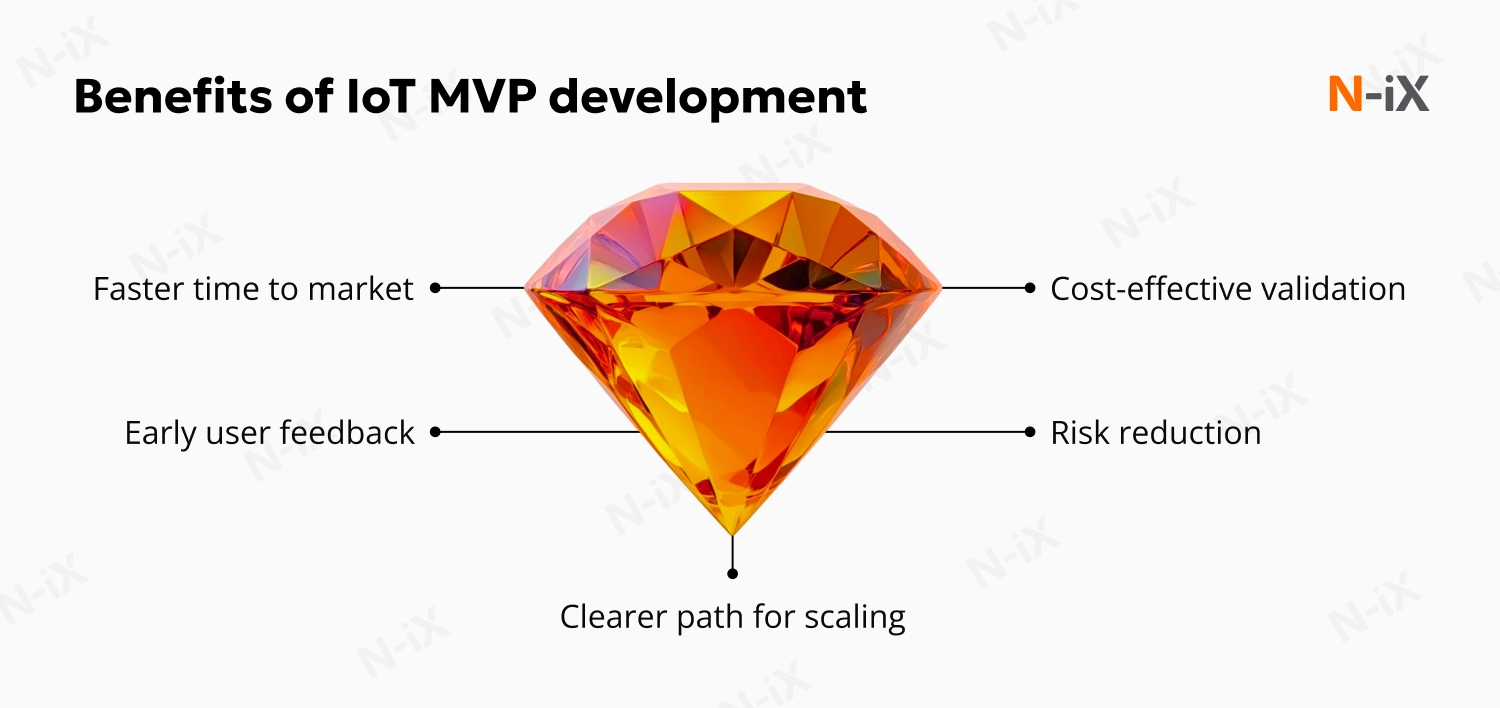
Faster time to market
A development of a minimum viable IoT product focuses on core functionalities, allowing you to quickly bring your IoT idea to life. For example, if you're developing a smart thermostat, your product could include only basic temperature control and Wi-Fi connectivity, helping you plan further steps.
Cost-effective validation
A minimum viable product of an IoT solution helps you avoid features that may not resonate with users or meet business goals. By testing with essential features first, like a basic sensor in an asset tracking system, you can ensure your solution is addressing the right pain points before investing in more complex capabilities.
Early user feedback
Releasing a basic deployable product version with core features early lets you gather real-world user feedback. For example, testing a connected device in a real-world environment with real users can reveal connectivity or sensor-accuracy issues that might not have been apparent during the PoC or development stages.
Risk reduction
MVP development for IoT enables you to identify technical or operational challenges early. If, for instance, you're building an IoT solution for predictive maintenance, testing core features can show whether your sensors provide accurate readings under various conditions and tailor your strategy when the risks are manageable.
Clearer path for scaling
Once the minimum viable product of IoT is validated, you have a clearer understanding of what works and what doesn't, making the transition to a full-scale product smoother. This approach is crucial for the Internet of Things solutions, where scalability can mean expanding sensor networks or increasing data processing capabilities.
Approach your IoT project avoiding major risks—get the guide!
Success!
By focusing on delivering a functional MVP for IoT, you ensure your project addresses the right problems with the right solutions. It allows you to save both time and money while setting the stage for smooth scaling. However, there are many ingredients to a successful release of a basic product's version. Let's discuss them.
Q&A with our expert on successful MVP development for IoT project
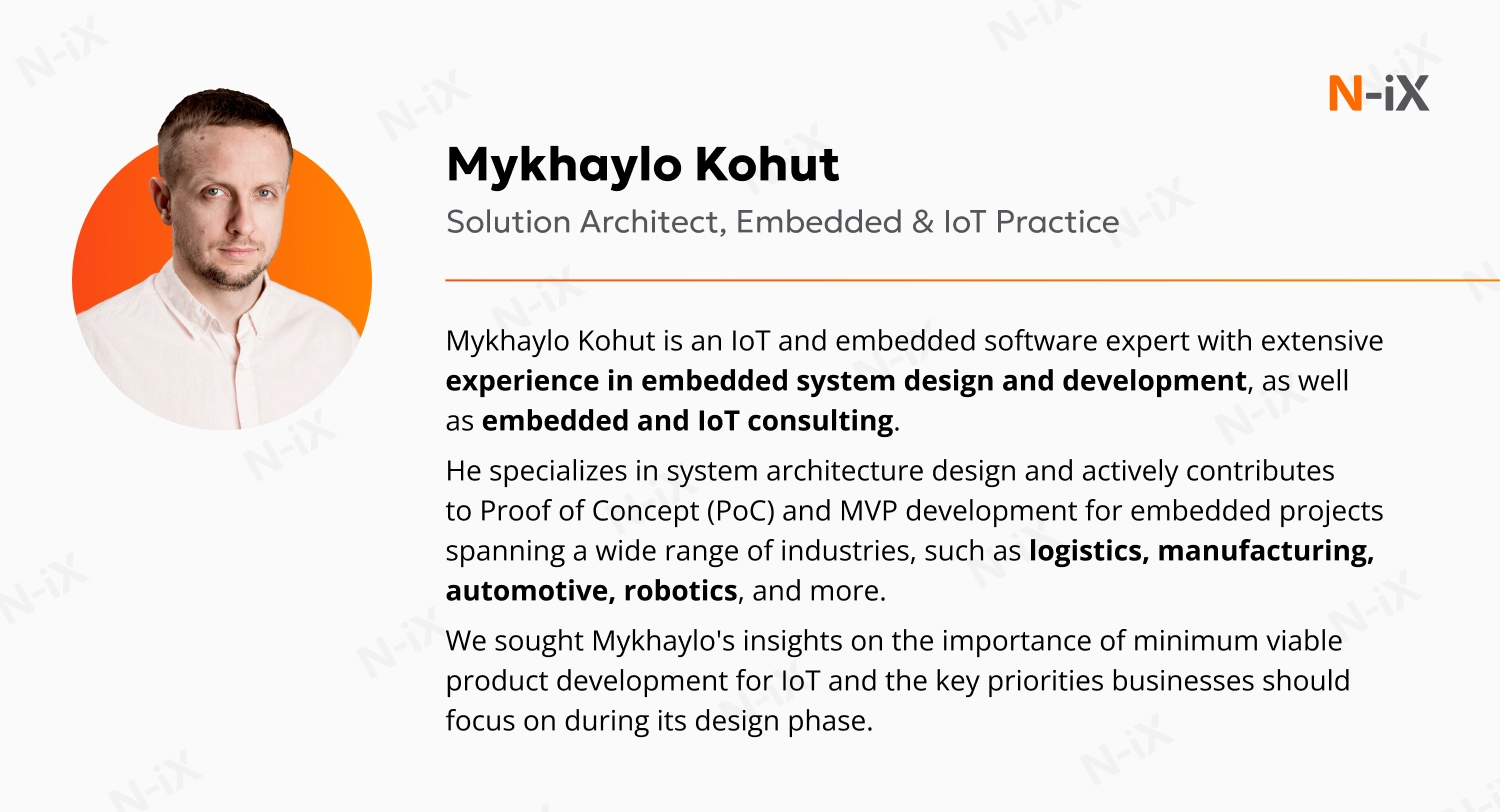
KS: What is the biggest advantage for businesses if they do MVP development for an IoT project?
MK: The biggest advantage for businesses is the ability to quickly validate the product's core functionalities with real users, while keeping costs and risks manageable. This stage aims to deliver a working, deployable version of the product that demonstrates its value to end users.
Let's take a company developing a smart home security system as an example. During MVP development for IoT, they would focus on delivering the key features such as motion detection, camera feed, and real-time alerts. These core functionalities would be tested in real-world environments, helping the business gather user feedback on whether the system solves their pain points (e.g., false alarms, ease of use) and is worth scaling.
KS: What are the key differences between an IoT PoC and an MVP?
MK: A PoC is essentially about testing a hypothesis, whether your creation can work in a controlled, minimal environment. An MVP, on the other hand, takes those successful PoC outcomes and builds a solution that's functional enough to be tested in real-world conditions at scale. The MVP in IoT projects is less about perfection and more about gathering feedback, iterating, and ensuring the product has potential for broader use in real business conditions.
KS: How may this difference impact the development from a business perspective?
MK: For businesses, the main difference is that IoT MVPs involve additional costs and risks due to the need for hardware, connectivity, and regulatory compliance. Unlike traditional software MVPs, where development focuses solely on the digital side, an IoT-based counterpart requires businesses to factor in expenses for prototyping, testing physical devices, and managing connectivity. This can lead to longer timelines and higher upfront costs. Additionally, businesses need to manage the complexities of hardware-software integration and ensure compliance with industry-specific regulations, which can impact time to market and resource allocation.
KS: Fast development is often associated with technical debt in the long run. Is it something that happens during IoT MVP development as well?
MK: Technical debt can definitely arise during the development of even a small-scale IoT solution, especially when teams are focused on delivering quickly. The pressure to validate the core functionality fast may lead to shortcuts in code quality, hardware integration, or security measures. For example, businesses may use temporary solutions for connectivity or data management that aren't scalable in the long term.
We at N-iX take a strategic approach to managing technical debt. While speed is important, we ensure that the MVP is built with scalability and flexibility in mind. We prioritize key areas, like choosing the right cloud infrastructure and using standard IoT protocols, which allows for smoother transitions to full-scale development without the need for a complete rebuild. By focusing on essential features and laying a good architectural groundwork, we help businesses avoid unnecessary technical debt while still moving fast.

KS: An IoT solution includes many features and functionalities. How do you prioritize them for an IoT MVP?
MK: The first step is to clearly define the problem you are solving. Focus on the critical features that will validate the core hypothesis. Then, prioritize the features that deliver business value as quickly as possible. Avoid adding "nice-to-haves" at this stage-only include features that are essential for testing whether your solution works at scale.
KS: How should data be handled during MVP development for IoT?
MK: Data handling is crucial because it directly affects the product's functionality and user experience. At this stage, the focus should be on ensuring data is captured accurately, transmitted securely, and processed efficiently.
For example, when developing an MVP for an IoT-based smart home device, data from sensors (such as temperature or motion) must be transmitted reliably to the cloud or a local hub for processing. Data flow must be optimized to avoid delays, as this can negatively affect real-time actions, such as triggering a thermostat adjustment.
Businesses should start with a lightweight data architecture to avoid overcomplication. This means prioritizing essential data points and simplifying the backend infrastructure, such as using a cloud platform like AWS IoT or Google Cloud IoT, which offers scalable solutions for device connectivity and data management.
KS: IoT security is a major concern at every stage of development. Are there any MVP-specific approaches businesses should take?
MK: Security must be prioritized from the start, as vulnerabilities can be costly to address later on. During the MVP stage, businesses should focus on securing the most critical aspects of the system: device-to-cloud communication, data storage, and user authentication.
For example, in a smart home MVP, basic security measures such as encrypted communication protocols (e.g., TLS) should be implemented to protect data sent between devices and the cloud from interception. Additionally, device authentication using certificates or unique tokens can help prevent unauthorized access.
In terms of data storage, businesses should ensure that sensitive data, such as user information or health metrics from a wearable device, is encrypted in transit and at rest, using methods like AES-256. This is especially critical for compliance with regulations such as GDPR or HIPAA.
Another MVP-specific approach is implementing a "secure by design" mindset. This means even in the early stages, businesses should identify potential IoT security issues and risks and address them incrementally. For example, during the MVP stage of a connected healthcare device, businesses should implement basic access controls to restrict access to sensitive health data to authorized users only.
You should also remember that the security of your IoT ecosystem is only as strong as its weakest link. Don't delay security measures; if you don't have the right experts, consult those who provide end-to-end IoT security services.
KS: The hardware choice for IoT concept validation isn't usually at the forefront, since PoCs typically don't use custom hardware. How should we approach hardware selection at the MVP stage of an IoT project?
MK: At the MVP stage for IoT projects, hardware selection should balance between validating core functionality and maintaining flexibility for future scaling. Unlike the Proof of Concept (PoC) phase, where off-the-shelf components are often sufficient, the MVP stage requires hardware that not only supports basic functionality but also meets the performance, reliability, and scalability needs of the final product.
For example, if you're building a basic deployable solution for a connected device like a smart thermostat or wearable, you might start with IoT development kits by Raspberry, Arduino, or a more specialized module such as Nordic Semiconductor's nRF52840 for Bluetooth connectivity. These choices provide key features such as low power consumption, robust IoT connectivity, and ease of integration with cloud services, while remaining adaptable for future customization as the product evolves.
KS: How important is iterative testing during the IoT MVP development phase, and what challenges can arise during this process?
MK: Iterative testing is crucial to ensure that the IoT MVP is functional and meets the desired outcomes. Since IoT solutions often involve physical devices, the environment, connectivity, and sensors must be tested repeatedly to ensure reliability. Challenges include managing the complexity of hardware-software interactions, ensuring stable device communication, and controlling power consumption. Additionally, real-world conditions, such as network interference or environmental factors, can introduce unexpected issues, necessitating continuous testing and refinement.

KS: How do you know when it's "enough" testing?
MK: The key to determining when testing is "enough" is ensuring that the product meets the core business goals and addresses the most critical use cases for users. The MVP development for IoT involves validating that the core features are functional, scalable, and ready for real-world usage. Assessing the following may help you decide when you can stop testing.
- Core functionality is validated. The MVP should have successfully validated its primary use cases. For instance, if you're building a connected health device, this means ensuring that the device accurately collects and transmits data (e.g., heart rate or temperature) under typical operating conditions.
- Firmware updates are stable. It will ensure that the MVP can be updated after the users report bugs.
- Scalability of key components. You should have tested that the system can scale at least to the expected user base in terms of device connectivity, data management, and cloud interaction. For example, testing that IoT devices work reliably when multiple devices are connected to a single system.
- User feedback. User feedback becomes critical during minimum viable product testing. Once the product demonstrates its core value proposition, the focus should shift to how users interact with the device. Testing is enough when you've gathered enough insights from actual users to make decisions about next steps. Are there usability issues? Is the device meeting user needs?
- Real-world conditions. Test your product in the environments where it will actually be used. For example, a connected smart agriculture device needs to be tested in outdoor conditions, and a wearable device should be tested under typical user activities.
Once these core aspects are validated and any critical issues are addressed, you can confidently move on to the next phase. At this point, you don't need exhaustive testing for every possible scenario. Instead, focus on iterating based on user feedback and prepare for a larger rollout.
KS: How do you balance the need for rapid prototyping with the requirement for a scalable solution in IoT MVP development?
MK: Balancing rapid prototyping with scalability requires focusing on the core functionality and building an MVP that proves the concept without overcomplicating it. You should start with off-the-shelf components, development kits, or cloud platforms that allow fast iteration while focusing on your key value propositions. Scalability should be considered in the design phase, even though the MVP itself may not be fully scalable. For example, select components that can easily be replaced or upgraded in future iterations to avoid technical debt as the system scales.
KS: Is there a typical timeline for MVP development for IoT?
MK: The typical timeline for developing an IoT MVP depends on the complexity of the solution. To stay on schedule, it's crucial to define clear milestones, use agile methodologies, and keep the scope focused on core functionality. Regular reviews with stakeholders, iterative testing, and early prototyping help identify issues early and avoid scope creep. The team's right mix of skills and experience is also important to deliver the solution on time.
KS: How do you decide on the right IoT platform and tools to use when developing an MVP?
MK: The choice of platform depends on the project's specific needs, such as costs, scalability, security, and integration requirements. For a small-scale IoT, it's important to select a platform that supports rapid development and integrates easily with your hardware and cloud services. Consider the ecosystem around the platform, such as SDKs, APIs, and third-party integrations, to ensure you can scale the solution in the future. Additionally, choose platforms with good community support and documentation to accelerate development.
KS: What role does user feedback play during the MVP phase, and how do you integrate it into the product development cycle?
MK: User feedback is invaluable in the MVP phase, as it helps validate assumptions and ensures the product meets user needs. After releasing the product, gather feedback through usage data, surveys, and user testing. This feedback should be used to iterate on both hardware and software, making adjustments to improve usability, reliability, and functionality. The feedback loop helps refine the product to ensure it effectively solves the intended problem and delivers value to users.
KS: How many people are typically involved in MVP development for IoT?
MK: In most cases, a minimum viable product development for IoT can be done by a small, cross-functional team. It usually includes:
- An IoT or solution architect to define the overall approach;
- An embedded or firmware engineer to work with devices and sensors;
- A backend or cloud engineer to handle data ingestion and processing;
- A data analytics specialist (optionally).
The final team composition and team size, however, should always reflect the project's needs and resources. Ideally, if you can quickly find a specialist for each stage. Some IoT development companies like N-iX can help you with that. N-iX has over 2,400 tech experts with skills in embedded development, cloud computing, data analytics, IoT data visualization, cybersecurity, and others under one roof. It helps maintain the project continuity and frees you from the hiring process.
KS: Minimum viable product development for IoT and software app development are different, with IoT MVP being more complex in terms of system integration. Does it mean that MVP development outsourcing for IoT projects isn't an option for the companies?
MK: Not at all. The fact that MVP development for IoT is more complex doesn't make outsourcing impractical. However, it does change the approach to it. IoT MVPs involve hardware, connectivity, cloud, and data working together as a single system, so outsourcing becomes risky only when it's treated as a handoff rather than a partnership.
In practice, outsourcing works well when companies involve experienced IoT teams early and keep them closely aligned with business and product stakeholders. A strong external team can bring system-level thinking and cross-disciplinary expertise that many in-house teams may not have at the MVP stage. That often reduces risk instead of increasing it, especially when internal teams are small or still building IoT capabilities.
The key is choosing a partner that can take responsibility for the whole MVP project, not just individual components. When the same team understands devices, firmware, connectivity, cloud services, and integration constraints, system complexity becomes manageable. In that setup, outsourcing IoT MVP development is a way to move faster while managing architectural and operational risks, rather than a compromise.
Explore the topic: An expert's guide to outsourcing IoT development for growth
KS: If you were advising IoT MVP best practices, what would your recommendations be?
MK: I'd start by saying that a minimum deployable solution should be treated as a real system, not a demo. The goal is to validate how it behaves under realistic conditions, even if the scope is intentionally limited. That means focusing on one clear use case, a small but representative set of devices, and real data flowing through the entire stack, from device to cloud and back.
From a technical standpoint, it's important to design the MVP around constraints early on. Power consumption, connectivity reliability, latency, and data volumes should be tested in practice rather than assumed. I usually recommend using proven components and reference architectures at this stage, avoiding custom hardware or overly complex software unless it is absolutely required by the use case.
Equally important is building the MVP with a path forward in mind. You don't need production-level scale yet, but you do need clean interfaces, modular components, and an architecture that won't need to be thrown away if the MVP is successful. Finally, keep feedback loops short. Measure how the system performs, how users interact with it, and what it costs to operate, then use those insights to decide whether to scale, adjust the approach, or stop. That clarity is the real value of a well-built product at this stage.
How N-iX engineering experience impacts MVP development for IoT solutions
Partnering with N-iX for IoT MVP development helps businesses move from concept to a market-ready foundation with clarity and control. With over 23 years of engineering experience, N-iX applies enterprise-grade delivery practices to IoT MVPs while maintaining the speed required at this stage. Our cross-functional teams combine embedded development, cloud, data, UI/UX, and other expertise to ensure your solution validates not only core functionality, but also real-world performance, connectivity, and scalability.
As a full-cycle MVP development partner for IoT projects, N-iX designs initial products on architectures that can evolve into production systems without costly redesigns. Having delivered over 60 IoT and embedded development projects, we apply structured discovery, clear success metrics, and iterative validation to reduce technical and business risk early. We hire from 25 across Europe and the Americas, allowing flexible team scaling as your IoT MVP gains traction.
As a result, decision-makers leave the MVP stage with a working system, validated assumptions, and a clear basis for deciding whether and how to scale further. With transparent cooperation models and proven experience across manufacturing, automotive, logistics, healthcare, and other industries, N-iX helps businesses turn a basic IoT platform into a solid platform for growth.

Final thoughts
MVP development for IoT is a decisive phase where technical choices, scope discipline, and execution quality determine whether an idea can move forward with confidence or stall later under real-world pressure. A well-structured IoT MVP helps businesses validate core assumptions, expose constraints early, and create a clear basis for scaling without unnecessary rework. The insights shared in this article and expert Q&A show that success at this stage depends on treating the MVP as a real system, aligning engineering decisions with business goals, and planning deliberately for what comes next. If you are preparing to move beyond concept validation and want your IoT MVP to stand up to production realities, an experienced engineering partner like N-iX can make that transition far more predictable.
Have a question?
Speak to an expert