
 ChatGPT
 Perplexity
 Claude
 Gemini
 Grok
Grok
Supply chains worldwide are getting increasingly complex and volatile. According to Deloitte, 79% of companies with high-performing supply chains achieve significant revenue growth. However, managing these supply chains effectively is a growing challenge. Businesses are grappling with issues like demand fluctuations, logistical inefficiencies, and unpredictable disruptions, leading to increased operational costs and missed market opportunities.
The core of the problem lies in the traditional methods of supply chain management, which often need help to adapt to the rapid pace of change in the global market. These methods typically rely on historical data and linear forecasting models, which can be ineffective in predicting future trends and responding to real-time issues. As a result, companies need reliable generative AI solutions to avoid difficulties in inventory optimization, demand planning, and maintaining a resilient supply chain.
Let's explore how companies can address these challenges with generative AI applications for the supply chain industry.
Challenges of supply chain industry
The supply chain is a complex domain fraught with challenges that can impede operational efficiency and business success. Here’s a detailed overview of common challenges and pain points:
- Demand volatility: Fluctuating consumer demand makes it difficult to predict and plan for inventory needs, often leading to excess stock or shortages.
- Supply chain visibility: Lack of transparency across the supply chain hinders the ability to track and manage inventory effectively, resulting in inefficiencies and potential disruptions.
- Operational costs: Rising costs in logistics, labor, and materials put pressure on companies to optimize operations and maintain profitability. According to Accenture, generative AI could affect 43% of all working hours within end-to-end supply chain activities, either by automating tasks (29%) or significantly enhancing the productivity of human employees (14%).
- Complexity in supplier management: Managing multiple suppliers across different regions adds complexity, making it challenging to ensure quality, reliability, and timely delivery.
- Risk management: Supply chains are susceptible to various risks, including geopolitical issues and natural disasters, causing delays, financial losses, and market fluctuations, necessitating robust risk management strategies.
- Customer expectations: The modern consumer expects fast, reliable, and transparent service, requiring supply chains to be more responsive and agile.
- Manual analysis: Traditionally, data analysis in supply chains was manual, time-intensive, and susceptible to human error, often leading to inefficiencies and inaccuracies in decision-making.
Let’s discover how generative AI in supply chain can help to mitigate these challenges.
Benefits of generative AI in supply chain adoption
Generative AI introduces a different operating model. Instead of producing a single prediction or rule-based recommendation, generative models generate multiple operational scenarios, simulate their outcomes, and recommend optimized actions across the supply network. Inventory strategies, supplier allocations, logistics routes, and warehouse layouts can be tested under thousands of possible conditions before decisions are implemented.
Operational efficiency and cost optimization
Operational planning remains one of the most data-intensive activities within supply chain management. Demand forecasting, inventory allocation, and transportation planning all depend on interpreting large datasets under uncertainty. Generative AI improves these processes by producing demand scenarios and operational simulations rather than relying on single-point forecasts.
When applied to demand forecasting, generative models analyze historical sales patterns alongside external signals such as macroeconomic indicators, market trends, seasonal factors, and promotional campaigns.
Key performance improvements observed in AI-enabled supply chains include:
- Reduced logistical costs: AI-supported logistics planning can reduce transportation and logistics costs by approximately 15% through better route optimization and improved coordination across distribution networks [1].
- Optimized inventory levels: Improved forecasting accuracy allows organizations to reduce inventory buffers, leading to up to a 35% decrease in inventory holdings while maintaining product availability [1].
- Improved return on investment: Companies deploying AI across business operations report an average ROI of around 1.7x, while specialized applications such as AI-driven contract analysis can exceed 300% ROI [2].
- Fulfillment network optimization: Integrated AI planning across transportation and warehouse operations can reduce transportation costs by up to 25% and overall fulfillment costs by approximately 23% [2].
Sourcing, procurement, and supplier network intelligence
Generative AI systems can process supplier information from procurement systems, financial records, regulatory databases, and operational performance data simultaneously. These models evaluate supplier performance across multiple criteria and generate sourcing recommendations based on both cost efficiency and risk exposure.
Some organizations have introduced AI-driven negotiation systems that analyze historical contracts and market pricing benchmarks to recommend negotiation strategies. Early deployments have demonstrated financial benefits:
- Savings in contract costs during procurement negotiations
- Faster contract cycles due to automated analysis of contractual clauses
- Improved supplier transparency through standardized negotiation frameworks
Logistics, transportation, and warehouse operations
Traditional logistics planning tools update delivery plans periodically, but they often struggle to respond dynamically to real-time disruptions. Generative AI improves transportation planning by continuously analyzing operational telemetry and external signals. Models evaluate multiple routing options and recommend delivery strategies that minimize cost and delivery time while respecting operational constraints.
Risk mitigation and supply chain resilience
Supply chains face a wide range of operational risks, including supplier insolvency, geopolitical instability, transportation disruptions, and natural disasters. Generative AI improves risk management by analyzing operational data together with external signals to identify early warning indicators.
AI models evaluate supplier financial health, delivery performance, and operational reliability. When anomalies appear in supplier behavior or production capacity, procurement teams receive early warnings that allow proactive mitigation.
Generative models enable detailed “what-if” simulations. AI supply chain optimization can test how disruptions such as supplier shutdowns, transportation bottlenecks, or demand spikes would affect operations.
Workforce productivity and operational expertise
Supply chain operations rely heavily on human expertise to interpret data and make planning decisions. Generative AI could influence approximately 43% of working hours across end-to-end supply chain operations [3]. The impact is divided between automation and augmentation.
Automation of approximately 29% of supply chain tasks, including documentation processing, reporting, and routine analytics [3]. AI-powered knowledge assistants, which synthesize data from ERP systems, logistics dashboards, supplier records, and internal documentation to provide quick operational insights.
Generative AI gives supply chain leaders something they have rarely had before: the ability to test decisions before the real world tests them

|
Supply chain function |
Generative AI capability |
Typical business impact |
|
Demand forecasting |
Multi-scenario demand simulation using historical and external signals |
Higher forecast accuracy and improved alignment between supply and demand |
|
Inventory management |
Dynamic safety stock and replenishment recommendations |
Up to 35% reduction in inventory levels while maintaining availability |
|
Logistics planning |
AI-driven route optimization and real-time planning |
Around 15% reduction in transportation and logistics costs |
|
Procurement |
Contract intelligence and supplier analytics |
Faster negotiations and procurement cycle optimization |
|
Fulfillment networks |
Integrated warehouse and transportation planning |
Up to 23% lower fulfillment costs |
Key generative AI supply chain use cases

Generative AI has diverse applications in supply chain management, revolutionizing how companies plan, execute, and optimize their supply chain operations. Here's a deep dive into some of the key applications:
Demand forecasting
Generative AI synthesizes historical sales data, market trends, consumer behavior, and external factors like economic indicators to predict future demand accurately. This dynamic forecasting enables companies to adjust their production schedules, manage inventory more effectively, and respond proactively to market changes, ensuring supply aligns with demand while minimizing waste and stockouts.
Key operational benefits include:
- Higher forecast accuracy, enabling better alignment between supply and demand
- Faster response to market changes through real-time data analysis
- Reduced stockouts and overproduction
2. Inventory optimization
Generative AI identifies the best strategies for distribution and storage, factoring in delivery times, transport costs, and demand variability. The outcome is heightened operational efficiency and significant cost savings. The technology recommends reordering points and safety stock levels, thereby improving warehouse management. This leads to fewer product shortages, reduced surplus inventory, and lower storage costs.
AI algorithms continuously assess sales data and demand patterns, recommending real-time adjustments to inventory levels for different products to align with market demand. Moreover, these models determine optimal safety stock levels, accounting for demand variability, seasonal trends, and market dynamics to prevent stockouts of popular items.
Generative AI simulates potential market scenarios, such as sudden demand spikes or supply chain disruptions, enabling companies to prepare and implement effective restocking strategies. By identifying slow-moving items that incur high holding costs, generative AI suggests actions such as pricing strategies or targeted marketing to improve product turnover.
3. Procurement intelligence
Generative AI enhances supply chain resilience by analyzing vast datasets to pinpoint optimal suppliers. It evaluates performance metrics, quality assessments, and cost factors to enable effective supplier relationship management. By analyzing historical interactions, contracts, and performance evaluations, generative AI identifies risks and opportunities for improvement, supporting proactive supplier management and fostering strong partnerships.
Key procurement applications include:
- Supplier portfolio analysis based on performance metrics and cost structures
- Contract intelligence, extracting renewal terms, obligations, and risk clauses from large contract datasets
- Supplier risk monitoring, detecting financial or operational instability
AI systems can analyze historical supplier interactions and operational data to identify opportunities for cost optimization or supplier diversification.
4. Logistics and route planning
Generative AI for supply chains improves transportation efficiency by analyzing traffic flows, weather conditions, vehicle capacities, and customer demand to optimize delivery routes, ensuring faster, more cost-effective paths. For example, logistics companies can use generative AI to manage delivery truck fleets, continuously gathering data from GPS traffic updates, weather forecasts, and current locations.
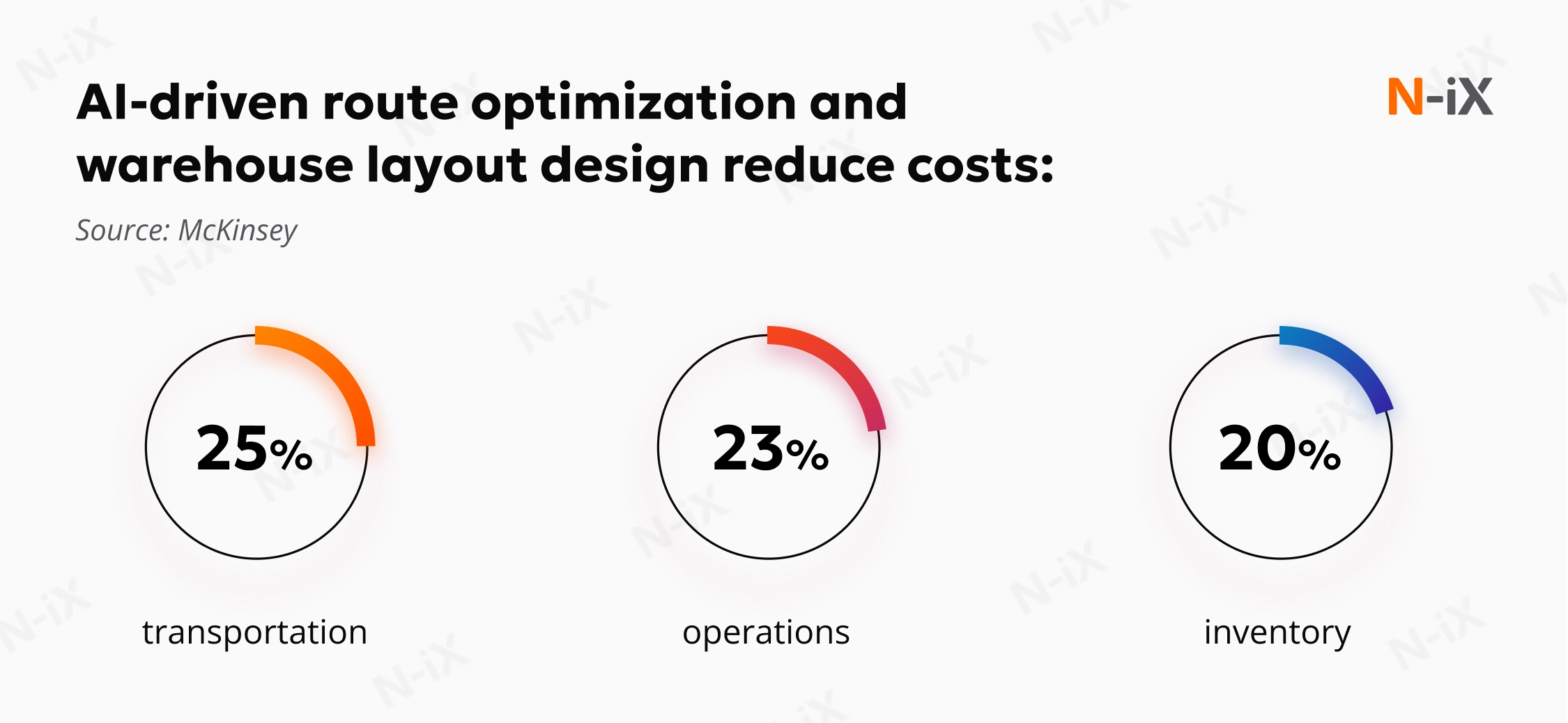
AI models provide real-time monitoring and re-routing capabilities during transit to circumvent delays caused by traffic congestion, accidents, or other disruptions, enhancing on-time delivery rates.
AI systems evaluate:
- traffic conditions
- weather forecasts
- vehicle capacities
- delivery schedules
- fuel consumption patterns
Generative AI streamlines reverse logistics by evaluating data on product returns, repairs, and refurbishment, optimizing return pathways, and selecting the most efficient and effective methods for repair, recycling, or disposal. It assists in managing the inventory of refurbished goods, ensuring efficient redistribution and reducing waste.
5. Risk modeling and disruption simulation
Generative AI in the supply chain identifies and manages risks by analyzing historical and external data, including weather patterns, geopolitical conditions, and supplier disruptions. These AI models, capable of processing extensive datasets, can detect trends and patterns related to supplier reliability and forecast potential supply chain interruptions.
AI models analyze operational data together with external signals such as:
- weather patterns
- geopolitical developments
- supplier performance trends
- transportation disruptions
Generative AI also enables scenario simulations that allow organizations to test disruption scenarios such as supplier shutdowns, sudden demand spikes, or logistics bottlenecks. Companies can then evaluate contingency strategies such as alternative suppliers or inventory redistribution.
6. Sustainability optimization
Generative AI promotes sustainable supply chain practices by optimizing transportation routes to reduce fuel consumption and emissions, improving packaging material usage to minimize waste, and advocating for eco-friendly practices. It analyzes data on traffic, vehicle capacities, delivery schedules, packaging alternatives, and resource utilization.
For instance, in logistics, generative AI optimizes delivery routes and schedules to improve fuel efficiency, reducing greenhouse gas emissions. In packaging, it recommends designs that use fewer materials and generate less waste, aligning with sustainability goals and generating strategies for reducing carbon footprints.
7. Warehouse layout optimization
Generative AI enhances warehouse layout optimization in supply chains by dynamically adjusting layouts based on real-time operational data and predictive analytics. An important advantage is its ability to adapt layouts on the fly to meet changing operational needs. Unlike traditional static layouts, which are based on historical data and assumptions, Generative AI continuously analyzes incoming data streams to identify opportunities for improvement.
AI systems analyze variables such as:
- product dimensions and storage requirements
- order frequency and demand patterns
- picking routes and worker movement
- storage capacity constraints
Furthermore, Generative AI can simulate various layout configurations and scenarios to identify the most efficient arrangement. For example, it can analyze historical order data to identify frequently accessed items and strategically place them closer to packing stations or shipping docks. Businesses can improve order fulfillment speed and customer satisfaction by reducing the distance traveled by warehouse workers and minimizing picking times.
8. Supply chain digital twins
A supply chain digital twin is a virtual model of the entire supply network that mirrors real-world operations using data from ERP systems, logistics platforms, IoT sensors, and supplier systems. Generative AI strengthens digital twins by enabling simulation, scenario generation, and operational optimization across procurement, production, and distribution.
Generative models analyze supply chain data and generate simulations of different operational conditions. Planners can test how disruptions such as supplier delays, demand spikes, transportation bottlenecks, or facility shutdowns affect the network. This allows organizations to evaluate mitigation strategies before disruptions occur.
Digital twins also support continuous operational monitoring. Real-time data from warehouses, transport fleets, and production facilities feeds into the digital model, allowing organizations to detect inefficiencies and identify opportunities to improve routing, inventory allocation, or production scheduling.
Risks and limitations of generative AI in supply chains
Generative AI can improve planning, sourcing, and execution across the supply chain. It can also fail in ways that are expensive, difficult to detect, and hard to govern.
Data quality and integration remain the first constraint
Generative AI depends on the quality, structure, and accessibility of enterprise data. In supply chains, that foundation is often weak. Data is spread across ERP platforms, warehouse systems, transport management tools, supplier portals, spreadsheets, emails, and plant-level operational technology. Many manufacturers and distributors still run heterogeneous IT and OT environments that were never designed for unified, real-time AI use. When source data is incomplete, inconsistent, or delayed, model outputs become unreliable regardless of model sophistication.
This creates several operational failure points:
- forecasts built on stale or partial demand signals;
- supplier risk assessments based on incomplete performance histories;
- inventory recommendations that ignore constraints hidden in local systems;
- generated explanations that appear coherent but are detached from current operational reality.
Data scarcity adds another limitation. Many organizations do not have enough high-quality internal data for specialized use cases such as rare disruption scenarios, niche procurement categories, or low-frequency failure events. Synthetic data can help in some cases, and Deloitte notes that generative AI itself can be used to supplement training datasets, but synthetic data does not remove the need for strong data governance and validation.
Hallucinations create legal, financial, and operational exposure
Large language models can generate answers that are fluent, plausible, and wrong. EY notes that hallucinations can produce responses that are out of context and unreliable, and warns that hallucinations must be minimized through sound data quality practices, governance, and operational guardrails. In a supply chain setting, that risk is not theoretical. A generated compliance summary can omit a critical clause. A customs-related document can include invented details. A supplier evaluation narrative can cite unsupported factors. Once these outputs enter procurement, trade compliance, or planning workflows, the organization carries the legal and financial exposure.
Hallucination risk rises when teams use general-purpose models without retrieval controls, reference data, or workflow boundaries. It also rises when users treat generated text as a final decision artifact rather than a draft requiring validation. In high-stakes supply chain processes, generated output should be treated as decision support, not autonomous truth.
Model drift is a structural problem in volatile supply chains
Supply chains change constantly. Supplier performance shifts. Routes are disrupted. Lead times move. Tariffs change. Demand patterns reset. A model trained on last quarter’s operating conditions can degrade quickly when the environment changes. That is classic model drift. In supply chains, drift is particularly dangerous because the operating context is external as well as internal. A model may still perform well statistically on old data while losing relevance in the current network.
This means generative AI programs need continuous monitoring rather than one-time deployment. Teams need to track whether recommendations still reflect current supplier behavior, network capacity, transport conditions, and customer demand. Without that discipline, the system gradually becomes less useful while still producing polished outputs that appear credible.
Bias, privacy, and explainability are operational risks
Bias in training data can distort supplier assessments, contract prioritization, and risk signals. Model bias, data privacy, and hallucinations among the core risks that must be managed through governance and controls. In supply chain contexts, biased outputs can influence vendor selection, payment prioritization, or escalation decisions in ways that are difficult to justify after the fact.
Privacy and intellectual property risks are equally material. Sensitive procurement data, proprietary product specifications, pricing structures, and supplier negotiations should not leak into public or weakly governed model environments. Recent regulatory developments are increasing pressure on organizations to address data protection, ethics, and compliance in generative AI deployments. For companies operating under audit, certification, or sector-specific controls, explainability also matters. If teams cannot show why a system recommended a sourcing strategy or flagged a supplier, they may struggle to defend the output in regulated workflows or internal reviews.
How to implement generative AI in the supply chain
In practice, value emerges when generative AI becomes embedded in operational workflows, supported by reliable data pipelines, integrated with enterprise systems, and governed through clear performance and risk controls. At N-iX, implementation typically follows a structured process. We connect business priorities with data engineering, model development, and operational integration.
Identify high-impact processes
Implementation begins with identifying operational processes where generative AI can deliver measurable impact. At N-iX, this phase starts with a structured assessment of supply chain workflows across planning, procurement, production, distribution, and after-sales operations. We analyze how decisions are currently made, which data sources support those decisions, and where operational inefficiencies or delays occur.
In many organizations, high-impact opportunities emerge in demand planning, supplier risk monitoring, inventory optimization, logistics coordination, and operational reporting. These processes share several characteristics: large volumes of operational data, repeated decision cycles, and a clear link between better decisions and measurable financial outcomes. During this stage we map processes into value-versus-complexity categories. High-frequency workflows such as demand-forecasting adjustments, supplier performance monitoring, or logistics documentation are often implemented first because they deliver measurable results quickly and require manageable integration effort.
Build data infrastructure
Generative AI systems rely heavily on structured and accessible operational data. Many supply chains operate across fragmented systems that include ERP platforms, warehouse management systems, transportation systems, supplier portals, and plant-level operational technology. Before models can generate reliable recommendations, these data sources must be unified and governed.
At N-iX, we begin by modernizing the data architecture that supports supply chain operations. This often involves building a centralized data platform that consolidates data from ERP systems, warehouse systems, transport management platforms, and external partner networks. The objective is to create a consistent operational dataset that reflects inventory levels, supplier performance, demand signals, logistics events, and production constraints in near real time.
Train and validate models
Once the data foundation is in place, the next step is selecting and training models appropriate for supply chain tasks. In most projects, organizations do not train large foundation models from scratch. Instead, they adapt existing models and enrich them with enterprise-specific data and operational context.
At N-iX, model development focuses on combining generative models with operational analytics pipelines. For example, large language models can be used to interpret operational data, generate planning scenarios, or summarize supply chain risks. In other cases, generative models work alongside forecasting models, optimization engines, and simulation systems.
Validation is a critical part of this phase. Supply chain decisions have financial and operational consequences, so model outputs must be rigorously tested. We conduct structured evaluation using historical operational data, scenario simulations, and expert review from supply chain specialists. This process helps identify hallucinations, unrealistic planning assumptions, or biased outputs. Human-in-the-loop validation remains essential during early deployment stages to ensure that generated recommendations align with real operational constraints.
Integrate with supply chain systems
We focus on connecting generative AI capabilities with existing supply chain platforms such as ERP systems, warehouse management systems, transportation management systems, and supplier portals. This integration is typically implemented through APIs and event-driven data pipelines that allow AI models to receive operational data and return recommendations directly within existing interfaces.
Instead of embedding AI directly into a single application, we implement composable AI services that can interact with multiple enterprise systems. This allows supply chain teams to access AI-generated insights within planning dashboards and other tools. For more advanced deployments, we introduce orchestration layers that coordinate interactions between generative models, analytics services, and operational systems.
Monitor and govern AI operations
Once generative AI systems enter production, continuous monitoring becomes essential. At N-iX, we implement observability frameworks that track model performance, data quality, and operational impact. These systems monitor metrics such as forecast accuracy, recommendation adoption rates, operational cost improvements, and anomaly detection results. When performance begins to degrade due to data drift or changes in supply chain conditions, models can be retrained or recalibrated.
Why choose N-iX for generative AI implementation in supply chain?
When the time comes to implement Generative AI within your supply chain operations, selecting the right technology partner can spell the difference between success and failure. N-iX is a reliable partner with a proven track record in implementing generative AI in supply chain management. Here are a few reasons why you should entrust this task to our tech experts:
- With over 24 years of experience in the tech industry, N-iX has delivered 60+ successful data science and AI projects. We have a team of 200 data, AI, and ML experts, including skilled Generative AI developers, who are well-versed in various verticals.
- We cover every process step, from the discovery phase, consulting, and end-to-end development to product release and post-production support.
- N-iX has been recognized globally for its outstanding services. We have been listed among the world's top 100 outsourcing service providers and consultants by IAOP and named a 2022 Solution Provider 500 leader by CRN.
- We adhere strictly to security protocols and regulatory frameworks, including ISO 27001:2013, PCI DSS, ISO 9001:2015, and GDPR, to guarantee the protection and integrity of data.

Get your ultimate guide on Generative AI use cases and applications!
Success!
FAQ
What is generative AI in supply chain management?
Generative AI in supply chain management refers to the use of AI models that can generate forecasts, operational scenarios, and decision recommendations based on large volumes of supply chain data. These systems analyze demand signals, supplier performance, logistics events, and operational constraints to simulate possible outcomes and support planning decisions.
What are the most common generative AI use cases in supply chains?
Generative AI is commonly used for demand forecasting, inventory optimization, supplier risk analysis, logistics planning, and supply chain simulation. Organizations also apply it to automate procurement documentation, analyze supplier contracts, and generate operational reports from multiple enterprise systems. Another growing generative AI supply chain examples are supply chain digital twins, where generative models simulate disruptions and operational changes to evaluate potential outcomes.
Can generative AI integrate with existing supply chain systems?
Yes, generative AI systems can integrate with existing supply chain platforms through APIs, data pipelines, and orchestration layers. These integrations allow AI models to access operational data from ERP systems, logistics platforms, warehouse management systems, and supplier networks.
Is generative AI suitable for complex global supply chains?
Generative AI can be particularly valuable in complex supply networks that involve multiple suppliers, distribution centers, transportation routes, and market regions. These environments generate large amounts of operational data that can be analyzed to detect patterns, simulate disruptions, and evaluate planning decisions. When implemented correctly, generative AI can help organizations anticipate supply risks, optimize inventory placement, and improve coordination across global logistics networks.
References
- Generative AI in Supply Chain Management - International Journal on Recent and Innovation Trends in Computing and Communication
- AI in action - Capgemini
- Supply Chain Networks in the Age of Generative AI - Accenture
Have a question?
Speak to an expert


