
 ChatGPT
 Perplexity
 Claude
 Gemini
 Grok
Grok
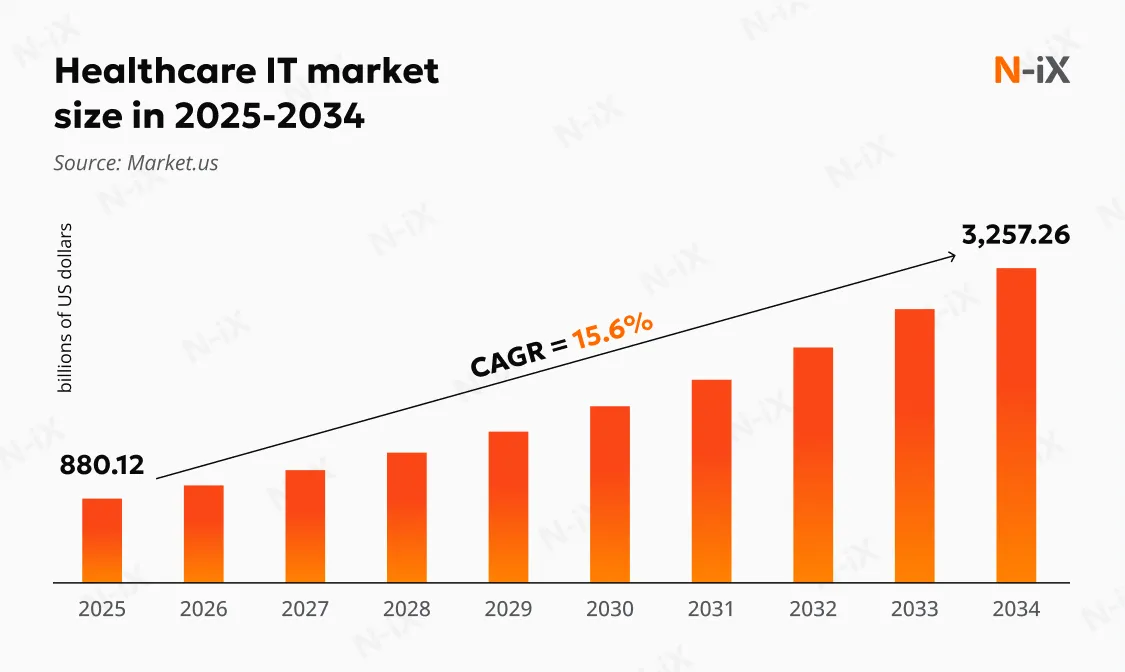
The healthcare industry is rapidly embracing technological solutions to enhance patient care, data analysis, and diagnostics. As a result, the medical IT sector is growing continuously. According to Polaris Market Research, the global healthcare IT market is projected to reach $3,257.26B by 2034. One of its key drivers is the increasing demand for cloud and DevOps solutions.
How exactly does DevOps in healthcare streamline medical processes? What are the best ways to integrate it into daily operations while overcoming common adoption challenges? Our DevOps experts provide insights and practical answers throughout this article.
Top 11 applications of DevOps for healthcare
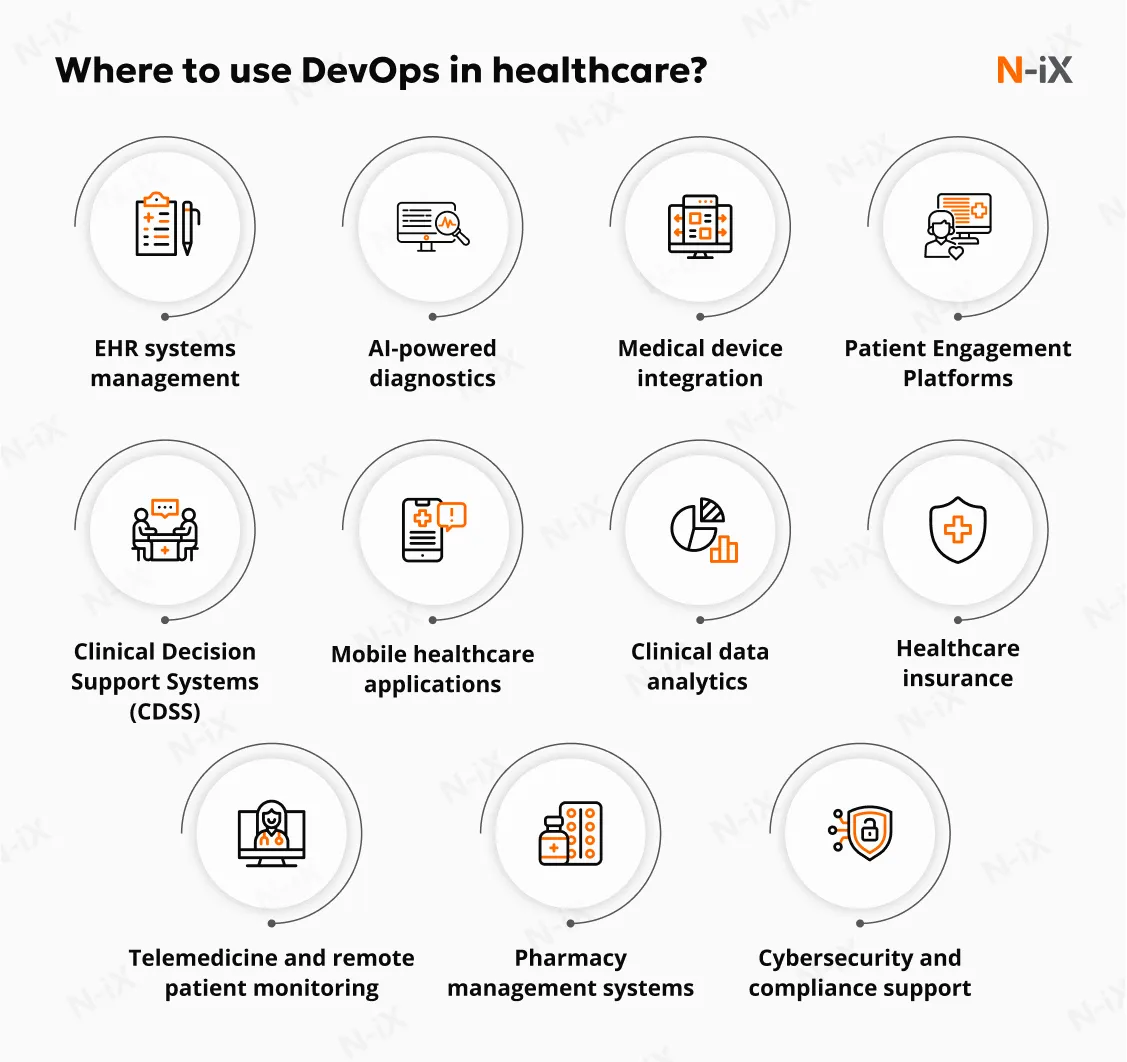
DevOps streamlines everyday healthcare operations, clinical trials, and access to powerful technologies. Here are the top use cases of how DevOps enhances the reliability and efficiency of medical systems:
1. EHR systems management
Electronic Health Record (EHR) platforms play a leading role in hospital operations. Even minor issues can slow down entire medical teams. DevOps keeps these systems responsive and up to date by automating routine updates, reducing deployment risks, and improving rollouts of new features. Medical and IT teams can respond quickly to feedback and upgrade systems without interrupting patient records access.
2. AI-powered diagnostics
AI-powered diagnostic tools depend on continuous model retraining, testing, and deployment. DevOps in healthcare simplifies these processes by automating version control, managing data pipelines, and monitoring performance. This allows diagnostic teams in radiology, pathology, and other fields to deploy accurate AI solutions without disrupting operations.
Discover where generative AI delivers the most value in healthcare—get the guide!
Success!
3. Medical device integration
Hospitals rely on hundreds of connected devices like infusion pumps, wearables, bedside monitors, etc. All of these constantly provide important patient data to clinical systems. DevOps streamlines their integration by standardizing how devices communicate with back-end systems and by automating configuration tasks. Thus, hospitals can create a more connected clinical environment where data flows where it needs to, without interruptions.
4. Telemedicine and remote patient monitoring (RPM)
Telehealth platforms and RPM solutions require reliable connectivity, strong security, and the ability to scale on demand. DevOps helps these platforms stay stable during high traffic, ensures video and audio run smoothly, and keeps integrations with wearable devices. Continuous monitoring enables DevOps teams to spot performance issues early and provide a seamless remote care experience.
5. Clinical decision support systems (CDSS)
CDSS are tools that deliver accurate recommendations based on the latest updates and patient data. DevOps can support these platforms, enabling better uptime and faster iterations. Automated testing ensures new rules and updates don't create conflicts, while continuous delivery (CD) shortens the time between identifying a need and rolling out an improvement. This keeps decision support tools relevant and trustworthy.
6. Mobile healthcare applications
Patients increasingly use mobile apps to schedule visits, track medication, or communicate with providers. DevOps streamlines the development and maintenance of these apps. It shortens release cycles, improves quality through automated testing, and supports compatibility across many devices. Development teams can experiment, gather insights from real users, and roll out refinements quickly.
7. Clinical data analytics
Healthcare analytics platforms rely on large volumes of structured and unstructured data. DevOps helps streamline ingestion pipelines, automate ETL tasks, and manage scalable cloud environments. Continuous monitoring ensures analytics dashboards remain accurate and accessible for clinicians, administrators, and researchers.
For example, N-iX also followed these practices while leveraging DevOps for healthcare data analytics. We supported a global healthcare company in modernizing its clinical-trial analytics platform. Our team applied DevOps practices, including containerizing deployments and enabling CI/CD-driven updates. We also help the client adopt microservices and implement automated data pipelines. These improvements reduced data processing time from nearly two hours to just a few minutes and created a reliable environment for analytics at scale. With a fully automated workflow, the client can now roll out updates safely and analyze trial data much faster.
Read the full case here: Modernizing digital solutions for efficient clinical trial data analysis
8. Pharmacy management systems
Pharmacy workflows depend on accurate data and smooth coordination between systems. DevOps adds predictability to these environments by automating updates, minimizing downtime, and simplifying integration with EHRs and inventory tools. Pharmacies can manage orders and prescriptions with fewer delays and manual fixes.
9. Patient engagement platforms
Patient portals and engagement systems let users request appointments, view lab results, or message providers. Thus, it is crucial to make them user-friendly and secure. Adopting DevOps in healthcare enables teams to refine the user experience more often, close security gaps faster, and keep services available even during heavy load. This consistency makes digital healthcare interactions smoother and more intuitive.
10. Healthcare insurance
Insurance companies deal with complex workflows, from claims processing to fraud detection. DevOps helps insurers automate repetitive tasks, modernize older systems, and maintain reliable customer portals. Continuous delivery is one of the top DevOps practices in healthcare IT projects. It accelerates updates that improve claim accuracy or streamline approvals, directly improving member satisfaction.
11. Cybersecurity and compliance support
Security is a constant concern in healthcare. DevOps enables the integration of DevSecOps practices into development and deployment pipelines to strengthen defenses. Automated scans, access control validation, and continuous monitoring help businesses identify vulnerabilities before attackers do. This strengthens the security posture without slowing down critical operations.
Best healthcare DevOps implementation practices
Implementing DevOps in healthcare requires balancing speed, safety, and compliance. Our experts share key best practices for streamlined adoption:
Adopt CI/CD with automated testing
Continuous integration and continuous delivery allow healthcare teams to release improvements faster without compromising reliability. And automated testing frameworks enable developers to identify issues early and ensure that updates do not break clinical workflows or disrupt critical systems. Combined, these technologies are especially important for systems supporting diagnostics, telehealth, and EHR operations. By implementing DevOps automation for healthcare, organizations can streamline testing and deployment processes, leading to reliable updates and more predictable release schedules.
Use Infrastructure as Code and containerization
Infrastructure as Code (IaC) helps healthcare organizations provision and manage environments consistently. Using tools such as Terraform or CloudFormation, teams can quickly provision secure environments that meet compliance and audit requirements. IaC also simplifies rollback, scaling, and disaster recovery procedures.
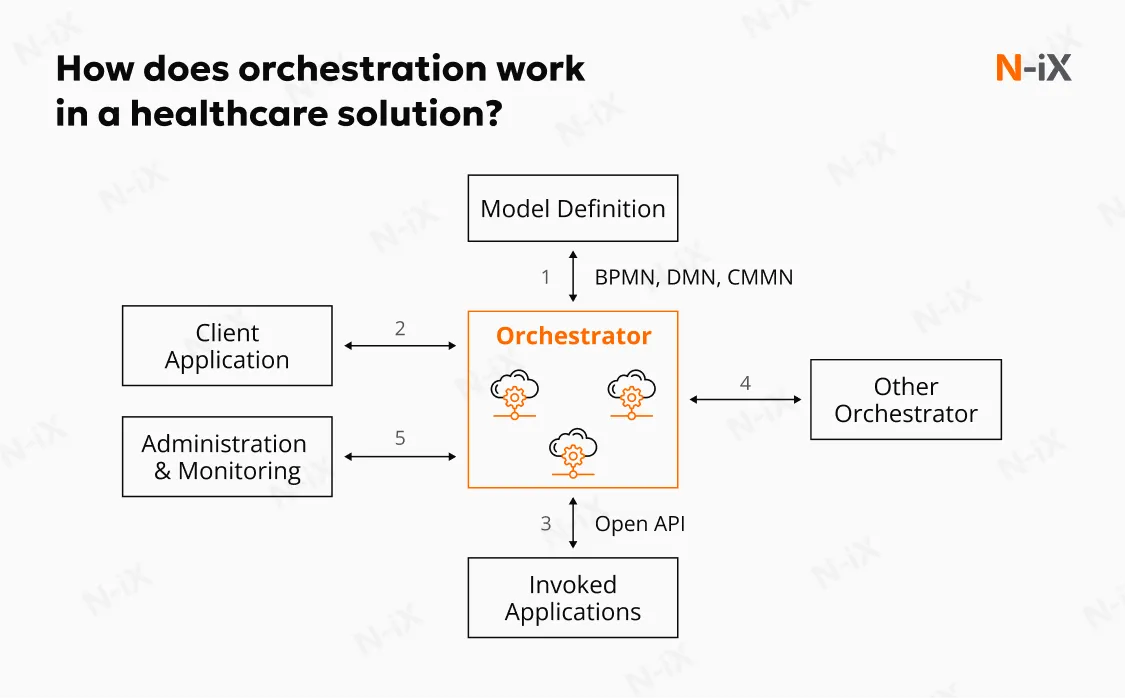
Our DevOps experts also recommend using containerization and orchestration to provide an additional layer of stability. These technologies make services easier to update, isolate, and scale, which is critical for high-load systems.
Integrate security and compliance practices from the start
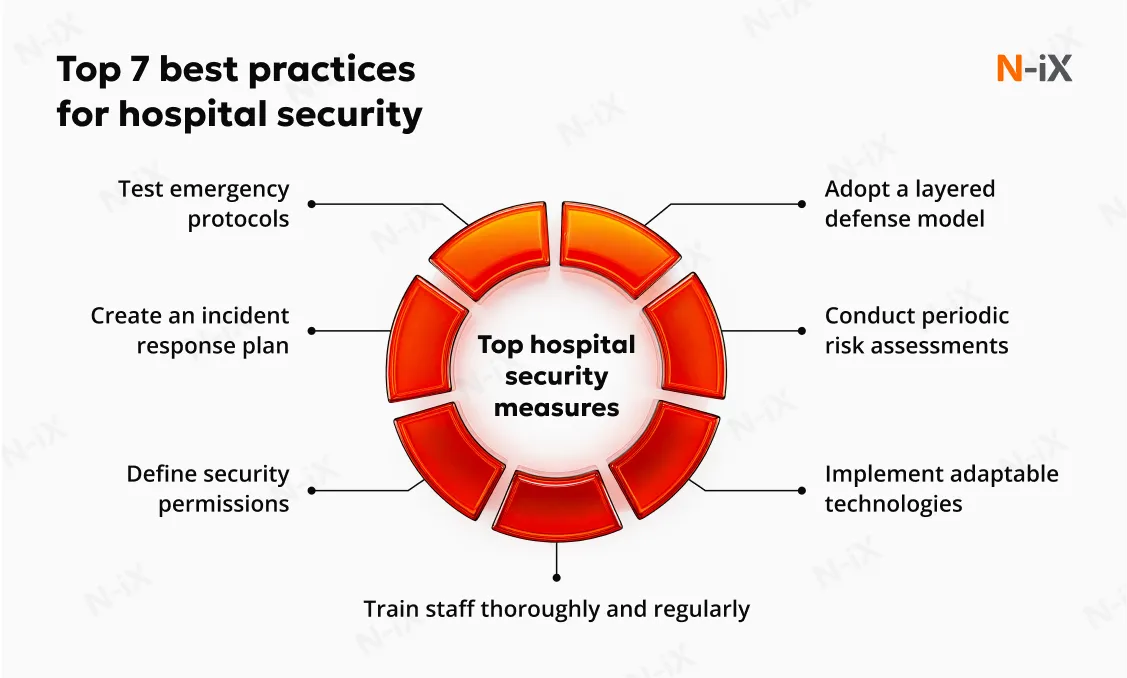
Healthcare data requires strict protection, so DevOps must include security controls from the earliest stages. This early focus on security is DevSecOps, a methodology that integrates protection into every phase of the development lifecycle. Its practices include encryption, role-based access control, logging, and vulnerability scanning, which are integrated in every build. This helps reduce both operational and regulatory risk.
By sharing security responsibility across teams, organizations can avoid late-stage fixes and maintain ongoing compliance with standards such as HIPAA, GDPR, and regional healthcare regulations.
Strengthen cross-team collaboration
Building healthcare products involves multiple stakeholders, including development and IT operations teams, clinicians, and medical administrators. Clear communication and shared ownership help ensure the software reflects real clinical workflows and addresses operational challenges.
Regular cross-team reviews, joint planning sessions, and aligned goals reduce misunderstandings and improve delivery speed. This collaboration also supports clearer requirements and more accurate prioritization of improvements.
Implement continuous monitoring and incident response
Real-time monitoring is essential in healthcare systems, where downtime or failures can compromise patient safety. Comprehensive observability, including logs, metrics, tracing, and alerts, helps teams identify issues early and resolve them before they affect clinical operations. With DevOps in healthcare, this continuous feedback loop ensures that potential challenges are addressed promptly.
Our security engineers also advise designing an incident response plan to strengthen product resilience. With a clear roadmap, teams can quickly detect and mitigate anomalies, maintaining service continuity. Combined with automated backups and disaster recovery, these practices help maintain high availability and predictable performance.
Follow a phased and iterative implementation strategy
Transforming healthcare with DevOps is not a one-time event. A phased approach helps teams modernize legacy systems, integrate new tools, and refine workflows without disrupting core medical services. Starting with pilot projects allows organizations to test technologies and build internal expertise.
Iterative improvements also make it easier to manage technical debt, assess compliance impacts, and adopt automation gradually. This reduces risks and supports smoother long-term transformation.
How to mitigate the challenges of DevOps healthcare implementation?
Healthcare workflows are complex, and even well-planned DevOps initiatives can face difficulties in adoption. Let's review the most common challenges and provide recommendations from N-iX experts for solving them.
Ensuring compliance with strict regulations
Healthcare providers must adhere to strict regulatory frameworks such as HIPAA, GDPR, and regional standards. Any DevOps workflow that handles patient data must operate within these rules, which can add complexity and slow down delivery.
N-iX tip: To address this challenge, you should integrate regular compliance checks. It is also important to automate audit logging, access control validation, policy checks, and encryption requirements. Treat compliance as a continuous process instead of a final review step to reduce delays and prevent non-compliant releases.
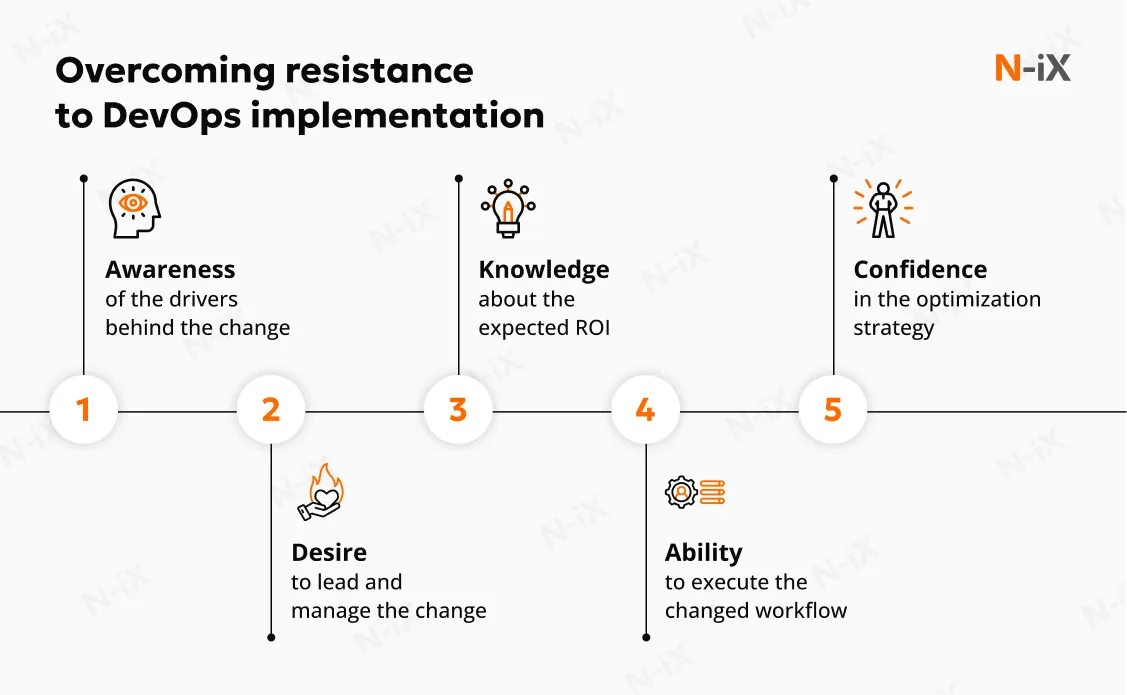
Resistance to change
Clinicians and IT teams may be hesitant to adopt new processes, especially when systems are mission-critical.
N-iX tip: To streamline the transition, encourage early involvement from clinical stakeholders and clearly communicate the benefits. Training sessions, pilot projects, and gradual rollout help build trust and reduce disruption.
Skill gap
Not all healthcare IT teams have experience with automation, cloud tools, or containerization. This can slow DevOps adoption or even make it impossible.
N-iX tip: In these cases, external expertise can play a key role. Partnering with an experienced DevOps consultant can accelerate implementation, design the right architecture, and leverage the necessary expertise.
Why choose N-iX as your DevOps healthcare consultant?
Healthcare organizations require digital systems that are resilient, secure, and adaptable to rapidly changing demands. DevOps practices provide the foundation for this transformation. However, adopting DevOps in healthcare may be complex and require many resources. Thus, partnering with an expert team can help address challenges and get quick access to skilled talent.
N-iX helps healthcare companies adopt DevOps and cloud solutions for 23 years. Our team of more than 70 DevOps experts successfully implemented over 50 DevOps projects in the past years. Additionally, N-iX helps medical businesses prepare for GDPR and HIPAA compliance and ensure secure data management.
Contact N-iX today and discover how we can optimize your healthcare operations and accelerate your digital transformation!
Have a question?
Speak to an expert