
 ChatGPT
 Perplexity
 Claude
 Gemini
 Grok
Grok
Most executives focus on business outcomes rather than database choices. Yet in many companies, the choice between Couchbase vs MongoDB often defines the speed of product development, system reliability, and predictability of cloud costs.
The challenge is when your data platform can't keep pace, customer experiences slow down, operations become fragile, and teams spend more time resolving problems than delivering value. That's why the Couchbase vs MongoDB decision has shifted from a technical preference to a strategic choice.
Although businesses usually consider several NoSQL options, such as Couchbase and MongoDB, many use cases require real-time performance, offline mobile support, and integrated caching, areas where Couchbase excels. This article compares these technologies and explains why businesses turn to Couchbase consulting to translate technical differences in business terms.
Why Couchbase vs MongoDB matters for enterprises
Modern enterprises need databases that handle:
- Massive scale (billions of operations daily) with sub-millisecond latency
- Flexible JSON data models supporting rapid schema changes
- Real-time analytics alongside transactional tasks
- AI-powered features for intelligent applications
- Global distribution with minimal downtime
Couchbase and MongoDB are NoSQL databases that support large-scale, real-time applications where traditional SQL databases struggle. They store data in flexible JSON formats, scale horizontally, and enable the kinds of high-velocity digital experiences enterprises depend on. The choice impacts the following business outcomes:
Total cost of ownership (TCO)
Database architecture influences long-term costs: cloud bills, infrastructure, and operational overhead.
- Infrastructure efficiency: Couchbase's memory-first design often uses 50-60% fewer servers than MongoDB clusters.
- Pricing: Couchbase offers transparent, usage-based pricing. In contrast, MongoDB's cluster-based pricing grows with added features, backups, or analytics.
- Operational labor: MongoDB deployments often require more manual sharding and indexing decisions, as well as external tools. Couchbase minimizes this overhead with built-in caching, auto-sharding, and integrated monitoring.
Operational resilience
Database reliability directly impacts uptime, incident frequency, and team productivity.
- Day-to-day load: MongoDB requires continuous index management and adjustments, while Couchbase reduces friction with auto-sharding and caching.
- Built-in reliability: Couchbase provides ACID transactions, cross-datacenter replication, and low-latency reads. MongoDB can achieve similar consistency but often requires additional configuration.
- Failure containment: Couchbase isolates workloads (query, search, analytics), preventing failures in one workload from affecting others.
- Operational visibility: Couchbase provides deep, real-time cluster insights, whereas MongoDB often relies on third-party tools.
Speed of innovation
The speed at which teams deliver new features relies on database capabilities.
- Unified development experience: Couchbase's SQL++ is familiar to SQL engineers, making queries easier. Integrated capabilities: Couchbase provides full-text, vector, and eventing search, as well as analytics, out of the box. MongoDB often requires add-ons.
- Multi-workload enablement: Couchbase separates services to prevent resource contention.
Implement data governance at scale—find out how in a white paper!

Success!
Couchbase vs MongoDB: Key differences you need to know
Though Couchbase, MongoDB, and Cassandra are all NoSQL databases, they are optimized for very different workloads. For executives, the key is to understand which platform aligns with real-time requirements, scale expectations, operational limits, and AI goals. Several Couchbase vs. MongoDB benchmark comparisons show that performance varies significantly under high-concurrency, low-latency workloads.
What is Couchbase?
Couchbase is a high-performance NoSQL database designed for modern applications that require speed, reliability, and offline capabilities. It combines document storage and key-value access in a single platform.
Key features:
- Multi-model support: JSON documents, key-value, and query-based access.
- Memory-first architecture: Fast read/write by keeping frequently accessed data in memory.
- SQL-like queries (N1QL): Familiar syntax for flexible and powerful queries.
- Mobile and edge support: Couchbase Mobile with offline-first sync.
Use cases: e-commerce, gaming, finance, telecom, real-time dashboards, mobile applications.
What is MongoDB?
MongoDB is a widely used document-oriented NoSQL database. It stores data as flexible, JSON-like documents, making it easy to handle changing data structures.
Key features:
- Document-based model: Store structured and semi-structured data in flexible documents.
- Scalability: Distribute data across multiple servers via automatic sharding.
- Rich querying: Strong query language for complex searches and aggregations.
- Community support: Large ecosystem, tutorials, and third-party tools.
Use cases: content management systems, real-time analytics, mobile apps, ecommerce, and IoT platforms.
Couchbase vs MongoDB vs Cassandra: Where each database excels
Couchbase vs MongoDB vs Cassandra are often compared because they all drive large-scale, distributed applications. However, they solve different categories of business operations. Understanding these distinctions helps enterprises choose the right platform and avoid expensive architectural mistakes.
Before comparing, it's worth introducing Cassandra: a distributed, masterless database used by telecoms, global streaming platforms, and IoT-heavy industries. Cassandra is strong for high-volume, write-intensive workloads, but comes with trade-offs in querying and operational complexity.
Real-time performance and use cases
Different applications demand varying performance characteristics. Here's where each database excels:
Couchbase: real-time and mobile applications
- Sub-millisecond latency for gaming leaderboards and financial transactions
- Operational dashboards with real-time aggregations
- Offline-first mobile apps with automatic cloud sync and peer-to-peer device sync
- Vector search for AI and semantic search, available on cloud, on-prem, and mobile
Example: A gaming company uses Couchbase to power live leaderboards for millions of players, maintaining response times even during peak hours.
MongoDB: flexible querying and developer ecosystem
- Ideal for ecommerce sites with tailored recommendations
- Strong ecosystem for JavaScript/Node.js developers
- Suitable for migrating legacy relational systems
- ACID multi-document transactions for moderate workloads
Example: An online retailer relies on MongoDB to manage product catalogs and complex search filters, while easily integrating with third-party analytics tools.
Cassandra: write-heavy, high-volume workloads
- Telecoms companies, processing billions of call records per day
- IoT applications, collecting 1M+ sensor readings per second
- Event logging and monitoring systems that require consistent write throughput
Example: A telecom provider ingests massive call data in real-time, scaling linearly across a 20-node Cassandra cluster.
Read also: What you need to know about a data warehouse vs database difference
Scalability and сloud integration
Scaling your database globally depends on architecture and cloud integration.
Couchbase:
- Linear scaling with predictable performance
- Built-in cross-datacenter replication (XDCR) for global deployments
- Service separation (KV, query, search, analytics) reduces resource contention
MongoDB:
- Supports live shard key changes for zero-downtime resharding
- Broad adoption in cloud environments with managed services
- May require add-ons for analytics or search at scale
Cassandra:
- Masterless design allows linear horizontal scaling High write throughput even at massive cluster sizes
- Read latency is higher; complex queries are limited
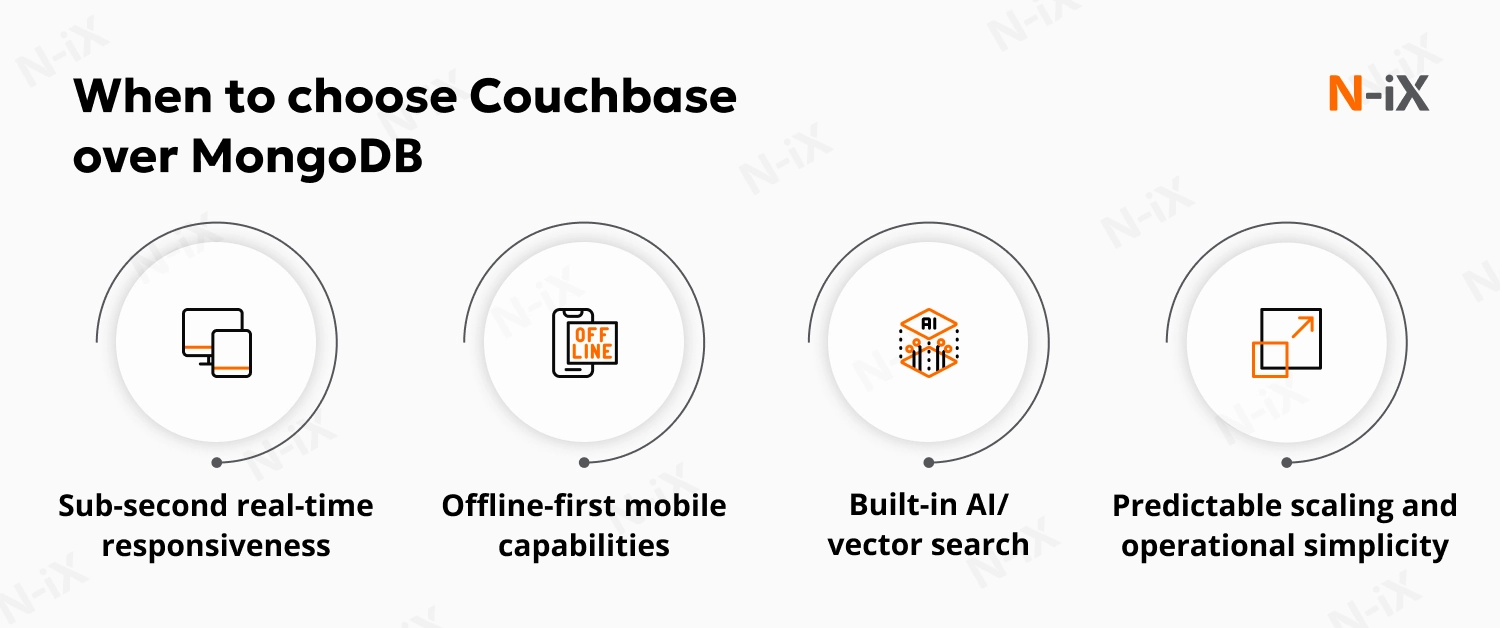
When to choose Couchbase over MongoDB
Couchbase is generally a better option when your business requires:
- Sub-second real-time responsiveness for customer-facing applications
- Offline-first mobile capabilities with seamless sync Built-in AI/vector search without adding multiple tools
- Predictable scaling and operational simplicity
Example: A fintech app uses Couchbase to combine real-time transaction processing, mobile offline mode, and vector-based fraud detection into a single integrated platform.
Couchbase vs MongoDB vs Cassandra: Side-by-side comparison
|
Feature / Use Case |
Couchbase |
MongoDB |
Cassandra |
|
Best for |
Real-time apps, mobile/offline-first, AI/vector search |
Query-heavy apps, developer ecosystem, flexible schemas |
Write-heavy workloads, telecom/IoT-scale ingestion |
|
Performance |
Sub-millisecond reads/writes, low-latency multi-model queries |
Fast for reads; flexible queries; write throughput moderate |
Extremely high write throughput; read latency higher |
|
Mobile & Offline |
Built-in Couchbase Lite + Sync Gateway; offline-first; peer-to-peer sync |
Limited; no official mobile/offline stack |
Not designed for mobile/offline |
|
AI / Vector Search |
Native hyperscale vector search on cloud, edge, and mobile |
Requires add-ons; slower at scale |
Not natively supported |
|
Scaling |
Horizontal scaling; multi-dimensional (KV, query, search, analytics) |
Horizontal sharding; live shard key changes |
Linear horizontal scaling; masterless nodes |
|
Operational Complexity |
Lower; auto-sharding, caching, integrated observability |
Moderate; requires tuning and some add-ons |
Higher; needs complex setup and maintenance |
|
Transaction Support |
ACID transactions built-in |
ACID multi-document transactions (16MB limit) |
Eventual consistency; limited transaction support |
|
Ecosystem & Community |
Growing, smaller than MongoDB |
Largest NoSQL community, many integrations |
Niche; mostly telecom/IoT-focused |
|
Micro-Case Example |
Gaming leaderboard: sub-2ms updates; mobile offline-first apps |
E-commerce product catalog with complex searches |
IoT sensor network: millions of writes/sec with predictable scale |
|
Performance & benchmarks |
Optimized for low-latency access; strong results in Couchbase vs MongoDB performance benchmarks for real-time workloads. |
Performs well for flexible querying; needs more tuning to match Couchbase in some high-concurrency benchmarks. |
Excels in write-heavy benchmarks; read and query flexibility is more limited. |
Explore more: Choosing a custom database development company: 7 tips in plain sight
Why enterprises choose Couchbase for specific modern workloads
While MongoDB and Cassandra offer strong capabilities in specific areas, Couchbase is suited for enterprises building real-time, highly available, or mobile-enabled systems. Here's how Couchbase delivers better business value in key use cases:
Uninterrupted operations at any scale
Modern digital services can't afford downtime, and Couchbase is built to keep applications responsive during spikes, failures, or region-level disruptions. Multi-region replication and distributed workloads guarantee consistently low latency for global users. At N-iX, we design and optimize these high-availability setups so enterprises can maintain mission-critical uptime without increasing operational risk.
New features and improvements faster
Couchbase's flexibility allows teams to evolve data models without slow migrations or strict schema changes, so product teams iterate quickly and release updates without waiting for backend refactoring. N-iX supports this agility by helping teams to structure their data models and queries to shorten development cycles and remove database bottlenecks.
Lower infrastructure waste and predictable costs
By combining caching, storage, search, and analytics into a single platform, Couchbase reduces the need for multiple systems and minimizes over-provisioning. Its memory-centric architecture also reduces server usage. N-iX helps enterprises fine-tune cluster configurations and scaling policies to achieve maximum performance with a lean, predictable cost structure.
Real-time operational insights and automation
Built-in eventing, analytics, and search enable real-time monitoring, instant triggers, and operational dashboards without relying on external pipelines. This helps business teams respond quickly and automate routine decisions. N-iX integrates these real-time capabilities into enterprise systems, enabling organizations to detect issues early and automate high-impact workflows.
Strengthen data governance and compliance posture
Couchbase offers encryption, detailed access control, and multi-region governance to support regulatory compliance. These capabilities help organizations protect sensitive data across hybrid-cloud or multi-cloud environments. N-iX ensures these security and governance features are configured correctly and aligned with the organization's compliance requirements.
How N-iX helps enterprises adopt Couchbase successfully
After comparing Couchbase vs MongoDB vs Cassandra, enterprises conclude that Couchbase best supports their real-time, mobile, and AI-driven workloads, but adoption still comes with architectural, migration, and operational challenges. This is where a specialized Couchbase consulting partner makes a tangible difference.
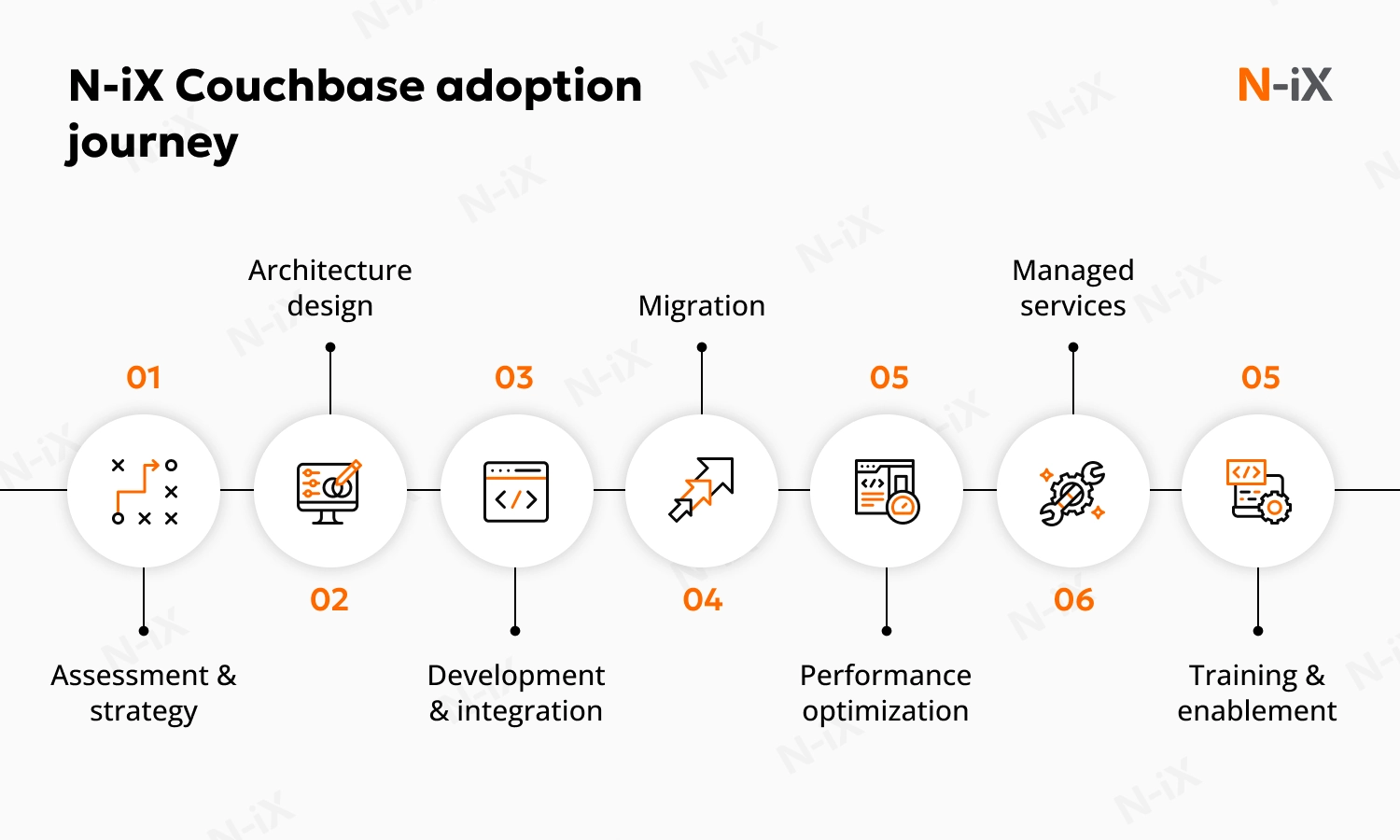
As an official Couchbase partner, N-iX provides end-to-end consulting and managed services to accelerate adoption, reduce risk, and ensure long-term success.
End-to-end consulting and strategy
N-iX evaluates your current architecture, workloads, and business goals to identify where Couchbase delivers maximum impact. Our consulting services include:
- Architecture assessments and ROI/TCO analysis
- Proof of Concept design and benchmarking
- Adoption roadmaps with HA, compliance, and GDPR-aligned best practices
Architecture, development, and integration
We design enterprise-grade Couchbase platforms optimized for scalability, security, and cloud-native operations:
- Flexible JSON schema design and SQL++ query modeling
- Cluster sizing, topology, and hybrid/cloud deployment
- Backend, microservices, and real-time eventing pipelines
- Mobile and IoT solutions with Couchbase Lite and Sync Gateway
- Integration with BI tools, data lakes, Kafka, and Spark
Migration, performance, and managed services
N-iX simplifies migration from legacy databases, ensuring minimal downtime and smooth data transformation. We also optimize Couchbase clusters for low-latency performance and provide fully managed services:
- Auto-scaling, backups, failover, and CI/CD integration
- Monitoring, performance tuning, and XDCR for global distribution
- Multi-tiered support, disaster recovery, and feature adoption
- This ensures reliable, cost-efficient operations at enterprise scale.
Training and enablement
We empower teams to manage Couchbase independently through:
- Hands-on labs for data modeling, queries, and cluster administration
- Knowledge transfer on multi-tenancy and scaling
- Certification preparation and project-specific mentorship
Read more: Big Data analytics for improved maintenance and flawless operation of the in-flight internet
Why enterprises choose a partnership with N-iX
With more than 23 years of engineering expertise, N-iX delivers Couchbase solutions with the scale, security, and efficiency global organizations expect.
We bring together:
- 200 data experts
- 400 cloud experts
- 70 devops experts
To cover every phase of Couchbase adoption, from strategy and architecture to daily operations. Supported by leading partners such as AWS, GCP, Azure, Snowflake, SAP, and OpenText, we help enterprises build scalable, high-performance, real-time data solutions powered by Couchbase.

Have a question?
Speak to an expert