
 ChatGPT
 Perplexity
 Claude
 Gemini
 Grok
Grok
Let’s begin with a question that pops up in the head of any business owner or CTO who decides to offshore software development. Why is it so hard to choose an offshoring provider? Every company seems to be on top of its game with big portfolios, long lists of certifications, and a proactive sales team. This guide will explore how to stop real signs of tech and business competency. Let’s go through the 15 steps of how to choose an offshore provider:
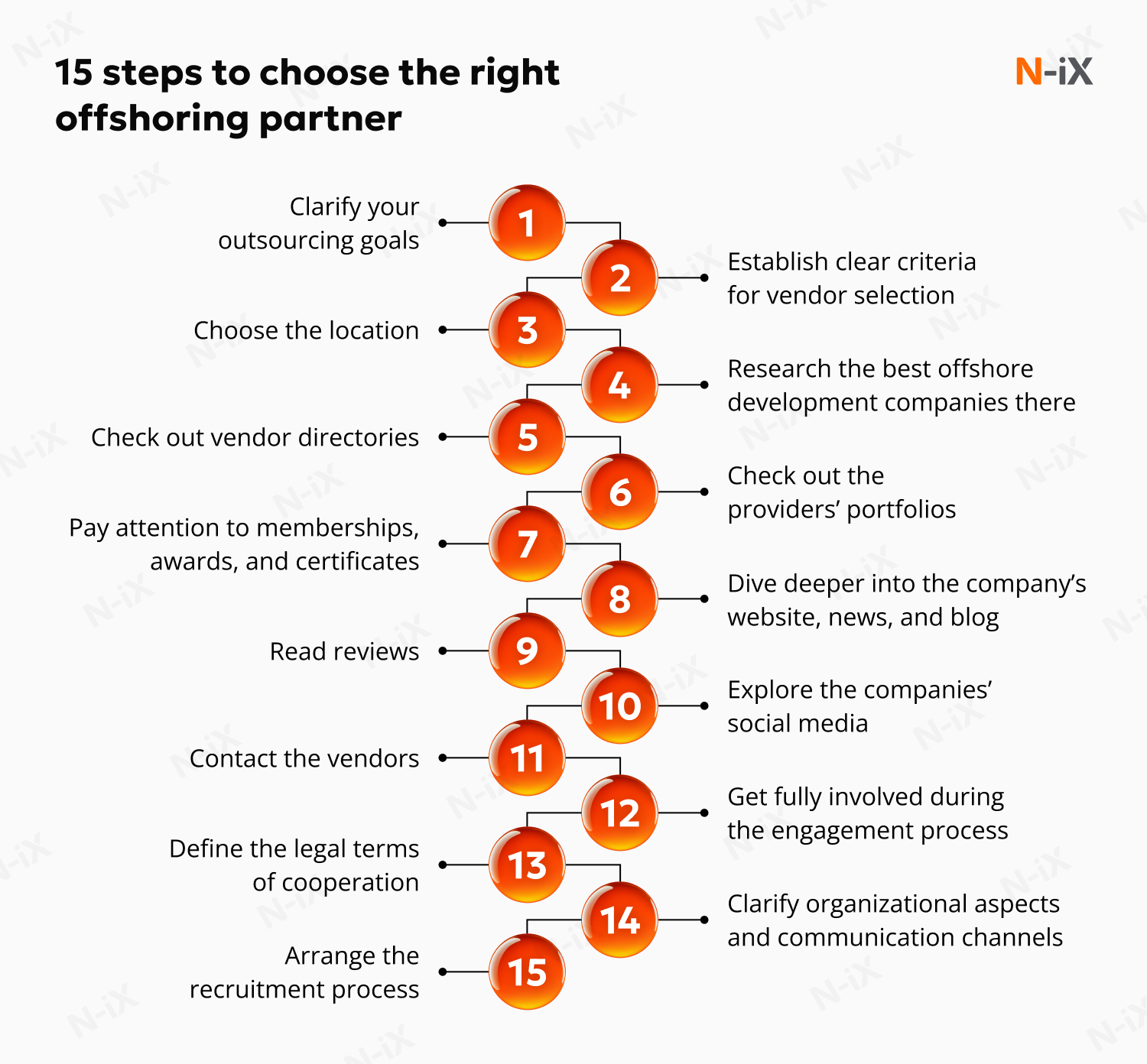
Select the right outsourcing partner in 15 steps
These steps will help you move from defining your business goals to making first contact with the right vendor. The process isn’t about rushing to sign a contract: it’s about understanding your needs, mapping them to the right engagement model, and vetting potential partners with precision. When approached methodically, each step builds on the previous one, turning a broad idea into a structured, low-risk collaboration plan ready for execution.
It’s about understanding your needs, mapping them to the right engagement model, and vetting potential partners with precision.
Step 1: Clarify your outsourcing goals
To achieve the best results, start planning from the outcomes. Define the business result you are aiming for, the constraints you face, and the KPIs that will indicate success. If you already have the skills, capacity, and governance to hit those targets in-house, outsourcing may add cost and coordination overhead without additional value.
Most teams, however, operate under headcount limits, tight timelines, or lack niche tech expertise. In that context, the right outsourcing partner accelerates delivery, reduces risks, and preserves your core team’s focus.
Choose the model or service that best aligns with your needs:
- Staff augmentation. If your roadmap is clear but you lack development capacity or need specific expertise, extend your team with qualified engineers who work under your product leadership and processes.
- Managed team. When you want to retain product ownership but delegate delivery management, a managed team operates as an autonomous engineering unit aligned with your goals.
- Custom solution development. For end-to-end ownership, the vendor delivers a complete solution for your needs. This model suits companies seeking faster time-to-market and minimal strain on internal management resources, with the vendor assuming full delivery and quality accountability.
- Tech consulting. If you face a business problem rather than a defined backlog, engage a partner to diagnose, propose a solution, and deliver it with measurable value tied to cost, risk, and time.
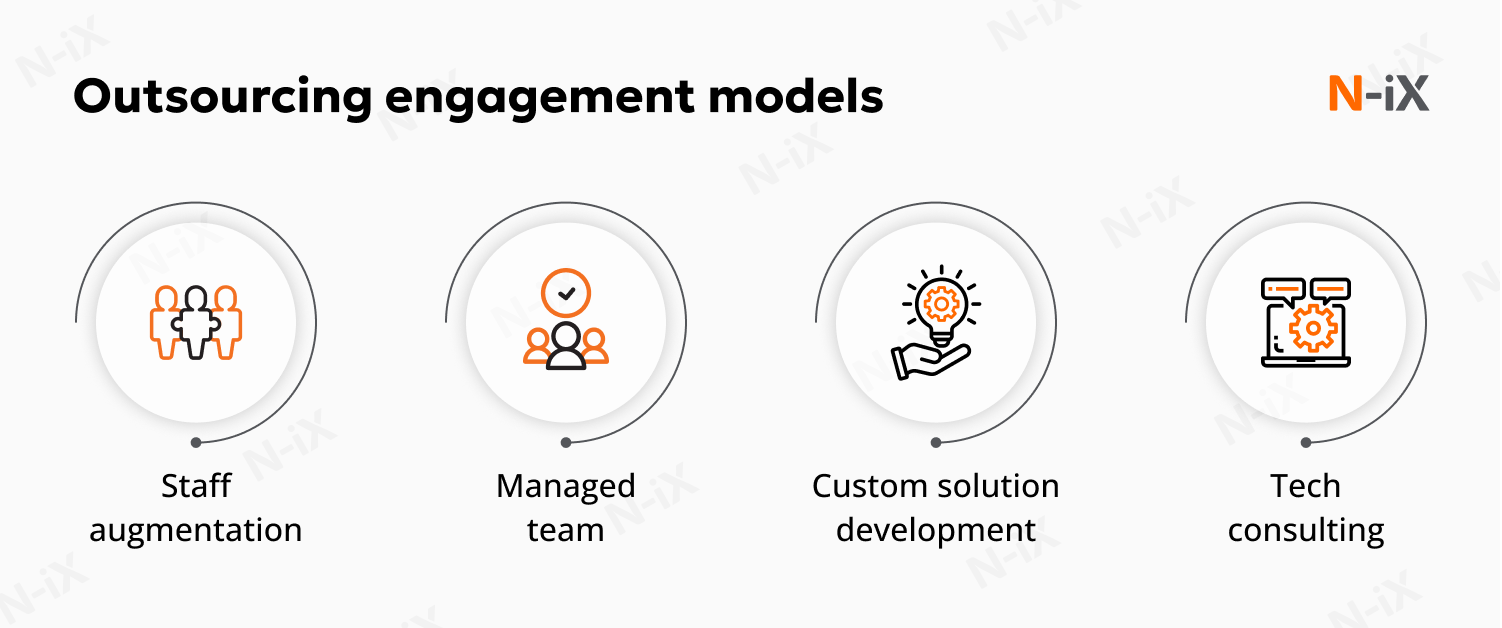
When goals, an engagement model, and accountability are clearly set, offshore outsourcing becomes an excellent way to reach targets faster.
Additionally, consider whether looking for an offshore outsourcing company is the right decision to begin with. The distinction between nearshore vs offshore outsourcing is increasingly fluid. For North American and European companies, destinations such as Poland, Ukraine, or Colombia are technically “nearshore,” yet they combine the benefits associated with traditional offshore regions.
The choice is less about distance and more about collaboration style. Nearshore partnerships offer real-time communication and smoother integration, whereas offshore models prioritize scale and round-the-clock operations.
Are you prepared for what’s next in IT outsourcing? Find out in the ebook!
Success!
Step 2: Establish clear criteria for vendor selection
Vendor selection is always based on certain criteria. One can hardly find an IT outsourcing company that will perfectly match all of them. Therefore, before rushing into the research and selection, you should clearly understand what aspects are critical for your case. Is your offshore outsourcing project about bringing specialized expertise, or quickly scaling up existing teams? We compiled a list of the most common factors influencing an outsourcing decision:
- Company size. If you need to scale up quickly, bigger companies will be a better choice as they often have larger and more diverse internal talent pools and established hiring pipelines. For example, N-iX has over 500,000 CVs in the database and 70 experienced recruiters, allowing N-iX to fill a position in 3-4 weeks.
- Tech expertise. Understand the tech stack of your project and look for companies with proven expertise in the relevant fields. When choosing an offshore outsourcing software development company, look for examples of similar partnerships in the vendor’s portfolio, focusing on the tech stack.
- Location. Choose a destination within a convenient time zone and easy to get to if you value in-person meetings.
- Communication. How is the clarity of communication, response time, and consistency of follow-through? Are they proficient in both written and spoken English? Additionally, treat cultural fit as a core factor, including meeting etiquette, feedback style, and decision-making norms.
- Company size. If you need to scale up quickly, bigger companies will be a better choice as they often have larger and more diverse internal talent pools and established hiring pipelines. For example, N-iX has over 500,000 CVs in the database and 70 experiences recruiters, allowing N-iX to fill a position in 3-4 weeks.
These criteria might differ depending on business needs, so you can add those that are relevant in your situation.
Step 3: Choose the location
Each destination has its benefits and pitfalls; let’s discuss the main offshoring regions and how to choose between them:
- CEE: Team extension in Poland offers the region’s largest capacity, with 650K tech professionals, strong corporate investment, and mature vendor ecosystems across Cloud, data, and embedded. Ukraine offers a senior-leaning pool of over 350K tech professionals and remains CEE’s second-largest outsourcing hub, delivering reliably on complex, enterprise-grade projects without disruptions. Romania, the Czech Republic, and Bulgaria offer diverse talent, competitive rates, and strong compliance for regulated workloads.
- Latin America: Colombia, Mexico, Brazil, and Argentina provide large, fast-growing pools with near-real-time overlap for North America. Team extension in Latin America benefits from cultural proximity, strong university pipelines, and active government incentives. Notably, Colombia’s outstanding expansion of the talent pool, top positions in skill rankings, and strong government support make it a strategic choice for real-time collaboration.
- India: An outsourcing powerhouse with vast technical capacity, process maturity, and competitive pricing. Best suited for large-scale delivery, though time-zone and communication gaps may require strong project governance.
- Southeast Asia: This emerging region offers compelling value and quality. Vietnam is strong in modern web, mobile, and AI-adjacent services; the Philippines excels in customer operations, content, and QA.
Let’s compare the regions side-by-side:
| Region | Talent pool size | Benefits | Challenges |
| Central and Eastern Europe | ~2,000,000+ | Mature vendor ecosystems, cutting-edge expertise, Western-aligned standards | High competition for top talent and compensation for top expertise attraction |
| Latin America | ~1,800,000+ | NA time-zone overlap, cultural proximity, university pipelines | Regulatory and infrastructure maturity varies; shortages in specialized expertise |
| India | ~5,800,000+ | Vast scale, process maturity, cost competitiveness | Requires stronger governance for communication and business goals alignment |
| Southeast Asia | ~2,100,000+ | Streamlined web, mobile development, and customer ops/QA infrastructure | Governance and IP risk may be higher in some cases |
Step 4: Research the best offshore development companies there
The next step is to create a shortlist of the top offshore development companies in the chosen location. How can one research companies? Use websites like Clutch to filter companies by size, expertise, location, and other criteria.
To aid you in this research, our market analysts have prepared a list of the top 30 offshore software development companies in the world.
Step 5: Check out vendor directories
Vendor directories such as Clutch, GoodFirms, or DesignRush provide an independent layer of verification. They collect detailed company data: size, industries served, pricing models, and service focus. Most importantly, they verify client reviews through direct interviews or reference checks. Use these profiles to cross-check several things:
- Consistency: Do the company’s stated services, industries, and headcount match what’s written on their official site and LinkedIn page?
- Client references: Look for reviews from organizations similar to yours in size or industry and needs.
- Longevity and activity: Check how long the vendor has been listed, how often they update their profile, and whether they have recent reviews.
A well-documented Clutch profile with multiple verified case studies and recent feedback is often a reliable indicator of an established and transparent outsourcing company.
Step 6: Check out the providers’ portfolios
To get a better grasp of an offshore outsourcing company’s experience and expertise, spend some time on their website. Look for the list of their clients, solutions developed for them, case studies, etc. This will help you learn more about the technologies the company specializes in, the business domains they serve, and the types of companies they typically work with. Search for the solutions that either match your industry or the tech stack you need.
Step 7: Pay attention to memberships, awards, and certificates
An established offshore outsourcing company typically has certifications from major tech partners. For instance, a company working with .NET needs to be certified by Microsoft. This will ensure that the service provider knows what they are doing within the given tech stack.
Moreover, membership in various chambers, associations, and business communities is a good sign. For example, N-iX holds high-tier hyperscaler partnerships: AWS Premier Tier, Microsoft Solutions Partner with AI specialization, and Google Cloud Data Analytics Specialization. Cloud partnerships signal audited expertise and unlock co-sell and funding programs. Partnerships such as Snowflake reinforce data, analytics, and embedded engineering delivery. The most important security and quality baselines include ISO 27001, SOC 2 Type II, PCI DSS, FSQS, and ISO 9001, which demonstrate a mature compliance framework that streamlines enterprise due diligence.
These credentials reduce delivery risk, speed build and migration timelines via credits and engineering access.
Step 8: Dive deeper into the company’s website, news, and blog
Audit the vendor’s owned channels with a simple goal: verify recency, consistency, and proof of delivery.
Check the blog and news for fresh, regular updates. Confirm the office footprint and locations. Review cooperation models and delivery approaches to see how they run discovery, QA, security, and governance. Scan the careers page for open roles, seniority mix, and hiring locations.
Map their technologies, services, and domain expertise to your needs. Read the company overview for headcount, certifications, and partnerships.
Study the portfolio for dated case studies, named clients, and outcomes.
Read more: How to mitigate offshore software development risks
Step 9: Read reviews
You can always ask for customer recommendations during the engagement process, but you can also check out customer reviews even before contacting the vendors. Browse recommendations on social media and Google. Also, check out client testimonials on the website. A lot of companies provide video testimonials as well, so you may see the real people describing their cooperation with this company.
Employee feedback is also important as the company’s brand image will affect its recruitment capabilities. If there are a lot of negative reviews about the vendor on social media, it may indicate a higher attrition rate.
Step 10: Explore the companies’ social media
The company’s social media can give you an inside look into its life. Most companies use LinkedIn to present their accomplishments, expertise, and experience. If you are looking to learn more about the company’s day-to-day life, visit their Facebook, Instagram, and Twitter pages. Browse their posts, photos, and videos to learn more about them as real people you’re going to work with. Look for a vendor with a similar culture and business ethics.
Step 11: Contact the vendors
No experience or expertise can make up for the absence of proper communication and customer approach. If you see that the vendor expresses little interest in your inquiry, doesn’t seem to be fully engaged, or replies weeks after the request was sent, it might mean that all future communication will be delayed.
Also, vendors research you as a potential client, so including important details in your initial inquiry or email can reduce the time needed to process your request. It also helps them understand whether they can help you with the services you need.

Step 12: Get fully involved during the engagement process
The next part of the process requires a lot of communication with a chosen vendor.
Make sure to discuss critical day-to-day details, such as what communication channels will be used, what delivery model will be provided, and within what timeframes. Ask as many questions as you need to reach the final decision.
Step 13: Define the legal terms of cooperation
Time to talk about liability, insurance, intellectual property ownership, timeframes of collaboration, and other clauses that are crucial for the draft of a contract. Depending on the type of contract (fixed price, time & material, dedicated development team), the terms may change. The final version of the contract always differs from the first draft, depending on further agreements.
When working with vendors in regulated markets, compliance becomes an additional layer of responsibility. Mature providers align their operations with frameworks such as the GDPR for data protection, NIS2 for cybersecurity, and DORA for ICT risk management in finance. These acts define how personal and operational data are handled, stored, and transferred, and they often require specific security controls, incident-reporting processes, and contractual clauses on vendor oversight.
In practice, compliance shapes the structure of outsourcing agreements, introducing audit rights, data-processing appendices, and stricter confidentiality terms to ensure full regulatory alignment across jurisdictions.
Step 14: Clarify organizational aspects and communication channels
Identify the preferred communication channels, clarify the stakeholders and knowledge holders, and define the onboarding and knowledge-transfer framework. This will help everyone avoid miscommunication or information loss.
In projects that involve legacy systems, onboarding can be a key challenge. In such systems, documentation can be outdated, domain knowledge concentrated among a few long-term employees, or integration relies on obsolete technologies or custom-built components. A structured onboarding process ensures that critical know-how is captured, transferred, and validated systematically, so new team members can contribute effectively without disrupting the existing operations.
Step 15: Arrange the recruitment process
There are several recruitment scenarios while working with an offshore outsourcing company. First, you trust the vendor to carry out all the screening and interviewing on your behalf. Second, you can interview all the candidates yourself; however, keep in mind that recruitment can take longer. In case you need a big team but don’t want to spend your time on all the interviews, you can hire a core team that will continue the recruitment process.
Regardless of the scenario you choose, make sure to describe the team you need as thoroughly as possible and define selection criteria for each specialist.
You’ve reached your destination
Once the final decision is made, the last step is to sign the contract that is beneficial to both you and your vendor. Review the final draft of the contract, preferably with your legal team. If there are no objections, it is time to sign the contract. Typically, most of the contracts are signed digitally and do not require the presence of both parties during the process. Once you are all set, you can begin working with the offshore outsourcing company, which will be committed to your project.
Once you seal the deal, the work can begin. You may want to visit the outsourcing destination or invite the team to your office for ramp-up and knowledge sharing.

Why N-iX is a trusted offshore outsourcing company
When assessing IT outsourcing partners’ fit across service quality, expertise, communication, governance, scalability, and compliance, N-iX checks every box:
- Service quality and end-to-end delivery: N-iX delivers end-to-end ownership, engaging qualified talent from day one: solution architects, security and compliance leads, data and AI engineers, DevOps/SRE, and QA. This ensures that architecture, delivery, and governance align. This minimizes rework, shortens lead time, and keeps compliance on track.
- Expertise and scale: With over 2,400 tech professionals onboard and over 24 years in the industry, N-iX can serve enterprise-level clients’ needs across Cloud, data analytics, AI, and IoT.
- Operational transparency and diverse cooperation models: Whether you need staff augmentation, a dedicated development team, or an end-to-end product implementation, N-iX offers clear communication protocols, shared governance, and scalable delivery.
- Compliance and process maturity: Security and regulatory controls are built into the delivery: ISO 27001 and GDPR compliance, industry-specific certifications.
- Domain knowledge: N-iX has over 300 engineering experts with deep financial domain knowledge, over 70 specialists with previous or current experince in healthcare, and high-maturity processes reduce third-party risk, audit surprises, and deployment delays.
Scalability and talent sourcing: N-iX has a strong recruitment network in 25 global locations, connecting you to top talent in Europe and Latin America.