 ChatGPT
 Perplexity
 Claude
 Gemini
 Grok
Grok
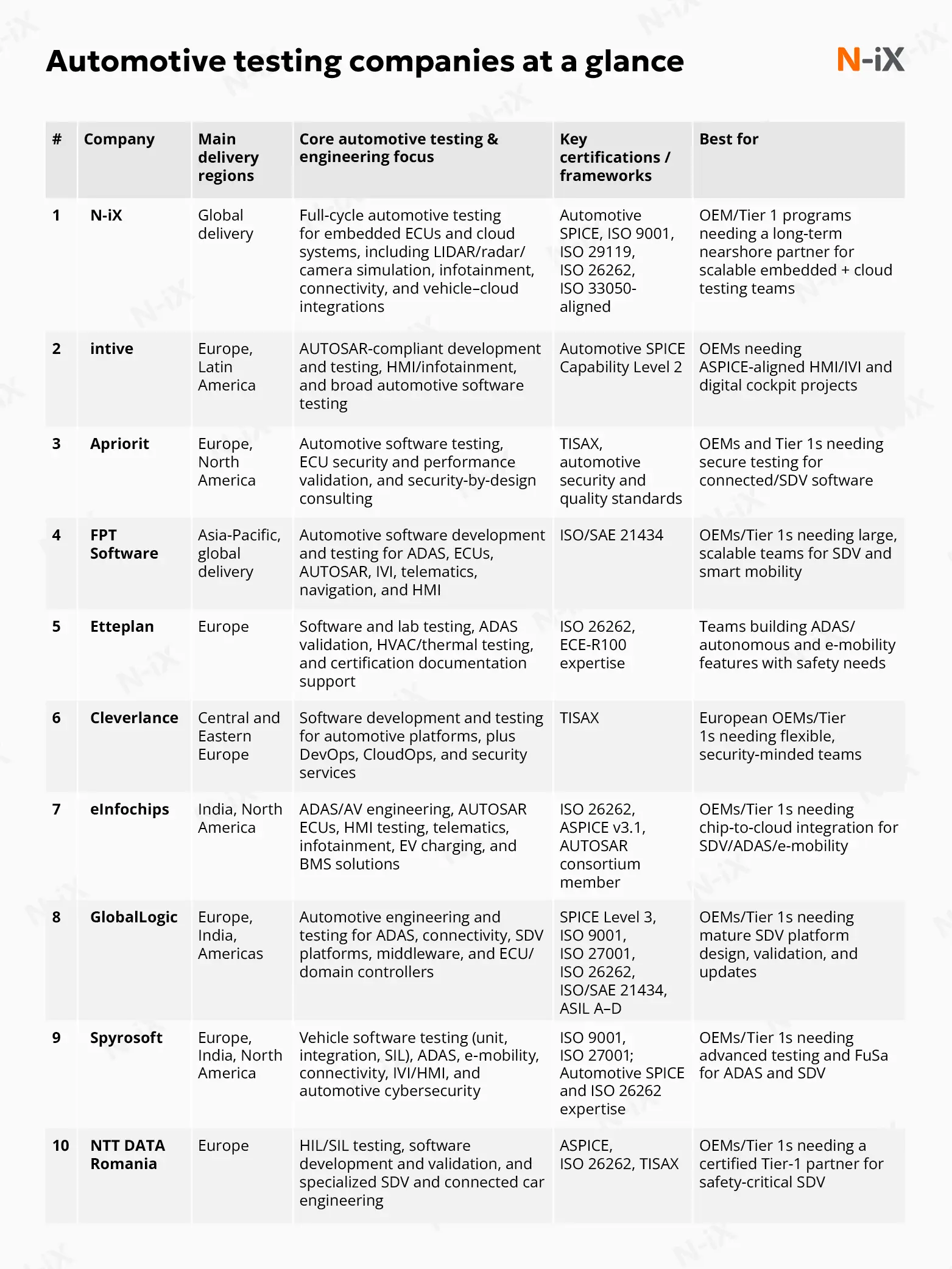
Automotive testing companies help OEMs and Tier 1–2 suppliers validate embedded software, ECUs (electronic control units), sensors, and connected services. They ensure compliance with strict safety standards such as ISO 26262 and Automotive SPICE. This list highlights 10 reliable automotive testing companies. Each has proven domain expertise, experienced engineering teams, and public case studies. It also includes a practical checklist to help you choose the best vendor for your project.
Who this guide is for:
- OEMs and Tier 1–2 suppliers looking to outsource their testing;
- Product and engineering leaders building ADAS, infotainment, or connected car platforms;
- Tech buyers comparing nearshore/offshore automotive testing vendors.

How we selected these automotive testing companies: Key criteria
To compile this list, we have analyzed independent directories, client reviews, and public case studies for vendors with a strong focus on automotive testing services. We then narrowed the list using the following criteria:
- Proven automotive and quality assurance expertise, including embedded systems, ECUs, and vehicle‑cloud integrations;
- At least five years on the market and more than 500 tech experts on board to ensure stability and scalability for long-term programs;
- Publicly available case studies or testimonials with OEMs and Tier 1–2 suppliers;
- Demonstrated experience with software testing , LiDAR and Radar validation, and real‑world simulation environments.
The companies below are organized to highlight a mix of geographies, engagement models, and specialization areas so you can find a good fit for your specific use case.
10 best automotive testing companies worldwide
We have compiled a list of international companies with delivery centers in one of several established outsourcing destinations and with sufficient internal resources to handle even the most complex projects.
1. N-iX
N‑iX is a global engineering company with 23 years on the market and over 2,400 qualified specialists across 25 countries in Europe and the Americas. It helps OEMs and Tier 1–2 suppliers validate complex automotive systems by combining strong embedded expertise with cloud, data, and AI capabilities. N‑iX extends automotive testing to AI-based systems, applying ISO 21448 (SOTIF) to address safety challenges that go beyond the scope of ISO 26262. A dedicated MATLAB/Simulink Academy enables N‑iX to build automotive testing expertise in-house, ensuring consistent depth across all client engagements.
- Our services: Full‑cycle automotive testing, including requirements analysis, test concept and framework design, manual and automated testing, as well as qualification support for in‑vehicle and cloud components;
- Focus areas: Testing of embedded ECUs and sensor stacks (LiDAR, Radar, cameras), infotainment and connectivity, and vehicle–cloud integrations;
- Certifications: Automotive SPICE, ISO 9001, ISO 29119, ISO 26262, and ISO 33050‑aligned testing processes;
- Best for: OEM and Tier 1–2 suppliers that need a long‑term partner capable of scaling mixed-embedded, cloud-based, and data‑driven automotive testing teams.
2. intive
Headquartered in Munich, Germany, this vendor also has development centers in Poland and Argentina. The company works primarily with OEMs and global automotive brands on software-intensive vehicle platforms.
- Services: AUTOSAR‑compliant development and testing, HMI and infotainment systems, and broad software testing for automotive applications;
- Focus areas: In‑vehicle infotainment, user interfaces, and digital cockpit experiences;
- Certifications: Automotive SPICE Capability Level 2 for quality assurance in automotive software development, assessed by a leading German OEM;.
- Best for: OEMs that need a partner with deep HMI/IVI expertise and experience integrating software into complex vehicle architectures.

3. Apriorit
This Polish automotive software and cybersecurity company has more than 20 years of industry experience and over 400 tech experts on board. It supports OEMs and Tier 1s in building compliant, scalable, and cyber‑resilient vehicle software from powertrain components to infotainment systems.
- Services: Automotive software testing, ECU security and performance validation, and security‑by‑design consulting for vehicle software;
- Focus areas: Infotainment, HMI, ADAS (Advanced Driver Assistance Systems), connectivity and telematics, fleet management, and automotive cybersecurity;
- Certifications: TISAX and adherence to automotive security and quality standards;
- Best for: OEMs and Tier 1 suppliers needing secure, high‑performance testing for connected and software‑defined vehicles (SDVs).

4. FPT Software
Among automotive testing providers, this global engineering firm stands out for its focus on accelerating the development of software‑defined vehicles and smart mobility for leading automotive brands. The company holds ISO SAE 21434 certification, making it the first ASEAN-based firm to meet this automotive cybersecurity standard.
- Services: Automotive software development and testing for ADAS, ECUs, AUTOSAR, IVI, telematics, navigation, and HMI;
- Focus areas: Enabling software‑defined vehicles, Automotive SPICE–aligned development, and in‑car digital services;
- Certifications: ISO/SAE 21434 for automotive cybersecurity;
- Best for: OEMs and Tier 1s that need large, scalable teams for SDV and smart mobility projects.

5. Etteplan
One of the Nordic automotive testing companies, this firm is an established software engineering and testing provider with over 30 years of market experience and more than 3,000 in-house experts. It combines lab and software capabilities for automotive manufacturers and their suppliers.
- Services: Software and lab testing, driver‑assistance system validation, HVAC testing, certification documentation support;
- Focus areas: LiDAR/Radar/AI algorithms, powertrain engineering, vehicle dynamics, HMI, telematics, and infotainment.
- Certifications: Expertise in ISO 26262 functional safety and ECE‑R100 approval;
- Best for: Vendors that aim to build ADAS or autonomous features that must meet strict safety and compliance requirements.

6. Cleverlance Enterprise Solutions
This Czech IT services company specializes in custom software development, quality assurance, and testing for industries such as automotive, finance, and telecom. It provides end‑to‑end software testing services, including test automation and managed QA teams, to help car manufacturers deliver reliable, safety‑critical, and connected vehicle solutions.
- Services: Software development and testing, DevOps, CloudOps, and security services;
- Focus areas: Digital platforms and enterprise systems for automotive clients;
- Certifications: TISAX certification for information security in the automotive ecosystem;
- Best for: European automotive customers who need a tech partner with both development and testing capabilities.

7. eInfochips
A global product engineering company that serves vehicle manufacturers and system suppliers across ADAS, infotainment, telematics, EV, and connected car platforms. Its testing spans MiL, SiL, and HiL environments, covering model‑based development, simulation, and verification and validation.
- Services: ADAS/AV engineering, AUTOSAR ECU software, HMI design and testing, telematics, infotainment, and EV charging;
- Focus areas: V2X and connected vehicles, multimedia and vision (camera, Radar, LiDAR), EV charging infrastructure, and functional safety.
- Certifications: ISO 26262 functional safety and cybersecurity expertise, ASPICE v3.1, AUTOSAR consortium member;
- Best for: OEMs and Tier 1s needing chip‑to‑cloud integration for SDV, ADAS, and e‑mobility programs.

8. GlobalLogic
This global digital engineering and product development firm helps clients build software-defined vehicles, digital cockpits, connected services, and mobility platforms. Its automotive testing covers ADAS, e‑propulsion, and zonal architectures. It validates vehicle software through virtualized, cloud-based environments independent of physical hardware.
- Services: Automotive engineering and testing for ADAS, connectivity, and digital cockpit, including SDV platform architecture, middleware, ECU consolidation, and domain controllers;
- Domain focus: Software‑defined vehicles, AUTOSAR (Classic and Adaptive), test automation, and connected in‑vehicle applications;
- Certifications: SPICE Level 3, ISO 9001, ISO 27001, ISO 26262, ISO/SAE 21434, and compliance with ASIL A–D safety levels;
- Best for: Automakers needing a partner to design, validate, and continuously update SDV platforms with strong process maturity and automated testing.

9. Spyrosoft
One of the Polish automotive testing companies, this firm delivers end‑to‑end engineering and testing for safety‑critical and software‑defined vehicle systems. Its coverage includes ISO 26262 functional safety testing, ASPICE‑ready processes, and unit and integration testing with VectorCAST, gtest, vTESTstudio, and CANoe. It also operates dedicated HMI test centres and provides automotive cybersecurity and penetration testing aligned with ISO 21434 and UNECE regulations.
- Services: Vehicle software testing (unit, integration, SIL), ADAS engineering, e‑mobility software development, connectivity integration, IVI/HMI development, and automotive cybersecurity;
- Focus areas: ASPICE‑aligned development, ISO 26262 functional safety, SDV architectures, BMS and DMS, and AI‑enabled predictive maintenance and driver monitoring;
- Certifications: ISO 9001 and ISO 27001; expertise in Automotive SPICE and ISO 26262 processes;
- Best for: automakers and their suppliers needing advanced testing and functional safety for ADAS, SDV, and e‑mobility features, with strong AI and cybersecurity capabilities.

10. NTT DATA Romania
One of the Romanian automotive testing companies, this firm provides embedded software development and end‑to‑end testing for complex ECUs and instrument clusters. Its services cover system, integration, and HIL testing for European vehicle manufacturers and system suppliers. It also develops the BoLo bootloader platform, enabling secure OTA and production‑line software updates aligned with automotive cybersecurity standards.
- Services: High‑end HIL/SIL testing, software development and validation, and specialized engineering for SDV and connected car ecosystems;
- Focus areas: Software‑defined vehicles, connected mobility, and embedded automotive platforms supported by dedicated hubs such as BMW TechWorks;
- Certifications: ASPICE, ISO 26262 (functional safety), and TISAX, ensuring rigorous software quality and cybersecurity;
- Best for: Car manufacturers and system suppliers seeking a certified Tier‑1 partner for safety‑critical, SDV, and connected-vehicle projects.

Read more: Best 15 automotive software development companies in 2026
How to choose the best automotive testing company
Picking an automotive testing partner is a long-term, high-stakes decision: it affects safety, certification timelines, and how fast you can ship new features. Use the questions below to identify a leader among automotive testing companies before making your choice.
1. Can they cover our whole testing lifecycle?
Look for automotive testing companies that can support you from requirements to certification, not just one test phase.
- Do they handle requirements analysis, test design, execution, automation, and reporting?
- Can they support MiL, SiL, HiL, and PiL where relevant?
- Do they help prepare evidence for audits and certification, not just run tests?
2. Do they have strong embedded, data, and DevOps skills?
Modern vehicles blend embedded software, connectivity, and data‑driven features. Therefore, you need a partner whose technical depth spans all three layers, not just one.
- Embedded development: Hands‑on experience with ECUs, AUTOSAR, and real‑time systems;
- Data expertise: Ability to collect, analyze, and use test and field data (logs, sensor streams, fleet data);
- DevOps expertise: Integration of testing into CI/CD to catch regressions early, not at the end.
3. Do they comply with the required standards and safety frameworks?
A trusted automotive testing partner should demonstrate working knowledge of your standards, not merely list them.
- Do they have Automotive SPICE, ISO 9001, ISO 29119, ISO 26262, and ISO/SAE 21434 certifications?
- Do they hold relevant certifications and assessments, such as Automotive SPICE ratings, ASIL compliance experience, TISAX, or ISO 27001?
- Do they have examples of how they maintain traceability from requirements to tests and defects?
4. Do they have proven experience with systems like yours?
References and case studies should reflect work comparable in scope, domain, and technical complexity.
- Do they have case studies or references for your domain: ADAS, infotainment, connectivity, EV, or fleet management?
- Have they tested comparable complexity (safety‑critical ASIL levels, multi‑ECU systems, over‑the‑air updates)?
- Can they explain typical pitfalls and how they adjusted their testing approach?
5. Do they offer the right delivery model and scale?
You need a partner that fits your geography, risk profile, and roadmap.
- Can they scale dedicated teams as your SDV or ADAS program grows?
- Do their delivery regions and time zones work for your engineering centers?
- Are they set up for long‑term partnerships, not just short, fixed‑scope projects?
Why choose N-iX among other automotive testing companies?
N‑iX combines end‑to‑end automotive testing, strong functional safety practices, and deep experience with both embedded and cloud systems. Its capabilities span the full testing lifecycle, from requirements through validation and qualification:
- In‑depth analysis of system and software requirements, with safety-centric requirements engineering aligned with functional safety and cybersecurity frameworks;
- Design of test concepts and frameworks tailored to your architecture and toolchain, covering everything from ECUs and sensors to back‑end services;
- Comprehensive handling of MiL, SiL, HiL, and PiL testing, including physical world virtualization, control system simulation, and sensor fusion scenarios;
- Testing processes built on Automotive SPICE and compliance with ISO 9001, ISO 29119, ISO 26262, and ISO 33050, with a strong focus on traceability and documentation;
- Versatile tech stack and data expertise across embedded software, cloud platforms, Big Data, and AI/ML, helping you automate reporting, increase coverage, and speed up releases.
This makes N‑iX a strong fit for OEMs and Tier 1–2 suppliers that want a long‑term partner to own their automotive testing strategy, not just execute separate test phases.
FAQ
1. What do automotive testing companies do?
Automotive testing companies validate embedded software, ECUs, sensors, and connected services for vehicle manufacturers and their suppliers. They ensure systems meet safety standards such as ISO 26262 and Automotive SPICE before a vehicle reaches production.
2. What is the difference between MiL, SiL, HiL, and PiL testing?
These are four levels of simulation-based testing commonly used by top companies in automotive testing. MiL (Model-in-the-Loop) tests software models before code is generated. SiL (Software-in-the-Loop) tests generated code in a simulated environment. HiL (Hardware-in-the-Loop) tests software running on real hardware connected to simulated vehicle systems. PiL (Processor-in-the-Loop) tests code on the target processor before full hardware integration.
3. Why is ISO 26262 important in automotive software testing?
ISO 26262 is the international functional safety standard for road vehicles. It defines requirements for identifying and mitigating risks in safety-critical electrical and electronic systems. Compliance is mandatory for components that could cause harm if they fail, such as braking, steering, or ADAS systems.
4. What is Automotive SPICE and why does it matter?
Automotive SPICE is a process assessment framework that evaluates the maturity and quality of software development and testing processes. OEMs commonly require their suppliers to demonstrate a specific SPICE capability level as a condition of engagement.
5. What is the difference between automotive testing companies and general software QA firms?
General QA firms focus on functional and performance testing for commercial software. Automotive testing firms specialize in safety-critical systems, real-time embedded software, and hardware-dependent environments such as HiL rigs. They also operate under automotive-specific standards (ISO 26262, Automotive SPICE, ISO/SAE 21434), which require domain knowledge that generalist QA providers typically lack.