
 ChatGPT
 Perplexity
 Claude
 Gemini
 Grok
Grok
While nearshore outsourcing has long been the default strategy for companies seeking a balance between cost efficiency and cultural alignment, the ground beneath this model is shifting. Organizations are looking for sustainable alternatives to nearshore software development outsourcing that prioritize skill availability and scalability over location. As demand for specialized tech talent surges, 75% of employers globally are reporting difficulty finding the skilled talent in 2024 (ManpowerGroup), with software development roles being among the hardest to fill. The reality is that geographic proximity is no longer a sufficient guarantee of agility or value.
Let’s explore how expanding your search globally can unlock deep specialized talent pools and restore the cost-to-value ratio your engineering organization needs.
When is nearshoring not the optimal solution?
While nearshoring is often celebrated as the "best of both worlds," it is ultimately a compromise that may not align with every strategic objective. Organizations should consider alternative models when their specific requirements outgrow the geographic convenience that nearshoring provides. Here when you should consider alternatives to nearshore software development outsourcing:
When engineers must be integrated into internal workflows
If real-time integration into internal teams is essential, staff augmentation becomes a better fit than a nearshore vendor operating semi-independently. Nearshoring can be suboptimal if the client needs direct managerial control rather than vendor-driven delivery.
When cost-effectiveness is the priority
If the primary decision driver is the lowest possible cost, offshoring to markets with significantly lower labor rates, such as India, Vietnam, the Philippines, and parts of LATAM become more attractive.
When the project requires highly specialized expertise
Certain specializations (AI/ML, embedded systems, cybersecurity, legacy modernization) may be more readily available in far larger offshore talent pools. Nearshore hubs sometimes cannot support aggressive scaling targets or provide niche expertise fast enough.
When local regulations complicate cross-border collaboration
Highly regulated industries often require work to remain onshore to satisfy legal or security standards. Nearshoring becomes unsuitable if even near-border data transfer triggers compliance concerns.
Alternative 1. Augmentation of your on-site teams
Team augmentation offers a distinct alternative to nearshoring for organizations that want to expand engineering capacity while keeping work fully aligned with their internal processes, culture, and regulatory environment. Inviting experienced engineers into existing teams creates a unified operating model in which communication, tooling, decision-making, and development practices remain consistent across the entire product organization, while boosting capacity on demand.
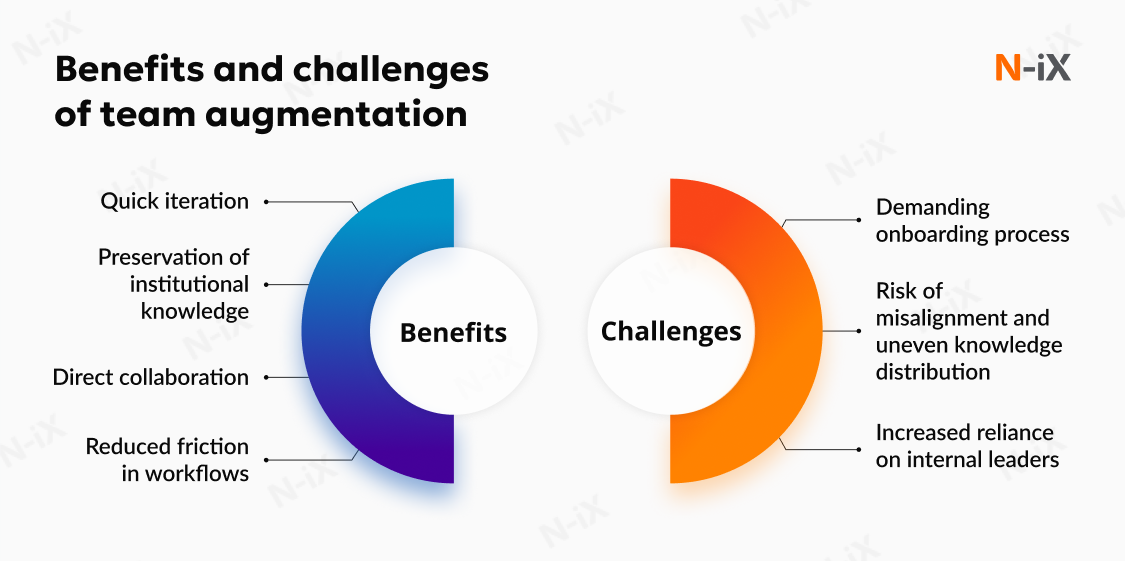
Benefits and challenges of team augmentation
Augmentation of an on-site team delivers a high degree of control and collaboration. External engineers join existing teams, which simplifies communication, enables faster iteration, and reduces friction around sensitive workflows such as design reviews, architecture discussions, or compliance-heavy development. It also preserves institutional knowledge by ensuring all work is aligned with internal standards and overseen by your own leadership.
The trade-off is operational responsibility. You remain fully responsible for day-to-day direction, planning, and team governance. International engineers join the internal team, but the organization must conduct comprehensive onboarding and knowledge-transfer processes. Attracting new developers can lead to uneven knowledge distribution and a reliance on internal leaders to keep the team aligned.
When is augmenting an internal team the right choice?
Among alternatives to nearshore software development outsourcing, team augmentation suits projects that require close collaboration, rapid decision-making, and continuous interaction with in-house product managers, designers, or architects. It is often chosen by companies that need to scale strategically while protecting domain knowledge and maintaining a consistent engineering culture. A simple decision checklist helps clarify when team augmentation is the better fit:
- You already have a product team on board and only need additional engineering capacity, not a separate vendor-led delivery stream.
- You want to keep architectural ownership in-house, ensuring standards, decisions, and long-term knowledge stay with your organization.
- Your workflows are mature enough to integrate external engineers into existing sprints, ceremonies, and tooling without requiring a managed service.
- Real-time collaboration matters, and you need engineers who join daily stand-ups, design reviews, and code discussions as part of your team.
- Requirements are evolving, and maintaining flexibility is easier when your internal team remains in the driver’s seat.
Team augmentation is well-suited to projects that require close collaboration, rapid decision-making, and continuous interaction with in-house product managers, designers, or architects.
How N-iX can augment your team with the top 2.6% of tech talent
N-iX supports onshore and multi-regional team augmentation with rigorously vetted engineers drawn from the top 2.6% of global talent. N-iX operates a robust, multi-regional hiring engine combining dedicated in-house recruiters, established sourcing frameworks, and an extensive talent database built across Eastern Europe, Latin America, and other strategic markets. This structure provides reliable access to specialists in Cloud, data, AI/ML, cybersecurity, DevOps, and full-stack development, even for niche or high-demand roles.
Alternative 2. Offshoring software development
Offshore software development offers an alternative to nearshoring by prioritizing scale, cost efficiency, and access to large global talent pools over geographic proximity. This model suits organizations that can structure work around asynchronous collaboration and clearly defined deliverables, and that want to widen their access to specialized skills.
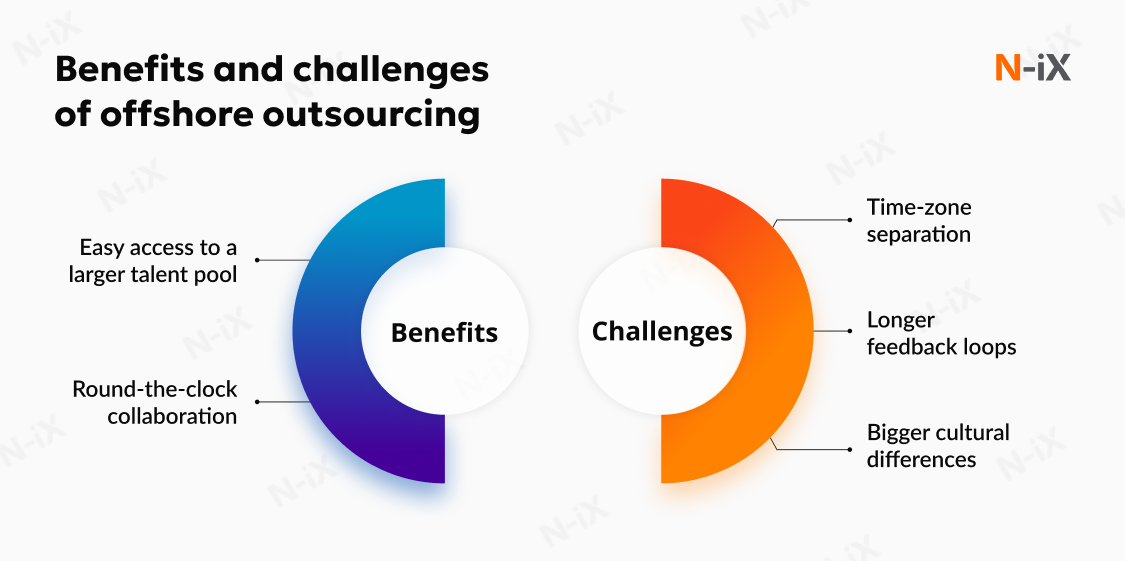
Benefits and challenges of offshore outsourcing
Offshore delivery provides clear advantages when access to larger and less competitive labor markets is the primary goal. It’s perfect for projects that require rapid team expansion and don’t require niche technical expertise. Companies that can operate with flexible communication schedules often benefit from the additional development hours created by time-zone differences, particularly for ongoing maintenance or round-the-clock development cycles.
However, offshore models introduce challenges that nearshore arrangements are designed to minimize. Time-zone separation can slow decision-making, extend feedback loops, and require more deliberate communication practices. Expectations remain clear to bridge the cultural differences and ensure work remains on track.
LatAm vs CEE
Latin America and Central and Eastern Europe are both mature outsourcing regions with deep technical talent pools, but their roles differ by client location. For North American companies, Latin America typically functions as a nearshoring destination, while CEE is offshore. For European companies, the logic reverses: CEE becomes nearshore, and Latin America offshore. This shift has practical consequences for collaboration, cost, governance, and delivery models. Let’s compare the two regions and inspect the leading countries for software development outsourcing:
Latin America as an offshoring location
For North American clients, it is easy to tap into LatAm’s over 2M strong talent pool due to overlapping work hours, government initiatives supporting cross-border cooperation, and familiarity with US business practices. For European clients, this region presents an alternative to nearshore software development outsourcing. Cooperation may be hindered by fewer overlapping working hours and less established cooperation practices, but the benefits of the growing Latin American outsourcing market remain. Here are the leading hubs for software outsourcing in the region:
- Brazil: over 750K ICT and software development professionals, the largest tech talent pool in the region; Sao Paulo is a major startup and innovation hub, ranking 25th globally. Brazil is the most eastern country on the continent, offering better time zone overlap with Europe; São Paulo is three hours behind London.
- Mexico: over 700K ICT professionals with a mature outsourcing sector and high talent availability, supported by a high number of service providers; strong expertise in emerging tech areas like AI/ML and data science.
- Colombia: over 150K developers in a rapidly growing ecosystem with high problem-solving skill proficiency and government support for AI and data infrastructure. Colombia ranks first in the region in the Coursera skill ranking. Additionally, the country shares the time zone with the East Coast.
- Argentina: over 115K developers with strong English proficiency and technical education; cultural alignment, leading technical universities, and communication readiness are standout features.
- Costa Rica: over 45K ICT professionals; smaller pool but excellent English skills, innovation focus, and seamless collaboration with US teams due to matching work hours.
| Country | Talent pool size | Expertise and skill indicators | English proficiency | Time zone |
|---|---|---|---|---|
| Mexico | ~700K | Large, mature outsourcing market; strong in enterprise software | Moderate to High | UTC−6 & UTC−5 |
| Brazil | ~750K | Largest tech talent pool; strong in enterprise systems, data engineering, fintech, and large-scale platforms | Moderate; stronger in senior teams | UTC−3 (to -5) |
| Colombia | ~150K | Fast-growing outsourcing hub; strengths in cloud, web, mobile, and data engineering; strong government support for tech | Moderate to High; high among developers | UTC−5 |
| Argentina | ~115K | Strong academic tradition; strengths in backend, product engineering, and complex problem-solving; strong startup culture | Very High | UTC−3 |
| Costa Rica | ~45K | Smaller talent pool; innovation-driven ecosystem; strong collaboration | High | UTC−4 |
Get a complete overview of the software development market in Latin America!
Success!
CEE as an offshoring location
CEE hosts a vast tech talent pool, with over 1.5M software developers across multiple countries, including Poland, Ukraine, Romania, the Czech Republic, Bulgaria, and Hungary. This density of skilled engineers contributes to the region’s reputation for delivering enterprise-level software and complex systems.
- Poland: over 500K developers and ICT professionals, the largest talent pool in CEE; mature outsourcing market with strengths in enterprise software, cloud, fintech, and data engineering. Polish engineers rank third globally in HackerRank programming competitions. Poland is 15th in the global English Proficiency Index (EPI).
- Ukraine: over 300K developers, one of Europe’s deepest engineering pools; strong expertise in backend, cloud, and AI and ML. Ukrainian developers rank 15th on the Coursera Global Skills Index. In EPI, Ukraine comes 45th. However, according to DOU, 55% of Ukrainian developers have an upper-intermediatelevel of English.
- Romania: over 200K developers and ICT specialists; strong STEM education, high English proficiency, and EU regulatory alignment; known for complex engineering, cybersecurity, and enterprise platforms. Romanian developers ranked 20th in HackerRank, highlighting the region’s competitive skill profile. Romania is 11th globally in English proficiency.
- Czech Republic: over 150K ICT professionals; high-quality engineering and R&D capabilities, particularly in enterprise and industrial software. The country ranks 23rd in EPI.
- Bulgaria: over 80K ICT professionals; competitive EU-based costs and strong outsourcing focus; expertise in fintech, telecom, and SaaS development. Bulgaria is in the high-proficiency tier, ranking 23rd.
| Country | Talent pool size | Expertise and skill indicators | English proficiency | Time zone |
|---|---|---|---|---|
| Poland | ~500K | Mature outsourcing market; strong in enterprise software; 3rd globally on HackerRank | Very High | UTC+1 |
| Ukraine | ~300K | Deep engineering pool; strengths in backend, cloud, AI, and ML; developers rank 15th on Coursera Global Skills Index | Moderate to High; high among developers | UTC+2 |
| Romania | ~200K | Strong STEM base; complex engineering, cybersecurity, enterprise platforms; 20th on HackerRank | Very High | UTC+2 |
| Czech Republic | ~150K | High-quality engineering and R&D; strong in enterprise, industrial, and product engineering | Very High | UTC+1 |
| Bulgaria | ~80K | Cost-competitive EU location; fintech, telecom, SaaS development | High | UTC+2 |
For North American clients, CEE offers an offshore alternative to nearshore software development outsourcing distinguished by engineering depth, strong academic foundations, and robust delivery capabilities. It is suitable for engagements that can accommodate structured coordination across time zones and where complex technical requirements outweigh the premium on time-zone overlap.
For European clients, CEE functions as a nearshore hub that combines geographic proximity, cultural and regulatory alignment, and mature tech ecosystems. This supports real-time collaboration, responsive delivery, and long-term team extension models.
Alternative 3. Hybrid dedicated teams
A Dedicated Team is an engagement model in IT outsourcing where a group of software developers works exclusively for one client while remaining employed by an external service provider. Unlike traditional project-based nearshore outsourcing, this model establishes a partnership that functions as an extension of your internal development capacity. The dedicated team operates with full-time commitment to your projects, maintaining consistent team composition and developing a deep understanding of your business requirements over time.
It is very common for teams to include developers based in different countries, especially in today’s globalized tech environment. Geographic flexibility distinguishes dedicated teams from nearshore arrangements. While nearshore development constrains your talent pool to specific regions.
Benefits and challenges of hybrid dedicated teams
International dedicated teams offer a distinct advantage over nearshore outsourcing by unlocking a global talent pool, allowing you to source niche experts at a significantly lower cost than restricted nearshore markets. Unlike project-based vendors, these developers integrate deeply into your company culture and workflows, working exclusively on your product to foster long-term ownership, better institutional knowledge, and alignment with organization’s internal standards.
However, this model introduces logistical friction regarding time zone disparities and communication latency, often requiring the adoption of asynchronous workflows that nearshore teams do not need. It also demands higher management overhead, as you retain full responsibility for the team’s daily direction, security compliance, and motivation, making it a hands-on leadership challenge rather than a "set it and forget it" service.
When is hiring a dedicated team the right choice?
Use this checklist to determine if a dedicated team model is the best strategic fit for your current needs:
- Growing project scope: You are building a product (like a SaaS platform or MVP) where requirements are likely to change, requiring Agile flexibility rather than a fixed-scope contract.
- Internal bandwidth is low: You have a CTO or Product Manager who can oversee strategy, but you lack the internal engineering hours to execute the roadmap.
- Tech stack is niche: You need specific expertise (e.g., Rust, IoT, AI/ML) that is harder to find in your local or nearshore market.
- Long-term retention: You want to build a team that retains knowledge of your codebase for years, avoiding the onboarding costs associated with switching project vendors.
How N-iX helps you build a dedicated team
N-iX combines a large global footprint and infrastructure that helps us avoid typical staffing hurdles, enabling clients to scale quickly and maintain focus on product outcomes. Our approach extends beyond filling roles: N-iX integrates dedicated teams into client workflows, manages administrative and operational complexity through its development centers, and invests in continuous professional growth and retention, all while giving clients control over product development and strategic direction.

Alternative 4. Onshore IT outsourcing
As one of the most traditional alternatives to nearshore software development outsourcing, onshore development offers the path of least resistance regarding communication and legal compliance. Hiring teams within your own country eliminates cultural barriers and time zone lag entirely, facilitating real-time collaboration and the ability to hold face-to-face meetings whenever necessary. This proximity simplifies the enforcement of intellectual property laws and data security regulations, making it an attractive option for highly regulated industries where strict local compliance is non-negotiable.
However, this convenience comes at a steep price, often rendering it financially unsustainable for scaling startups. You face the highest labor costs in the global market, paying a premium not just for skills, but for local cost-of-living requirements. Furthermore, local talent pools in major tech hubs are often saturated, leading to fierce competition, slow recruitment cycles, and high turnover rates. Ultimately, you limit your search to a geographic radius that, while comfortable, drastically restricts your access to specialized talent compared to the abundance found in global markets.
When is onshore development the right choice?
Use this checklist to see if the high premium of onshore development is justified for your needs:
- Physical interaction required: You are developing software for hardware (IoT, robotics) that is physically located in your office.
- Strict government compliance: You are working on government or defense contracts that legally require all developers to be citizens located within the country.
- Higher costs: Your company has significant capital and is prioritizing ease of collaboration over burn rate or runway.
Wrap up
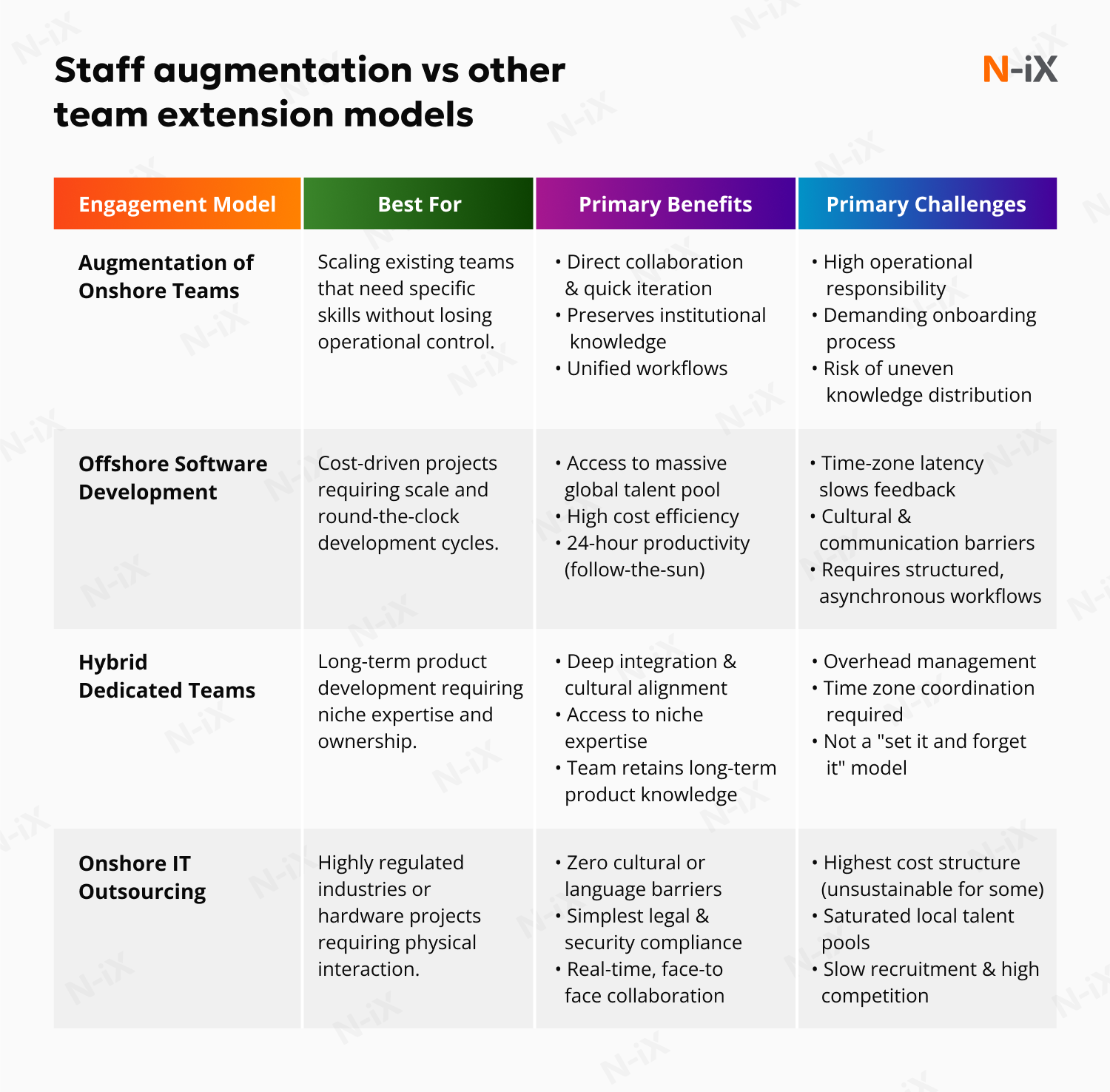
Selecting one of the alternatives to nearshore software development outsourcing is a decision about how much control you retain versus how much operational flexibility you need. Onshore delivery supports close collaboration and regulatory alignment, offshore models provide access to broader engineering capacity, and hybrid dedicated teams enable rapid scaling across locations without diluting ownership of the product roadmap. The right choice depends on your delivery maturity, collaboration requirements, budget constraints, and long-term product priorities, not on a one-size-fits-all outsourcing partner.
Have a question?
Speak to an expert