
 ChatGPT
 Perplexity
 Claude
 Gemini
 Grok
Grok
Modern software development has changed how organizations approach quality assurance and software testing . Systems are more distributed, release cycles are shorter, and engineering teams operate across multiple platforms, technologies, and locations. In this environment, quality is no longer something that can be managed purely at the team level. At the same time, it can't be enforced through rigid central controls. A testing center of excellence (TCoE) was originally introduced to address this tension.
At their best, TCoEs provided shared standards, centralized expertise, and a consistent approach to quality across growing organizations. At their worst, they became detached from delivery realities, limiting their effectiveness.
As delivery models evolved, attempts to preserve legacy TCoE structures or dismantle them entirely proved problematic. Centralized testing slowed delivery and weakened ownership, while full decentralization led to fragmentation, duplicated effort, and limited visibility into risk.
The practical question today is not whether a TCoE is still relevant. It is how it should be designed to support quality, risk management, and delivery predictability without introducing unnecessary bureaucracy or constraining innovation. And that's what this article explores.
Why traditional TCoE models struggle in modern delivery
When TCoEs fail, the root cause is rarely testing skill gaps. More often, it is organizational design.
Centralized execution introduces queues and delays. Tool standardization without contextual adoption leads to parallel solutions. Rigid quality gates slow CI/CD pipelines and erode trust in automation.
Another frequent issue is excessive bureaucracy. Overly detailed approval workflows, mandatory artifacts, and rigid compliance processes can turn the TCoE into a decision bottleneck. Organizations that succeed deliberately limit governance to what is necessary to manage risk, allowing teams to move quickly within clearly defined boundaries.
What is a testing center of excellence today?
A modern testing center of excellence is not a centralized testing department that executes test cases on behalf of delivery teams. That model was built for sequential delivery and infrequent releases, and it does not reflect how software is built today.
Instead, a TCoE serves as a cross-organizational capability focused on quality enablement and risk governance. Its role is to establish clear guidelines for achieving quality, support teams through expertise and frameworks, and ensure alignment—without owning the entire testing process.
By offering organization-wide standards, reusable frameworks, and centralized oversight of testing infrastructure, a modern TCoE enables consistent, efficient quality practices, reduces wasted effort, and enhances risk management across all initiatives.
While the core purpose of a testing center remains consistent across delivery models, Agile environments make the trade-offs around ownership, speed, and governance more explicit. Examining TCoE in the Agile context helps clarify how these tensions are resolved in practice.

Testing centers of excellence in the Agile era
Agile delivery has significantly influenced how TCoEs must operate. As ownership moved closer to product teams and feedback cycles shortened, centralized test execution increasingly conflicted with daily delivery practices. According to Capgemini's 2024-2025 World Quality Report, only 27% of organizations continue to use traditional Testing Centers of Excellence, a dramatic decrease from 70% in 2023 [1]. It reflects a clear trend towards more integrated and Agile-friendly practices.
In modern environments, testing centers of excellence now function as a federated quality system. It defines standards, enables teams, and governs risk, while leaving execution within product teams. A key risk in Agile environments is treating the TCoE as the sole source of innovation. When experimentation is limited to the central group, teams lose opportunities to evolve practices organically. As the report highlights, 40% of organizations now have QA engineers embedded within Agile teams [1].
Mature TCoEs explicitly encourage experimentation at the team level, using an agile testing center of excellence to observe, validate, and scale successful practices rather than suppress them.
Explore further: How to apply the right QA strategies to address the needs of your project
How testing center of excellence roles and responsibilities translate into operating models
Understanding a testing center of excellence is only useful if it translates into a workable operating model. Organizations adopt different TCoE models based on scale, risk profile, and delivery maturity. The core responsibilities, however, remain the same while their exercise varies by context.
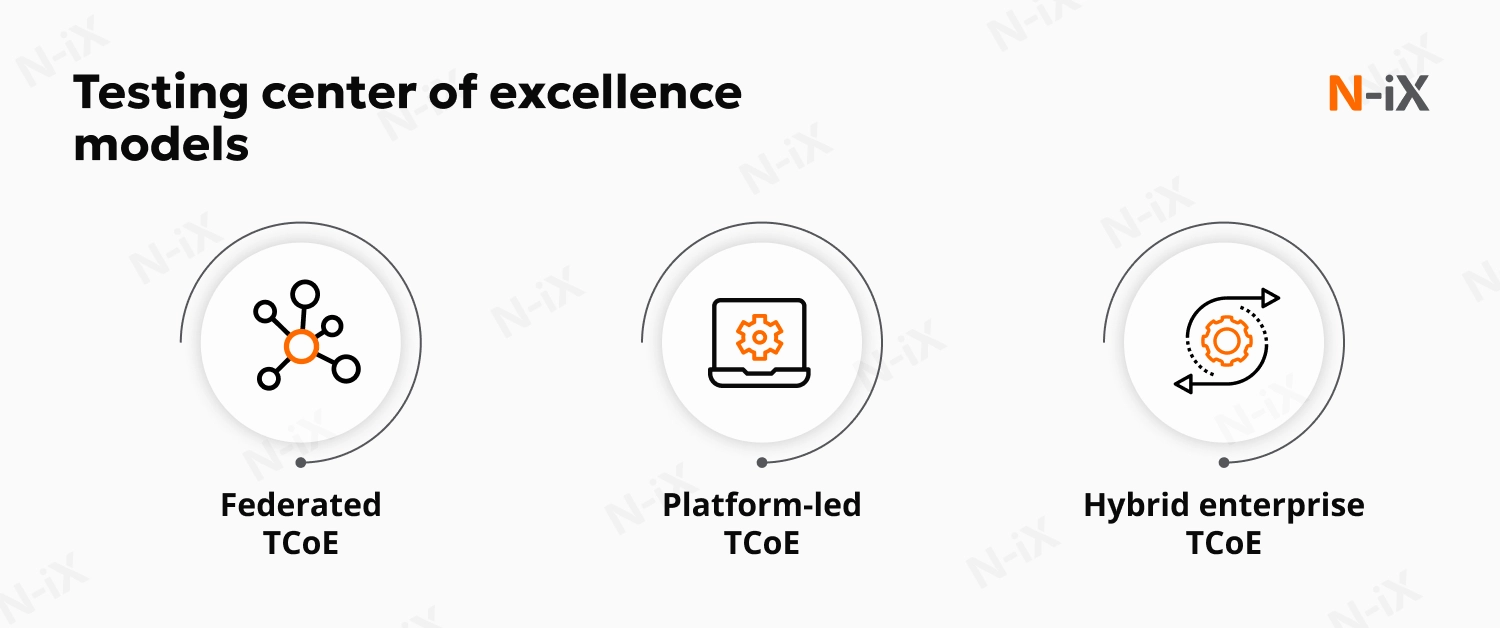
Federated TCoE model
In a federated model, the TCoE acts primarily as a standards and enablement layer, while execution remains embedded within delivery teams.
Here, the TCoE:
- Defines quality standards and reference practices that teams adapt locally
- Provides reusable frameworks and guidance rather than centralized services
- Coordinates cross-team non-functional testing where needed
Testing execution, automation, and release decisions stay with product teams. This model works best when teams are mature, Agile practices are established, and quality ownership is already embedded in delivery.
For senior testing officers, the key challenge in a federated model is maintaining consistency without drifting into enforcement. Influence matters more than control.
Platform-led TCoE model
In platform-led organizations, the TCoE responsibilities are often delivered through an engineering or quality platform rather than a traditional organizational unit.
In this model, the TCoE:
- Owns shared testing infrastructure, environments, and test data
- Integrates quality capabilities directly into CI/CD pipelines
- Provides self-service automation frameworks and tooling
Teams consume quality capabilities as platform services, reducing friction and manual coordination. Execution remains decentralized, but quality practices become standardized through the platform itself.
This model shifts focus from policy definition to product thinking: quality capabilities are built, maintained, and evolved like any other engineering platform.
Hybrid enterprise TCoE model
Most large organizations operate in a hybrid model, combining centralized and federated elements.
In a hybrid setup, the TCoE:
- Retains centralized ownership of high-risk areas such as compliance, security, and performance testing
- Provides standards, tooling, and enablement to product teams
- Supports legacy systems and shared platforms where embedded ownership is impractical
Daily testing remains with delivery teams, but the TCoE steps in where cross-team coordination or regulatory oversight is required.
The hybrid model requires constant boundary management. The risk is not centralization itself, but allowing temporary central execution to become permanent.
No operating model is inherently superior. What matters is alignment between the organizational scale and delivery maturity, regulatory and risk constraints, and platform capabilities and team autonomy. The goal is not to select a “correct” model, but to ensure that the chosen structure reinforces quality ownership, reduces risk, and scales with the organization.
Before deciding on a TCoE model, consider when this structure is most beneficial and when it isn’t.

When should you choose a testing center of excellence model?
Building a testing center of excellence is not a universal best practice. Its value depends on organizational context, delivery complexity, and the problems it is expected to solve. Treating a TCoE as a default structure may cause unnecessary overhead rather than better quality outcomes. Let's explore when to opt for it and when to avoid it.
When a testing center of excellence makes sense
This model becomes valuable when coordination and consistency cannot be sustained through informal alignment alone. This typically happens as organizations scale, diversify, or operate under increased external constraints.
A TCoE makes sense when:
- The engineering scale becomes a constraint. For example, when dozens of teams use different tools and test strategies, leadership loses visibility into delivery risk and quality maturity.
- System and architectural complexities increase. Organizations operating across multiple platforms, shared services, or legacy systems need centralized ownership of test architecture, environments, and non-functional testing.
- Regulatory or compliance requirements apply. In regulated industries, teams must demonstrate traceability, coverage, and audit readiness, even using Agile delivery.
- Delivery is distributed across locations or vendors. Global teams and multi-vendor models require shared quality standards to avoid fragmentation while preserving local autonomy.
When a TCoE does not make sense
In some contexts, a testing center adds more structure than value. This is especially true when existing team-level practices already provide sufficient alignment and control.
This model is often unnecessary when:
- The organization is small or tightly aligned. A limited number of teams working on a single product can usually maintain quality through direct communication and shared ownership.
- Delivery practices are still forming. Early-stage Agile adoption benefits more from strengthening team fundamentals than introducing a centralized quality function.
- Quality issues stem from delivery discipline, not coordination. If teams struggle with basic testing practices, a testing center will not make up for weak foundations.
An honest assessment at this stage prevents overengineering and misplaced expectations. When a TCoE is introduced for the right reasons, it can effectively scale quality. When it is introduced too early or by default, it often becomes a constraint.
This distinction sets the stage for the next question: how to design and introduce this model to support delivery rather than disrupt it.

Best practices for building a testing center of excellence
Based on what consistently works in practice, the following principles make the difference between a testing center that enables delivery and one that becomes a bottleneck.
- Start with a clearly defined problem, not a target structure. A testing model should be created to address specific issues such as inconsistent quality practices, limited risk visibility, or duplicated testing effort. Starting with an abstract “best practice” model usually leads to unnecessary complexity.
- Introduce it incrementally. Rolling out a testing center of excellence all at once often disrupts existing workflows and creates resistance. Successful organizations pilot the model with selected teams, validate assumptions, and scale based on the value they deliver.
- Preserve team ownership of testing execution. Quality responsibility should remain with the delivery teams. The testing center defines standards, frameworks, and guidance, but avoids taking over day-to-day testing activities, which would weaken accountability.
- Limit governance. Excessive approval steps, mandatory artifacts, and rigid processes quickly turn the TCoE into a bureaucratic layer. Effective testing units focus governance on high-risk areas while allowing teams to move quickly within clear boundaries.
- Secure executive sponsorship early and visibly. Without leadership support, a TCoE struggles to influence priorities or resolve cross-team conflicts. Executive backing is sustained by tying TCoE outcomes to measurable results such as reduced defect leakage, improved release predictability, or optimized infrastructure costs.
- Align the TCoE with other teams. Close collaboration with engineering, DevOps, and platform teams ensures that quality practices integrate naturally into CI/CD pipelines and shared infrastructure.
- Design for enablement, not enforcement. The testing center should act as a support system that helps teams succeed, not as a control function that polices compliance. Adoption increases when teams see the TCoE as a resource rather than an obstacle.
- Continuously measure impact and adjust the model. TCoEs that remain static lose relevance. Regularly reviewing outcomes, team feedback, and delivery metrics allows the operating model to evolve as the organization and its delivery practices mature.
The TCoE effectiveness is reflected in outcomes that influence delivery decisions, not in test volumes or activity counts. Here are a few metrics that will help you monitor its performance.
Explore the topic: Software testing best practices for 2026
TCoE testing metrics to measure quality
Mature organizations use metrics to understand delivery risk, guide investment, and assess whether quality practices are actually supporting business goals. Let's review some.
|
Metric |
What it measures |
Meaning for the business |
|
Defect escape rate |
Defects found in production or late stages vs earlier phases |
High escape rates increase operational risk, production incidents, and the cost of fixes |
|
Time to feedback |
Speed of receiving test results after a code change |
Slow feedback delays decisions and increases rework, making delivery timelines unreliable |
|
Test pipeline stability |
Reliability of automated test pipelines and flakiness |
Unstable pipelines reduce confidence in release signals and lead to delayed or risky releases |
|
Release confidence |
Predictability and risk awareness of release decisions |
Low confidence forces last-minute validation and conservative release decisions |
|
Test automation effectiveness |
Impact of automation on reducing manual effort and feedback time |
Ineffective automation increases maintenance costs without improving delivery speed |
|
Coverage of critical business flows |
Testing focuses on high-risk, high-value user journeys |
Poor coverage increases the likelihood of business-critical failures in production |
|
Mean time to defect resolution |
Time required to fix defects after detection |
Slow resolution extends delivery cycles and increases engineering effort |
|
Environment and test data availability |
Frequency of blocks caused by unstable environments or data |
Frequent blockers waste engineering time and make delivery planning unreliable |
When tied to shared KPIs and business objectives, these metrics allow leadership to assess delivery readiness, compare quality maturity across teams, and evaluate the ROI. More importantly, they provide early signals that enable course correction before issues impact customers or delivery timelines.
When you align best practices with your business's requirements, measure performance, and continuously update your processes, you'll get the model that best solves your specific challenges. It will also help you gain several advantages.
Explore the topic: 7 golden rules of software testing outsourcing
Testing center of excellence benefits
When implemented with clear intent, a testing center of excellence delivers practical, measurable benefits across engineering, delivery, and operations. Let's review the common ones.
Cost reduction through standardization
This practice helps reduce costs by consolidating testing tools, frameworks, and environments that would otherwise be duplicated across teams. Shared automation frameworks and centralized infrastructure decrease licensing overhead and maintenance effort. Over time, this approach lowers the cost of change by preventing parallel investments in similar testing solutions.
Faster onboarding and reduced learning curves
Standardized practices and tooling shorten the ramp-up time for new engineers and teams. Instead of learning bespoke testing setups for each product, teams inherit familiar pipelines, frameworks, and quality expectations. This allows new team members to contribute earlier and reduces dependency on informal knowledge transfer.
Improved consistency without sacrificing autonomy
A modern testing center establishes common quality standards while allowing teams to decide how to apply them in their specific delivery context. Teams retain ownership of execution, but outcomes become more predictable across products and platforms. This balance prevents fragmentation without imposing rigid processes.
Improved delivery predictability and quality risk visibility
By aligning testing practices and metrics across teams, a testing center of excellence provides leadership with earlier and more reliable signals about delivery readiness. Quality risks are identified sooner, not during late-stage validation. This improves release predictability and reduces last-minute escalations driven by unexpected test results.
Stronger alignment between business objectives and quality
A TCoE helps translate business priorities such as reliability, compliance, and time-to-market into shared quality goals and comparable metrics. When quality indicators are consistent across teams, leadership can assess trade-offs more clearly and evaluate the impact of investments in business terms.
Innovation enablement at scale
A TCoE creates a structured way to explore new testing approaches, tools, and technologies without limiting innovation to isolated teams. Promising practices can be piloted, validated, and scaled across the organization. By acting as a center for learning and experimentation, this unit helps organizations stay ahead of emerging quality challenges rather than reacting to them after issues surface.
Realizing these benefits consistently requires more than defining a TCoE structure. It depends on understanding delivery constraints, organizational dynamics, and quality risks at scale. This is where an experienced software testing outsourcing company , such as N-iX, helps organizations build operating models that work in real delivery environments.
Learn more about hiring an offshore testing team in 4 steps

Final thoughts
The evolution of software delivery has created both opportunities and challenges for organizations seeking consistent, scalable quality. A testing center of excellence (TCoE) is no longer about controlling testing, but about enabling teams to deliver robust software through shared standards, tools, and practices. Well-executed, it becomes a strategic asset that aligns quality goals with business outcomes and provides clear visibility into delivery risk and performance.
Establishing an effective testing center requires more than just defining processes; it requires deep expertise and resources to translate strategy into practice. At N-iX, we leverage our global team of over 150 QA professionals to help organizations design and implement TCoEs tailored to their specific needs. With over 23 years of experience in software development and testing, we help companies build reliable end-to-end testing processes compliant with regulatory requirements and security standards, including ISTQB.
Whether you're outsourcing QA , expanding testing capacity, optimizing CI/CD processes, or enhancing compliance in highly regulated industries, our full-cycle QA and testing capabilities ensure seamless integration and continuous improvement. With N-iX by your side, your TCoE will become a driving force for continuous innovation and quality.
Sources:
- World Quality Report 2024-2025 | Capgemini
FAQ
What is a testing center of excellence?
A testing center of excellence (TCoE) is a centralized unit within an organization that defines, standardizes, and governs testing practices across all teams and projects. It ensures consistent quality, optimizes testing efforts, and provides shared frameworks, tools, and expertise. A modern TCoE acts as a quality enablement function, guiding teams with best practices without taking over the test execution.
Why do organizations need a testing center?
Organizations implement testing centers to address fragmentation in testing approaches, improve quality assurance consistency, optimize resource use, and better manage risk. As delivery practices scale and become more complex, a TCoE helps standardize testing frameworks and enhance collaboration across teams.
How to create a testing center of excellence TCoE?
Start by defining clear goals such as improving consistency, reducing testing duplication, and managing risk. You should also establish standardized processes, frameworks, and tools that align with Agile practices. Implement incrementally, starting with pilot teams, and focus on enabling teams rather than controlling testing execution. Alternatively, you can outsource TCoE design, set-up, and implementation to software development and testing companies like N-iX.