
 ChatGPT
 Perplexity
 Claude
 Gemini
 Grok
Grok
The cost of human error in supply chains is high. It’s reflected in excess spending, lost customers, and operational inefficiencies. Enterprises today are striving to improve the visibility of their processes, make data-driven decisions, and achieve sustainable growth. How can businesses accomplish all these goals? The solution lies in a supply chain control tower (SCCT).
Imagine an airport control tower, which coordinates hundreds of planes by collecting data about inbound flights, weather, and runway availability. The SCCT does something similar for your supply chain—it collects data from all sources, analyzes it, and makes informed decisions. The best part? It doesn't just recommend actions; it automatically executes them, optimizing your supply chain operations without manual intervention.
Let’s delve deeper into the concept of a supply chain control tower, the advantages of the custom development of a control tower for supply chains, the components of SCCT architecture, implementation steps, and more.
What is a supply chain control tower and how does it work?
As supply chains evolve, businesses introduce a variety of workflows that can become difficult to manage and monitor. To stay ahead, companies need a comprehensive solution that provides full visibility and control over these increasingly complex processes. This is where a supply chain control tower (SCCT) comes into play.
An SCCT is a unified, personalized ecosystem of information, technologies, processes, and people that helps businesses make data-driven decisions regarding resources and workflows. Think of it as a think tank that automatically determines the optimal strategy for your entire supply chain system. And when we say "optimal," we mean achieving business goals in the shortest time frame while minimizing risks.
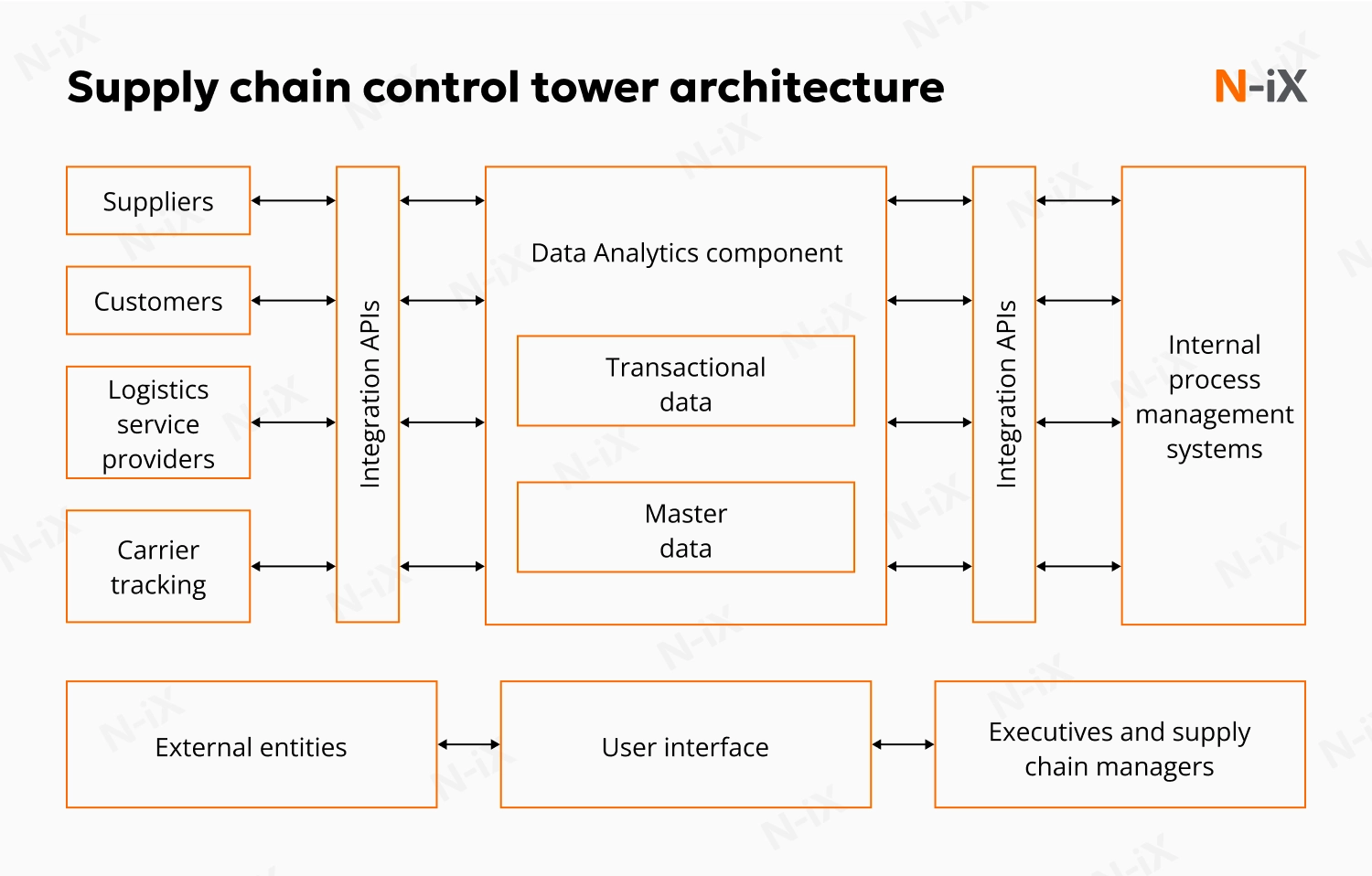
So, how does the SCCT automate decision-making and drive proactive management? By leveraging IoT and robotics, the SCCT collects real-time data from all parts of the supply chain ecosystem, ensuring comprehensive visibility of business operations. As the system matures, it becomes smarter. A well-developed control tower provides supply chain providers with a bird’s-eye view of workflows and offers data-driven recommendations.
The SCCT simulates various scenarios, identifies risks, and predicts potential outcomes, helping organizations choose the most effective ways to mitigate risks and optimize operations. With proactive decision-making, businesses can reduce costs related to unforeseen events and avoid reputational damage.
The system is continuously refined by a collaborative effort of the company’s teams, who "teach" the SCCT by setting criteria for event evaluation and forecasting. This ongoing process ensures higher forecasting accuracy and more relevant recommendations, driving smarter decisions.
To ensure the system’s effectiveness, it's crucial to partner with a tech vendor that has expertise in ML algorithms. As of February 2026, Clutch lists over 9,100 ML service firms offering tech consulting and custom development. One such company is N-iX, where our AI and Data Science specialists and MLOps experts are highly experienced in the implementation, continuous training, and monitoring of scalable ML systems.
Discover how AI agents are transforming data analytics—get the white paper!
Success!
The SCCT also manages critical tasks for transportation providers, including inventory tracking, optimized route planning, and minimizing shipping costs. Since mature systems can automate the entire logistics cycle with minimal human intervention, the SCCT transitions from a simple visibility tool into a fully integrated end-to-end service.
More on the topic: Innovation in logistics: How to succeed with it
How to implement a supply chain control tower and what are its capabilities?
Siemens research reveals that using a supply chain control tower powered by AI can lead to a 15% reduction in detention and demurrage charges. This technology helps prevent costly surprises that could otherwise erode quarterly margins.
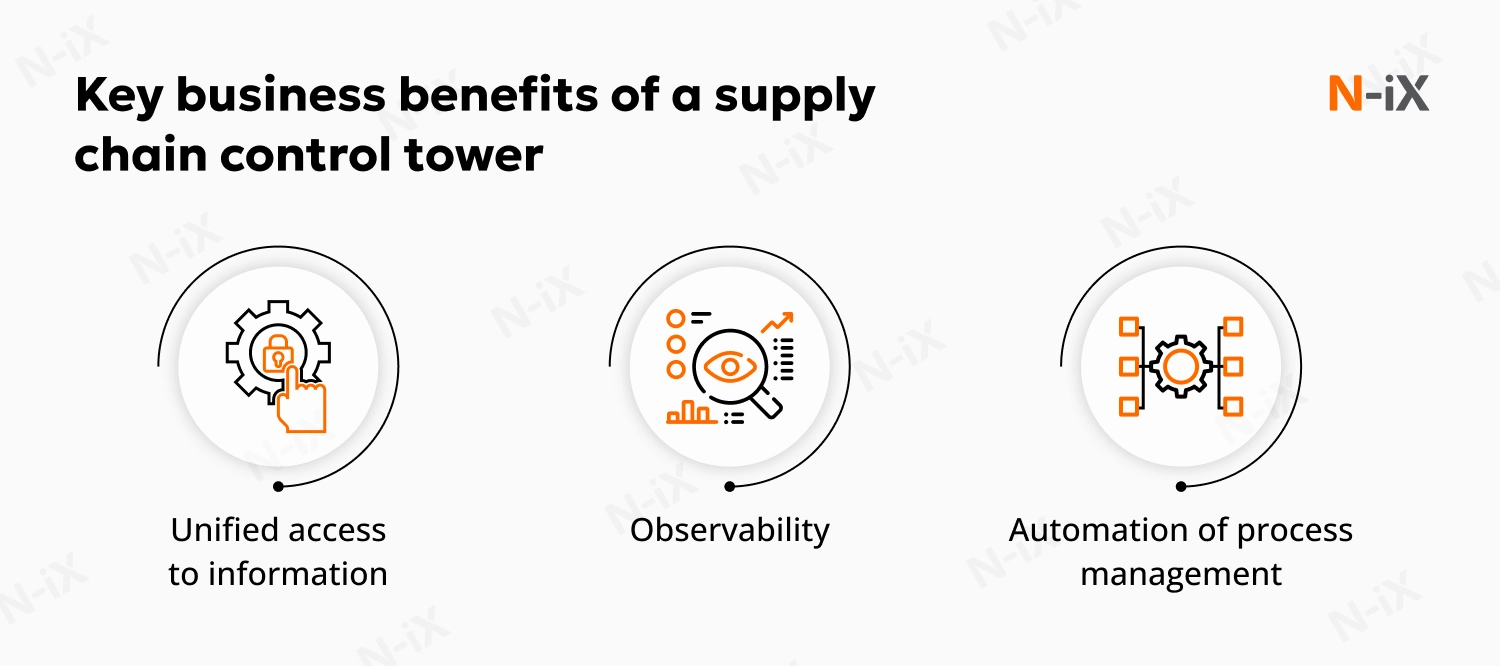
Once your trusted engineering partner conducts a Product Discovery, designs the SCCT architecture, and integrates the control tower, your business gains full visibility into the supply chain ecosystem and centralized access to data. Moreover, advanced, dynamic platforms help businesses automate process management, improving overall efficiency.
Four phases of technological maturity
The benefits of the SCCT are cumulative, leading to continuous technological growth. As the control tower evolves, its value increases, progressing through four levels of SCCT technological maturity:
Visibility
At the first level, the SCCT integrates data into a single unified system, providing businesses with targeted information for any segment of the supply chain. This gives enterprises a 360° view of all events within the ecosystem. The system displays the collected data on dashboards, allowing you to track key milestones and other important factors as you work toward your business objectives.
Alerts
At the second level, the SCCT becomes smarter, focusing on your business goals. With complete visibility into your ecosystem, the control tower can now manage processes and events based on predefined criteria. It not only gathers data but also provides actionable recommendations for process optimization. Users receive data-driven advice and alerts (e.g., notifications) that assign tasks to specific individuals. At this stage, the SCCT adds business value through:
- Built-in quality control;
- Cost forecasting for processes;
- Flexibility in reestablished processes;
- Real-time flow tracking.
Decision support
The third level enables the automation of decision-making. While the human decision-maker still has the final say, the SCCT automatically simulates the best and worst-case scenarios and presents them to the decision-maker. This data-driven approach allows the business to choose the optimal scenario, reducing risks and saving costs.
Autonomy
At the highest level of automation, human intervention is eliminated. The SCCT operates autonomously, executing actions according to the best possible scenario. It engages both human teams and external systems, such as robotic systems, to carry out tasks without human oversight.
Keep reading: How to choose the best supply chain software development company: An ultimate guide
Let’s now look at how SCCT capabilities evolve through these four stages, using a logistics control tower as an example:
- Level 1 (visibility): Initially, the control tower collects and dynamically updates information to optimize routes based on factors like safety, costs, and weather conditions. This minimizes risks related to extra fuel costs, natural events, and infrastructure outages.
- Level 2 (alerts): At this level, the SCCT becomes more autonomous, reducing the need for human intervention. Drivers no longer need to communicate with suppliers directly; instead, they automatically receive notifications about goods that are in shortage. This prevents errors at warehouses and in financial departments.
- Level 3 (decision support): At this stage, the SCCT prepares one of the recommended scenarios for execution. The algorithm takes over the decision-making process, automatically generating directives for the driver and uploading the route map to the navigator, along with other necessary actions (such as fuel purchases). The driver simply follows the plan.
- Level 4 (autonomy): At the highest level, the transportation decisions are fully realized in the physical world. The driver follows a plan generated by the SCCT, ensuring the timely delivery of goods, with minimal to no human intervention.
The transition between technological maturity levels, particularly from the third to the fourth, can be challenging and time-consuming. N-iX tech professionals are here to guide you through the digital transformation journey smoothly and efficiently. By adhering to MBD/MBT system modeling principles, our experts take a high-level perspective, ensuring seamless responsibility sharing between organizations.
What are the technologies and expertise that power a control tower in the supply chain?
A supply chain control tower is much more than just a set of dashboards. It needs to gather and process every bit of data from your ecosystem, evaluate the impact of every possible scenario, and interact with the physical world. To achieve this, a reliable engineering partner designing your SCCT architecture must have technological expertise across several domains.
Robotics and IoT
IoT and robotics play an essential role in SCCTs. Technologies like sensors, smart security systems, and automated doors enable the tower to interact with the physical world—whether for data collection or executing actions based on data insights. With IoT and robotics integrated, the SCCT can perform data-driven tasks, monitor real-time conditions, and adjust workflows automatically, improving efficiency across the entire supply chain.
Related: IoT in supply chain: Success stories and tips
Artificial Intelligence
AI expertise is crucial for smart SCCT implementation. AI systems enable the SCCT to learn from previous decisions and apply these insights to future scenarios. This self-learning AI component analyzes past performance, continuously improving decision-making over time. At N-iX, we leverage AI to develop advanced recommendation systems, Deep Learning solutions, and ML platforms, optimizing operations in manufacturing and transportation. By implementing AI and ML solutions, we help clients automate manual tasks and quickly identify potential issues within their ecosystems.
You might be interested in: Computer vision in supply chain: Top 6 use cases
Enterprise-level continuous integration
Real-time processing and seamless updates are essential for systems like the SAP supply chain control tower. Integrating an SCCT into your existing ecosystem should be smooth and painless. The key here is the ability to link new information channels during the decision-making process. N-iX excels in CI practices, ensuring timely software updates and hardware replacements without disrupting operations.
Impact analysis
Before making critical business decisions, it’s vital to understand the potential consequences and their value. Vendors with expertise in impact analysis can build a more effective SCCT by applying risk evaluation methods. This expertise enables businesses to assess how even small actions affect the entire organization, driving better decision-making that directly impacts business value.
Advanced analytics
Every decision within a control tower is based on data analysis. The SCCT processes signals, groups them, and identifies interdependencies between various events within the system. It’s important to partner with an engineering firm experienced in AI, Deep Learning, neural networks, and mathematical predictability. At N-iX, our team of 200 data experts has vast experience in developing Deep Learning systems that enhance the SCCT’s capabilities.
More on the topic: Supply chain analytics: Making data work for you
Scenario simulation
Scenario simulation allows the SCCT to model system behavior, define optimal actions, and implement them in real life. This expertise helps track how signals translate into events, which then generate alerts, and how these actions ultimately affect business outcomes. With this capability, enterprises can monitor and predict the impact of different scenarios on the supply chain, optimizing decision-making.
Future-proofing your supply chain control tower: How to manage risks effectively?
As your business grows and the supply chain landscape continues to evolve, it’s critical to ensure that your supply chain control tower remains adaptable and resilient. A future-proof SCCT not only meets current operational needs but also accommodates changes in market conditions, technological advancements, and new business models. Below are key considerations to help you future-proof your SCCT and manage emerging risks effectively.
Integrating predictive analytics for risk management
An SCCT that incorporates predictive analytics can help businesses foresee potential disruptions before they occur. By analyzing historical data, market trends, and environmental factors, the control tower can identify risks like supply chain bottlenecks, potential delays, or resource shortages. By integrating AI-powered forecasting models, your SCCT can proactively mitigate these risks, ensuring continuity in operations.
To build resilience, your SCCT should continuously update its predictive models as new data becomes available. This enables the system to improve the accuracy of forecasts, adapt to shifting conditions, and offer actionable insights for risk mitigation.
Adapting to market volatility and disruptions
Supply chains face numerous challenges, from natural disasters and geopolitical instability to sudden changes in demand or supply shortages. An agile SCCT should be able to quickly adjust and reconfigure operations when disruptions occur. Through automated scenario planning, the system can simulate different response strategies based on real-time data, helping you react swiftly and minimize any negative impacts on the supply chain.
For example, when facing supply shortages, the supply chain control tower can automatically reroute deliveries, suggest alternative suppliers, or prioritize high-value customers based on real-time market conditions.
Continuous system upgrades and technological advancements
To keep pace with rapid technological advancements and evolving industry standards, regular system upgrades and enhancements are necessary. A future-proof SCCT will be modular, allowing for seamless integration of new technologies such as blockchain, 5G, or edge computing as they become available.
By partnering with an engineering team that stays ahead of technological trends, you ensure that your SCCT can quickly adopt the latest innovations, keeping your supply chain competitive and resilient in the long run.
Building robust data governance and compliance measures
As the reliance on data-driven decision-making grows, so does the importance of ensuring robust data governance and compliance. A future-proof SCCT must prioritize data security, privacy regulations, and compliance with industry standards (e.g., GDPR, ISO 27001, PCI-DSS). This helps to safeguard sensitive business information, protect customer data, and minimize risks related to cyber threats.
Your SCCT architecture should include data encryption, real-time monitoring for unauthorized access, and compliance reporting features to keep your system in line with evolving legal requirements.
Cross-department collaboration for comprehensive decision-making
A future-proof supply chain control tower does more than just optimize supply chain operations—it promotes cross-department collaboration. As your organization grows, the SCCT should evolve into a collaborative tool that connects multiple departments, including finance, sales, procurement, and logistics. This integrated approach ensures that decision-making across the business is data-driven and aligned with overall organizational goals.
By breaking down silos and fostering a culture of collaboration, your SCCT will become a centralized hub for making holistic decisions that balance multiple factors, from cost optimization to customer satisfaction.
Aligning the SCCT with sustainability goals
In 2026, sustainability is not just a buzzword—it’s a core objective for many organizations. A future-proof SCCT should be designed with sustainability goals in mind, enabling businesses to track and reduce their carbon footprint. The system can monitor emissions, resource usage, and waste production throughout the supply chain and recommend sustainable alternatives.
For instance, the SCCT could suggest routes with lower carbon emissions, prioritize suppliers with green certifications, or help optimize production schedules to minimize waste, aligning operational goals with long-term environmental objectives.
Why should you choose N-iX experts to help you streamline and manage your supply chain processes?
- N-iX is a reliable engineering company with 23 years of experience in delivering tech consulting and software development services to logistics and supply chain enterprises;
- The company’s team consists of 2,400 qualified tech experts that are well-versed in IoT, industrial robotics, Artificial Intelligence, Deep Learning, the implementation of neural networks, and other services;
- Our engineering portfolio spans the development of robust and scalable desktop, web, and mobile apps, as well as building optimized and adaptable systems with automated control;
- We have a long history of delivering scalable cloud solutions based on Azure and AWS and are certified cloud partners with Microsoft, Google, and AWS;
- N-iX has vast experience in introducing CI/CD, integration according to SAFe 5.1 and International Standard for Software Process Assessment (SPACE), as well as modeling of processes and systems based on MBD/MBT;
- The vendor complies with the regulations and industry standards, including GDPR, PCI/DSS, ISO27001, ISO9001, and ISO 27001:2013.
FAQ
How do I ensure that the SCCT aligns with my company’s existing systems and infrastructure?
To ensure alignment, it’s crucial to choose an engineering partner with expertise in enterprise-level continuous integration (CI) and system integration. A thorough Product Discovery phase will help assess your current infrastructure, identify integration points, and ensure that the SCCT can seamlessly interact with existing systems, such as ERP and CRM platforms.
How customizable is an SCCT solution to fit my specific industry or business model?
SCCT solutions are highly customizable to meet the unique needs of different industries, such as manufacturing, retail, logistics, and healthcare. Your engineering partner should work closely with you to tailor the control tower’s architecture, integrate industry-specific data sources, and ensure that it addresses the most critical challenges in your supply chain operations.
What ongoing support and maintenance are required for an SCCT?
Ongoing support is essential to ensure that your SCCT continues to operate at peak performance. This includes regular software updates, hardware maintenance, performance monitoring, and troubleshooting. Additionally, as your business evolves, your SCCT may need to be reconfigured or optimized. A long-term partnership with your vendor ensures that your system adapts to changing business needs and continues to provide value.
What level of human oversight is required once the SCCT reaches full automation?
While the SCCT can automate many processes, human oversight may still be necessary for strategic decisions, exception handling, and responding to highly complex or unprecedented situations. However, the goal of the SCCT is to reduce manual intervention by handling routine tasks and decision-making processes, freeing up your teams to focus on higher-value activities.
How do I measure the success of an SCCT once implemented?
The success of an SCCT can be measured through key performance indicators (KPIs) such as inventory turnover, order fulfillment rates, lead times, cost savings, and customer satisfaction. Additionally, monitoring the system’s ability to identify and resolve issues in real time, and the overall reduction in manual interventions, will help assess its effectiveness.
Can the supply chain control tower be scaled as my business grows?
Yes, SCCTs are designed to scale with your business. As your supply chain evolves, the system can be expanded and adjusted to handle increasing volumes of data, new processes, or additional business units. The modular nature of SCCT architecture allows for future upgrades without disrupting current operations, ensuring long-term adaptability.
Have a question?
Speak to an expert