
 ChatGPT
 Perplexity
 Claude
 Gemini
 Grok
Grok
Software as a service (SaaS) tools help teams scale operations, innovate, and access advanced capabilities without a large upfront investment. In the long term, however, these advantages come with a less visible challenge. As more tools are added across teams, costs accumulate and become difficult to track or predict. This is a common drawback businesses face globally. According to Zylo’s 2026 SaaS Management Index Report, 61% of organizations had to cut projects in the past year due to unplanned SaaS cost increases. When software budgets limit strategic initiatives, SaaS spend optimization becomes critical.
Where does waste actually come from? How can you reduce costs without disrupting business operations? In this article, we provide answers and practical tips to help organizations regain control over SaaS budgets.
Why is SaaS spend difficult to control: Key reasons
Understanding the main sources of financial waste in SaaS use is a key to efficient cost optimization. Let’s review them.
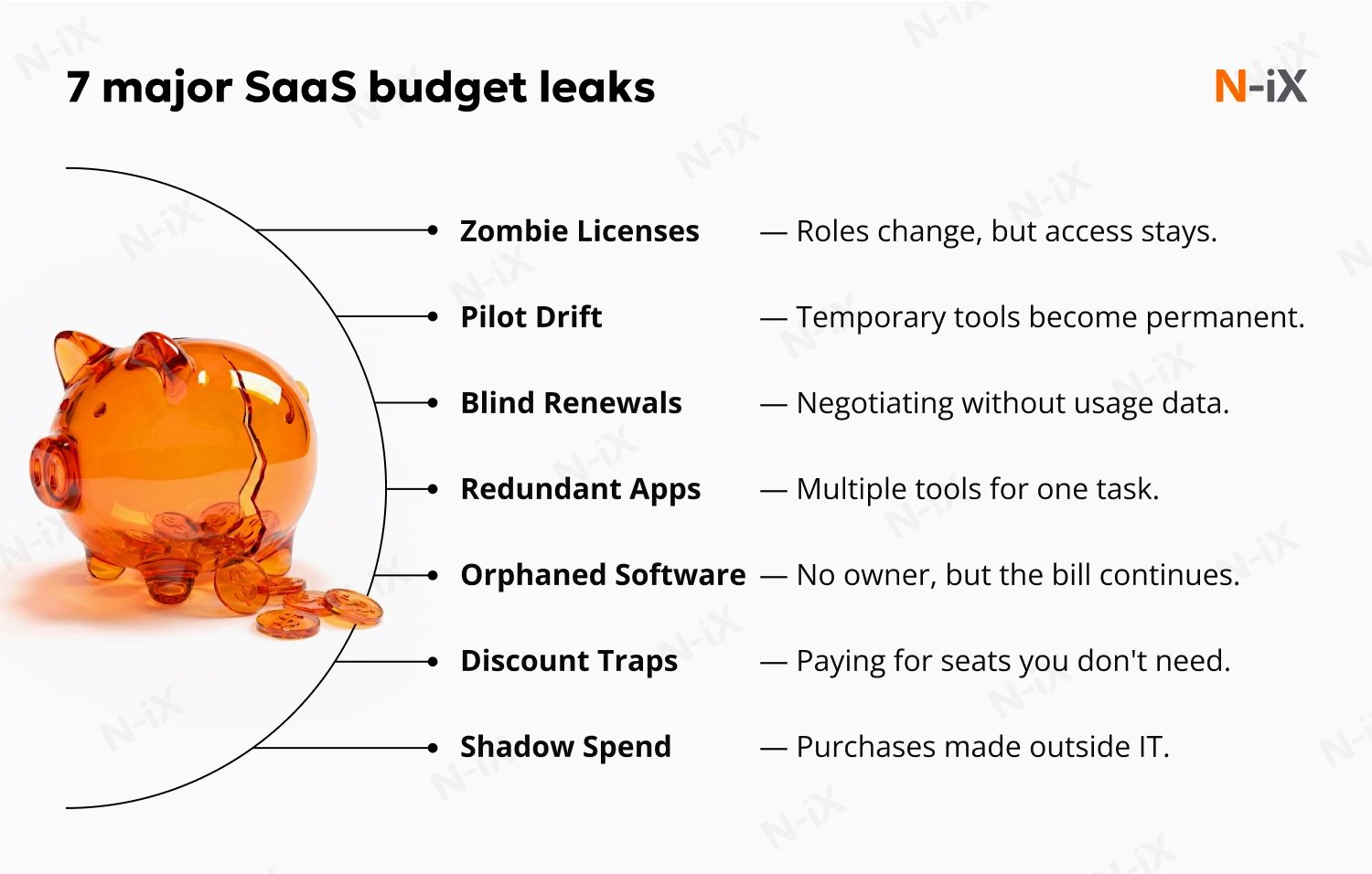
SaaS sprawl and shadow IT
SaaS solutions are easier to adopt but harder to control. Business units often purchase tools independently, especially in decentralized budget environments. Over time, IT and finance departments lose a clear view of which software is used, who owns it, and why it was introduced.
Shadow IT develops gradually. Teams adopt SaaS cloud tools to solve immediate problems, often without visibility into existing solutions. Each choice is reasonable in isolation. At scale, this leads to overlapping platforms, fragmented ownership, intricate SaaS cost management, and an increasingly complex environment that is difficult to govern or rationalize.
Inefficient license usage and access management
Once SaaS tools are rolled out, access is usually granted quickly to avoid blocking teams. Further, that access is rarely revisited. Tech experts move into new roles, projects wrap up, or people leave the organization, yet licenses often remain assigned and continue to generate costs. Thus, organizations accumulate inactive users, unused premium licenses, and permissions that no longer reflect how tools are actually used. If left unnoticed, this can be a substantial waste for companies.
Renewal and vendor management challenges
Most cloud solutions are purchased on subscription contracts that renew automatically each year or over longer terms. These renewal moments are critical for effective SaaS spend optimization as they help focus on reassessing whether software is still needed, how widely it is used, and whether its cost reflects current business requirements. In reality, renewals are often considered at the last minute. In a hurry, usage insights and contract context are limited, and continuity becomes the immediate priority. Additionally, without proper visibility, it is difficult to track who owns a certain tool and how critical it is.
This timing and lack of a centralized view shape vendor negotiations. Without early preparation, pricing discussions could rely on past assumptions rather than current demand. Thereby, long-term commitments are extended with limited flexibility.
Operational and financial complexity
As SaaS adoption accelerates, complexity spreads beyond procurement. Finance teams see software spending rise but lack the detail needed to explain why. Forecasts become less reliable, and budgeting turns into damage control rather than planning. IT teams, meanwhile, support an expanding mix of applications with different security models, integrations, and support requirements. Thus, standardization becomes difficult, government becomes fragmented, and risks quietly increase.
From a leadership perspective, the picture is unclear. Costs are up, but returns are hard to measure. This is rarely a technology failure, but a sign that governance and data practices have not evolved at the same pace as SaaS adoption.
10 best practices for SaaS spend optimization
To eliminate SaaS budget leaks, we gathered the top 10 SaaS spend optimization strategies from our leading SaaS developers. Let’s look up.
1. Build visibility through continuous SaaS audits
Effective SaaS cost optimization starts with visibility, but visibility alone is not enough. Organizations need a centralized view of their SaaS landscape that connects tools, usage, cost, and business purpose.
This is where continuous SaaS audits play a critical role. Rather than treating audits as annual cleanups, organizations need to review their SaaS architecture on an ongoing basis. Thus, they can validate which tools are active, how they are used, who owns them, and which business capabilities they support.
2. Align SaaS spending with your goals
SaaS developers from N-iX suggest tying SaaS audits directly to business outcomes. Each application should support a specific process, team, or business initiative. When that connection is unclear, it becomes harder to justify ongoing spend.
Evaluating SaaS costs against your business goals changes how you make optimization decisions. Instead of focusing only on reducing expenses, teams evaluate whether a tool contributes to revenue, compliance, or day-to-day operations. This approach also brings more clarity to renewals, helping organizations continue investing where value is clear and scale back where it is no longer needed.
3. Implement data analytics for intelligent optimization
Data analytics helps elevate SaaS spend optimization decisions. Beyond basic usage reports, advanced analysis can reveal patterns that could otherwise go unnoticed. Seasonal fluctuations, feature-level adoption gaps, predictive analytics for usage, and correlations between tool usage and productivity offer deeper insight.
It is also helpful to combine SaaS data with organizational context, such as role distribution, team size, and project lifecycles. This enables more accurate forecasting and more nuanced decisions about how to optimize SaaS spend without compromising efficiency. Analytics also supports long-term planning. Organizations can model future scenarios and align contracts accordingly, reducing waste and maximizing ROI.
4. Define and track KPIs
To understand where optimization is needed, organizations need indicators that show how software is actually used and how that usage supports day-to-day operations. This applies to both internally managed tools and platforms introduced through outsourcing SaaS solutions, where visibility can be more limited. Key performance indicators (KPIs) like cost per active user, adoption trends over time, and spend growth relative to team size help detect meaningful patterns. They highlight which tools deliver value at scale and which quietly accumulate cost.
N-iX engineers recommend keeping KPI sets intentionally small to manage SaaS spend precisely. A focused set of well-chosen metrics gives clearer insights and more confident decisions than complex dashboards filled with disconnected data.

5. Rightsize licenses based on real usage
When organizations gain clearer visibility into how SaaS services are used, license rightsizing becomes one of the most practical ways to reduce unnecessary spend. This step often delivers early savings, but only when usage data is reliable and regularly reviewed. Rightsizing focuses on matching licenses and feature tiers to actual needs. Over time, some users stop using a tool, others no longer require advanced features, and some accounts remain active simply because no one revisits them. Instead of renewing these licenses by default, they should be flagged for review.
The common way to optimize SaaS spend is to set clear usage thresholds to guide these decisions. When adoption falls below agreed levels, the license or plan is reassessed. This approach removes guesswork, ensures consistency across teams, and keeps license allocation aligned with real demand.
6. Reduce complexity through rationalization
An efficient SaaS spend management strategy also includes simplifying the software ecosystem. Tool overlap increases costs indirectly through integration effort, training overhead, and fragmented workflows. Application rationalization focuses on reducing redundancy while maintaining business continuity.
These decisions require context. Some tools deliver strategic value despite limited usage. Others exist only because alternatives were not visible at the time of purchase. SaaS spend optimization strategies work best when rationalization decisions consider both current usage and long-term direction.
7. Turn vendor management into a strategic function
Vendor management becomes more effective when you strategically prepare for renewals. Gather clear data on how tools are used, who relies on them, and how demand is changing. It will help understand whether the current contract still fits the business. With this clarity, conversations with vendors become more balanced. Instead of defaulting to standard terms, organizations can adjust contract length, pricing tiers, or commitments based on real usage and expected needs.
It is important to prepare for renewals in a structured way, following consistent timelines and criteria. Thus, last-minute pressure decreases, negotiating positions improve, and decisions about ongoing investments become more reasonable.
8. Establish strong governance
SaaS spend optimization depends on a clear structure. When ownership of tools is unclear or review cycles are inconsistent, optimization efforts can lose their impact. Clarifying ownership for each app, decision-making rules, and review cycles helps maintain continuity.
Good cloud governance should also provide clarity. When teams understand the policies around SaaS adoption and ongoing evaluation, decisions become more consistent and easier to make.
9. Centralize procurement while sharing accountability
Centralizing procurement is about coordination, not control. It creates a single view of SaaS usage, contracts, and standards, while allowing teams to remain involved in selection decisions. This visibility helps prevent overlap and ensures new tools fit the existing environment.
Procurement works best when paired with shared accountability. IT teams assess integration and security implications. Business teams provide context on how tools are used. Finance aligns spending with planning and budgets. When these roles work from the same data, SaaS management and spend optimization become proactive.
10. Avoid arbitrary cost reductions
Reducing SaaS spend without context can create short-term savings but long-term disruption. Removing tools or licenses too quickly can interrupt workflows and weaken trust across teams.
More sustainable SaaS spend optimization relies on targeted changes. Clear communication, phased adjustments, and decisions based on usage data allow teams to adapt smoothly. Thus, optimization improves how software is managed rather than limiting how teams work.

How can N-iX help you with SaaS spend management?
SaaS spend optimization relies on establishing repeatable processes, sharing responsibilities, and implementing analytics to guide decisions. Over time, it becomes part of how the organization operates cloud solutions. This transition requires more than tools. It is also about cultural change, deep expertise, and experience. To adopt this approach smoothly, organizations often turn to SaaS consultants. This helps avoid common pitfalls and reach your ROI goals faster.
N-iX helps enterprises design and implement cost optimization strategies that balance cost control with operational continuity. Our team of 480+ certified cloud engineers works closely with clients to build visibility, analyze usage patterns, and introduce scalable governance models. By applying data analytics and engineering expertise for over 23 years, N-iX supports organizations in building SaaS spend optimization systems that balance costs and business continuity.
If your organization is assessing how to optimize cloud costs without disrupting teams, N-iX can help you define a data-driven path forward.
Have a question?
Speak to an expert


