ChatGPT
 Perplexity
 Claude
 Gemini
 Grok
Grok
Multicloud architectures help organizations achieve better flexibility, resilience, and scalability by distributing workloads across cloud providers. According to the Flexera 2025 State of the Cloud Report, 86% of organizations worldwide embraced multicloud, mixing hybrid, public, and private cloud environments. Despite the widespread adoption, many companies struggle to manage integration, security, and costs effectively in this complex setup.
So, how can businesses maximize the benefits of a multicloud strategy? What are the best practices for ensuring seamless adoption and management? In this article, we provide actionable insights to help organizations go multicloud confidently.
Why do organizations choose a multicloud strategy
Multicloud solutions help businesses remain agile, competitive, and secure. Here are the main benefits of a multicloud strategy:
- Reduced vendor lock-in: Organizations can reduce their reliance on a single cloud vendor and go cloud-agnostic, gaining the flexibility to switch providers or use a mix of services from different cloud environments.
- Enhanced performance: Businesses can leverage the best services from different providers, selecting tools for their specific needs.
- Optimized disaster recovery: With a multicloud approach, businesses can create redundant systems, ensuring faster recovery in the event of a cloud failure and minimizing data loss risk.
- Cost optimization: A multivendor cloud strategy enables companies to select the most cost-effective provider for each workload, improving overal, improving overall cloud ROI.
- Flexible access to specialized services: By choosing multiple cloud providers, businesses can access offerings that a single vendor may not provide, such as industry-specific solutions, cloud-native services, or advanced AI/ML capabilities.
- Global reach: By using multiple cloud providers, organizations can extend their reach across geographies, ensuring low-latency services and compliance with local data regulations worldwide.
Read more: Multi-cloud vs hybrid cloud: key differences and tips
10-step plan for adopting a multicloud setup
While the advantages of a multicloud strategy are clear, organizations often face challenges during its implementation and management. To avoid them, you have to carefully plan and execute your strategy. Our cloud engineers shared a comprehensive 10-step guide to help you throughout the adoption.
1. Define clear objectives
Before implementing a multicloud strategy, define specific, measurable objectives that align with your overall business goals. Objectives could include improving performance, ensuring business continuity, optimizing cloud costs, enabling faster innovation, and others. Additionally, it is important to define key performance indicators (KPIs) for each objective and regularly review them to ensure they align with evolving business needs.
2. Choose the right cloud providers
Moving to multicloud can only provide flexibility if you choose the right cloud service providers. You need to evaluate each of them, considering the following factors:
- Computing power;
- Storage capacity;
- Data security features;
- Industry-specific services;
- Clear service level agreements (SLAs) that define performance expectations, uptime, and support response times.
Carefully choose providers whose capabilities complement each other to ensure compatibility and reduce the risk of vendor lock-in. An effective multivendor cloud strategy should enable you to select the best platform for each workload.
3. Establish strong governance and cost management
Strong cloud governance is crucial to maintaining control over a heterogeneous environment. Establish clear policies to ensure compliance with company standards and regulatory requirements. Governance tools like cloud management platforms (CMPs) can help centralize control across multiple clouds, offering features such as monitoring, resource allocation, and compliance tracking.
At this phase, it is also crucial to create a comprehensive cost management strategy. Leverage tools like AWS Cost Explorer, Azure Cost Management, or Google Cloud’s Billing to track spending, allocate costs to specific departments or teams, and optimize usage across clouds.
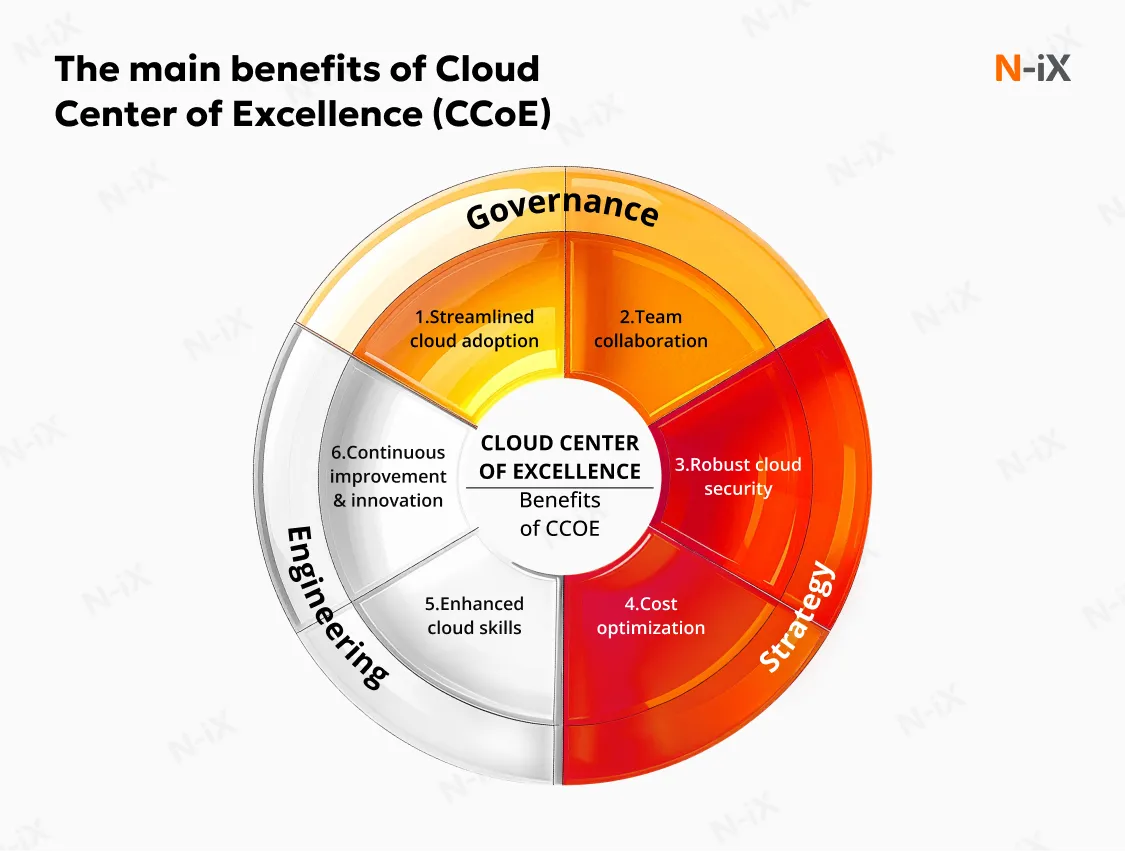
Additionally, establishing a Cloud Center of Excellence (CCoE) can greatly enhance governance and cost management. A CCoE acts as a centralized team responsible for enforcing best practices, ensuring compliance, and overseeing cost optimization efforts. They ensure your strategy aligns with business goals while minimizing risks, fostering continuous innovation, and streamlining cloud management.
4. Implement strong security practices
Security is a critical aspect of a multicloud strategy. To safeguard your data and applications, implement a Zero Trust security model that ensures access controls and encryption are consistently applied across all platforms. Adopt multicloud security best practices, including continuous monitoring, regular assessments, data encryption, and more. It is also helpful to implement cloud security posture management (CSPM) platforms, such as CloudHealth, and identity and access management (IAM) systems, such as AWS IAM or Okta.
Additionally, data privacy and compliance should be integrated into your security practices to meet legal and regulatory requirements. Ensure data encryption at rest and in transit, and deploy tools to track compliance in real time across cloud providers.
5. Ensure integration and interoperability
In a multicloud strategy, seamless integration and interoperability between cloud platforms are essential for optimal performance. To ensure smooth communication and data flow, it iscrucial to establish a strong integration framework early on. Our cloud engineers recommend using cloud orchestration platforms to manage workloads efficiently, automate deployment, scaling, and management. Tools like Kubernetes and Terraform enable consistent infrastructure management across different cloud providers.
API management tools facilitate secure, reliable data exchange and ensure compliance with security protocols. Additionally, data synchronization tools such as Apache Kafka and AWS Glue help keep data in sync across all environments, preventing data discrepancies and ensuring smooth operation.
6. Leverage automation and AI-powered tools
Automation and AI-driven cloud tools can significantly streamline cloud management, reducing manual intervention, improving efficiency, and minimizing human error. To implement automation successfully, our cloud experts suggest utilizing:
- AI-powered cost optimization services to enable automatic adjustment of cloud resources based on usage patterns;
- Automated scaling of cloud resources to match demand, ensuring optimal performance while controlling costs.
- Predictive analytics to identify performance and usage trends and get proactive optimization recommendations.
7. Develop an observability framework
To effectively manage a multicloud environment, you need a centralized view of each cloud’s performance. Implementing an observability framework will help you monitor and gain real-time insights into how different cloud services and applications work.
To achieve this, you can use cloud-native monitoring tools to track infrastructure health. For end-to-end application visibility, use application performance management (APM) tools, such as New Relic or Datadog. Additionally, centralized logging platforms can help you collect, store, and analyze logs across all cloud environments, providing a comprehensive view of system performance. This proactive monitoring enables you to detect and resolve issues early.
8. Plan for disaster recovery and business continuity
A multicloud approach enhances your disaster recovery capabilities by providing redundancy across multiple cloud providers. This ensures that, if one provider experiences downtime, services remain uninterrupted.
To make it work for you, back up critical data across clouds using backup solutions. This helps keep your data secure and accessible, even if one cloud platform becomes unavailable. Additionally, implement failover strategies that automatically switch to another cloud in the event of a failure. This minimizes downtime and ensures continuous operations. Besides, it is also crucial to regularly test disaster recovery plans to review your recovery processes and train your team to act swiftly during a real outage.
9. Follow a phased implementation approach
To avoid disruptions, implement your multicloud strategy in phases. Begin by migrating non-critical workloads to test the architecture integration, performance, and compatibility across cloud platforms. This allows you to identify and address issues in a controlled environment before they affect critical operations. After successful testing, gradually move mission-critical applications, ensuring that each phase is stable and well-managed. This approach enables you to manage risk effectively and ensure smoother transitions.
10. Build a skilled multicloud team
Adopting multicloud requires strong engineering skills. Hiring external cloud professionals allows you to quickly leverage the necessary skills and effectively manage complex cloud environments. Look for experts who specialize in cloud architecture provisioning, governance, automation, and performance optimization to ensure efficient resource management. Besides, hiring cloud-certified professionals will bring in-depth knowledge to your strategy. For example, at N-iX, our cloud engineers hold vendor certifications and have years of experience in ensuring seamless multicloud integration, troubleshooting, and optimizing cloud environments.

How N-iX can support your multicloud strategy
N-iX provides end-to-end support for your multicloud environment, from initial planning to ongoing management. With more than 200 successfully delivered cloud projects, N-iX offers deep expertise in cloud transformation, migration, architecture redesign, governance, maintenance, and infrastructure configuration. Our team of 400+ cloud professionals is ready to guide you through adopting a complex cloud setup and help you avoid common pitfalls. As an AWS Premier Tier Services Partner, Microsoft Solutions Partner, and Google Cloud Platform Partner, we ensure that your cloud solutions are built on a strong, reliable foundation. We also adhere to industry-leading security standards, including PCI DSS, ISO 9001, ISO 27001, and GDPR, ensuring the safety of your data throughout the cloud adoption process.
Ready to implement a strategy that drives flexibility for your business? Contact our experts today to start building a robust multicloud solution tailored to your unique needs.
Have a question?
Speak to an expert