 ChatGPT
 Perplexity
 Claude
 Gemini
 Grok
Grok
Since an asset is any resource owned by a business that has value and can be used to generate future benefits, it’s in the business’s interest to ensure it remains in proper working order.
Traditional asset management relied on periodic inspections and rule-based maintenance schedules, even when supported by CMMS systems. It also focused on post-damage repairs, which often led to unexpected breakdowns or inefficient operations.
Internet of Things (IoT) in asset management uses interconnected devices and sensors to monitor, track, and manage physical assets, often in real-time. The technology transforms the approach by providing continuous, real-time monitoring of equipment, enabling businesses to shift their maintenance approach from reactive to proactive. And those who switched have reported obtaining tangible business value.
According to The Asset Lifecycle Report 2026 by Brightly, a share of respondents adopting and actively using IoT for asset management has grown from 18% in 2025 to 68% in 2026 [1]. It's a clear sign the technology has tangible benefits for the business. Yet the real challenge lies in integrating IoT data into IT and OT legacy systems like CMMS, ERP, and EAM.
In this article, we’ll explore how businesses can use IoT to improve visibility, control, and efficiency in asset management and overcome the IT/OT convergence challenges that entail.
You'll also learn:
- What is the role of IoT in asset management?
- How does IoT work in asset management?
- How can IoT help businesses optimize asset performance and reduce costs?
- How does IoT enable real-time insights and predictive maintenance in asset management?
- What are the key use cases of IoT in asset management across different industries?
- How can businesses achieve higher asset availability and reduce maintenance costs using IoT?
- What are the strategic benefits of the Internet of Things in asset management?
How IoT asset management works
An IoT asset management solution involves several integrated components that work together to provide real-time monitoring, data analysis, and predictive maintenance. Here's how the process typically unfolds:
- Data collection. Organizations attach sensors to machinery, equipment, vehicles, or inventory to capture data about location, usage, condition, and performance, etc.
- Data transmission. Data collected by these sensors is transmitted over a network (e.g., Wi-Fi, 5G) to a centralized platform for processing. This can happen through various communication protocols, depending on the environment, such as MQTT, CoAP, NB-IoT, LTE-M.
- Device management. This layer handles provisioning, authentication, firmware updates, and lifecycle control of thousands of distributed devices.
- Real-time data ingestion. Data is ingested through streaming pipelines (Apache Kafka or AWS Kinesis) for fast, scalable processing. For latency-sensitive assets or environments with intermittent connectivity, critical data is first processed at the edge (e.g., via edge gateways or local compute) before being forwarded to cloud platforms like AWS IoT Core or Azure IoT Hub.
- Data storage and processing. The data is then stored on a cloud platform or an on-premises system, where it is aggregated and organized for analysis. Popular platforms include AWS IoT, Microsoft Azure IoT, or custom-built solutions tailored to specific business needs.
- AI-powered data analysis. Advanced analytics and machine learning algorithms process the data to identify trends, patterns, and anomalies, and predict asset performance.
- User interface and alerts. The system provides a user interface (e.g., dashboards, mobile apps) that displays real-time asset data, alerts, and actionable insights. Technicians and operations managers receive alerts and recommendations on when to perform maintenance or address potential issues.
- Integration with existing systems. The Internet of Things asset management integrates with other business systems, such as CMMS (Computerized Maintenance Management Systems), ERP, or EAM (Enterprise Asset Management), to provide a unified approach to asset lifecycle management.
This is a complex system that requires a deep understanding of how the components, such as sensors, connectivity, data processing, and analytics, work together. Without proper integration and alignment, the full potential of IoT in asset management can remain a theory. However, when implemented correctly, this technology can enable smoother, more efficient coordination.

IoT use cases in asset management
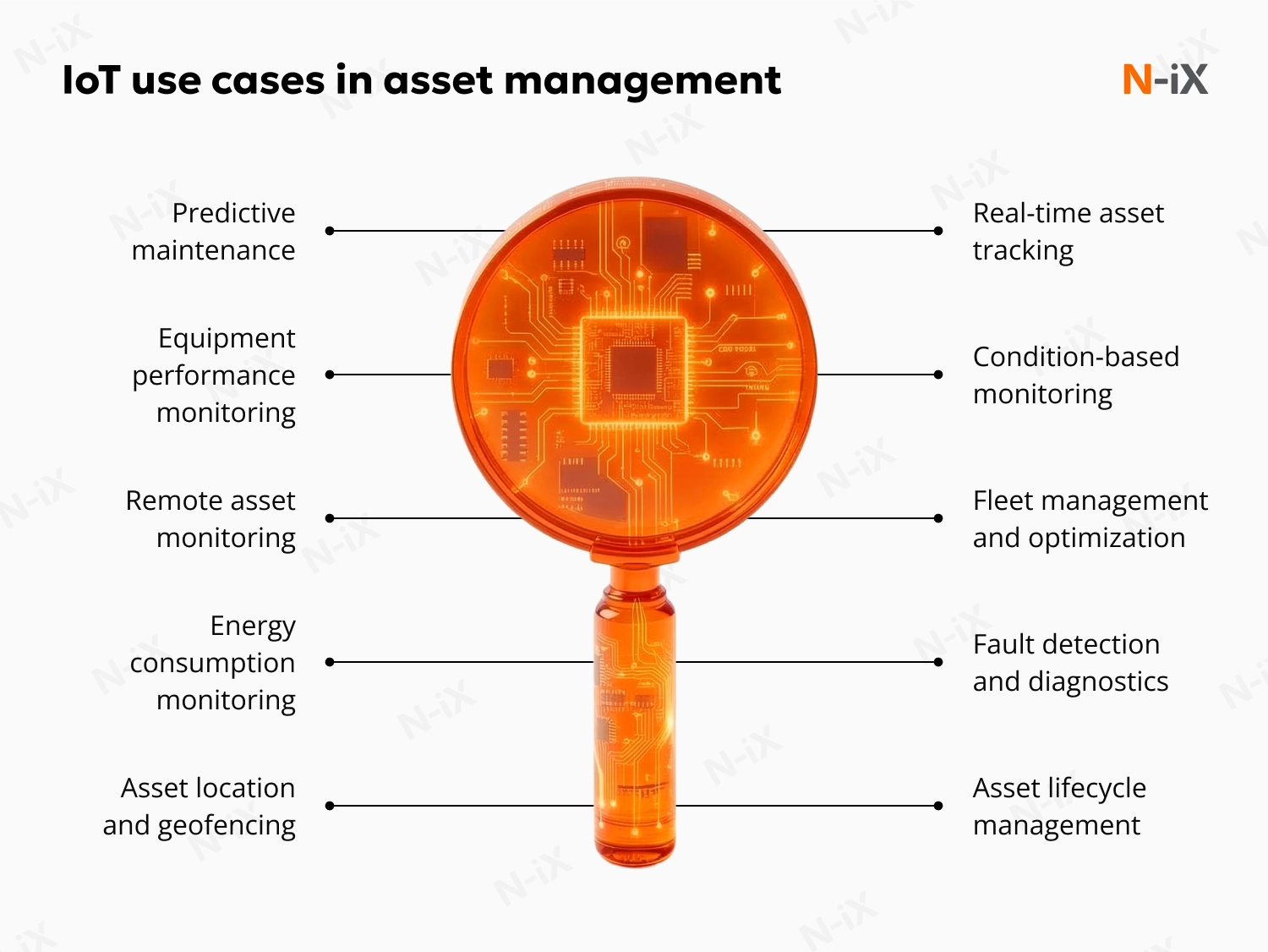
IoT in enterprise asset management enables businesses to monitor and control equipment and tools, both static and in motion. It expanded the possibilities and scale of asset management. Here are a few use cases where on-the-go connectivity has proven helpful.
Predictive maintenance
IoT-powered predictive maintenance uses real-time data and machine learning to predict when equipment is likely to fail. This allows companies to perform maintenance only when needed, reducing costs and minimizing downtime.
Example: GE Aviation uses IoT sensors to monitor fleet health and aircraft performance in the air and on the ground, and to predict maintenance needs. It helps the company improve uptime and reduce maintenance costs [2].
Real-time asset tracking
IoT in asset tracking enables businesses to locate and monitor the asset condition in real time, improving visibility across operations. This is especially useful in industries like logistics and healthcare, where asset utilization is critical.
Example: Amazon uses an IoT asset tracking solution to track inventory locations in real time, allowing for dynamic logistics management. It helps the company to forecast product data throughout the supply chain. Additionally, IoT enhances the accuracy of information flow through data analysis, reducing the risk of information discrepancies [3].
Equipment performance monitoring
IoT sensors monitor the health and performance of equipment, providing data on factors like temperature, pressure, and vibration. This helps businesses ensure optimal operation and spot issues early.
Example: Siemens uses IoT to monitor turbine performance in power plants. The technology helped lower OT asset maintenance efforts and costs by up to 25%, and increase asset availability by up to 15% [4].
Condition-based monitoring
Instead of relying on fixed maintenance schedules, IoT condition-based monitoring only triggers maintenance when specific conditions are met, such as abnormal wear or performance drops.
Example: Shell uses its Remote Sense solution to monitor the oil level in the equipment. It uses sensor data and advanced analytics to inform when the oil level is below the acceptable threshold [5].
Remote asset monitoring
IoT in asset management enables real-time remote monitoring, reducing the need for on-site inspections. The designated person can take immediate action from anywhere.
Example: In oil and gas, Aramco uses IoT sensors to monitor oil wells remotely. It helps engineers detect and address issues without being physically present. This approach helps the company to cut physical inspection times by 40%. [6]

Fleet management and optimization
The businesses may improve fleet operations by adopting IoT fleet management tools. By tracking vehicle location, speed, and condition, they can help optimize routes, reducing fuel consumption and enhancing driver safety.
Example: N-iX helped a client develop an IoT-based fleet tracking solution. It allowed the client to receive real-time data on speed, fuel consumption, and engine efficiency. This solution enhanced operational performance, ensuring timely maintenance and optimizing resources across the fleet.
Energy consumption monitoring
IoT sensors measure energy usage in real-time, helping businesses identify inefficiencies and reduce energy costs.
Example: Coca-Cola uses IoT in its factories to monitor energy consumption and optimize its production processes. It helps the business save costs and balance resource usage. The case study reports 20% lower energy spending and 9% lower water spending annually [7].
More on how IoT in retail industry helps businesses evolve
Fault detection and diagnostics
IoT can detect equipment faults by monitoring performance metrics and identifying deviations from normal operations. This leads to timely repairs and minimizes unplanned failures.
Example: In residential buildings, IoT asset monitoring can be used for automated fault detection and diagnostics (AFDD). It can help identify issues with heat, ventilation, and air conditioning (HVAC) systems and prevent them from being out of service [8].
Asset location and geofencing
Asset management based on the Internet of Things enables businesses to track the exact location of assets and create geofences to receive alerts when assets leave designated areas, preventing theft or misuse.
Example: In construction, companies like Schielicke Bau use IoT to track heavy machinery and ensure it stays within authorized zones on job sites. In addition, it helps manage the machine deployment by data, eliminating time inefficiencies and preventing resource underutilization [9].
Asset lifecycle management
IoT helps businesses monitor the entire lifecycle of their assets from acquisition to decommissioning. It allows businesses to provide timely maintenance, upgrades, and replacements.
Example: Sund & Bælt Holding A/S uses IoT-powered solutions by IBM to monitor the conditions of their assets (bridge infrastructure) and plan for upkeep. This way, the company expects to manage and extend the asset lifecycle [10].
These IoT use cases improve asset management across enterprises in different industries. In the next section, we’ll explore the specific benefits that IoT brings to asset management.
Explore further: IoT in inventory management: Top tips to make it work
Benefits of the Internet of Things in asset management
The integration of IoT into asset management brings numerous benefits that directly impact business operations, from increasing efficiency to driving cost savings. Here’s how IoT enhances asset management.
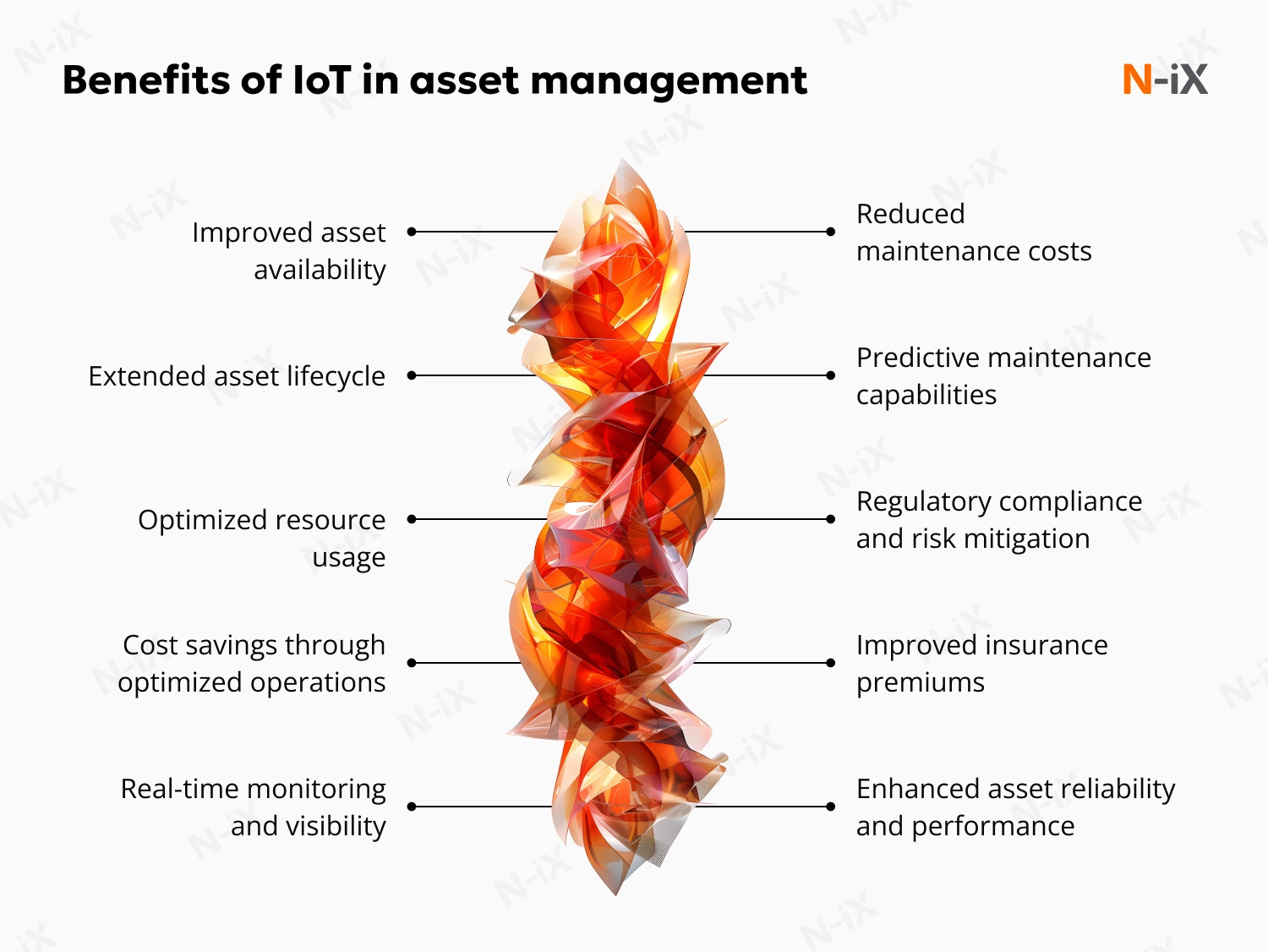
- Improved asset availability (measured via OEE or MTBF). It drives tangible cost reductions by minimizing downtime and maximizing production capacity, which directly impacts operational efficiency and bottom-line profitability.
- Reduced maintenance costs. By identifying issues early through real-time monitoring, IoT minimizes unplanned repairs and unnecessary services, optimizing the maintenance budget and reducing lifecycle costs.
- Extended asset lifecycle. Continuous monitoring of asset health enables businesses to maintain equipment at optimal conditions, extending its lifespan by reducing wear and tear and preventing premature asset failure.
- Predictive maintenance capabilities. IoT sensors detect early anomalies and predict failures before they occur, allowing businesses to schedule maintenance based on actual asset condition, rather than arbitrary time-based schedules.
- Optimized resource usage. IoT helps businesses track asset usage in real time, enabling better resource allocation and preventing both overuse and underuse of critical equipment, enhancing asset management efficiency.
- Regulatory compliance and risk mitigation. By continuously monitoring asset conditions, IoT helps companies stay compliant with industry regulations and avoid costly penalties. It also mitigates risks associated with asset failures, reducing the potential for safety incidents and legal liabilities.
- Cost savings through optimized operations. IoT in asset management helps businesses spot inefficiencies across operations, allowing them to optimize asset performance and reduce energy consumption, thus lowering operational expenses.
- Improved insurance premiums. Businesses leveraging IoT for proactive maintenance and failure prevention can often benefit from lower insurance premiums, as real-time monitoring reduces the risk of large-scale damage or loss.
- Real-time monitoring and visibility. Real-time insights into asset location, condition, and performance allow businesses to respond to issues quickly. It helps maintain operational continuity and enables informed, data-driven decisions.
- Enhanced asset reliability and performance. Continuous monitoring and proactive intervention help businesses fine-tune asset performance, ensuring equipment operates at peak efficiency, improving overall reliability, and meeting performance expectations over time.
These benefits highlight the potential of IoT in asset management, but businesses must also navigate challenges to realize its value fully. Let’s explore them.
Challenges of IoT in asset management and monitoring
Any IoT solution is a complex system that requires integration skills and experience. IoT for industrial asset management in particular, presents several unique challenges due to large asset fleets, data flows, and data processing. Here are some of the challenges and our tips on how to navigate through them.
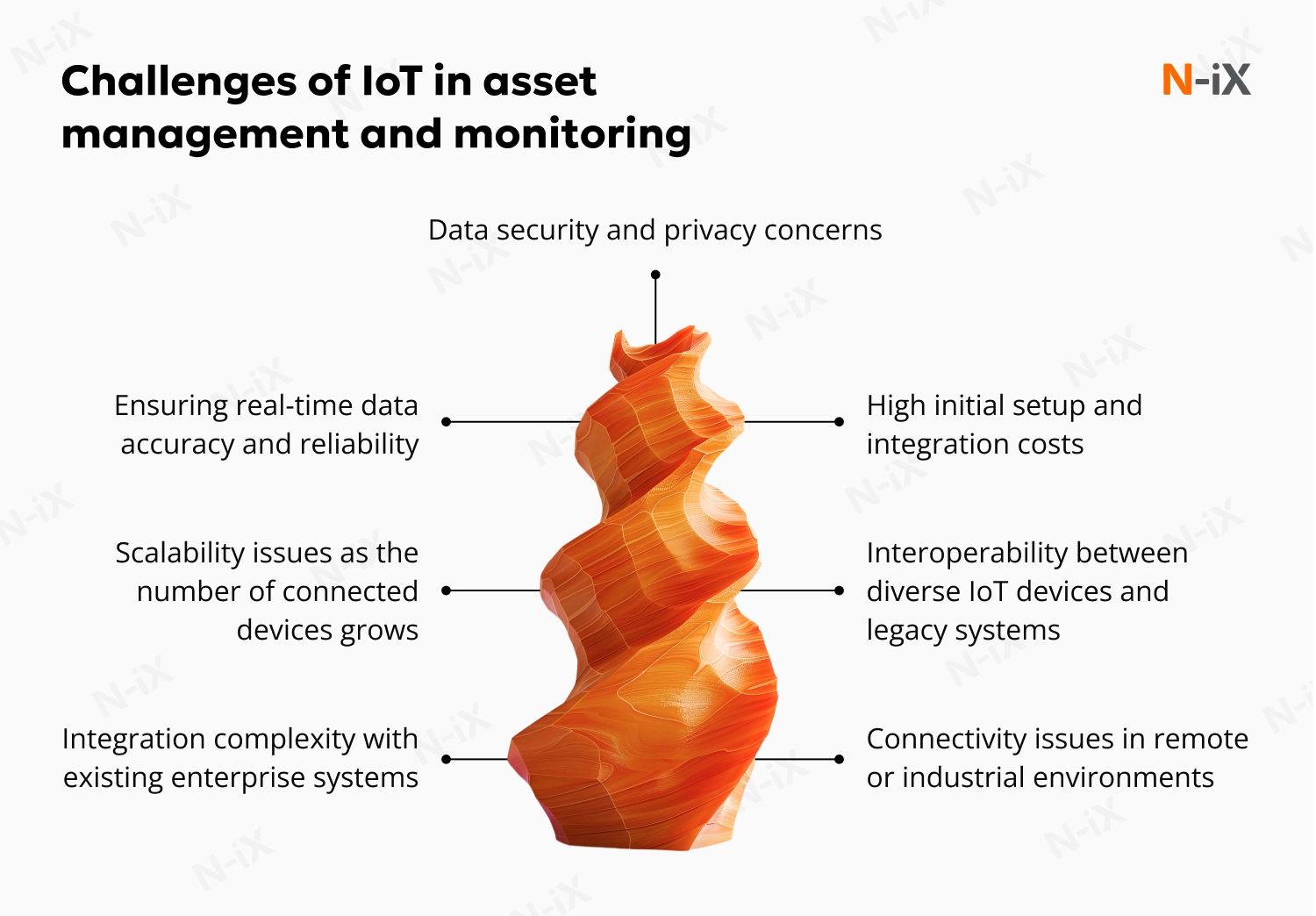
Data security and privacy concerns
With the growing volume of data generated by IoT devices, businesses face significant security risks, including unauthorized access and data breaches. Protecting sensitive asset data is crucial, particularly in industries like healthcare and energy.
Possible solution: IoT security extends beyond encryption and requires a layered strategy. From device identity management to network segmentation and secure communication protocols, every component must be validated and secured to ensure no vulnerabilities compromise your asset data, business continuity, or regulatory compliance.
High initial setup and integration costs
Setting up an IoT system involves significant upfront investment in sensors, devices, and integration with existing systems. These costs can be a barrier, particularly for small to medium-sized enterprises.
Possible solution: To manage costs, prioritize a phased implementation approach, focusing on high-impact areas first, and leverage scalable, cloud-based solutions to reduce upfront infrastructure costs.
Interoperability between diverse IoT devices and legacy systems
Many businesses struggle with integrating IoT devices into their existing infrastructure, especially when legacy systems lack compatibility with new technologies.
Possible solution: Choose IoT platforms with strong integration capabilities and ensure robust middleware to bridge the gap between IoT devices and legacy systems, enabling smooth data flow.
Scalability issues as the number of connected devices grows
As the number of IoT devices increases, businesses may encounter challenges related to managing large volumes of data, processing, and maintaining these devices across multiple locations.
Possible solution: Use cloud-based solutions and edge computing to scale your infrastructure efficiently, while focusing on ensuring your system can handle increased data throughput and device management needs.
Connectivity issues in remote or industrial environments
IoT devices require reliable connectivity to transmit data. It can be challenging in remote or industrial environments with limited network coverage.
Possible solution: Choose a proper network according to your environment and implement reliable communication over it that includes retransmits, timeouts, etc. Where connectivity remains intermittent, edge computing can process data locally and sync to the cloud when a connection is available.
Discover 15 industrial IoT use cases that change business
Integration complexity with existing enterprise systems
Integrating IoT data with enterprise systems such as CMMS, ERP, or EAM can be complex, requiring custom interfaces and ensuring data consistency across platforms.
Possible solution: Work with experienced IoT solution providers who can offer seamless integration with your existing systems, ensuring smooth data flow and minimizing disruptions to business operations.
Ensuring real-time data accuracy and reliability
For IoT to be effective in asset management, the data it generates must be accurate and reliable. Inaccurate readings can lead to poor decision-making and operational inefficiencies.
Possible solution: Implement regular calibration and validation processes for your IoT devices and sensors, and ensure continuous monitoring of data integrity to maintain the reliability of your asset management system.
The challenges of IoT in asset management can be addressed with proper planning and a strategic approach. N-iX has a few suggestions on how to do it right.

Top IoT implementation tips for improved asset management from N-X
Successfully implementing IoT for asset management requires a strategic approach that balances technology, business goals, and long-term scalability. Here are key tips tailored for IoT in asset management:
1. Align IoT deployment with measurable asset KPIs
IoT initiatives should be engineered around specific outcomes such as reduced MTBF, improved OEE, lower maintenance cost per asset, or higher fleet utilization. Without baseline metrics and target thresholds, it is impossible to prove operational impact. Define financial and operational KPIs before solution design begins.
How N-iX does it: We start every IoT engagement with KPI mapping workshops, translating business objectives into technical architecture requirements and measurable success criteria.
2. Define data ownership and governance early
IoT generates cross-functional data spanning IT, OT, and analytics teams. Without defined ownership, standardized asset identifiers, and validation rules, data quality deteriorates and accountability becomes unclear. Governance must be embedded in architecture, not added post-deployment.
How N-iX does it: We design unified data models, standardize asset schemas, and formalize ownership frameworks that align IT and operational stakeholders from day one.
3. Design integration into enterprise systems from the outset
IoT value materializes only when insights trigger operational workflows. Direct integration with CMMS, ERP, and EAM ensures that alerts generate automated work orders and that performance data informs lifecycle decisions. Parallel dashboards disconnected from enterprise systems limit impact.
How N-iX does it: We build API-driven integration layers and middleware connectors that embed IoT intelligence directly into existing enterprise workflows.
4. Architect the edge-to-cloud split deliberately
Latency-sensitive environments, safety systems, and intermittent connectivity require edge processing, while cloud platforms support fleet-wide analytics and long-term modeling. The wrong split increases costs, risk, and exposure to downtime.
How N-iX does it: We design hybrid architectures that allocate real-time control logic to edge infrastructure while leveraging cloud platforms for scalable analytics and centralized visibility.
5. Engineer scalability into the infrastructure layer
As connected asset volumes grow, data ingestion, device management, and security complexity scale non-linearly. Cloud-native architectures, event-driven pipelines, and automated device provisioning are essential for sustainable growth.
How N-iX does it: We implement containerized microservices, device identity management, and OTA update frameworks that support horizontal scaling across distributed asset fleets.
6. Integrate advanced analytics into the core architecture
Raw telemetry does nothing for operations without contextual intelligence. Machine Learning supports anomaly detection, performance forecasting, and maintenance optimization. Analytics pipelines must support both real-time alerting and historical modeling.
How N-iX does it: We embed predictive models and anomaly detection algorithms directly into IoT data pipelines, enabling proactive decision-making rather than reactive monitoring.
7. Prioritize security as a foundational design principle
IoT expands the attack surface by connecting devices and distributing networks. Enterprise-grade deployments require certificate-based device identity, encrypted communication, secure firmware updates, and continuous monitoring.
How N-iX does it: We apply zero-trust architecture principles, device-level authentication, and secure communication protocols across the entire IoT stack.
8. Validate financial scalability before enterprise rollout
Developing an MVP for IoT asset management solutions may demonstrate technical feasibility, but full-scale deployment changes cost dynamics. Connectivity fees, storage costs, and lifecycle management expenses must be modeled per asset before scaling.
How N-iX does it: We develop cost-per-asset economic models during MVP phases and stress-test infrastructure assumptions against projected growth scenarios.
Related: IoT PoC: Expert insights for successful idea validation
9. Plan digital twin integration strategically
IoT digital twins enhance asset management by making simulation, failure modeling, and lifecycle forecasting possible. Integrating twin-ready data structures early prevents expensive architectural redesign later.
How N-iX does it: We design IoT data architectures that support digital twin frameworks, enabling advanced modeling capabilities as asset intelligence matures.
10. Treat IoT as a long-term operational capability
IoT is not a one-time deployment. Continuous firmware updates, recalibration, analytics refinement, and infrastructure optimization are required to sustain value over time.
How N-iX does it: We help with ongoing device management, performance monitoring, OTA updates, and iterative optimization services to ensure IoT systems evolve alongside operational needs.
When these principles are applied cohesively, IoT in asset management evolves from a technology deployment into a structured operational capability. This is the difference between collecting data and building a resilient, intelligent asset ecosystem.

How N-iX helps businesses improve asset management with custom IoT services
At N-iX, we offer a comprehensive range of end-to-end IoT services designed to improve asset management across industries. Our team excels at creating custom solutions that integrate with existing systems and deliver real-time insights, predictive maintenance, and enhanced operational efficiency. Here’s how we can help:
- Embedded engineering and firmware development. We design and implement embedded software for connected devices, including firmware development, sensor integration, device provisioning, and over-the-air update mechanisms to ensure long-term device reliability.
- Hardware-software integration. We bridge the gap between physical equipment and digital platforms by integrating sensors, controllers, and edge gateways into unified IoT ecosystems suited for industrial and distributed environments.
- Industrial protocol integration. Our engineers work with industrial communication standards such as Modbus, CAN bus, MQTT, and other OT protocols to ensure secure and reliable data exchange between legacy machinery and modern IoT platforms.
- Custom IoT solution development. We architect tailored systems for asset tracking, condition monitoring, predictive maintenance, and lifecycle management, aligning technical design with business KPIs such as OEE, MTBF, and asset utilization rates.
- Cloud-native IoT platforms. We implement scalable cloud infrastructures on AWS, Azure, and other platforms, allowing for secure data ingestion, streaming pipelines, and fleet-level analytics across distributed assets.
- Edge computing architecture design. We design hybrid edge-cloud solutions that process latency-sensitive data locally while leveraging the cloud for historical modeling and cross-site optimization.
- Advanced analytics and digital twin enablement. We integrate Machine Learning models, anomaly detection systems, and digital twin frameworks that simulate asset behavior and support long-term performance forecasting.
- IoT data visualization. We help build custom IoT data visualization solutions that transform complex asset data into intuitive dashboards and interactive reports. This enables businesses to gain real-time insights, monitor asset performance efficiently, and make informed decisions that drive operational improvements.
- Enterprise system integration. We embed IoT intelligence directly into CMMS, ERP, and EAM systems through API-driven integration layers, ensuring insights trigger automated workflows and operational actions.
- IoT security services. We implement certificate-based device identity, secure boot mechanisms, encrypted communication channels, and zero-trust principles across the entire IoT stack.
- Ongoing support and maintenance. We provide device management, OTA updates, infrastructure monitoring, analytics refinement, and performance optimization to ensure IoT systems evolve with operational demands.
With N-iX’s custom IoT services, you get a trusted partner for the entire process, from concept to implementation, ensuring that your asset management system is scalable, secure, and perfectly aligned with your business goals.
Wrap-up
Enterprises that treat IoT as a core strategic asset, rather than a secondary initiative, achieve long-term competitive advantage through improved operational efficiency, real-time insights, and predictive capabilities. IoT in asset management helps gain real-time visibility into critical assets, reduce unplanned downtime, and move from reactive fixes to data-driven decisions. But it's only true if the well-designed architecture, secure connectivity, reliable data flows, and tight integration with systems like CMMS, ERP, and EAM are in place. When they are not, the value of IoT investment remains untapped.
At N-iX, we help businesses design and implement end-to-end IoT solutions that actually deliver results. From architecture design and cloud deployment to advanced analytics and long-term support, we build systems that scale and evolve with your asset management needs. If you are ready to turn connected devices into measurable business impact, we are ready to build that foundation with you.
Sources:
- The Asset Lifecycle Report 2026: Realizing Value in Every Asset Stage | Brightly
- GE Aviation and AT&T Enable Aircraft Health Monitoring | GE Aerospace News
- Research on Supply Chain Optimization at Amazon, 2024 | Advances in Economics Management and Political Sciences | Research Gate
- How Siemens Energy uses AWS for its IIoT platform and smart manufacturing | AWS
- Shell Remote Sense – Live oil condition monitoring | Shell
- Digitalization in the oil & gas industry - Energy innovation | Aramco
- Improving Operational Performance Using AWS IoT SiteWise | Coca-Cola İçecek Case Study
- Grid Connected Appliances: Deployment IoT Solution for Fault Detection and Diagnostics | The US Department of Energy
- Optimized Machine Tracking with Industrial IoT | IoT Use Case
- Sund & Bælt Holding A/S | IBM
FAQ
What is IoT asset management?
IoT asset management uses Internet-connected sensors attached to physical assets, such as machinery, vehicles, and infrastructure, to monitor their location, condition, and performance in real time. It helps eliminate manual inspections and fixed maintenance schedules with continuous, data-driven visibility across the entire asset lifecycle.
How does IoT enable predictive maintenance?
Sensors collect operational data (e.g., vibration, temperature, pressure) which machine learning models analyze to detect early signs of failure. This lets maintenance teams act before a breakdown occurs, rather than on a fixed schedule or after the fact. The result is less unplanned downtime and lower maintenance spend.
How does IoT integrate with CMMS, ERP, and EAM systems?
IoT connects to existing enterprise systems via API-driven middleware that translates sensor data into operational triggers, automatically generating work orders, updating asset records, and informing lifecycle decisions. Without this integration, IoT insights stay in disconnected dashboards and deliver little business value.
What are the main challenges of implementing IoT in asset management?
The biggest hurdles are integrating IoT data with legacy IT and OT systems, securing a growing fleet of connected devices, and managing the upfront costs of hardware and infrastructure. Scalability and reliable connectivity in remote or industrial environments add further complexity as deployments grow.
What ROI can businesses expect from IoT in asset management?
ROI is measured through KPIs such as reduced downtime, lower maintenance costs per asset, and improved OEE. Real-world results are tangible: Siemens cut turbine maintenance costs by up to 25%, Coca-Cola saved 20% annually on energy, and Aramco reduced physical inspection time by 40%. The degree of ROI depends directly on how deeply IoT is embedded in existing operational workflows.
Have a question?
Speak to an expert