 ChatGPT
 Perplexity
 Claude
 Gemini
 Grok
Grok
Rising operational costs, recurring downtime, and performance bottlenecks rarely stem from a single failing component. More often, they reflect the impact of aging infrastructure and fragmented processes that no longer align with business demands.
Data center modernization tackles these bottlenecks. If done right, it transforms infrastructure into a flexible, secure, and efficient platform that scales with business growth. But without a strategy, it risks wasting investment and missing opportunities.
When enterprises realize that legacy systems can no longer keep pace with workloads and compliance requirements, they often seek guidance on modernizing their data centers. N-iX supports enterprises in redesigning architecture, integrating hybrid and cloud environments, and embedding automation and security controls.
The sections below explore key aspects of data center modernization, including infrastructure types, operational benefits, and the challenges enterprises face, and show how N‑iX supports these initiatives.
What is data center modernization?
Data center modernization is the process of upgrading infrastructure to support current workloads and scale with evolving business demands. It involves rethinking how servers, storage, and networks are structured and managed to improve performance and security.
Many enterprise data centers were designed for stable, predictable demand. Today, they must handle higher data volumes, hybrid cloud environments, stricter regulatory requirements, and more complex security threats. Legacy systems may still meet some needs, but in many cases, they introduce constraints. Modernization may include:
- Infrastructure upgrades
- Adoption of software-defined architectures
- Increased automation
- Integration with public and private cloud environments
The scope and approach depend on your business priorities, risk tolerance, and long-term IT strategy.
Traditional vs modernized data center
A side-by-side comparison of traditional and modernized environments highlights the value of data center modernization.
|
Dimension |
Traditional data center |
Modernized data center |
|
Design model |
Centralized, hardware-centric, fixed architecture |
Modular, software-defined, cloud-integrated |
|
Capital model |
High upfront CapEx for full-scale build |
Incremental investment aligned with demand |
|
Scalability |
Expansion requires physical retrofitting and downtime |
Scales on demand through modular units, virtualization, or cloud |
|
Operational flexibility |
Rigid infrastructure, limited adaptability |
Flexible resource allocation across on-prem, edge, and cloud |
|
Energy efficiency |
High power and cooling requirements |
Optimized power usage, modern cooling, lower footprint |
|
Resilience |
Centralized risk concentration |
Distributed architecture with improved redundancy |
|
Role in business |
Supports operations |
Enables scalable growth |
Types of data centers
Modernization decisions are closely tied to the type of data center and its operational role:
- Traditional (on-premises): Fully owned and managed by the organization. Provides control but requires significant capital and operational resources.
- Colocation: Organizations rent space in third-party facilities, reducing operational overhead while retaining some control over hardware.
- Cloud: Hosted by providers like AWS, Azure, or Google Cloud. Highly scalable and flexible, allowing capacity adjustments.
- Edge: Smaller facilities located near end-users to reduce latency and support real-time applications. Often used alongside cloud or on-premises systems in hybrid setups.
Many industry whitepapers note that a hybrid modern infrastructure approach combining on-premises, colocation, and cloud resources offers greater flexibility, visibility, and cost management than traditional models.
When should you consider modernizing your data center?
As more workloads move to the cloud, some leaders question whether enterprise data centers will remain relevant. The reality is that some facilities may become obsolete, while others continue to provide critical value. But only if they evolve to meet today’s operational, security, and business requirements.
Modernization is rarely a one-time project. Instead, it’s an ongoing, incremental process designed to ensure infrastructure can keep pace with changing demands. Waiting too long can increase complexity and operational risk, while timely updates preserve flexibility and efficiency.
Common signals that it may be time to modernize:
Rising operational costs
- Power and cooling costs increasing 10–15% annually without additional capacity
- Hardware maintenance contracts exceeding the replacement value of legacy servers
- Infrastructure teams spending most of their time on manual operational support
Limited scalability
- New environments requiring hardware procurement and physical installation
- Storage expansion dependent on scheduled downtime windows
- Systems unable to handle seasonal or unexpected demand spikes
Frequent downtime
- Regular maintenance windows affecting business operations
- Aging network or storage components causing recurring failures
- Backup and recovery processes exceeding acceptable RTO/RPO targets
Security and compliance risks
- Manual or inconsistent patch management
- Fragmented logging and monitoring across systems
- Audit preparation requiring manual data collection
New technology demands
- AI or analytics workloads exceeding available compute density
- Storage bottlenecks affecting real-time processing
- Network latency impacting distributed applications
Sustainability challenges
- Power usage effectiveness (PUE) above modern efficiency benchmarks
- Cooling systems operating near maximum capacity
- Difficulty meeting ESG reporting requirements
Recognizing these indicators does not automatically trigger a full-scale transformation. Rather, it signals the need for a structured evaluation of infrastructure through a business lens. For executives, data center modernization can ensure that core systems continue to support changing business demands.
Why businesses invest in data center modernization
A well-planned data center modernization strategy helps businesses strengthen operations, support growth, and position themselves for future opportunities. Executives prioritize modernization because it delivers measurable benefits across security, agility, performance, and efficiency:
Enhanced security and compliance
Modernized data centers strengthen security and compliance through automated monitoring, centralized patch management, and improved access control. Impact is reflected in faster patch cycles, reduced critical vulnerabilities, improved audit readiness, and shorter incident response times.
Support for complex and high-performance workloads
Data-intensive workloads, AI applications, and high-performance computing (HPC) require modern infrastructure. Updated hardware, faster processors, and efficient storage enable organizations to reliably handle complex tasks at scale, supporting analytics, machine learning, and other next-generation workloads.
Business agility and innovation
Modernized environments allow infrastructure to scale without lengthy procurement cycles or disruptive upgrades. Provisioning times are reduced from days or weeks to minutes, enabling faster deployment of applications and services. This flexibility supports digital initiatives, market expansion, and rapid response to changing demand.
Elevated performance and reliability
Reliable infrastructure reduces operational risk. Improvements can be measured by higher uptime, fewer unplanned outages, improved SLA compliance, and lower mean time to recovery (MTTR). Consistent performance directly supports customer experience and revenue continuity.
Operational efficiency
Automation and software-defined management reduce manual intervention and configuration errors. Organizations can measure gains through higher infrastructure utilization rates, increased automation coverage, and reduced time spent on routine maintenance. IT teams can then focus on strategic initiatives rather than reactive support.
Reduced operational costs
Energy consumption and cooling often represent a significant share of data center operating expenses. Efficiency improvements are measurable through indicators such as Power Usage Effectiveness (PUE). For example, reducing PUE from typical higher levels to 1.2 lowers energy waste and ongoing electricity costs. Additional savings come from optimized resource utilization, reduced hardware maintenance, and demand-aligned capital investment.
Easier cloud and hybrid integration
Modern data centers are built to integrate with public cloud and hybrid environments. This reduces complexity in workload placement and improves visibility across infrastructure. Measurable benefits include faster migration timelines, better workload portability, and more predictable cost management across environments.
Read about how to build a successful data center consolidation strategy
Key challenges shaping data center modernization decisions
Modernizing enterprise infrastructure rarely occurs in isolation. It is often driven by external constraints that organizations cannot fully control, but must navigate. Industry surveys highlight several pressures influencing infrastructure decisions.
Power and grid capacity constraints
As AI adoption accelerates, power and grid capacity have become limiting factors in several regions. Expanding physical infrastructure is not always feasible within required timelines. In this environment, modernization efforts focus on architectural efficiency. Optimizing workload distribution, reducing infrastructure sprawl, and enabling intelligent hybrid scaling allow organizations to extract more value from existing capacity.
N-iX supports this shift by redesigning application and infrastructure architectures for higher resource efficiency, enabling workload portability, and implementing automation that improves utilization without increasing energy footprint.
Timeline and supply chain mismatches
Permitting delays, hardware shortages, and extended procurement cycles can slow down expansion plans. Meanwhile, business demand continues to grow. To mitigate this imbalance, organizations adopt software-defined infrastructure, containerization, and hybrid cloud models that decouple growth from the pace of physical build-out.
With deep experience in cloud integration, infrastructure automation, and distributed systems, N-iX helps enterprises reduce dependency on rigid infrastructure timelines and build scalable environments that evolve incrementally.
Cybersecurity and compliance pressures
Legacy systems often lack unified visibility and automated governance controls, increasing operational and regulatory risk. Modernization initiatives increasingly include zero-trust architectures, automated compliance monitoring, and centralized observability.
N-iX brings expertise in secure architecture design, DevSecOps practices, and cloud security implementation, helping organizations reduce exposure while maintaining operational agility.
Workforce constraints
Operating complex data center environments requires expertise. Automation, Infrastructure-as-Code, and standardized operating models reduce reliance on manual processes and make environments easier to manage at scale. By implementing automation frameworks and modern DevOps practices, N-iX enables organizations to increase operational stability while easing pressure on internal teams.
In this context, data center modernization becomes an architectural and operational redesign effort. The value lies not only in new infrastructure, but in how effectively it is integrated, automated, secured, and aligned with business growth.
That is where experienced technology partners play a decisive role.
How N-iX supports data center modernization initiatives
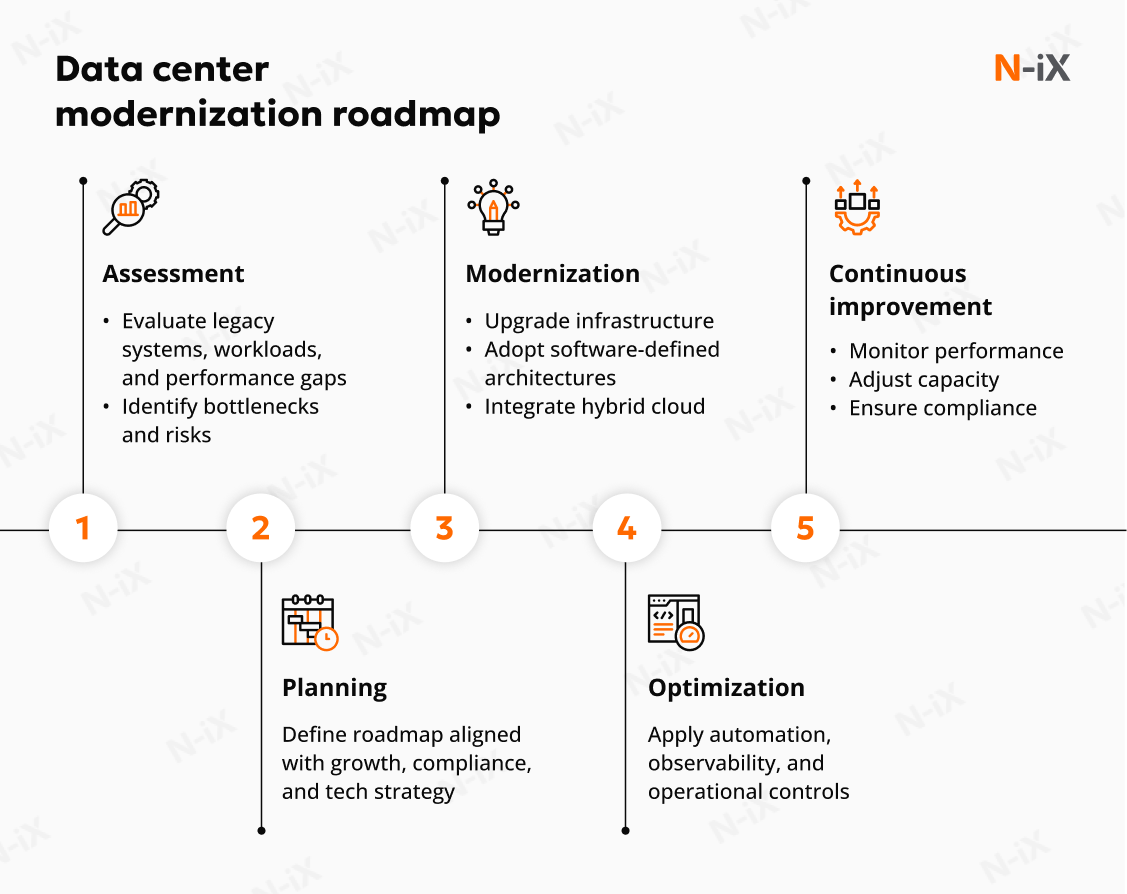
Data center modernization is a coordinated transformation across architecture, cloud strategy, automation, and security, all aligned with business objectives. With more than 23 of experience in software engineering and cloud transformation, N-iX supports enterprises in executing complex modernization programs across logistics, manufacturing, fintech, healthcare, and retail. In practice, this experience shapes how we approach modernization programs.
Architecture-led modernization
Modernization requires architectural redesign to align infrastructure, governance, and operating models with long-term growth plans. Infrastructure consolidation or cloud migration often serves as a starting point. However, without rethinking data flows, application dependencies, and compliance controls, migration alone does not deliver sustainable value.
In the healthcare domain, N-iX combined cloud transition with data platform restructuring on Google Cloud. Beyond relocating workloads, the engagement strengthened regulatory compliance, improved scalability, and enabled advanced analytics capabilities. The result was not just a migrated environment, but a more resilient, future-ready architecture.
Read the full case study: Streamlining operations in healthcare with data modernization and GCP migration
Hybrid enablement, automation, and security by design
As physical expansion timelines extend, hybrid strategies become critical. N-iX designs environments that balance on-premises systems with leading cloud platforms, enabling workload portability and cost optimization. As an AWS Premier Tier Services Partner, Microsoft Gold Certified Partner, and Google Cloud Platform Partner, we help enterprises build scalable hybrid ecosystems aligned with long-term strategy.
Modernization also requires automation-first operating models. By implementing Infrastructure-as-Code, CI/CD pipelines, container orchestration, and observability frameworks, N-iX reduces operational friction while improving governance and resilience.
Security and compliance are embedded throughout the modernization lifecycle. Applying DevSecOps practices, zero-trust principles, and automated monitoring controls, we help organizations reduce exposure while maintaining agility.
Final thoughts
In many enterprises, modernization starts as a hardware discussion and ends as an architectural one. It is a strategic initiative that shapes how efficiently an organization can scale, innovate, and manage risk in the years ahead.
Organizations that approach data center modernization as an architectural and operational transformation rather than a series of isolated upgrades are better positioned to navigate capacity constraints, regulatory pressure, and evolving digital demands. N-iX works with enterprises to define and execute data center modernization strategies that align infrastructure decisions with measurable business outcomes.
If you are evaluating your current environment or planning the next phase of modernization, our experts can help assess your infrastructure landscape and define a practical roadmap forward.

FAQ
What is data center modernization?
Data center modernization is the transformation of infrastructure, architecture, and operational models to support evolving business demands. It goes beyond hardware replacement and focuses on redesigning the structure, management, and integration of compute, storage, networking, and security components.
Modernization usually includes upgrading legacy systems, adopting software-defined architectures, enabling automation, and integrating hybrid or cloud environments. The goal is to improve scalability, resilience, efficiency, and security while aligning infrastructure with long-term business objectives.
Why is data center modernization important for organizations?
Modernization is essential because legacy infrastructure often limits scalability, increases operational risk, and drives rising maintenance costs. As workloads grow more complex, particularly with AI, analytics, and distributed applications, traditional environments struggle to meet performance, security, and compliance requirements.
By modernizing infrastructure, organizations improve reliability, reduce downtime, enhance cybersecurity posture, and enable faster innovation cycles. It ensures that core systems support business growth rather than constrain it.
What are the key goals of data center modernization?
The primary goal is to create a scalable and resilient infrastructure foundation that supports current and future workloads. Organizations aim to increase operational efficiency through automation, reduce energy consumption and operational costs, strengthen compliance and security controls, and enable seamless integration with hybrid and cloud environments.
Another critical objective is architectural flexibility. Modernized data centers allow dynamic workload allocation, improved observability, and faster provisioning of new services. This flexibility directly supports digital transformation and long-term competitiveness.
What challenges do organizations face when modernizing data centers?
Modernization initiatives often involve complex architectural dependencies and integration risks. Legacy systems may lack compatibility with modern platforms, creating technical and operational challenges during migration.
Organizations also face external constraints such as power capacity limitations, supply chain delays, cybersecurity risks, and evolving regulatory requirements. In addition, limited internal expertise and resource constraints can slow down transformation efforts.
Without a structured roadmap and phased execution strategy, modernization can lead to cost overruns or fragmented environments. That is why many enterprises engage experienced technology partners to assess infrastructure maturity, define modernization priorities, and implement secure, scalable solutions aligned with business goals.