
 ChatGPT
 Perplexity
 Claude
 Gemini
 Grok
Grok
Most enterprises already have more data than they can control, trust, or monetize. As AI and digital initiatives accelerate, the real constraint is no longer data itself, but the ability to access the right data, governed and at scale, when your business needs it.
Data as a Service (DaaS) responds to this challenge by providing on-demand, governed access to enterprise data through cloud-native services. It enables data and analytics initiatives to scale without being locked into underlying systems or infrastructure decisions, shifting the focus from platforms to execution.
To see where DaaS fits within a data and analytics strategy, it’s essential to understand what Data as a Service is and why it represents a shift from traditional data platforms.
What is Data as a Service (DaaS)?
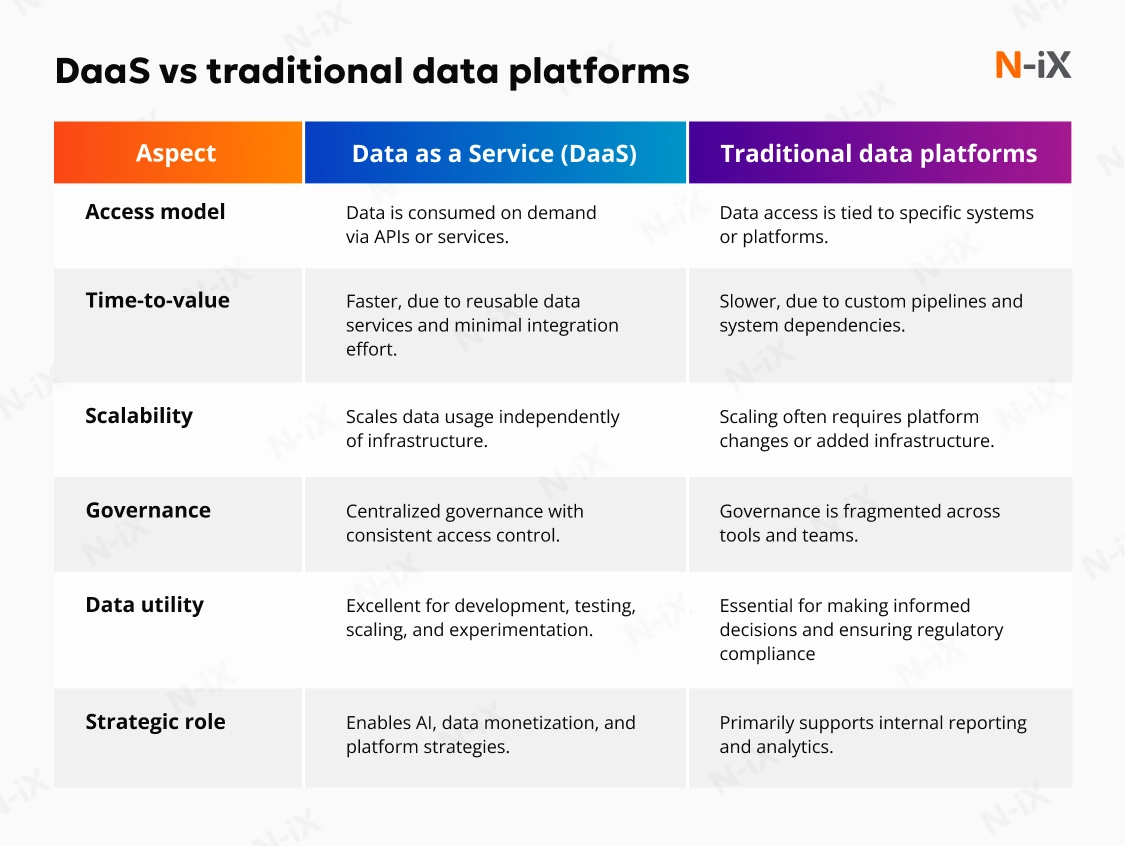
Data as a Service is a cloud-based model that delivers data on demand, without tying it to a specific system, location, or infrastructure. Instead of locking data inside individual platforms, DaaS decouples data from infrastructure and delivers it as a scalable cloud service via APIs and applications. DaaS platforms can also act as intermediaries for external or high-volume data that organizations cannot host themselves due to storage, compute, or compliance limits.
DaaS has become one of the fastest-growing data delivery models, driven by the need for scalable access to reliable, business-ready data. This approach enables organizations to:
- Access enterprise data on demand without owning or managing infrastructure
- Reduce the time and cost required to make data usable across teams and use cases
- Apply consistent governance and security as data scales across platforms and regions
- Support AI, analytics, and digital products from a shared, reusable data layer
- Expose data externally safely for partners, customers, or new revenue models
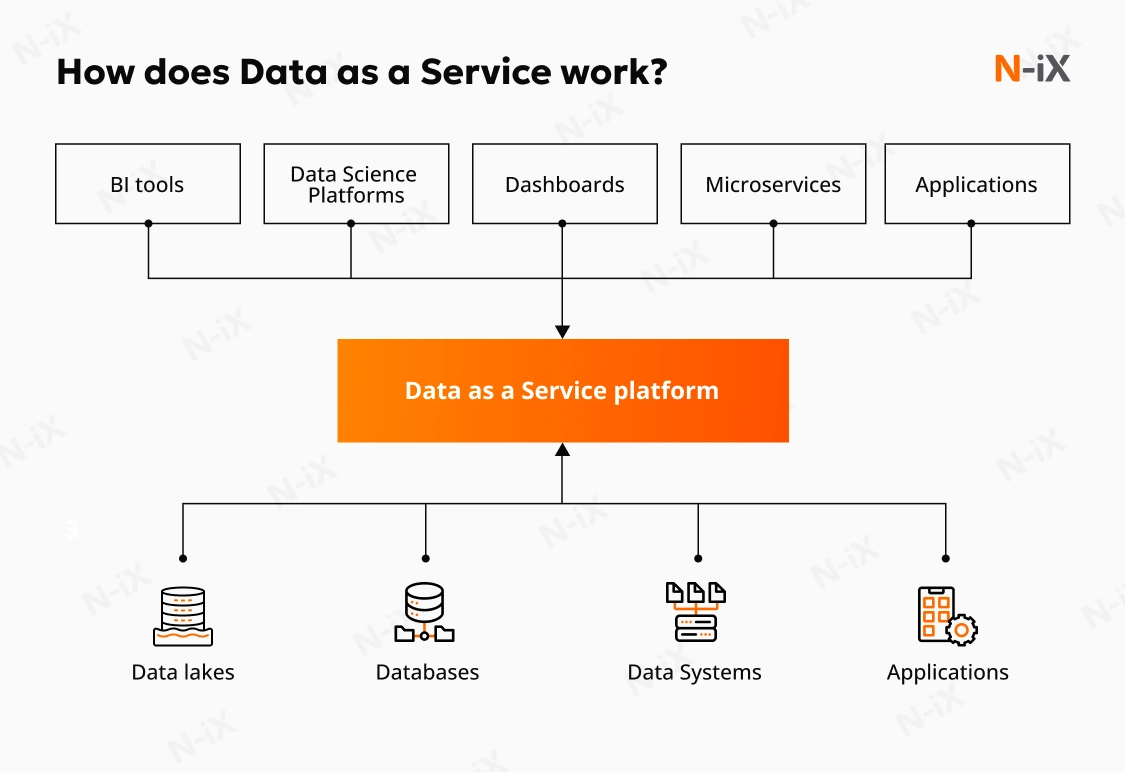
How DaaS works
- It collects data from multiple sources
A DaaS platform gathers data from across the organization and beyond. Sources may include cloud data lakes, operational databases, data warehouses, file systems, enterprise applications, and third-party providers.
- It extracts and virtualizes data
The platform extracts the data and routes it through a virtual data layer. This layer standardizes and transforms datasets or data streams, so they remain usable regardless of their original format or structure.
- It enforces security, privacy, and governance controls
Before delivery, the platform applies security and governance policies. This step enforces access rights, supports compliance requirements, and protects data integrity.
- It manages APIs and orchestrates data delivery
The platform exposes data through managed APIs. This includes tasks such as data representation, orchestration, registration, caching, and documentation. These capabilities make data easier to discover, integrate, and reuse across teams or with external partners.
- It delivers data to business users, applications, and partners
Finally, the DaaS platform delivers data to business users, customers, or third parties. Access typically happens through dashboards, applications, microservices, or web-based interfaces, depending on how the organization consumes data.
Why executives adopt DaaS
Executives embrace Data as a Service when traditional data complexity begins to slow growth or digital initiatives. For this reason, DaaS is rarely adopted as a standalone tool, it’s usually part of a broader data, AI, or platform strategy and requires both strategic alignment and efficient execution.
Analyst forecasts reflect this shift: the global Data as a Service market is projected to grow at over 20% CAGR over the next decade, driven by enterprise demand for scalable, governed data access that supports AI, analytics, and digital products.
DaaS as a foundation for AI and analytics
Judging from our experience, AI initiatives fail because data access, quality, and governance don’t scale. In most organizations, data remains fragmented across systems, teams, and regions. DaaS addresses this by standardizing data access, enforcing governance, and decoupling data from source systems. This reduces the effort needed to prepare data for machine learning, predictive analytics, and generative AI use cases.
For executives, the focus is not the tooling itself, but time-to-value. Architecture and operating model choices determine whether AI initiatives scale or stall.
Business impact: Faster AI rollout with lower data preparation cost.
DaaS and data monetization
Many organizations recognize the value of their data but lack a controlled way to share or commercialize it. DaaS enables data monetization by delivering curated datasets through governed APIs. This approach supports external use cases such as partner integrations, customer-facing products, or data-driven services, without duplicating data or weakening control. Adopting DaaS in this context means defining data products, access rules, pricing models, and compliance boundaries, not just deploying infrastructure.
Business impact: New revenue streams without duplicating data or increasing risk.
Platform modernization and M&A integration
DaaS plays a central role in cloud migration, system modernization, and post-merger integration. By decoupling data from applications, DaaS allows multiple teams, regions, or products to rely on a single data layer. This reduces redundancy, supports consistent reporting, and simplifies the rollout of new digital services.
For management teams, DaaS becomes a long-term capability, one that must be designed, implemented, and evolved alongside the organization’s technology landscape.
Business impact: Reduced platform complexity and faster delivery of digital products.
Types of data delivered through DaaS platforms
At an enterprise level, Data as a Service platforms operate across two interconnected layers: a data access layer and a data management layer. Together, they determine how data is consumed and how it stays reliable at scale.
Data access layer
The layer focuses on how business teams and systems consume data. It provides standardized, governed access to different categories of enterprise and external data, depending on business needs. This may include:
- Core enterprise data, such as organizational structures, locations, and operational entities
- Relationship data that reflects hierarchies across business units, regions, or subsidiaries
- Contextual and derived data that enriches analytics, reporting, or AI models
The goal of this layer is usability, not volume. Data must be easy to discover, access, and reuse across teams without duplicating pipelines or logic.
Learn more about Enterprise data integration: How to achieve scalability and efficiency
Data management layer
The data management layer ensures that data remains consistent, accurate, and fit for purpose as it moves across the organization. This layer usually supports:
- Data cleansing, normalization, and deduplication
- Enrichment from multiple internal or external sources
- Governance controls, access rules, and quality standards
- Integration mechanisms that keep downstream systems synchronized
For executives, this layer is critical. Without it, DaaS quickly degrades into another data siloonly this time at cloud scale.
In more mature implementations, organizations also extend DaaS with advanced data services. These may include large-scale data delivery for analytics platforms, custom enrichment workflows, or domain-specific models that support strategic use cases such as AI enablement or data monetization.
DaaS use cases: Where organizations apply it in practice
Executives usually adopt Data as a Service to solve recurring data problems that cut across functions and industries. The most common Data as a Service use cases fall into a few categories:
AI and advanced analytics enablement
Many organizations invest in AI but struggle to operationalize it because their data is fragmented and inconsistent. DaaS provides a unified, governed data layer that feeds machine learning, predictive analytics, and generative AI use cases. By standardizing access to internal and external data, teams reduce the time spent on data preparation and focus on model development and deployment.
Outcomes: Faster AI rollout, lower data engineering overhead, more reliable analytics.
Customer and market intelligence
Understanding customers, partners, and markets often requires combining internal data with external signals. With DaaS, organizations integrate transactional data with firmographic, behavioral, or third-party datasets to build richer customer profiles. This supports better segmentation, targeting, and personalization across sales, marketing, and product teams.
Outcomes: Improved targeting, higher conversion rates, better product-market alignment.
Platform modernization and post-merger integration
Data complexity often increases during cloud migration, system modernization, or mergers and acquisitions. DaaS decouples data from applications, allowing multiple systems, teams, or regions to rely on a shared data layer. This reduces redundancy, simplifies integration, and supports consistent reporting across the organization.
Outcomes: Lower platform complexity, faster integration, reduced long-term operating cost.
Operational and risk intelligence
Many operational decisions depend on timely access to both internal and external data. DaaS supports use cases such as risk modeling, fraud detection, supply chain visibility, and operational forecasting by continuously ingesting and standardizing real-time and historical data from multiple sources.
Outcomes: Better risk control, faster response to change, improved operational resilience.
Data as a Service challenges and how N-iX addresses them
Data security and privacy across distributed environments
DaaS requires data to move across cloud infrastructure, APIs, and networks. This expands the attack surface and raises concerns around data breaches, unauthorized access, and exposure of sensitive or regulated data.
How N-iX addresses it: N-iX designs DaaS architectures with security built in from day one, including encryption in transit and at rest, identity and access management (IAM), zero-trust principles, and secure API design. We also help organizations assess vendor security postures and implement controls that align with enterprise security policies and risk tolerance.
Compliance, data residency, and governance complexity
When data is delivered as a service, organizations may struggle to enforce regulatory requirements (GDPR, HIPAA, industry-specific rules), data residency constraints, and internal governance standards across external providers and cloud regions.
How N-iX addresses it: N-iX helps enterprises map regulatory and governance requirements directly to their DaaS architecture. This includes defining data residency rules, implementing policy-driven access controls, aligning external data feeds with internal governance models, and ensuring auditability across cloud and third-party data sources.
Insufficient data quality and lack of business context
DaaS accelerates access to data, but APIs and feeds often lack sufficient metadata, lineage, or standardized definitions. This can lead to inconsistent analytics, duplicated logic, and reduced trust in insights.
How N-iX addresses it: We design data management layers that enrich DaaS inputs with metadata, lineage, and business definitions. N-iX helps organizations establish data quality rules, validation pipelines, and semantic layers so DaaS outputs are analytics-ready and aligned with business context.
Hidden engineering effort for integration and transformation
Despite the promise of “ready-to-use” data, internal teams often still face significant work schema alignment, deduplication, transformation, and integration with internal platforms. This erodes time-to-value and increases operational risk.
How N-iX addresses it: N-iX reduces the DIY burden by designing scalable ingestion and transformation pipelines that integrate DaaS seamlessly into existing data platforms. We help standardize schemas, automate transformations, and align DaaS with internal data models, BI tools, and AI pipelines.
Schema drift and breaking changes in external data feeds
DaaS providers can update APIs, schemas, or data structures without notice. These changes can silently break dashboards, automation, or machine learning models downstream.
How N-iX addresses it: We implement monitoring, validation, and versioning strategies to detect schema drift early and protect downstream systems. N-iX also designs resilient architectures with decoupling layers, contracts, and automated testing to minimize disruption from external changes.
Turning DaaS into AI-ready, monetizable data
Many organizations adopt DaaS for speed but struggle to convert raw data access into AI-ready assets or revenue-generating capabilities. Without proper modeling and governance, DaaS remains an operational convenience rather than a strategic asset.
How N-iX addresses it: N-iX helps organizations structure DaaS as part of a broader data and AI platform strategy, enabling advanced analytics, machine learning, and data monetization. This includes preparing data for model training, feature engineering, and designing architectures that support internal and external data products.
Addressing these challenges requires more than deploying a DaaS platform. It demands architectural expertise, governance design, and integration experience, making a trusted technology partner critical to achieving sustainable business value.
Making Data as a Service a strategic advantage
Data as a Service delivers value only when it is treated as a business capability, not a standalone platform. Organizations that succeed with DaaS design it around clear economic outcomes: faster execution, lower operational cost, controlled risk, and the ability to scale data use without scaling complexity.
At this level, DaaS decisions are architectural and organizational as much as technical. They affect how data supports AI initiatives, digital products, partner ecosystems, and future platform evolution. Poorly designed implementations may increase data access but fail to deliver on trust, speed, or scale monetization.
This is where experienced execution matters. With over 23 years of experience, 200 data engineers, N-iX helps enterprises design and implement DaaS architectures that align data access with business priorities, integrate with existing platforms, and evolve as data volumes, regulations, and use cases grow. The result is not just faster data delivery, but a durable foundation for long-term data-driven advantage.
Have a question?
Speak to an expert