
 ChatGPT
 Perplexity
 Claude
 Gemini
 Grok
Grok
According to the 2025 Stack Overflow Developer Survey, over 32.4% developers globally work in remote environments, with the USA leading by country at 45% [1]. For businesses, distributed development teams can be a solution to talent shortages or budget constraints. However, without best practices for distributed engineering teams, these companies risk not obtaining the full advantage of having their engineers located worldwide. And the practices that actually work aren't about tools. They're about structure, communication discipline, and building a culture within a remote dedicated development team that doesn't depend on everyone being in the same room.
This guide to managing distributed development teams breaks down exactly that: from choosing the right team model to running async workflows, protecting your IP, and keeping distributed engineers engaged long-term. The tips for managing distributed engineering teams are drawn from our 23-year-long software engineering experience and developing custom software for global organizations and Fortune 500 clients across finance, manufacturing, logistics and supply chain, retail, telecom, automotive, healthcare, energy and utilities, and agritech. Let's start with what makes distributed engineering teams different from remote or hybrid ones.
Key takeaways:
- Structure determines delivery speed more than tooling or headcount;
- Undefined communication channels create invisible decision-making, and invisible decisions create debt;
- Engineers who are onboarded without structure take longer to contribute meaningfully;
- Output metrics expose delivery problems weeks before presence-based tracking ever would;
- Undocumented systems don't scale; they just move more slowly with every new hire;
- Culture built intentionally retains engineers, while culture left to chance loses them quietly;
- Unverified access and ungoverned AI tools are the two most common sources of IP exposure in distributed teams.
What is a distributed engineering team?
A distributed engineering team is a software development team where engineers work from different cities, countries, or continents. These teams rely on digital tools rather than physical proximity to collaborate and deliver solutions. The term is often conflated with two related models, such as remote and hybrid, even though the latter work differently.
|
Distributed vs remote vs hybrid engineering teams |
|||
|
Distributed |
Remote |
Hybrid |
|
|
Location |
Globally, no central office |
Remote-first, but often in the same region |
Mix of office and remote |
|
Office dependency |
None |
Low |
Medium to high |
|
Hiring area |
Global |
Regional or global |
Usually local |
|
Collaboration model |
Async-first |
Async-capable |
Sync-heavy |
|
Time zone span |
Often 3+ time zones |
1-2 time zones |
Usually 1 time zone |
The practical difference that matters most is that hybrid and remote teams can fall back on synchronous communication when things get complicated. Distributed teams can't, and that's what forces the discipline that makes them work.
Engineering work is usually well-suited to the distributed model. Code is written alone. Reviews happen asynchronously. The work itself usually doesn't require a shared physical space. However, to do their jobe well, distributed engineers need clear interfaces, good documentation, and reliable tooling. If you choose the right model, engineering from different locations stops being a constraint and becomes an advantage for the organization. Let's review how you can structure your team.
Distributed engineering team models
Before you establish distributed teams best practices or processes, you need the right structure. Most distributed engineering problems, such as slow delivery, unclear ownership, and miscommunication, are structure problems in disguise. Here are three models you should know about before setting up a team.
|
Functional |
Pod-based |
Regional hubs |
|
|
Best for |
Large organizations, stable products |
Product companies, fast iterations |
Enterprise scale, 24-hour development cycles |
|
Team size |
20+ engineers |
5–30 engineers |
50+ engineers |
|
Time zone span |
Low tolerance |
Medium tolerance |
High tolerance |
|
Main risk |
Handoff bottlenecks |
Coordination between pods |
Context loss across regions |
Functional (horizontal) model
Engineers are organized by discipline: a front-end team, a back-end team, a QA team, each with its own lead. Teams work in parallel on their slice of the stack and hand off to each other at defined interfaces.
This works well for larger organizations where each function has enough engineers to form a self-sufficient group, and where cross-team dependencies are predictable and well-documented. The risk is that handoffs may become bottlenecks, especially across time zones.
Pod-based (cross-functional) model
Small, autonomous squads with four to eight engineers that own a full feature, product area, or user journey end-to-end. Each pod includes the skills it needs to ship independently: front end, back end, sometimes QA, and design.
This is the default structure for product companies. It's also the one that scales best in a distributed context. Pods minimize cross-team coordination, which is the main source of friction in async environments. In this model, the ownership is clear, and the accountability is local.
Regional development hubs
Engineering capacity is organized around geography rather than function or product. A hub in Eastern Europe, another in Latin America, another in Southeast Asia, each operating as a semi-autonomous center that collaborates with HQ and each other.
This model suits companies at scale that want to leverage time zone distribution deliberately, especially if they use the follow-the-sun workflows where one hub picks up where another leaves off. It requires a strong documentation culture and explicit handoff protocols to avoid losing context between regions.
For example, if your organization has or wants to set up the follow-the-sun development model, N-iX can help you build distributed teams across the Americas, Europe, and APAC. This way, you may set up a 24/7 development cycle and get the advantages of continuous development, such as accelerated delivery timelines, 24-hour incident coverage, uninterrupted progress on parallel workstreams, and a reduction in the idle time.
Your go-to list of practices for a successful distributed team will depend on the team structure, company policies, and other factors. Here we've collected the best practices for distributed engineering teams from our experience in helping businesses build engineering teams across the globe.
Best practices for managing distributed engineering teams
Structure tells you how your team is organized. These best practices for distributed engineering teams determine whether it actually works.
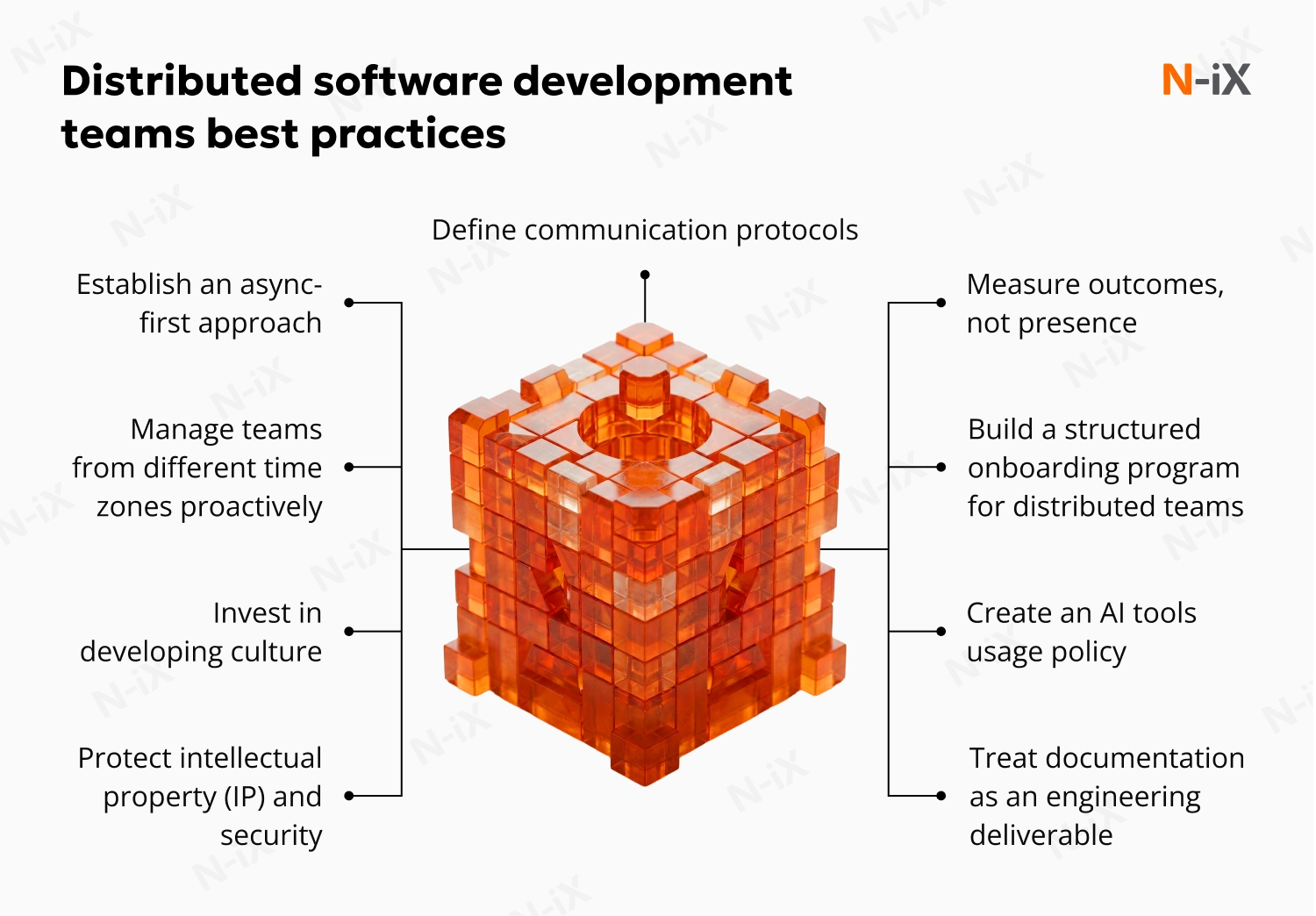
1. Establish an async-first approach
Async-first doesn't mean no meetings. It means meetings are either planned ahead or are the last resort, not the default response to uncertainty. This approach is based on the “if it can be written, write it; if it can be recorded, record it” principle. In practice, this means defining a clear decision framework for your team and following the best practices for distributed teams:
- Use a written update for progress reports, end-of-sprint summaries, and non-urgent blockers;
- Record videos for walkthroughs, demos, and anything visual;
- Schedule meetings for complex decisions, conflict resolution, or onboarding conversations that need human interaction;
- Establish a minimum 2-4 hour window per day where all involved engineers are online simultaneously so they can communicate with each other;
- Use end-of-day updates for teams spanning more than three time zones. Before logging off, every engineer documents what they completed, what’s blocking them, and what the next person taking over the work needs to know.
2. Define communication protocols
One of the best practices for managing remote teams is defining the communication channels and their purpose. Often, important decisions are made in Slack DMs, never make it into the tracker, and are completely invisible to engineers joining six months later. Spell out exactly what belongs where and set this standard during onboarding. The 3-channel rule gives every piece of communication a designated home:
- Instant messaging chat (Slack, Teams, etc.) for everything that doesn't need to be findable in three months: real-time conversation, quick questions, social interaction, etc.;
- Project tracker (Jira, Linear, Asana, etc.) for task-level discussion, decisions tied to specific work, or status updates that need to be auditable;
- Documentation (Confluence, Notion, etc.) for decisions, architecture, processes, onboarding, templates, best practices, and everything that should be picked up by every new engineer.
Communication and alignment meetings are very simple. The availability is excellent, and it's easy to work remotely on a daily basis with the team.
3. Build a structured onboarding program for distributed teams
Onboarding a distributed engineer is harder than onboarding someone in an office. There's no one to tap on the shoulder, no ambient context absorbed from sitting near the team, no informal lunch where half the unwritten rules get explained. If your onboarding program is a Confluence page and a calendar invite, you're setting engineers up to underperform for months. Try one of the best practices for distributed engineering teams—establishing a practical framework to achieve better results:
- Week 1: Environment setup, access provisioning, tool walkthrough, meet-the-team calls;
- Week 2: Codebase orientation, architecture overview, first small completable task;
- Weeks 3-4: First meaningful contributions, like a real feature development or fix with a pull request (PR) review cycle.
You can also assign every new hire an onboarding peer who can answer the questions in the same or similar time zone.
Discover the top tips on how to choose the best custom software development company
4. Manage teams from different time zones proactively
Identify the window when all engineering teams are simultaneously online, and use it for standups, design discussions, and decisions that require more than one person. If the time difference between the teams is more than three time zones, make sure you either set up the meetings at convenient times for both teams or rotate meeting times to distribute the inconvenience fairly and avoid resentment building.
If you have a time-sensitive project, you may use the follow-the-sun model, in which work passes between regional hubs over a 24-hour cycle. Note that it requires airtight handoff documentation and clearly separated workstreams. Without these distributed teams best practices, you get continuous confusion instead of continuous development.
For me, the most important is the ability of communication across time zones and across distance, the attitude of the team, the energy level within the teams, and the motivation level to identify issues and find solutions. And I do see those characteristics in the N-iX teams.
5. Measure outcomes, not presence
Nothing erodes trust in a distributed team faster than presence-based management. Checking whether engineers are online, tracking message response times, or running daily status standups that exist solely to confirm people are working signal distrust and drive good engineers out. One of the best practices for managing remote teams is to measure what the work produces instead:
- Deployment frequency: How often is working software shipped?
- Lead time for changes: How long does production take from ticket creation to artifact?
- PR review turnaround: Are reviews happening within agreed SLAs?
- Change failure rate: How much rework is coming back from QA or production?
- Mean time to recovery (MTTR): How long does it take to restore service after a production failure?
These metrics tell you whether your distributed system is properly functioning.
6. Treat documentation as an engineering deliverable
Documentation is the connective tissue of a distributed engineering team. Without it, knowledge lives in people's heads, context disappears when someone leaves, and onboarding becomes an archaeology project.
The standard to aim for: any engineer who joins your team should be able to understand the system, the decisions behind it, and how to contribute from your documentation. That requires a few top practices for successful distributed team:
- Architecture decision records (ADRs): Short documents capturing why a technical decision was made, not just what was decided;
- Runbooks: Step-by-step guides for operational tasks, deployments, and incident response;
- API contracts: Clear interface documentation between services or between teams;
- Continuously updated onboarding guides.
Documentation debt compounds faster in distributed teams than anywhere else. Schedule it into sprints, treat it as a deliverable, and review it in retrospectives.
7. Invest in developing culture
In an office, culture emerges from proximity: shared lunches, hallway conversations, the ambient social life of a shared space. Distributed teams don't have that—their culture has to be designed online.
The risk of ignoring this step materializes in a high attrition rate. As the State of Devs 2025 survey showed, over 30% of respondents mentioned "Culture” as a workplace difficulty they currently face [2]. Here are a few low-effort, high-impact rituals that work:
- A dedicated Slack channel for team wins;
- Optional monthly social calls with no agenda and no work talk;
- Recorded demo days where engineers share what they've built, async-first with a live Q&A option.
In-person gatherings are worth the budget. Try setting up one or two per year for the relationship investment that makes remote collaboration work better for the other 50 weeks. The ROI shows up in retention, velocity, and the willingness to have hard conversations over Slack instead of letting problems fester.
Why did we select N-iX over others? Great culture fit, good value for cost, company values aligned.
8. Protect intellectual property (IP) and security
IP protection matters most to anyone having distributed software development teams or working with outsourced or nearshore engineering partners. Here are a few best practices for distributed teams for strengthening security:
- Every employee, contractor, or outsourced team member should sign an NDA, an IP assignment agreement, and a work-for-hire clause before writing code. These aren't bureaucratic formalities. They're the difference between owning your codebase and spending two years in litigation.
- Apply the principle of least privilege for access control. Every engineer gets access to what they need to do their job, nothing more. Enforce VPN policies, manage devices where possible, and audit access quarterly.
- Establish a straightforward offboarding process with a formal offboarding checklist. Revoking access to repositories, cloud environments, internal tools, communication platforms should happen on the engineer's last day.
If you're working with an outsourcing partner, verifying their security certifications should be in your guide to managing distributed development teams. The compliance with ISO 27001 and SOC 2 is a baseline signal that security is treated as a practice, not an afterthought.
9. Create an AI tools usage policy
Distributed engineering teams may adopt AI tools fast. If that happens without visibility from leadership, it may become a structural risk. IBM's 2025 Cost of a Data Breach Report found that one in five organizations experienced incidents linked to shadow AI, unsanctioned tools adopted by employees without IT oversight. Those incidents added an average of $670,000 to breach costs and exposed customer PII and intellectual property [3]. For distributed teams where engineers operate across geographies and devices, shadow AI adoption is harder to detect and spreads faster.
Adopting an AI usage policy ensures the tools your engineers are already using don’t become a liability. Here are a few best practices for distributed engineering teams:
- Define approved tools explicitly. Maintain a short, up-to-date list of approved AI tools (code assistants, documentation generators, review bots) and include it in onboarding. If it’s not on the list, engineers should ask before using it.
- Clarify which data can be entered into AI tools. Specify which data types, proprietary source code, customer data, internal architecture docs, must never be submitted to external AI models. This is especially critical for teams working in regulated industries.
- Establish a lightweight approval process for new tools. Engineers will find new AI tools faster than any policy can anticipate. A simple, fast-track review process (security team sign-off within 48 hours) is more effective than a blanket ban that gets ignored.
- Audit access controls for AI-integrated systems. IBM's report found that 97% of organizations that experienced AI-related breaches lacked proper access controls [3]. Review which systems your AI tools can access and apply the same principle of least privilege you use for human engineers.
Learn how to build an AI development team
N-iX helps you put the best practices for distributed engineering teams into action
N-iX has been applying best practices for managing distributed engineering teams for global clients since 2002. As of 2026, we have over 2,400 tech specialists across delivery centers in Europe, the Americas, and APAC. With established development hubs in Poland, Colombia, Ukraine, Romania, Bulgaria, and India, and hiring capabilities across 25 countries, we give clients the geographic flexibility to staff teams across time zones without disrupting processes or sacrificing delivery quality.
What makes distributed engineering actually work at N-iX:
- Flexible engagement models: Staff Augmentation, Managed Team, or Custom Solution Development, structured around your delivery needs and stage of growth;
- Deep tech expertise: Engineering expertise across cloud computing, AI/ML development, data engineering, DevOps, embedded systems, IoT development, cybersecurity, intelligent platform automation, immersive tech, and more;
- Strategic partnerships with AWS, Microsoft, and Google Cloud, giving your team access to certified expertise and accelerated delivery;
- Development and delivery security: Compliance with ISO 9001:2015, ISO 27001, and other certifications, DevSecOps practices, and rigorous IP protection built into every engagement from day one;
- Established async and cross-timezone workflows, including the communication protocols, onboarding frameworks, and documentation standards.
N-iX also has industry recognition for the exceptional outsourcing practices. We'd been ranked among the world's top outsourcing providers on the IAOP Global Outsourcing 100 for eight consecutive years, three of them in the Leaders category.
Whether you need to extend an existing engineering team, build a dedicated development team from scratch, or transition from a fragmented vendor model to a single reliable partner, N-iX has the structure, the talent, and the track record to make it work.
Final thoughts
The best practices for distributed engineering teams aren't complicated but they do require consistency. The companies that get this right choose the right team structure, build communication and async habits before problems force them to, and work with partners who bring the processes, the talent, and the operational experience to make distribution a competitive advantage rather than a management headache.
If you’re building or scaling a distributed engineering team, N-iX is the ideal tech partner to help you. We’ve helped companies from even the most regulated industries, such as healthcare, manufacturing, and finance, establish distributed development teams globally. And we can help you to do the same.
Sources:
- 2025 Stack Overflow Developer Survey | Stack Overflow
- State of Devs 2025: Workplace| State of Devs
- Cost of a Data Breach Report 2025 | IBM
FAQ
What is a distributed engineering team?
A group of software engineers working from different cities, countries, or continents with no shared office, collaborating entirely through digital tools and structured async processes.
What is the difference between a distributed and a remote engineering team?
Remote teams have a central office that some members work away from, usually within the same time zone. Distributed teams have no central office, and the entire operating model is built around geographic separation.
What are the biggest challenges of managing distributed engineering teams?
Communication gaps, knowledge silos, onboarding friction, and engineer isolation are the most common. Most are solvable with the best practices for distributed engineering teams, like setting the right standards, expectations, and communication tools.
What team structure works best for a distributed engineering team?
Pod-based structures work best for most product companies. Functional structures suit larger orgs with clearly separated disciplines. Regional hubs work for enterprises that deliberately leverage time zone distribution.
What are the distributed software development teams best practices for effective communication?
Distributed teams use different communication tools for specific purposes to maintain the structure and document processes. Assign a clear purpose to each channel (e.g., instant messaging for real-time conversation, a project tracker for decision-making, and documentation for anything that needs to outlive the conversation) and set those rules during onboarding.
How do you manage time zones in a distributed engineering team?
Protect core overlap hours for real-time decisions, rotate meeting times fairly, and require end-of-day handoff updates for teams spanning more than three time zones. The follow-the-sun model enables near-continuous development but demands airtight documentation to work.
How do you protect IP when working with a distributed engineering team?
NDAs, IP assignment agreements, and work-for-hire clauses before any code is written. Principle of least privilege for all system access. A formal offboarding checklist for access revocation. ISO 27001 or SOC 2 certification as a baseline when vetting an outsourcing partner.
How do you onboard a remote software engineer effectively?
A structured week-by-week framework: access and tools in Week 1, codebase orientation in Week 2, first real contribution by Week 3-4. An onboarding buddy in the same time zone makes the difference between an engineer who ramps quickly and one who disengages quietly.
What are the best practices for distributed engineering teams to measure productivity?
Track outcomes such as deployment frequency, cycle time, PR review turnaround, and defect escape rate. These reflect whether your distributed system is functioning.