
 ChatGPT
 Perplexity
 Claude
 Gemini
 Grok
Grok
80%. That's the portion of IT budgets legacy systems consume on maintenance rather than innovation. Not eight—eighty. Application modernization redirects those resources toward growth. The following application modernization trends are helping organizations stop maintaining the past and start building competitive advantages.
So what's working? What are the organizations that aren't burning 80% of their IT budgets doing differently? Let's break it down.
Enterprise application modernization trends you need to know about in 2026
Cloud-native development
Cloud-native architecture has become the default approach for application modernization, and there's a reason 95% of new digital workloads are now built this way. It works. Cloud-native moves beyond simple "lift and shift" migrations to rebuilding applications specifically for cloud environments using containers, microservices, and serverless computing. This design enables automatic scaling, faster deployment cycles, and better resource utilization. Organizations adopting this approach report 50% increases in application development speed and 40% reductions in infrastructure costs. These results explain why cloud-native has become central to application modernization & migration trends.
The architecture separates application components into independently deployable services, allowing teams to update specific features without affecting the entire system. For legacy applications, cloud-native modernization typically involves containerizing monolithic code, implementing orchestration through Kubernetes, and gradually refactoring components into microservices as needed.

Rise of AI and automation in modernization
AI and machine learning represent major application modernization trends, accelerating modernization efforts in two ways: automating the modernization process itself and adding intelligent capabilities to modernized applications. In a Coursera and AWS survey , 95% of technology leaders are investing in cloud transformation, and 91% are prioritizing generative AI. These figures underscore how closely AI and cloud ecosystems are now intertwined in modernization programs. AI-powered tools can analyze legacy codebases, identify dependencies, suggest refactoring strategies, and automate repetitive coding tasks. This reduces the time developers spend on technical debt from 42% of their work week to more productive activities.
For the applications themselves, modernization creates opportunities to add predictive analytics, intelligent automation, and personalization features that legacy systems cannot support. Organizations are using AI to optimize cloud resource allocation, automate testing and deployment, and improve application performance monitoring. Statista’s analysis projects that the global AI market could reach about $1.68T by 2031, reflecting rapidly increasing investment in these capabilities.
Hybrid cloud technologies
Hybrid cloud adoption reaches 73% of organizations as companies balance cloud benefits with operational requirements and regulatory constraints. This approach combines public cloud services with private cloud or on-premises infrastructure, allowing organizations to modernize applications gradually without complete migration. Financial services and healthcare sectors particularly favor hybrid models due to data residency regulations and compliance requirements. The strategy lets companies move non-sensitive workloads to the public cloud for scalability while keeping regulated data on-premises.
Hybrid implementations use unified management platforms to coordinate resources across environments, ensuring consistent security policies and simplified operations. Organizations report that this flexibility reduces modernization risk by allowing phased transitions rather than all-or-nothing migrations. This aligns with broader application modernization and migration trends toward incremental transformation. The approach also supports disaster recovery, letting companies replicate critical systems across multiple environments.
Low-code/no-code development
Low-code and no-code platforms are among the key application modernization trends, and they're solving a real problem. With 70% of new applications expected to utilize these technologies in 2026, organizations are finally addressing the skills gap that's been slowing modernization for years. These platforms let business users and citizen developers create applications through visual interfaces rather than traditional coding, addressing the skills gap that slows modernization efforts. For legacy system updates, low-code tools enable rapid development of APIs that connect old and new systems, automate business processes, and create modern user interfaces for outdated applications. This approach speeds development cycles and reduces bottlenecks caused by limited developer availability.
Organizations use these platforms to build integration layers between legacy applications and modern cloud services, to automate workflows across multiple systems, and to develop mobile-friendly interfaces for legacy backends. The technology works best for standardized business processes and straightforward integrations, while complex custom logic still requires traditional development.
API-first and microservices architecture
API-first development has become standard practice in modernization projects, delivering integrations 3.9x faster and enabling changes 5.6x faster than traditional approaches. This approach designs APIs before building application features, creating standardized interfaces that let different systems communicate reliably. Breaking monolithic legacy applications into microservices allows independent scaling, faster updates, and technology stack flexibility.
Each microservice handles a specific business function and communicates through well-defined APIs, reducing dependencies that make legacy systems rigid. These patterns represent core legacy application modernization trends that enable incremental transformation. Organizations can modernize incrementally by extracting individual functions from monolithic applications and rebuilding them as microservices while the legacy system continues operating. This reduces risk compared to complete rewrites and delivers value faster through gradual improvements.
Edge computing and real-time data processing
Edge computing is reshaping modernization strategies for applications that require real-time processing or operate in distributed environments. This architecture processes data closer to where it's generated rather than sending everything to centralized cloud servers, reducing latency and bandwidth costs. Manufacturing, retail, and IoT applications benefit most from edge deployments that enable immediate responses to sensor data, real-time inventory tracking, and local processing during network disruptions.
Modernization efforts increasingly incorporate edge nodes that work with cloud backends, creating hybrid architectures that balance local processing speed with cloud-based analytics and storage. The approach requires rethinking application design to handle distributed data, intermittent connectivity, and synchronization across edge and cloud environments.
Cybersecurity and compliance focus
Security and compliance have moved from afterthoughts to core application modernization trends, with 77% of organizations citing security as a major concern. Legacy systems pose significant security risks through outdated encryption, unsupported software with known vulnerabilities, and limited integration with modern security tools.
Modernization provides opportunities to implement zero-trust architecture, automated security monitoring, and compliance controls that legacy systems cannot support. Organizations are embedding security throughout development cycles rather than adding it late, using DevSecOps practices to automate security testing and vulnerability scanning. Cloud migration enables faster deployment of security patches and access to advanced threat detection services. Regulatory requirements around data privacy, industry-specific compliance standards, and cross-border data transfer rules increasingly drive modernization decisions as legacy systems struggle to meet evolving mandates.
Read more: Application modernization strategy: Executive’s handbook
Technologies enabling application modernization
Let's talk about what actually enables these application modernization trends. Application modernization doesn't happen through wishful thinking; it requires specific technologies that provide the infrastructure, automation, and capabilities needed for transformation. Here's what's working:
DevOps and Agile practices
DevOps methodologies provide the operational framework for successful modernization by automating deployment pipelines and enabling continuous delivery. CI/CD tools like Jenkins, GitHub Actions, and Azure DevOps automate testing, integration, and deployment processes that traditionally required manual intervention and coordination.
Organizations implementing DevOps report 37% faster time to market and 43% productivity gains in application development. Agile practices complement this technical automation through iterative development cycles, allowing teams to modernize applications incrementally rather than through risky big-bang migrations. Cross-functional teams combining developers, operations staff, and security experts collaborate throughout the modernization lifecycle, catching issues early and maintaining system stability during transitions.
Serverless computing
Serverless platforms like AWS Lambda, Azure Functions, and Google Cloud Functions eliminate the need for infrastructure management in modernization projects. These services automatically provision compute resources, scale based on demand, and charge only for actual execution time.
For legacy modernization, serverless functions handle specific modernized components: API endpoints, event processing, or integration logic, while core legacy systems continue operating. This approach reduces operational overhead and enables organizations to focus resources on application logic rather than infrastructure maintenance. Serverless architecture is best suited for event-driven workloads, microservice APIs, and variable-demand applications, where traditional always-on servers incur unnecessary costs.
Kubernetes and containerization
Kubernetes orchestrates containerized applications across hybrid and multi-cloud environments, with around 80% of organizations running it in production and over 90% using, piloting, or evaluating it. Containerization packages applications with dependencies into portable units that run consistently across development, testing, and production environments. For modernization, containers provide an initial step that improves portability without immediate code changes. Organizations can containerize legacy monoliths, gain deployment flexibility, and then gradually refactor components into microservices.
Kubernetes automates scaling, load balancing, and failure recovery across these containerized workloads. The technology solves environment inconsistency problems and enables workload portability across different cloud providers, reducing vendor lock-in concerns during modernization.
Data lakes and data warehouses
Cloud-native data platforms enable organizations to consolidate data from legacy systems into modern architectures that support analytics and AI. Data lakes store structured and unstructured data at scale. Cloud data warehouses like Snowflake, Amazon Redshift, and Google BigQuery provide high-performance analytics on modernized data. These platforms separate data storage from legacy applications, creating centralized repositories that multiple modernized services can access.
Organizations migrating data from proprietary legacy formats to modern platforms gain new capabilities for real-time analytics, machine learning, and business intelligence. Legacy databases cannot support these advanced functions. Managed cloud data platforms eliminate much of the database infrastructure maintenance while improving query performance. These platforms unify previously siloed legacy data, enabling more advanced analytics and personalization capabilities.
Read more: Application modernization challenges & how to overcome them
Wrap-up
Application modernization isn't optional in 2026—it's survival. Legacy systems aren't just expensive; they're business liabilities that prevent innovation, create security vulnerabilities, and widen the competitive gap while your competitors build cloud-native capabilities.
The application modernization trends we've covered: cloud-native development, AI automation, hybrid strategies, API-first architecture, edge computing, and security-first approaches, represent what's actually working. Organizations implementing these approaches are achieving substantial cost reductions, faster deployment cycles, and the agility to respond to market changes. These aren't projections. They're results.
But here's what matters most: choosing the right technology partner. Understanding trends doesn't transform legacy systems—execution does. Most modernization projects fail not from choosing the wrong approach, but from partnering with teams that lack the experience to navigate complexity, plan properly, and deliver results.
The difference between staying stuck in maintenance mode and building competitive advantages comes down to working with a partner who knows how to execute modernization without joining the majority that fail. The technology exists. The approaches work. What separates successful projects from failed ones is having expertise that turns strategy into functioning systems.
Your legacy systems won't fix themselves, and the competitive gap only widens with time. Choose a partner who's done this before.

How N-iX can help with application modernization
N-iX provides application modernization services for enterprises updating legacy systems to cloud-native architectures. With over 2,400 professionals, including 400 cloud experts, we work with organizations in financial services, healthcare, manufacturing, and technology sectors.
Our process starts with an assessment of application portfolios and the documentation of technical debt, security issues, and dependencies. We evaluate modernization options: rehosting, re-platforming, refactoring, or rebuilding, based on business requirements and technical constraints. This assessment prioritizes applications by business impact and complexity.
We execute modernization projects through phased implementations that minimize disruption to ongoing operations. Our teams handle cloud migration, architecture updates, automation setup, and security requirements. We work on both new development and incremental updates to systems that must remain operational during transformation.
N-iX engineers work alongside internal IT teams throughout planning, implementation, and transition phases. With 23 years of experience serving over 160 active clients across 25 countries, we provide specialized cloud expertise while transferring knowledge to internal staff.
FAQ
What is application modernization?
Application modernization is the process of updating legacy software systems to work with current technology standards. This can involve moving applications to the cloud, updating code, changing system architecture, or replacing outdated components. The goal is to improve performance, reduce costs, and add capabilities that old systems cannot support.
What are the current application modernization trends?
Key application modernization trends include cloud-native development, containerization with Kubernetes, microservices architecture, serverless computing, and AI-powered automation. Organizations are also prioritizing API-first designs, low-code platforms for faster development, and event-driven architectures for real-time processing.
Why do businesses need application modernization?
Legacy systems consume 60-80% of IT budgets on maintenance rather than innovation. They create security vulnerabilities, cannot scale efficiently, and lack integration with modern tools. Current application modernization trends reflect these challenges, with organizations prioritizing cloud migration, AI integration, and API-first architectures. Organizations need modernization to reduce costs, improve agility, meet customer expectations, and stay competitive. Systems built 10-20 years ago were not designed for today's requirements, such as mobile access, real-time data, or cloud integration.
What are the most effective strategies for application modernization?
The most common strategies are rehosting (moving applications to the cloud without code changes), re-platforming (making minimal changes to run in the cloud), refactoring (restructuring code into modern architecture), and rebuilding (creating new applications from scratch). Effective modernization typically uses phased approaches rather than complete system replacements. Organizations see best results when they start with high-impact, lower-risk applications to build experience before tackling complex core systems.
How do we measure the success of application modernization?
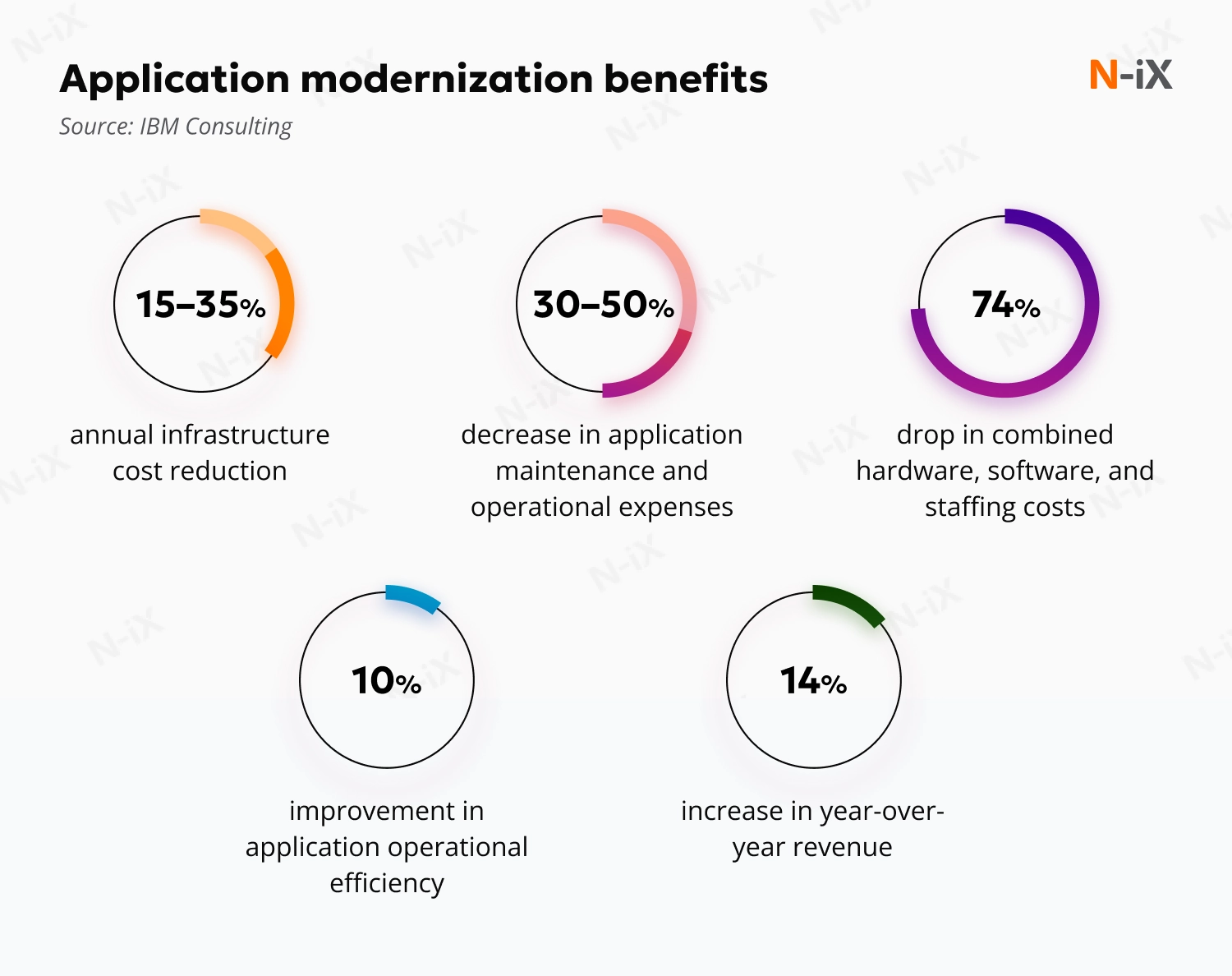
Success metrics include infrastructure cost reduction (typically 15-35% annually), reduced maintenance expenses (30-50% lower), improved deployment speed, reduced downtime, and faster time-to-market for new features. Organizations also track improvements in application performance, reductions in security vulnerabilities, and gains in developer productivity. Business metrics, such as customer satisfaction scores and revenue growth tied to new capabilities, provide additional success indicators.
How risky is the application modernization process?
Risk depends on approach and planning. Complete system rewrites carry a high risk of extended downtime and project failure. Phased modernization reduces risk by updating applications incrementally while maintaining business operations. Main risks include data loss during migration, compatibility issues between old and new systems, unexpected downtime, and cost overruns. Organizations mitigate these risks through thorough assessments, pilot projects, rollback procedures, and the maintenance of parallel systems during transitions. Working with experienced teams further reduces risk through proven methodologies and tools.
Sources:
- CNCF, 2025. State of Cloud native development.
- BayOne, 2026. Business Case for Legacy Application Modernization.
- AWS, 2025. Coursera and AWS survey reveals how technology leaders navigate cloud and AI transformation.
- CodeScene, n/a. Business costs of technical debt.
- Statista, 2025. Artificial Intelligence - Worldwide | Market Forecast.
- Statista, 2026. Worldwide enterprise cloud strategy 2021-2024.
- European Journal of Computer Science and Information Technology, 13(13), 47-64, 2025. iPaaS: Revolutionizing Enterprise Integration in Distributed Commerce.
- Flexera, 2025. State of the Cloud Report.
Have a question?
Speak to an expert