
 ChatGPT
 Perplexity
 Claude
 Gemini
 Grok
Grok
In 2026, digital products are no longer isolated applications. They operate as interconnected systems, integrate with multiple platforms, and evolve continuously as business requirements change. In this environment, traditional development approaches often struggle to keep pace with growing complexity and integration demands.
API-first development addresses this challenge by shifting the focus from implementation to strategic interface design. Rather than treating APIs as an afterthought, organizations position them as core components of their digital ecosystem. This approach to software engineering enables business leaders to align technology with strategic goals, reduce integration complexity, and build scalable systems that can evolve with market demands from day one.
Now, how can API-first transform your digital strategy, streamline integration, and scale your systems? This guide explores what the API-first approach is, its key benefits, challenges, and practical steps for transitioning to API-first.
What is API-first development?
API-first development is an approach in which application programming interfaces (APIs) are designed, documented, and validated before any implementation begins. APIs serve as formal contracts that define how systems, services, and applications communicate with each other.
Imagine APIs as blueprints for a building that define how all rooms and systems connect before construction begins. With an API-first approach, teams agree on these blueprints upfront, so different systems can be built in parallel without breaking integration.
Unlike traditional development models, where APIs emerge during or after coding, API-first treats interfaces as primary architectural artifacts. This enables teams to design system interactions deliberately, ensure consistency across services, and align technical architecture with product and business requirements. From a business perspective, API-first creates a structured foundation for digital products, making them easier to scale, integrate, and adapt to new use cases.
Structured API lifecycle: A must-have foundation for adopting an API-first approach
An API-first strategy does not start with tools or code. It begins with a clear lifecycle that defines how APIs are conceived, designed, delivered, and evolved across the organization. On its own, such a lifecycle reflects good API engineering practice. When applied deliberately before and during product development, it becomes the operational basis for an API-first approach.
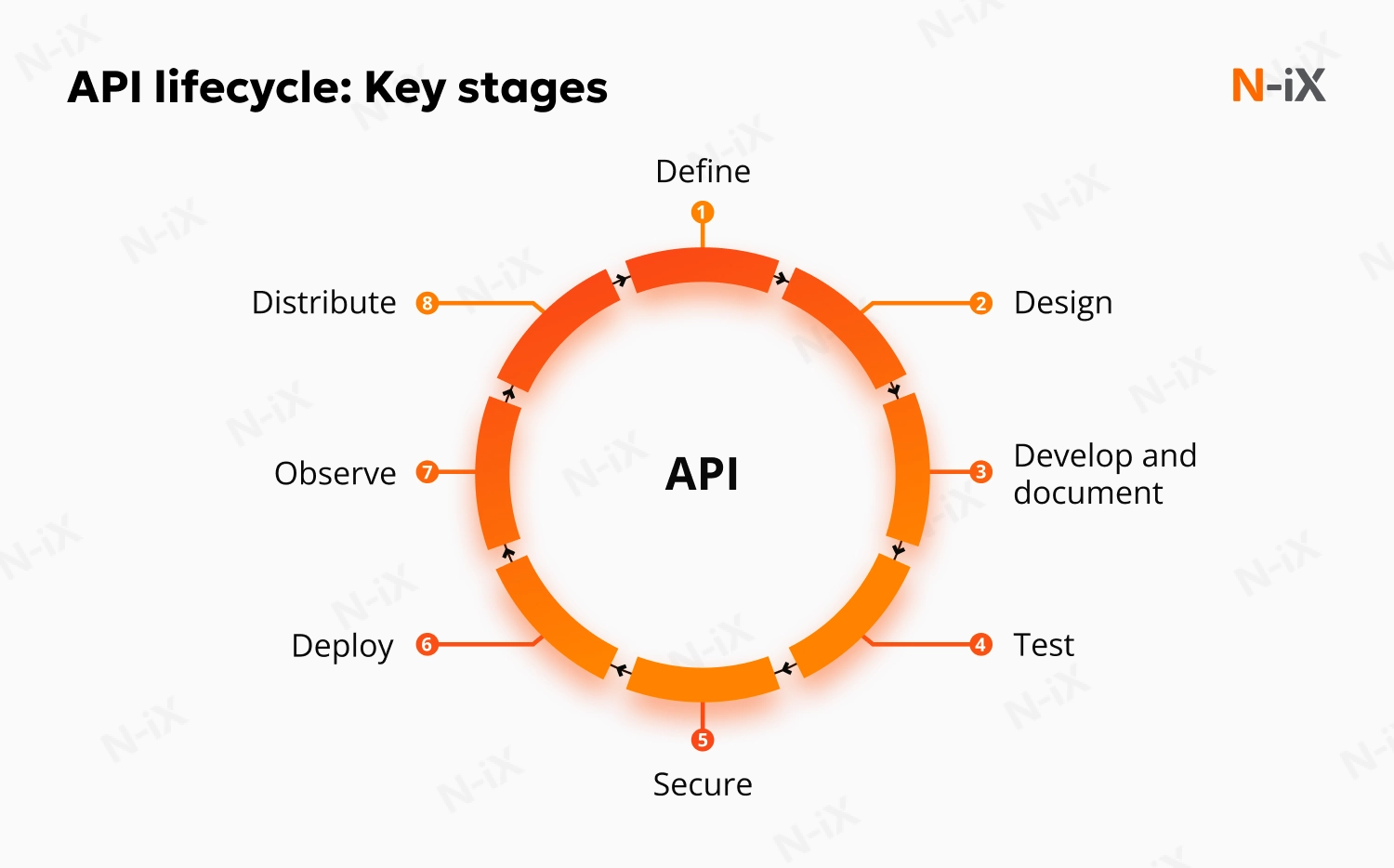
In this sense, the API lifecycle provides the discipline and sequence that allow organizations to treat APIs as primary architectural elements rather than secondary integration layers. A structured API lifecycle typically includes the following stages:
- Define. Organizations clarify business capabilities and user scenarios, while system boundaries are defined to shape API requirements.
- Design. Architects design API contracts that define endpoints and data models, ensuring consistent interaction across systems.
- Develop and document. Engineering teams build APIs, while documentation is created in parallel to support alignment across stakeholders.
- Test. APIs are tested for functionality and performance to identify potential integration issues early.
- Secure. Security controls are embedded into APIs, while access rules and data protection mechanisms are defined.
- Deploy. APIs are released into production environments, where versioning and controlled rollout processes are applied.
- Observe. Teams monitor API usage and performance, while insights are used to improve reliability and scalability.
- Distribute. APIs are published for internal and external use, enabling faster integration across products and partners.
Why is API-first development becoming popular?
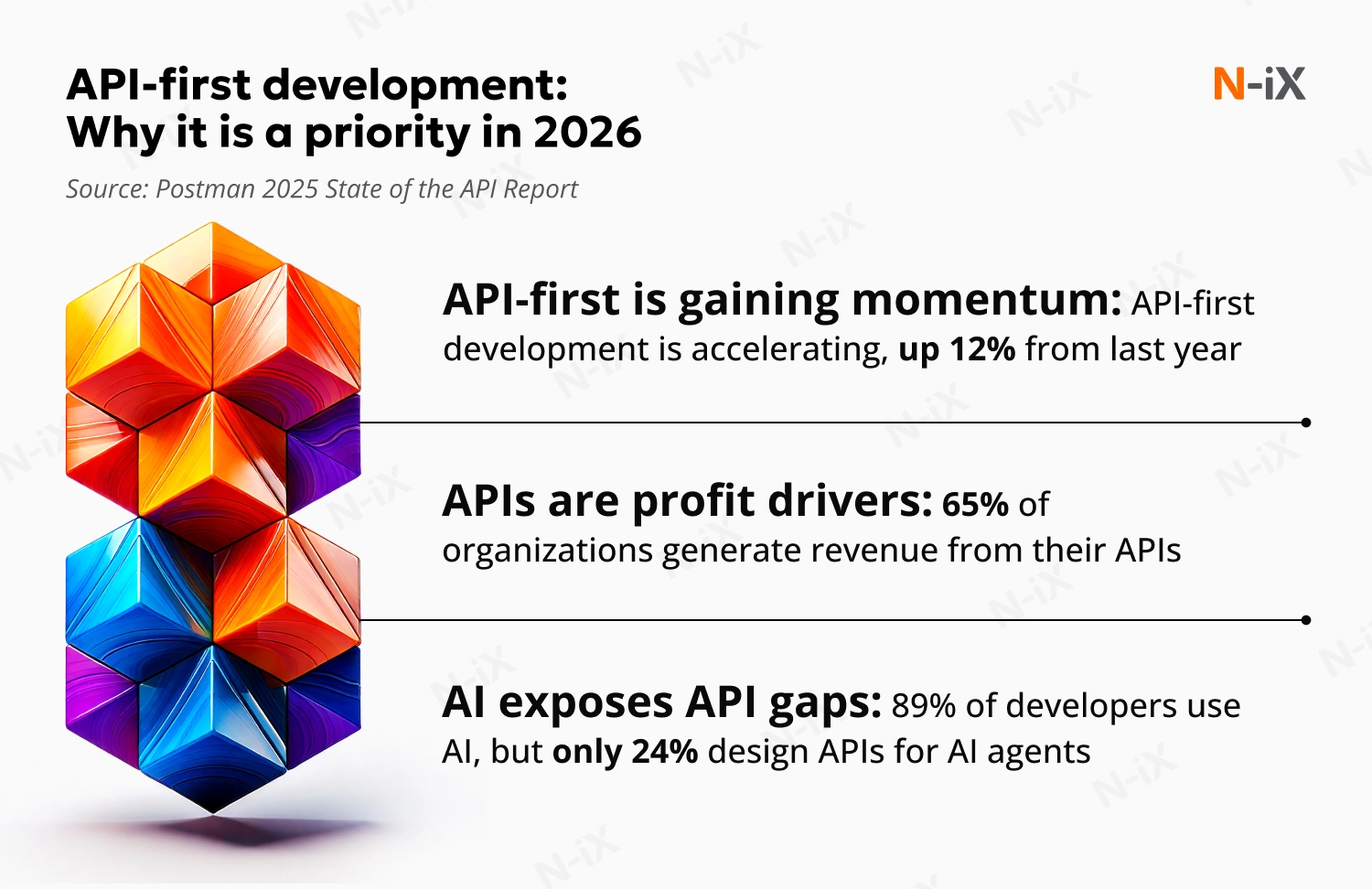
According to the Postman State of the API Report, 82% of organizations have already adopted an API-first approach to some extent. 25% of the surveyed businesses now operate as fully API-first organizations, marking a 12% increase since 2024. This shift reflects not a short-term technology trend but a structural change in how digital systems are designed and scaled. Why is API-first becoming a foundational approach rather than an optional architectural choice?
The growing adoption of microservices, cloud-native architectures, and distributed systems has made API integration a central challenge for modern organizations. At the same time, companies are expanding digital channels, partnering with external platforms, and implementing AI-driven capabilities that rely on seamless data exchange.
The API-first approach responds to these trends by providing a predictable and reusable integration layer across systems. It enables organizations to move beyond monolithic architectures and build flexible digital ecosystems that support continuous innovation and AI adoption.
Key benefits of API-first development for businesses
If you still doubt whether the API-first approach is worth prioritizing, it is worth looking beyond architectural theory and focusing on its tangible impact on delivery speed, system stability, and organizational scalability. In practice, API-first reshapes how teams collaborate, how systems evolve, and how digital products are built and governed across the enterprise. Let’s explore these and other advantages in detail:
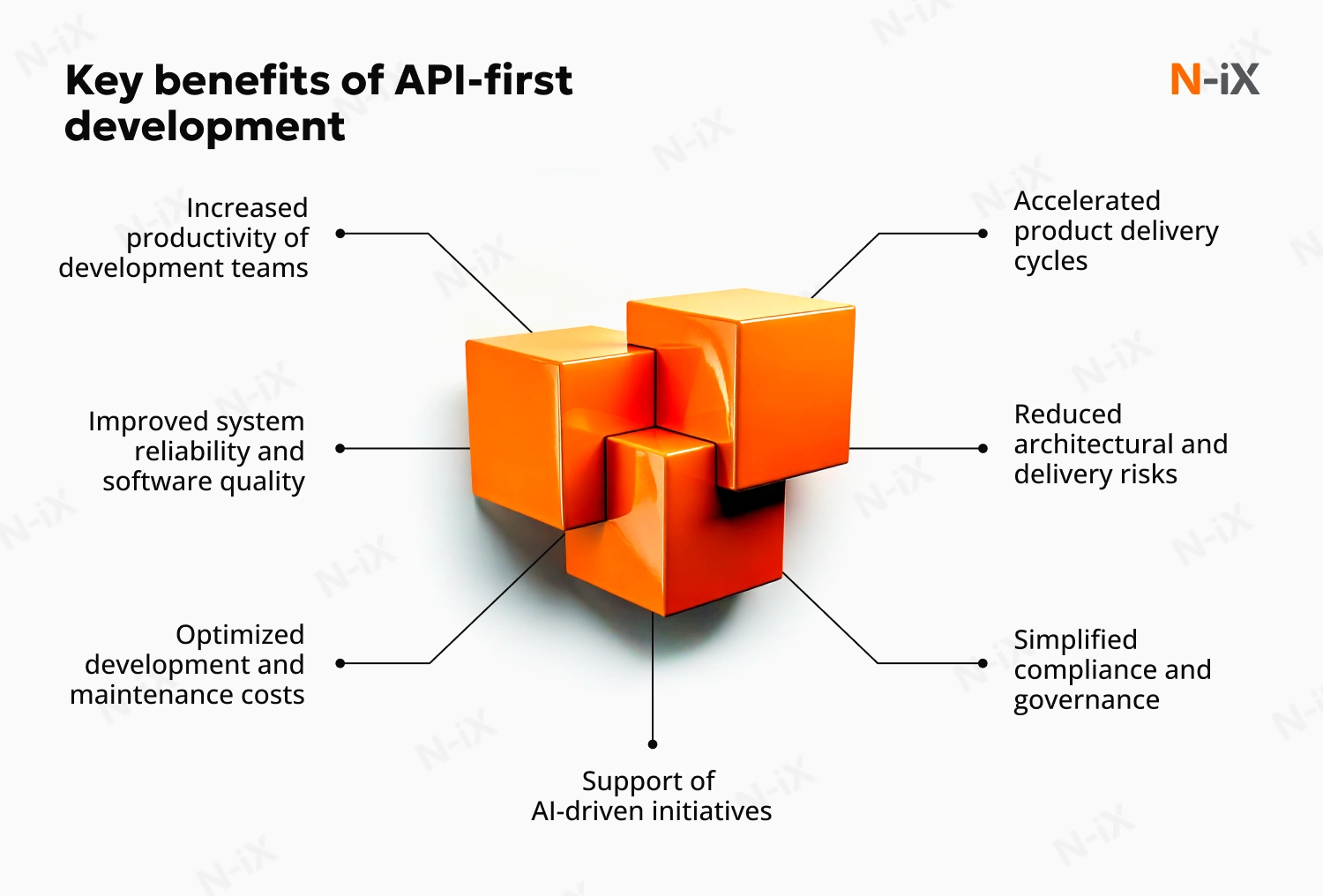
Increased productivity of development teams
This approach enables teams to start work based on clearly defined API contracts rather than waiting for dependent components to be implemented. Front-end, back-end, and integration teams can move forward in parallel, reducing idle time and coordination friction. For organizations with distributed teams and complex architectures, this translates into more predictable timelines and higher overall engineering throughput.
Improved system reliability and software quality
When APIs are designed and validated upfront, system interactions become explicit and consistent across services. This reduces ambiguity in implementation, simplifies testing, and minimizes integration errors. As a result, organizations get more stable systems and higher quality standards across their digital products.
Optimized development and maintenance costs
Reusable APIs reduce duplicated logic across applications, channels, and integrations. Over time, this decreases the cost of developing new features, onboarding additional teams, and maintaining complex system landscapes. API-first development also helps organizations avoid costly rework caused by poorly defined interfaces.
Accelerated product delivery cycles
With stable API contracts in place, teams can introduce new features and integrations without reengineering core systems. This shortens release cycles and allows organizations to respond faster to evolving business requirements and market conditions.
Support of AI-driven initiatives
Well-defined APIs simplify access to data and services required for analytics, automation, and AI-based solutions. By structuring systems around consistent interfaces, organizations create a scalable foundation for integrating AI capabilities into existing products and future digital initiatives.

Reduced architectural and delivery risks
Early API design exposes dependencies, technical constraints, and integration challenges before large-scale development begins. This allows organizations to address potential issues at the architectural level, reducing the likelihood of late-stage redesigns and delivery disruptions.
Simplified compliance and governance
Standardized APIs provide a structured way to enforce security policies, data governance rules, and compliance requirements. This is particularly important for organizations operating in regulated industries, where transparency and control over data flows are critical.
How to shift to API-first development: Step-by-step roadmap
Implementing an API-first methodology requires coordinated changes in architecture, workflows, and governance. The objective is not only to design better APIs but to make APIs the backbone of product development and system integration. Many organizations attempt to adopt API-first practices incrementally, but without a structured approach, these efforts often remain fragmented and inconsistent. Here’s how to do it right:
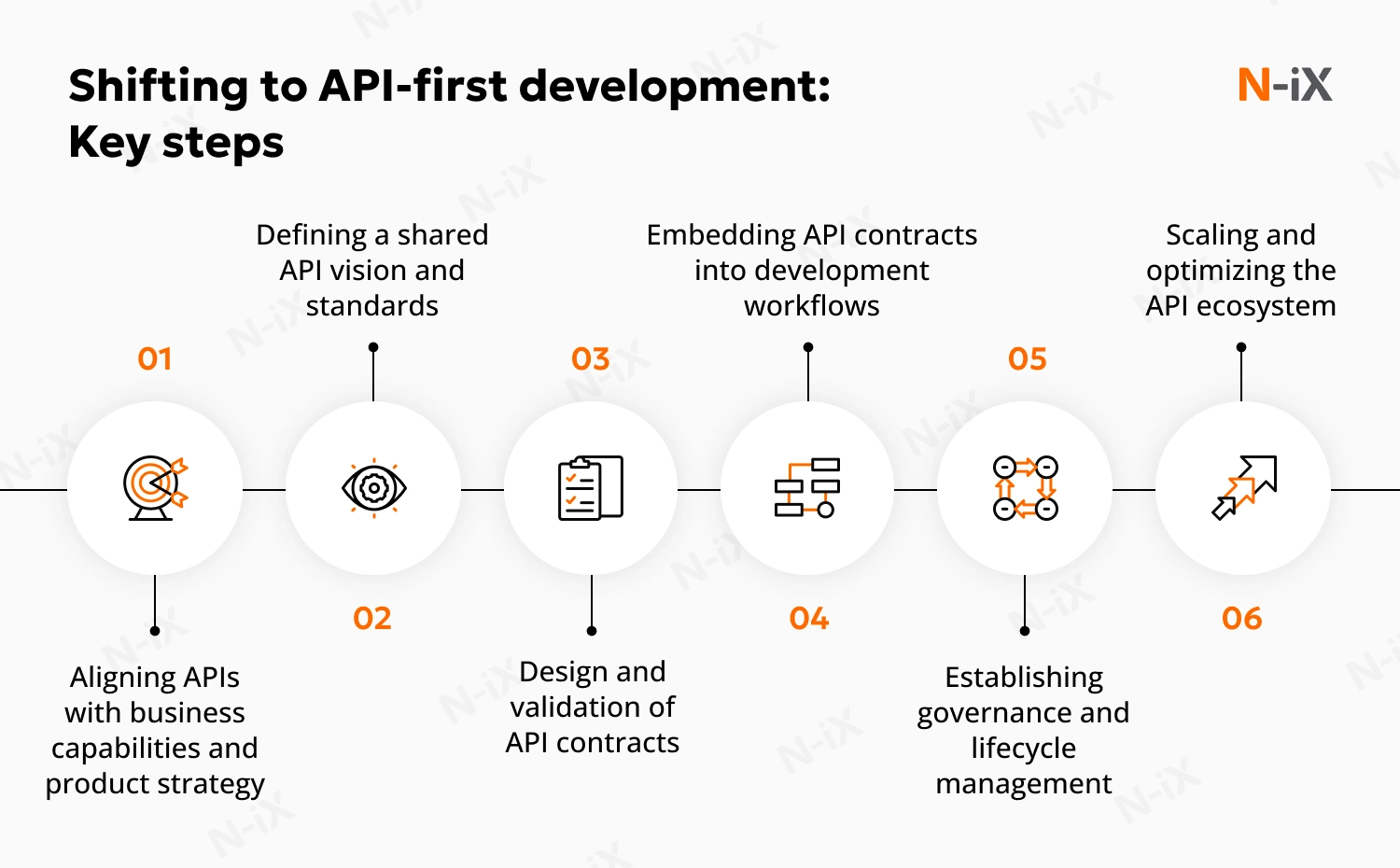
1. Aligning APIs with business capabilities and product strategy
Start by identifying core business domains, critical user journeys, and integration scenarios across internal and external systems. APIs should represent business capabilities rather than isolated technical functions. This alignment ensures that your development approach directly supports product strategy and long-term scalability.
2. Defining a shared API vision and standards
The next step is to establish organization-wide principles for API structure, naming, versioning, security, and documentation. You don’t want teams to define APIs in isolation, using inconsistent conventions that complicate integration and governance. Therefore, you need standards that will create a common framework for teams and prevent fragmentation as the API ecosystem expands. At this stage, APIs become architectural assets rather than project-specific artifacts.
3. Design and validation of API contracts
With standards in place, the focus shifts to formalizing API contracts. This presupposes creating specifications and validating contracts with engineering teams, architects, and product stakeholders to ensure technical feasibility and business relevance. At this point, approved contracts become the single source of truth for development and integration.
4. Embedding API contracts into development workflows
To ensure that API design translates into consistent implementation, API specifications should be integrated into CI/CD pipelines, testing frameworks, and collaboration workflows. Contract testing, mock services, and automated validation help maintain alignment between defined APIs and system behavior throughout the development lifecycle.
5. Establishing governance and lifecycle management
Once API contracts are defined and embedded into development workflows, it is time to introduce governance mechanisms to manage API quality, security, versioning, and backward compatibility. At this stage, organizations define processes for reviewing, evolving, and deprecating APIs. This approach ensures that APIs remain stable and scalable as products and integrations grow.
6. Scaling and optimizing the API ecosystem
As API-first practices mature, the focus shifts from implementation to continuous improvement and expansion. Here’s when your tech partner will refine APIs based on usage patterns, evolving business priorities, and architectural changes, while increasing the reuse of API components across products and teams. Over time, this approach transforms APIs into a cohesive ecosystem that supports sustainable innovation, faster product evolution, and controlled system growth.
API-first vs other approaches: Key differences
How to be sure that API-first is the right choice for your organization? Let’s compare it with other common approaches to highlight its advantages and determine if it aligns with your organization’s goals.
API-first development vs code-first development
In a code-first approach, APIs are derived from existing application logic. Interfaces evolve organically as features are implemented, which often results in tightly coupled services, inconsistent contracts, and limited reusability. Integration issues typically surface late in the development cycle, when changes are already costly and difficult to implement.
API-first reverses this logic. Interfaces are defined as formal contracts before implementation begins, shaping how systems communicate from the outset. This leads to clearer separation of concerns, more predictable integration, and greater architectural consistency across services. For organizations, the difference is not only technical but strategic: API-first creates a scalable integration layer, while code-first often reinforces siloed system design.
From a business perspective, API-first reduces uncertainty in system evolution, whereas code-first tends to accumulate hidden technical debt as products scale.
API-first development vs API-first design
API-first design focuses on defining APIs before implementation. Teams design interface contracts, data models, and interaction patterns upfront to ensure technical clarity and consistency. However, in many organizations, API-first design remains a localized engineering practice rather than a company-wide approach.
An API-first approach goes further by embedding API-first principles into the entire product lifecycle. It influences architecture decisions, team workflows, governance models, security policies, and system evolution strategies. In this sense, API-first is not limited to designing interfaces—it shapes how digital products are built, scaled, and managed across the organization.
Whether you need to shift from code-first to API-first or scale your existing API-first design across teams, N-iX can help you make the transition smoothly. Our experts integrate API-first principles at enterprise scale, ensuring consistency, scalability, and alignment with long-term business objectives.

Transitioning to API-first development: Common challenges and tips
While the shift to API-first brings significant benefits, the transition itself can be complex and requires careful planning. Adopting API-first principles often disrupts established workflows and requires aligning multiple teams around shared contracts. Here are the most common challenges, and, most importantly, expert tips to mitigate them.
Shifting development workflows from implementation-driven to contract-driven
In traditional development, teams start with implementation and adjust APIs along the way. Transitioning to API-first requires rethinking workflows so that APIs become the primary artifact guiding implementation, testing, and integration. This shift often disrupts established delivery habits and toolchains.
N-iX’s tip: Integrate API contracts directly into development pipelines using contract testing, CI/CD automation, and shared tooling. This helps teams treat APIs as executable specifications rather than static documentation.
Aligning multiple teams around shared API contracts
An API-first approach assumes that multiple teams build services, interfaces, and integrations based on shared API definitions. In practice, teams may interpret contracts differently or diverge from agreed specifications, leading to inconsistencies between design and implementation. According to the Postman State of the API Report, 93% of API teams face collaboration blockers like inconsistent documentation and definitions.
N-iX’s tip: Establish cross-team ownership of APIs and introduce validation mechanisms such as schema validation and automated compatibility checks. This ensures that APIs remain a single source of truth throughout development.
Integrating an API-first approach with legacy and hybrid architectures
The API-first approach often emerges in environments where microservices, monoliths, and legacy systems coexist. Ensuring consistent API behavior across heterogeneous architectures is technically complex and operationally challenging.
N-iX’s tip: Introducing abstraction layers such as API gateways and service meshes to standardize communication patterns is an optimal solution. This allows organizations to apply API-first principles even in hybrid and transitional architectures.
Related: Legacy software modernization: When, why, and how to part with legacy systems
How API‑first development becomes a strategic move with N‑iX
With API‑first development, APIs become reusable, governed, and aligned with core business capabilities, not just technical interfaces. N‑iX helps organizations embed this discipline into architecture, governance, and delivery practices so that APIs accelerate product evolution rather than add complexity. Through rigorous API design, contract validation, and automation, we help reduce technical debt and unlock predictable integration patterns across systems. The result is a flexible, scalable digital ecosystem that supports rapid innovation and long‑term business strategy.
FAQ
What types of businesses benefit most from API-first development?
This approach is particularly relevant for organizations building complex digital products, operating multiple integration channels, or scaling distributed systems across cloud and on-premises environments.
Is API-first suitable for legacy systems?
Yes. Many organizations adopt API-first principles gradually by exposing legacy functionality through modern APIs and modernizing architectures incrementally.
How long does it take to transition to an API-first approach?
The timeline depends on system complexity, organizational maturity, and integration requirements. In most cases, companies start with critical domains and expand API-first practices progressively.
Have a question?
Speak to an expert