ChatGPT
 Perplexity
 Claude
 Gemini
 Grok
Grok
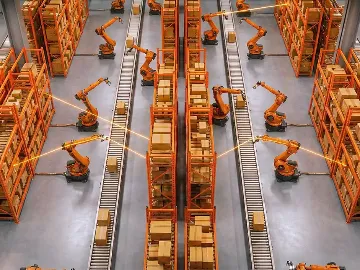
The integration of AI in robotics marks a fundamental shift from deterministic (pre-programmed) to probabilistic (adaptive) machines. By integrating Machine Learning and Computer Vision, modern robots can perceive, analyze, and respond to unstructured environments in real time, significantly reducing operational downtime and manual reprogramming costs.
However, successfully implementing AI in robotics requires specialized expertise in both robotics and AI. Businesses must ensure seamless AI integration, real-time processing, and scalable automation, which can be challenging without the proper technical foundation. This is why companies turn to robotics consulting and AI consulting services to develop high-performance AI-driven robotic solutions.
Key differences between traditional robotics and AI in robotics
Traditional robots excel at high-speed, repetitive tasks in controlled environments. However, they follow rigid instructions and lack the ability to learn. Unlike conventional systems, AI-powered robots use real-time data to optimize workflows and adapt to new conditions without human intervention.
Core comparison: Automation vs. autonomy
|
Feature |
Traditional robotics |
AI-driven robotics |
|
Logic |
If-then (deterministic) |
Learning-based (probabilistic) |
|
Environment |
Structured/Static |
Unstructured/Dynamic |
|
Adaptability |
Requires manual reprogramming |
Self-correcting via feedback loops |
|
Data source |
Internal encoders |
External sensors (LiDAR, Vision, Radar) |
What are the most efficient use cases of AI-powered robotics? How to implement AI in robotics and avoid making costly mistakes? Let’s find out.
Artificial intelligence in robotics: core technologies and components
Core technologies in Artificial Intelligence in robotics include Machine Learning, Deep Learning, Computer Vision, NLP, SLAM, sensor fusion, and Reinforcement Learning. Each plays a distinct role in how modern robots perceive, decide, and act.
Machine Learning
Machine Learning enables robots to improve with experience. Rather than following explicit rules, ML models generalize from data. They detect patterns across thousands of sensor readings, identify when something is about to fail, and learn the optimal picking motion for an unfamiliar object shape.
In practice, this powers predictive maintenance, adaptive assembly, and dynamic path planning. The robot does not need to be reprogrammed every time conditions change. The model updates from new data.
Deep Learning
Deep Learning is a subset of ML that enables robots to extract meaning from raw, unstructured inputs without requiring engineers to hand-engineer every feature. Those inputs include images, video streams, and sensor arrays. A Deep Learning model trained on hundreds of thousands of product images can identify a surface defect that no rule-based system would catch consistently.
This is what makes modern computer vision practical at scale in AI in robotics. The model performs pattern recognition that would otherwise require explicit programming for each product variant, lighting condition, and defect type.
Computer Vision
Computer Vision is how robots see. Cameras and depth sensors feed image data into computer vision models that identify objects, track movement, measure distances, and interpret spatial relationships, all in real time.
Advances in 3D mapping and depth perception have pushed this well beyond simple object recognition. Robots operating in surgery can distinguish tissue types. Harvesting robots can assess fruit ripeness. Autonomous mobile robots in warehouses can navigate around a person who just walked into their path.
Natural language processing (NLP)
NLP allows robots to understand and respond to spoken or written instructions from humans. This fundamentally changes human-robot interaction: operators can give verbal commands, adjust tasks via conversational interfaces, and receive spoken status updates without touching a screen.
In healthcare, robots that understand clinical language can take verbal instructions from surgeons. In warehouses, workers can redirect autonomous mobile robots with voice commands. The integration of large language models into robotic control systems is still in its early stages, but it's moving fast, and it's already commercial.
SLAM (Simultaneous Localization and Mapping)
SLAM is the technology that lets a robot build a map of an unknown environment while tracking its own position within it. Without SLAM, autonomous navigation requires a pre-built map. With SLAM, robots used in AI in robotics applications can operate in environments they've never seen before.
It works by fusing data from cameras, LiDAR, radar, and inertial sensors into a continuously updated spatial model. Delivery robots use it to navigate office buildings. Inspection drones use it to survey power infrastructure. Agricultural robots use it to move through fields that change shape as crops grow.
Sensor fusion
No single sensor type gives a robot everything it needs. Cameras lose accuracy in low light. LiDAR is excellent at measuring distance but weak at capturing texture. GPS degrades indoors and in dense urban environments.
Sensor fusion combines data from multiple sources simultaneously, compensating for each sensor's weaknesses with another's strengths. An autonomous vehicle fuses LiDAR, radar, and camera inputs to detect a cyclist in heavy rain. A surgical robot fuses force sensors and visual feeds to guide a needle with precision that exceeds what the human hand can achieve.
N-iX specializes in sensor fusion architecture, developing real-time data pipelines that turn noisy, multi-source sensor streams into reliable situational awareness for robotic systems.
Reinforcement Learning
Reinforcement Learning trains robots through trial and feedback rather than labeled datasets. The robot attempts a task, receives a reward signal based on its performance, and updates its behavior accordingly. Over thousands of iterations (run in simulation, then transferred to the physical robot), complex physical skills emerge.
Boston Dynamics used Reinforcement Learning to develop the parkour capabilities in Atlas. OpenAI used it to train robotic hands that can solve a Rubik's Cube. In industrial settings, RL is increasingly used to develop grasping strategies for irregular or fragile objects that would be impractical to hand-program.
What types of AI-powered robots exist?
The AI approach varies significantly depending on which type of robot you're working with. Here's a quick breakdown of the main categories:
Autonomous Mobile Robots (AMRs) navigate dynamically using onboard sensors and AI, unlike older AGVs (Automated Guided Vehicles) that follow fixed paths. Kiva robots in Amazon fulfillment centers are the most widely deployed example.
Collaborative robots (cobots) work alongside humans rather than in caged enclosures. They use AI to detect human proximity and adjust force, speed, and path accordingly. Universal Robots and Fanuc are the main commercial vendors.
Articulated robots are the multi-joint arms used in manufacturing. When paired with computer vision and ML, they can adapt to variations in part placement, surface conditions, and assembly sequences. Tasks like these would require hours of reprogramming in traditional systems.
Humanoid robots are bipedal, dexterous machines designed to operate in environments built for humans: factories, hospitals, and homes. Tesla's Optimus, Boston Dynamics' Atlas, and Agility Robotics' Digit are in various stages of commercial deployment. This is the fastest-moving category in AI robotics right now.
Autonomous vehicles and drones are AI-driven robots operating in transportation, logistics, agriculture, and inspection. Self-driving vehicles, last-mile delivery robots, and agricultural UAVs all sit in this category.

15 use cases of AI in robotics, by industry
Manufacturing
1. Autonomous production lines
AI-driven robots on modern production lines self-adjust to material variation, changing product specifications, and environmental conditions. Machine Learning models monitor assembly outcomes in real time and update process parameters without operator intervention.
Tesla's Gigafactories use AI-powered robots that adapt to the dimensional tolerances of individual battery cells. In traditional automated lines, that would require constant manual adjustment. Siemens and ABB Robotics have deployed similar adaptive assembly systems across automotive, electronics, and consumer goods production.
2. AI-driven predictive maintenance
Rather than replacing parts on a fixed schedule or waiting for failure, AI maintenance systems continuously analyze sensor data. They track vibration signatures, temperature trends, and acoustic patterns to predict when a component is approaching failure. Maintenance is then scheduled before the breakdown occurs.
The business case is concrete. Unplanned downtime costs US manufacturers an estimated $50 billion annually. Predictive systems typically reduce that by 30 to 50 percent in documented deployments. N-iX builds AI monitoring pipelines for industrial robotics that integrate directly with existing SCADA and MES infrastructure.
3. AI-powered quality control
Computer vision systems now inspect products at speeds and resolutions that human inspectors cannot match. Deep learning models trained on defect libraries identify surface cracks, dimensional deviations, solder bridges, and foreign material at rates exceeding a thousand parts per minute.
Unlike rule-based vision systems, deep learning models generalize from training data. They hold up when lighting conditions shift or new product variants are introduced.
4. Cobots as intelligent assistants
Collaborative robots handle ergonomically demanding or precision-critical assembly tasks while humans manage judgment-intensive tasks. In AI in robotics deployments, they detect human proximity, adapt their motion in real time, and respond to verbal instructions.
The next phase is LLM-powered cobots that interpret natural language directives and orchestrate multi-step workflows. Several manufacturers are piloting systems in which operators describe a task verbally and the cobot executes it.
Read more: Robotics in manufacturing: technology requirements and use cases
Supply chain and logistics
5. Intelligent warehouse automation
AI-powered picking robots handle order fulfillment at speeds and error rates that manual picking cannot match. The AI component covers real-time route optimization, dynamic task prioritization based on order urgency, and grasp planning for irregular objects.
Ocado's customer fulfillment centers process over 65,000 orders per week using a grid of AI-coordinated robots. The system continuously rebalances robot assignments as order profiles and inventory positions change throughout the day.
6. Dynamic demand forecasting
AI models analyze historical sales data, supply chain signals, weather patterns, and external events to predict demand shifts before they materialize. Robots in distribution centers receive updated tasking instructions automatically. They prioritize pick locations, adjust staging areas, and reroute transport paths based on what is actually coming rather than what was planned.
7. Last-mile delivery
Autonomous delivery robots from companies like Serve Robotics now handle last-mile food and package delivery in urban environments. Serve's robots achieve a 99.8 percent delivery success rate across real-world deployments. Reaching that figure required significant AI iteration, particularly around pedestrian prediction and curb negotiation.
Learn more about robotics in logistics
Healthcare
8. Robotic-assisted surgery
The da Vinci Surgical System from Intuitive Surgical has performed over 10 million procedures worldwide. AI augments surgeon input with tremor filtering, tissue recognition, and instrument tracking. Surgeons control the system through a console while AI handles stabilization, scale translation, and instrument positioning in real time.
The clinical benefits are measurable. Minimally invasive robotic procedures typically result in shorter hospital stays, lower complication rates, and faster patient recovery compared with open alternatives.
9. Neurological monitoring and intervention
AI-driven EEG analysis platforms monitor brain activity continuously. They identify abnormal patterns associated with epileptic seizures, sleep disorders, and cognitive impairment before clinical symptoms become apparent. Medtronic's closed-loop neuromodulation system adjusts electrical stimulation in real time based on detected neural activity. It treats Parkinson's disease and epilepsy with a level of adaptivity that fixed-parameter devices cannot provide.
10. AI-powered medical assistants
Smart monitoring systems track patient vital signs, detect anomalies, and flag deteriorating conditions to clinical staff. In ICUs and post-surgical wards, AI monitoring systems catch deterioration patterns hours before they become critical. The category of embedded AI medical devices is already in widespread clinical use. Insulin pumps that adjust dosing based on real-time glucose readings and cardiac monitors that detect the onset of arrhythmia are two examples.
Read more: Robotics in healthcare: Applications and benefits
Agriculture
11. Precision farming and crop monitoring
AI-powered drones and ground robots analyze soil composition, moisture levels, nitrogen content, and plant health indicators across entire fields in hours. The data feeds directly into variable-rate application systems that adjust irrigation and fertilizer delivery on an acre-by-acre basis. This reduces input costs while improving yield.
John Deere's See and Spray system uses computer vision to distinguish crops from weeds in real time. It applies herbicide only to the weeds, reducing chemical usage by up to 77 percent in documented field trials.
12. Autonomous harvesting
Robotic harvesters from Agrobot, Harvest CROO, and others use computer vision to assess ripeness and AI-controlled arms to pick fruit without bruising. Tevel's drone-based harvesting system operates 24/7 across farms in Israel, the US, and Italy.
The timing problem in harvesting suits AI well. Harvest windows are narrow, and the system can monitor crop status continuously. It triggers harvesting at the optimal moment rather than waiting for a scheduled pass.
Automotive
13. Autonomous vehicle systems
Self-driving technology from Waymo, Tesla, and Mobileye integrates AI-driven sensor fusion, real-time object recognition, and trajectory prediction. Waymo's robotaxi service in Phoenix and San Francisco operates commercially. It handles edge cases such as construction zones, emergency vehicles, and unusual pedestrian behavior that require ongoing AI model development to address.
14. AI-powered driver assistance (ADAS)
Advanced driver assistance systems represent the largest current deployment of AI in automotive robotics. Systems from Mobileye and Continental detect lane departures, identify pedestrians and cyclists, predict collision risk, and intervene faster than human reflexes allow. Deep learning-based pedestrian behavior prediction is now in production in several ADAS platforms.
15. Vehicle telemetry and fleet maintenance
AI analysis of vehicle telemetry data predicts component failures before they occur. The system continuously tracks engine behavior, brake wear, and suspension response. Fleet operators using AI-driven maintenance scheduling report 25 to 35 percent reductions in unplanned breakdowns. The same technology applies to the robots on manufacturing lines that build the vehicles.
The shift to Physical AI: what it means for industry
Physical AI is a term used to describe AI systems that not only process data but also act in the physical world. The distinction from earlier automation matters.
Traditional robots operate deterministically. The same input produces the same output, every time. Physical AI systems perceive their environment, learn from experience, and adapt their behavior based on real-time data. A factory robot recalculates its route when production schedules shift mid-operation. A delivery drone adjusts its flight path as wind conditions change. An inspection robot detects an anomalous acoustic signature and flags it before anyone checks the schedule.
The IFR's 2026 position paper identifies logistics and warehousing as the leading sector for Physical AI deployment. Manufacturing and the service sector follow close behind. China's Ministry of Industry and Information Technology has designated embodied AI a national strategic priority. In the US, Amazon, Tesla, and NVIDIA have each announced significant investments in Physical AI infrastructure in the past 12 months.
Humanoid robots are the frontier of this category. They are bipedal, general-purpose machines designed to navigate human spaces. They are no longer purely research projects. Tesla's Optimus is in limited factory trials. Agility Robotics' Digit is deployed in Amazon warehouses. Foundation models are large AI models pretrained on broad datasets. Their convergence with physical robot platforms is compressing what previously took years of narrow-task training into months of general-purpose capability development.
Implementing AI in robotics: The N-iX approach
N-iX provides end-to-end AI-driven robotics solutions, ensuring seamless integration, optimal performance, and long-term scalability. Our experts combine deep expertise in Machine Learning, Computer Vision, Sensor Fusion, and AI model optimization to help your company leverage robotics for automation, precision, and efficiency.

1. Feasibility assessment
Our AI and robotics specialists begin with a comprehensive assessment of your business objectives and operational challenges. We analyze your existing infrastructure, data availability, and integration requirements to determine the best approach for AI deployment.
Our team also conducts a cost-benefit analysis to ensure the proposed solution aligns with your budget, scalability goals, and expected ROI. Success metrics—such as increased efficiency, improved accuracy, or reduced operational costs—are established to guide the implementation process.
2. Process simulation
Before full-scale deployment, we develop digital twins and AI-driven simulations to test robotic workflows in a controlled environment. Through advanced simulation tools, our AI specialists validate how robots interact with complex environments, unstructured data, and dynamic tasks.
Whether your project requires autonomous navigation, intelligent sorting, robotic precision handling, or predictive maintenance, simulations allow us to eliminate inefficiencies, refine AI behavior, and ensure seamless integration before physical deployment.
3. Robotics implementation
Once the AI models are optimized, our team integrates robotic systems into your operational environment, ensuring seamless interaction among AI algorithms, sensor networks, and mechanical components.
We configure real-time data processing, edge AI computing, and cloud connectivity, enabling your AI-powered robots to analyze sensor inputs, make autonomous decisions, and adapt to new conditions instantly.
4. Stabilization phase
Following deployment, our AI engineers work closely with your team to monitor, refine, and optimize robotic performance. We analyze real-time operational data to improve AI accuracy, enhance robotic movement precision, and adjust to evolving production variables.
Feedback from your operators and robotics teams is incorporated to fine-tune AI models for better adaptability, efficiency, and reliability. Our experts provide hands-on training and support, ensuring smooth collaboration between human workers and AI-powered robotic systems.
5. Expansion and optimization
Once your AI-driven robotic systems are stabilized, N-iX helps scale your automation capabilities across multiple production lines, warehouses, medical facilities, or agricultural operations. Our AI specialists continuously refine Machine Learning models, allowing your robots to adapt to new environments, handle more complex tasks, and improve decision-making over time.
We also integrate advanced AI capabilities, such as predictive analytics for supply chain automation, real-time anomaly detection in manufacturing, and AI-powered enhancements for surgical robotics. Regular system updates and performance monitoring ensure your AI-driven robotics solutions remain competitive, efficient, and future-proof.
Common challenges in robotics and AI integration and solutions by N‑iX
Implementing AI in robotics comes with challenges that affect efficiency, adaptability, and cost. N-iX ensures AI models are scalable, accurate, and cost-effective by mitigating key risks through advanced development strategies.
Data quality and availability
AI-powered robots depend on large datasets for training and real-time decision-making. Incomplete, biased, or noisy data reduces model accuracy, causing errors in object detection and decision-making. Many industries struggle with limited labeled datasets, making it difficult to develop reliable robotic perception systems.
N-iX enhances data reliability through advanced preprocessing, synthetic data generation, and domain adaptation. Our experts build custom pipelines to filter noise, balance datasets, and improve accuracy. Where real-world data is scarce, synthetic data augmentation ensures AI models remain robust, while sensor fusion improves perception and reliability.
Limited generalization and adaptability
AI models trained in controlled environments often fail in real-world, unpredictable settings. A robot optimized for structured warehouse navigation may struggle outdoors, requiring frequent retraining.
We improve AI adaptability with transfer learning, reinforcement learning, and domain adaptation. Our models adjust to new environments without full retraining, reducing downtime and increasing scalability. Reinforcement learning enables robots to self-optimize based on real-time feedback, ensuring consistent performance in dynamic conditions.
High deployment and maintenance costs
AI-driven robotics requires significant investment in hardware, training, and maintenance. Ongoing model updates and system optimization increase costs, making AI adoption expensive for many businesses.
N-iX reduces costs with modular AI development, cloud-based deployment, and automation-driven MLOps. Our pre-trained models and transfer learning techniques lower training expenses while maintaining high accuracy. Cloud-integrated robotics solutions optimize resource allocation, allowing businesses to scale AI automation without excessive infrastructure costs.
N-iX technology stack for AI-driven robotics
N-iX provides full-cycle AI robotics development, integrating model-based design, real-time control, and cloud infrastructure to build intelligent, scalable robotic systems. Our approach leverages both traditional and model-based methodologies, allowing us to optimize development time, enhance accuracy, and improve system verification.
We combine MATLAB/Simulink modeling, ROS2 for robotic control, and AWS for cloud-based fleet management to create AI-powered robotics solutions that are adaptive, efficient, and enterprise-ready.

1. Development, modeling, and simulation
To ensure high-precision robotic behavior, N-iX utilizes advanced simulation environments for prototyping, testing, and optimization before real-world deployment.
- Model-based development with MATLAB & Simulink: Our experts use MATLAB & Simulink along with Simulink, SimScape, SimMechanics, Control System Toolbox, and Stateflow to model complex robotic systems, design control algorithms, and perform physics-based simulations. These tools help streamline system behavior representation, automate code generation, and improve verification processes.
- Advanced AI and robotics system toolboxes: We integrate ROS Toolbox and Robotics System Toolbox to seamlessly connect AI-driven simulation models with real-world robotic frameworks, allowing an efficient transition from simulation to deployment.
- 3D simulation for virtual testing: Platforms like Gazebo and NVIDIA Isaac Sim allow us to train AI models in high-fidelity, physics-based environments, enabling robots to navigate, interact, and make intelligent decisions before physical deployment.
- Programming languages: Our engineers develop AI perception models, motion planning algorithms, and real-time control systems using Python for machine learning and data analysis and C++ for high-performance robotics applications.
2. Middleware for robot control
To ensure seamless communication between AI models, robotic hardware, and enterprise systems, N-iX integrates advanced middleware solutions for real-time robotic control.
- ROS2 (Robot Operating System 2): Our robotics engineers implement ROS2-based frameworks for navigation (Nav2), motion planning (MoveIt 2), and embedded systems (Micro-ROS), enabling adaptive and precise robotic movements.
- Data Distribution Service (DDS) for scalable robotics: We utilize DDS to enable real-time data exchange across distributed robotic systems, ensuring reliable and low-latency communication in multi-robot environments.
- High-performance transport mechanisms: Our solutions incorporate FastRTPS and CycloneDDS, optimizing robot-to-robot and robot-to-cloud communication for high-speed decision-making in industrial automation, autonomous vehicles, and AI-driven logistics.
3. Cloud infrastructure
For large-scale robotics deployments, cloud-based management and AI-driven updates are critical. N-iX integrates scalable cloud solutions to optimize remote monitoring, real-time AI updates, and fleet coordination.
AWS RoboMaker for scalable robotics deployments: We leverage AWS RoboMaker to enable cloud-based simulation, AI-driven model updates, and remote fleet management, allowing our clients to scale robotic operations efficiently while maintaining real-time performance monitoring.
Transform your manufacturing processes with AI: Discover key use cases in the white paper!
Success!
Conclusion
The gap between traditional automation and AI-driven robotics is widening. Robots that adapt to conditions, learn from operational data, and collaborate with humans are no longer prototype technology. They are deployed at scale across manufacturing, logistics, healthcare, and agriculture.
The organizations capturing value from AI in robotics share three traits. They start with a clear operational problem. They invest in proper simulation and validation before deployment. They treat model maintenance as an ongoing operational function, not a project with a completion date.
N-iX develops AI-powered robotics solutions across industrial automation, predictive maintenance, autonomous systems, healthcare robotics, and smart supply chain management. If you are evaluating where AI robotics can reduce costs, improve safety, or create a competitive advantage, the starting point is a feasibility assessment. Not a technology selection.

FAQ
What is AI in robotics?
AI in robotics refers to the use of technologies such as Machine Learning, Deep Learning, and Computer Vision to make robots autonomous, adaptive, and capable of operating in unstructured environments. Unlike traditional automation, AI-powered robots continuously improve their performance from operational data rather than following fixed instructions.
How do AI and robotics work together?
AI provides perception, prediction, and decision-making capabilities, while robotics provides physical actuation, so together they enable automated systems that sense, think, and act in the physical world. The result is machines that can handle variability, uncertainty, and complexity that rule-based systems cannot.
What technologies enable Artificial Intelligence in robotics?
Key technologies include Machine Learning, Deep Learning, Computer Vision, sensor fusion, and edge computing for real-time processing in robotics. SLAM and natural language processing are increasingly important as robots move into dynamic environments and human-facing roles.
What frameworks and tools are commonly used for AI in robotics?
Robotics teams often use ROS2, MATLAB/Simulink, Gazebo, or NVIDIA Isaac Sim for simulation, and AI frameworks such as TensorFlow or PyTorch for model development. Cloud platforms like AWS RoboMaker handle deployment, fleet management, and model versioning at scale.
When should a company work with an external AI and robotics consulting partner?
Engaging a consulting partner is valuable when internal teams lack experience in AI model development, simulation-based validation, safety certification, or large-scale robotics integration. It is also the right move when implementation timelines do not allow for building those capabilities in-house.
How do you measure ROI from AI for robotics investments?
ROI from AI for robotics is typically measured using four metrics: reduction in unplanned downtime, increase in per-shift throughput, reduction in defect or rejection rates, and reduction in manual labor hours for specific tasks. Most documented deployments achieve payback within two to four years, with predictive maintenance and quality control applications typically returning the fastest.
Have a question?
Speak to an expert