
 ChatGPT
 Perplexity
 Claude
 Gemini
 Grok
Grok
Businesses today face mounting pressure to deploy AI in ways that are dependable, auditable, and aligned with business intent. We are hearing a growing amount of discussion about how enterprises actually coordinate agentic AI systems in production. Are current integration patterns sufficient, or are organizations building on foundations more fragile than they realize?
From our perspective, the shift from AI that responds to requests to AI that plans and acts autonomously exposes a gap that traditional application frameworks were never designed to close. Enterprises don't have time to debate whether agents can collaborate on complex tasks; they only have time to figure out how to reliably coordinate, compose, and control their interactions as they scale.
AI agent orchestration addresses this issue by providing the control plane that manages agent coordination, task routing, and workflow execution in production environments. Orchestration becomes mandatory as soon as workflows cross boundaries between systems, teams, and decision points. Understanding where orchestration fits in the agent lifecycle will help you invest in the right foundations early, before lack of coordination turns into operational chaos.
Moving forward, we'll explore:
- Defining agent AI orchestration and layer's role as both control plane and coordination mechanism
- Examining the core components of an agentic AI orchestration framework
- Examining enterprise orchestration needs in 2026
- Exploring real-world use cases across operations, compliance, analytics, and customer service
- Analyzing orchestrated systems handling complex workflows, including task decomposition, state management, and adaptive reasoning
- Planning next steps for teams evaluating production-grade orchestration implementations
What is AI agent orchestration?
AI agent orchestration is the systematic management and coordination of multiple autonomous AI agents, each specialized in a specific task, within a unified system.
At a practical level, orchestration defines how work flows through agents. Instead of relying on a single general-purpose AI component, orchestration brings together a set of agents, each optimised for a specific role, and manages their collaboration across a workflow. This approach makes it possible to automate complex, multi-step processes that span systems, data sources, and decision points without losing control over execution.
Agentic AI becomes risky only when autonomy outpaces structure. Orchestration restores balance by making decision flow explicit, ownership enforceable, and failure containable conditions required for AI to operate at enterprise scale.

Effective agentic orchestration also relies on a small set of foundational capabilities that support reliable execution:
- State management to preserve context across steps and long-running interactions
- Communication protocols to standardise how agents exchange information and intent
- Orchestration patterns to define task sequencing, branching, and parallel execution
- Tool integration to connect agents to external systems in a controlled manner
- Error handling and recovery to detect failures, isolate their impact, and resume execution safely
From system of record to system of action: What does an AI agent orchestration layer do?
As a control layer, orchestration defines how autonomous behaviour is allowed to happen. It determines which agent can act, under what conditions, with which permissions, and at which point in a workflow. Autonomous agents may be capable of planning and decision-making, but without an external control mechanism, their actions remain implicit, hard to constrain, and challenging to audit. Orchestration makes execution explicit.
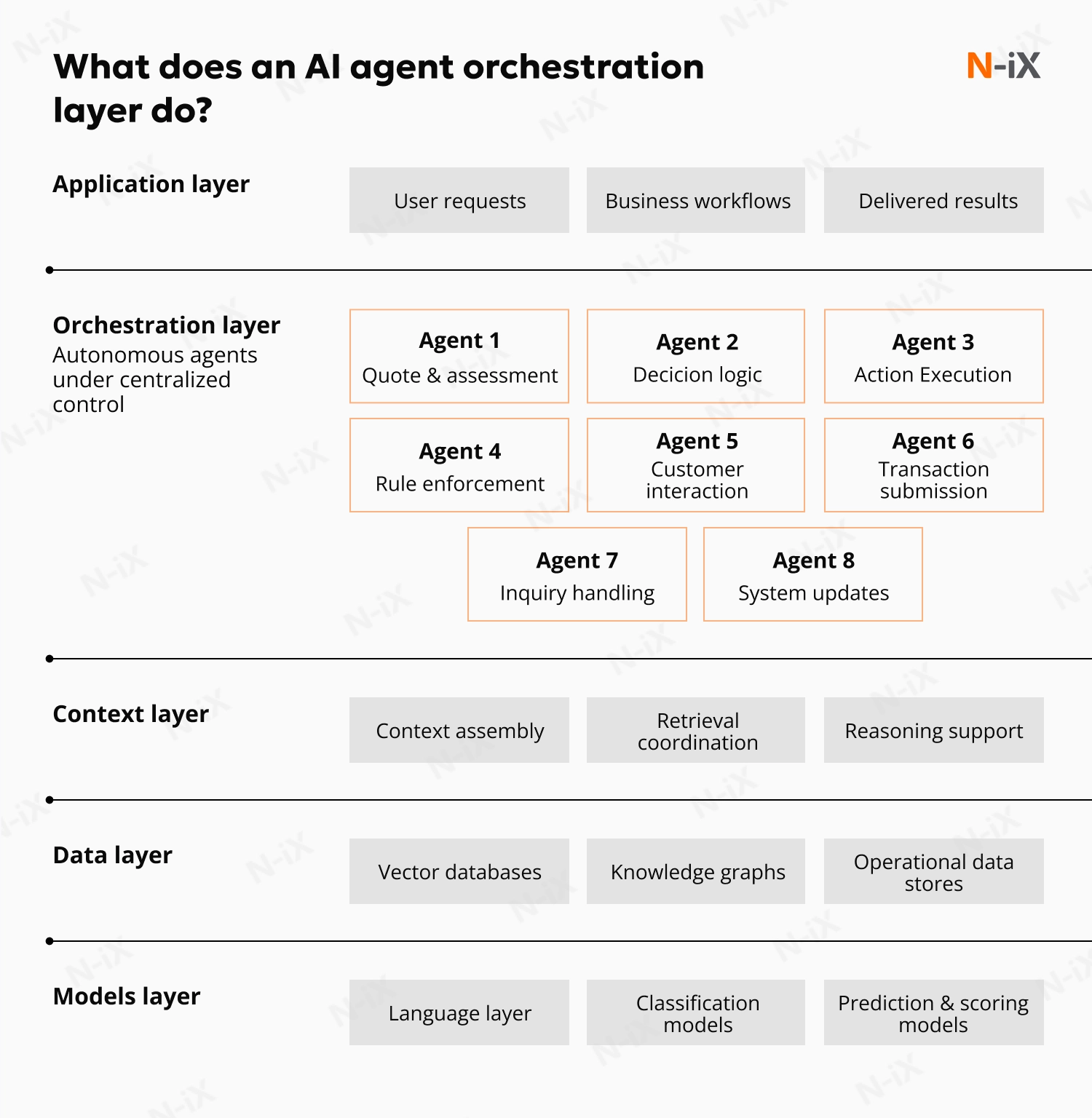
As a coordination layer, orchestration manages how work is distributed and combined across multiple agents. In real systems, no single agent holds all the context required to complete complex tasks end-to-end. Different agents contribute partial capabilities, such as data retrieval, reasoning, validation, interaction with external systems, or user communication. Multi-agent AI orchestration defines how these contributions are sequenced, how dependencies are resolved, and how intermediate results are passed forward, ensuring work progresses coherently rather than fragmenting.
Crucially, orchestration sits between intent and execution. High-level goals or requests enter the system at one end. Concrete actions against data, systems, and users emerge at the other end. The agentic AI orchestration layer bridges that gap by translating intent into coordinated steps, enforcing execution boundaries, and maintaining shared state throughout a task's lifecycle. Without this layer, agent-based systems rely on implicit assumptions about order, ownership, and responsibility, assumptions that tend to break as soon as scale, risk, or regulatory scrutiny increase.
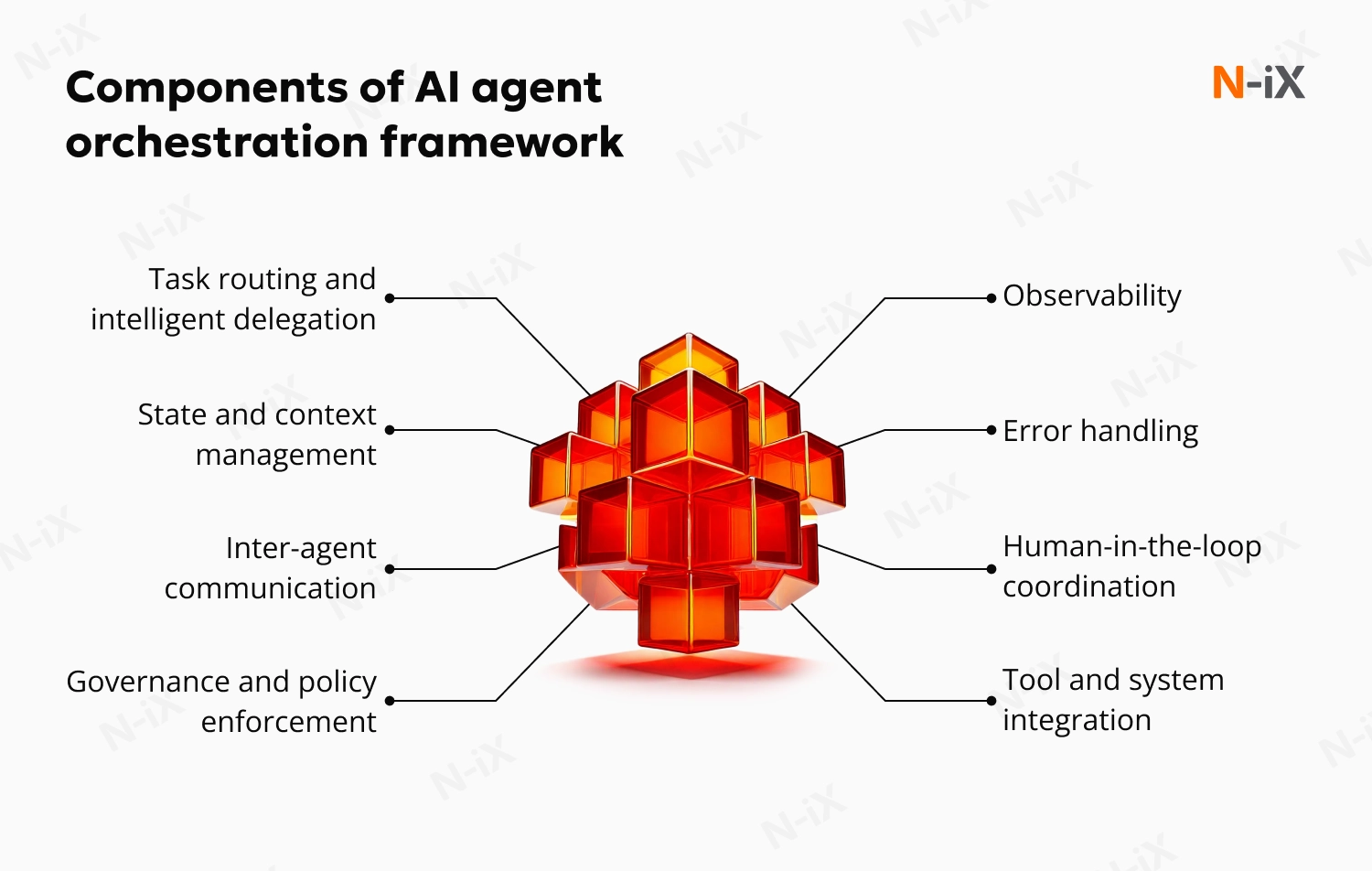
What are the components of the AI agent orchestration framework?
An effective orchestration layer manages the full lifecycle of agent-based execution through a set of tightly coupled responsibilities:
- Task routing and intelligent delegation: The orchestration layer decomposes incoming requests into executable subtasks and assigns them to the most suitable agent based on capability, context, and real-time system state. Delegation logic adapts continuously as conditions change, rather than relying on static workflows or hard-coded routing rules.
- State and context management: The framework preserves state across interactions, agent handoffs, and long-running workflows. Agents operate with a shared context that includes conversation history, intermediate outputs, and prior decisions. This continuity enables consistent behaviour, reliable recovery, and reproducible outcomes.
- Inter-agent communication: Standardised communication protocols define how agents exchange information, coordinate actions, and return results. The orchestration layer enforces message structure, sequencing, and timing so agents built on different models or frameworks can collaborate without misalignment or semantic drift.
- Governance and policy enforcement: The orchestration layer applies enterprise policies at execution time, not after the fact. Access controls, data usage rules, and operational guardrails constrain autonomous behaviour so agents act within security, privacy, and regulatory boundaries at every step.
- Observability and monitoring: The system captures execution telemetry across all agents, including latency, cost drivers, failure conditions, and decision paths. AI agent observability allows teams to understand how outcomes emerge, identify bottlenecks, and diagnose failures without reverse-engineering agent behaviour.
- Error handling and reliability: The framework detects failures early and activates recovery mechanisms before issues propagate. Retries, alternative routing, and circuit breakers keep workflows moving when individual agents return incomplete, incorrect, or unexpected results.
- Human-in-the-loop coordination: The orchestration layer escalates control when tasks exceed defined risk thresholds. Human operators receive full execution context, reasoning traces, and system state, enabling informed decisions without having to reconstruct earlier steps.
- Tool and system integration: The AI agent orchestration frameworks mediate access to APIs, data stores, and enterprise systems through controlled connectors. Centralised credential management, permission checks, and execution boundaries ensure agents interact with external systems safely and predictably.
Why do enterprises need agentic AI orchestration in 2026?
AI agents already generate insights, recommendations, and decisions across enterprise systems, but without orchestration, that intelligence stops at the point of action. Let’s discover the core benefits of agentic orchestration for enterprises.
For turning isolated agents into a system that acts
Most enterprises already run dozens of AI-enabled components across customer service, operations, finance, and IT. Each one solves a narrow task. The moment a workflow crosses boundaries, data validation, decision logic, execution in downstream systems, manual glue appears: scripts, human handoffs, brittle integrations.
McKinsey’s research on digital service excellence shows that organizations only achieve sustained automation impact when coordination is centralized, reducing cross-system fragmentation by up to 50%. This condition mirrors what enterprises now experience with AI agents: without orchestration, intelligence scales faster than execution coherence [1].
A simple example illustrates the difference. A fraud detection agent can flag suspicious activity. Orchestration allows that signal to trigger verification agents, request additional data, apply policy checks, and initiate containment actions, all within a governed flow. Without orchestration, teams still rely on tickets and emails to close the loop.
For containing complexity before it scales out of control
As agent-based systems grow, complexity increases faster than headcount. Each new agent introduces its own prompts, tools, state assumptions, and error modes. Without coordination, logic duplicates across agents and context fragments; failures propagate unpredictably.
Orchestration introduces structure where complexity would otherwise compound:
- Clear task decomposition prevents agents from overlapping responsibilities or competing for the same decision.
- Explicit execution boundaries define what each agent can decide and when escalation must occur.
- Shared state management preserves context across long-running workflows, even when execution spans hours or days.
This structure allows teams to add new capabilities without destabilising existing flows. McKinsey’s findings show that automation speed improvements fade quickly unless execution ownership and handoffs are structurally redesigned. Agent AI orchestration addresses this by making task boundaries, dependencies, and escalation paths explicit before complexity compounds.
For scaling automation without losing cost discipline
Uncoordinated agents often default to expensive models and redundant processing. Orchestration changes the cost profile by enabling intentional selection of models and tools at each step.
AI agent monitoring and orchestration enable routine classification, enrichment, or validation tasks to run on lightweight models. High-stakes reasoning or synthesis can escalate to more capable ones only when needed. Parallel execution reduces latency, while dependency-aware sequencing avoids unnecessary recomputation.
The outcome is predictable automation economics. Leaders gain visibility into where compute budgets go and why, instead of treating AI spend as an opaque operational cost.
For establishing governance that stands up to scrutiny
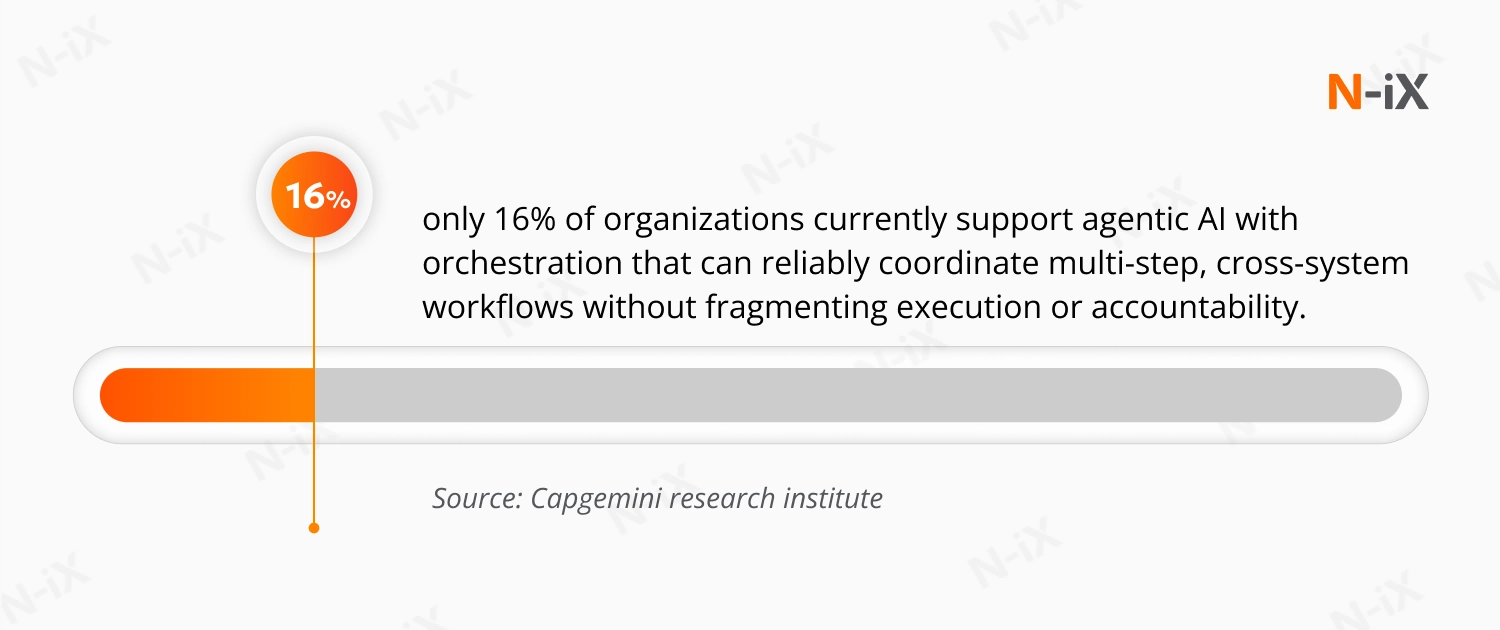
Autonomous agents introduce new governance expectations. Industry projections suggest that over 40% of agentic AI initiatives may be cancelled by 2027, not due to model failure, but because orchestration, governance, and risk controls were introduced too late. Systems that allow agents to act without explicit execution boundaries accumulate hidden operational debt until rollback becomes more expensive than continuation [1].
Regulators and internal risk teams no longer ask only what decision was made. They ask how the system arrived at that point, which data it used, and what safeguards constrained it.
AI agent orchestration platform provides that foundation by design:
- Centralised policy enforcement governs tool access, data exposure, and permissible actions;
- Execution traceability records decisions, intermediate states, and handoffs across agents;
- Failure-handling routes anomalies through defined retries or human escalation paths.
Designing orchestration after agents are already in production is where most enterprise programs fail. Validate the execution, governance, and escalation model before scale makes corrections expensive.
For integrating human judgment where it still matters
Fully autonomous operation remains neither realistic nor desirable for many enterprise workflows. Orchestration enables a pragmatic balance by embedding human checkpoints at moments of uncertainty, risk, or exception.
Instead of pausing entire workflows, orchestration isolates review to specific decision points. Agents continue operating within guardrails, while humans intervene only when context, ethics, or accountability demand it. Over time, teams adjust thresholds as confidence grows, without redesigning the system.
For converting systems of record into systems of action
Most enterprises already own a wealth of data estates. Value remains locked because data stops at dashboards. AI agent orchestration platforms make the difference and connect insight to execution.
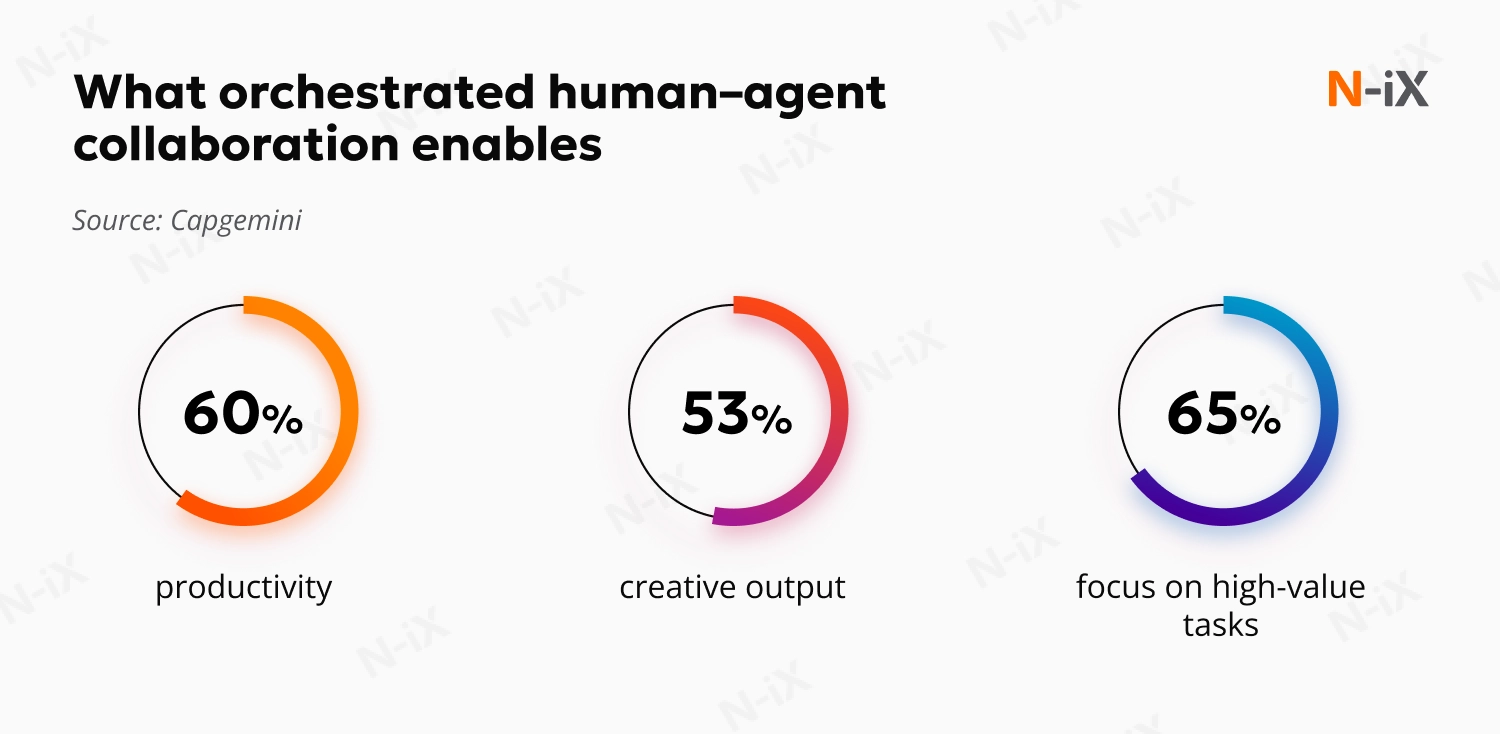
Agents can read from systems of record, apply domain logic, and coordinate actions across operational platforms, CRM updates, and supply chain adjustments, within a single, governed flow. Results become measurable: shorter cycle times, fewer handoffs, and consistent outcomes.
What are the AI agent orchestration use cases?
Cross-system operational workflows
Operational processes rarely live inside a single system. Once execution spans ERPs, CRMs, data platforms, and external services, coordination becomes the primary risk factor. A typical example appears in order-to-cash or incident response workflow: one agent validates inputs, another retrieves records from multiple systems, a third applies business rules, and a fourth executes actions downstream.
Agentic AI workflow orchestration governs sequencing, enforces system-specific permissions, and ensures that partial failures trigger recovery rather than corrupting state across platforms. Without orchestration, teams rely on scripts, tickets, and manual reconciliation to keep systems aligned.
Long-running investigations and approvals
Processes that unfold over hours or days expose the limits of single-session AI execution. Context must persist, ownership must remain clear, and execution must resume reliably after pauses.
Fraud investigations, compliance reviews, or procurement approvals illustrate the pattern. Agents collect evidence, request additional data, apply policy checks, and wait for human input at defined points. Orchestration preserves state across time, manages controlled handoffs, and ensures that decisions remain traceable even when execution resumes long after the initial trigger.
Decision-heavy workflows with escalation
Many enterprise processes depend less on automation speed and more on decision quality under uncertainty. In such cases, orchestration defines when autonomy applies and when escalation becomes mandatory.
Credit risk assessment offers a clear example. Separate agents evaluate transaction behaviour, external risk signals, and regulatory constraints. Orchestration consolidates these signals, evaluates confidence thresholds, and routes borderline cases to human review with full reasoning context.
Multi-agent analytics pipelines that drive action
Analytics delivers limited value when insights stop at dashboards. Multi-agent orchestration closes the gap between analysis and execution. In demand forecasting or operational optimisation, one agent analyses historical data, another models constraints, and a third evaluates the impact of the scenario. Orchestration reconciles outputs, validates assumptions, and triggers downstream actions such as inventory rebalancing or pricing updates. The result is a continuous loop from insight to execution, rather than fragmented analytical outputs.
In large-scale ecommerce analytics programs, orchestration becomes essential once insights must continuously trigger downstream actions. In one N-iX engagement, we built a coordinated analytics pipeline that aligned data ingestion, modeling, and decision logic across multiple systems, enabling faster operational decisions without fragmenting ownership or context.
You may also find it interesting to read about building multi-agent AI system
Customer service workflows with dynamic escalation
Customer interactions frequently cross functional boundaries mid-conversation. Orchestration ensures that intent shifts do not fragment context or responsibility. A service request may begin as a general inquiry, evolve into a billing issue, and escalate into a technical or compliance concern. AI agent orchestration for complex workflows manages agent handoffs, preserves conversational and account context, enforces authorization rules, and ensures that actions taken in one system extend correctly across others.
While 85% of consumers recognize AI’s efficiency benefits, only half trust AI-driven decisions, with concerns clustering around accountability, fairness, and governance [2]. Orchestration addresses this gap by making autonomous execution explainable, constrained, and auditable at the point of action.
Compliance-sensitive operational execution
In regulated environments, the ability to act autonomously depends on explainability and control. Orchestration provides both at execution time. Financial reporting, healthcare operations, or regulated manufacturing workflows rely on agents to gather data, apply rules, and generate outputs. Orchestration enforces segregation of duties, records decision paths, and prevents unauthorized actions. Auditability becomes a system property rather than a manual afterthought.
How does an orchestrated AI agent system handle complex workflows?
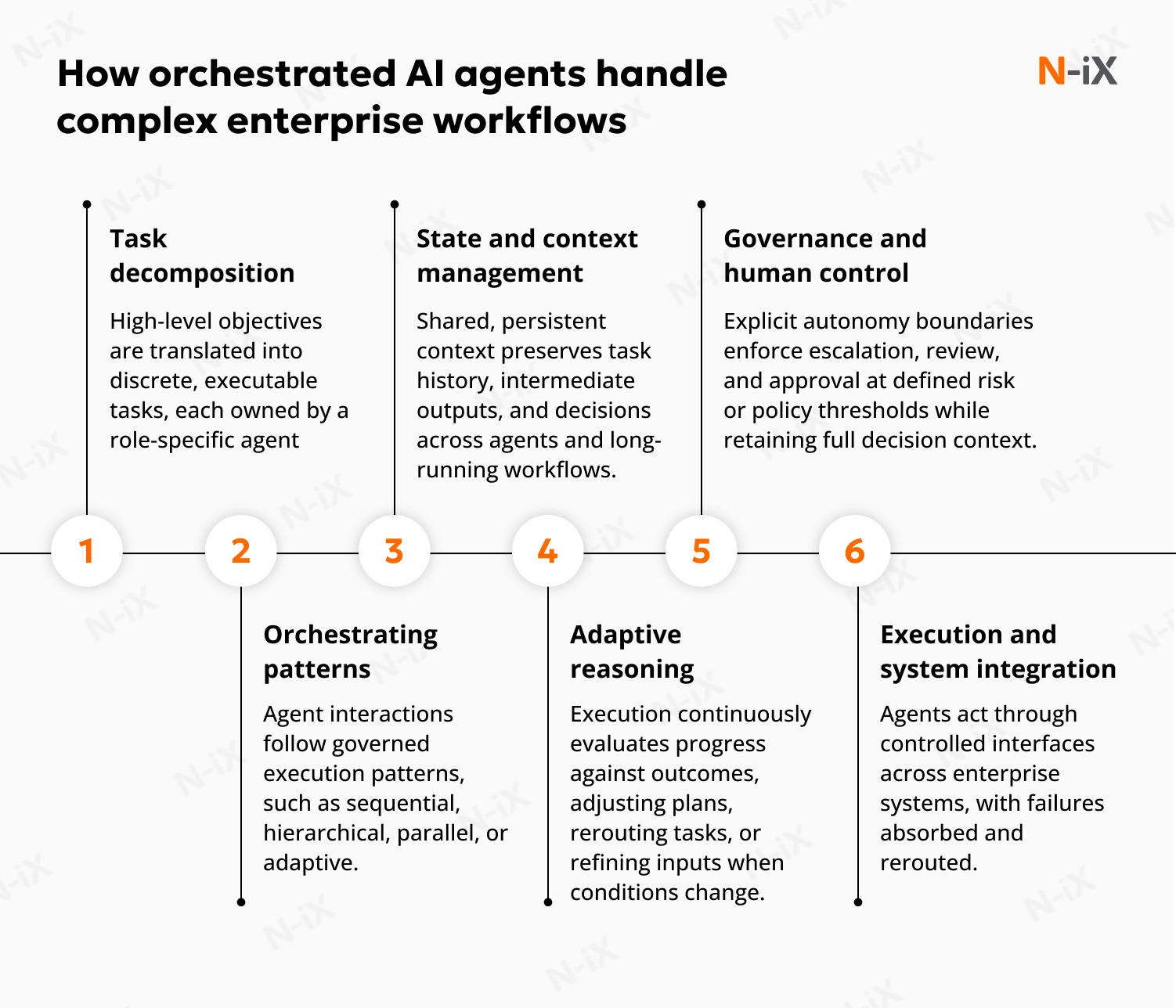
Agent orchestration governs how multiple autonomous agents collaborate to execute complex, multi-step workflows that exceed the practical limits of a single model. Instead of concentrating logic, memory, and responsibility in a single prompt-driven system, orchestration introduces a control plane that coordinates execution, routes decisions, preserves context, and adapts behavior as conditions change.
Below is a detailed breakdown of the core mechanisms that make this.
1. Task decomposition and specialization
At the outset, the orchestrator translates a high-level objective into a structured set of executable tasks. Each task is defined by scope, dependencies, expected output, and failure criteria, then routed to an agent designed to handle that specific function. Rather than overloading one model with conflicting responsibilities, orchestration enforces functional separation across agents with distinct roles, tools, and model configurations.
In practice, a customer support automation workflow may split into intent classification, account lookup, policy validation, response drafting, and escalation handling—each owned by a different agent. The orchestrator manages dependencies between these steps, ensures outputs meet predefined contracts, and prevents agents from duplicating work or drifting beyond their remit.
Key considerations handled at this layer include:
- Defining task boundaries and success conditions.
- Matching task complexity to model size and cost profile.
- Enforcing role-level constraints on tools, data access, and actions.
2. Selection of AI agent orchestration patterns
Once tasks are defined, the orchestrator applies a workflow pattern that determines how agents interact and in what sequence. Pattern choice directly influences system reliability, latency, and cost, and is typically driven by the predictability of the task and the tolerance for outcome variance.
Commonly applied patterns within agentic AI orchestration platforms include:
- Sequential execution, where each agent consumes the verified output of the previous step, is often used in compliance-sensitive processes such as document generation or financial reporting.
- Hierarchical coordination, where a supervisory agent plans the approach, delegates subtasks, evaluates results, and resolves conflicts across contributors.
- Parallel execution enables multiple agents to work independently on the same input to generate alternative solutions, rankings, or risk assessments.
- Dynamic handoffs, where control transfers between agents as intent, context, or confidence thresholds shift during execution.
- Magentic orchestration, suited to open-ended or exploratory work, where plans are continuously revised based on intermediate findings recorded in structured tasks and progress ledgers.
- Pattern enforcement ensures that autonomy does not degrade into unpredictability as system complexity increases.
3. State and context management
Sustaining continuity across agents requires persistent, structured memory that survives beyond individual model calls. The orchestrator maintains shared state objects that capture task history, intermediate outputs, retrieved facts, decisions taken, and pending dependencies. Agents consume only the context relevant to their role, reducing token overhead while preserving situational awareness.
In long-running workflows, such as fraud investigations or procurement approvals, state persistence allows execution to pause and resume without loss of fidelity. Human interventions, retries, or policy checks can occur hours or days later while maintaining a consistent operational thread.
Critical responsibilities at this layer include:
- Maintaining authoritative task state across agent boundaries.
- Managing context scope to balance accuracy with cost.
- Preventing divergence between parallel execution paths.
4. Adaptive reasoning and self-correction
Orchestrated systems replace static execution paths with reasoning-driven control loops. Agents do not simply execute predefined steps; they continuously assess whether progress aligns with the intended outcome. When signals indicate stalled execution, inconsistent outputs, or conflicting evidence, the orchestration layer intervenes and adjusts the plan rather than forcing the workflow to continue unquestioningly.
Correction can take several forms: re-prompting an agent with refined context, delegating the task to a different specialist, decomposing the task further, or switching execution patterns entirely. In data analysis workflows, for example, an agent producing inconclusive results may trigger parallel validation by another agent before the system proceeds. This adaptive behavior allows workflows to converge on results even when inputs are incomplete or conditions change mid-execution.
5. Governance and human-in-the-loop control
As agents begin to influence outcomes with financial, legal, or operational impact, orchestration becomes the enforcement point for accountability. Rather than embedding guardrails inconsistently across individual agents, the orchestration layer defines when autonomy is allowed, when escalation is required, and what evidence must accompany decisions.
Human-in-the-loop control does not arbitrarily interrupt workflows. The orchestrator identifies decision thresholds, ambiguity, confidence decay, policy violations, and high-risk actions, and pauses execution while preserving full context. Once a human reviews, approves, or corrects the action, the workflow resumes without losing state or continuity.
Agentic AI governance responsibilities handled centrally include:
- Action-level authorization and escalation rules
- Preservation of decision context during human review
- Traceability for audits, compliance, and incident analysis
6. Integration as an execution layer
Orchestration does not stop at reasoning. It connects agents to the systems where work actually happens. The orchestration layer manages how agents interact with CRMs, ERPs, ticketing systems, data warehouses, and external services through controlled interfaces and standardized protocols.
By centralizing integration, orchestration prevents agents from hard-coding credentials, bypassing access policies, or executing actions out of sequence. Each interaction becomes observable, reversible where possible, and aligned with the broader execution flow. When a downstream system fails or responds unexpectedly, orchestration absorbs the failure and reroutes execution instead of cascading errors across agents.
Next steps towards agentic AI orchestration
Enterprises have already seen this pattern with cloud and API proliferation: experimentation without orchestration scales faster than control. Agentic AI introduces the same risk profile, but with autonomous execution layered on top.
The practical path forward starts with clarity. Teams first need to identify where autonomy creates value today, typically in workflows that already span multiple systems, involve repeated human handoffs, or suffer from latency and inconsistency. From there, orchestration design becomes an exercise in constraint-setting: defining goals, acceptable risk, escalation points, and ownership before any agent runs in production.
From an execution standpoint, the progression is deliberate:
- Assessment and planning focus on mapping candidate workflows, dependencies, and failure modes, rather than on model selection.
- Agent specialization follows, with narrowly scoped agents aligned to clear responsibilities rather than broad, ambiguous mandates.
- Orchestration framework implementation establishes the control plane: execution flow, state continuity, policy enforcement, and system integration.
- Autonomous execution then shifts to the orchestrator, which assigns tasks, coordinates agents, and manages context in real time.
- Continuous optimization closes the loop, combining system telemetry with human oversight to refine boundaries, performance, and cost.
What matters most at this stage is sequencing. Enterprises that attempt to “add orchestration later” usually inherit brittle workflows and governance gaps that are expensive to unwind.
N-iX works as an engineering and advisory partner for production-grade orchestration. We combine AI engineering, distributed systems thinking, and enterprise delivery discipline. Our role spans the full lifecycle: from identifying the right orchestration entry points, to designing agent responsibilities and execution boundaries, to building and integrating orchestration layers that operate reliably across enterprise systems. Just as importantly, we help teams embed governance, observability, and human oversight into the architecture from the start.
If your organization is evaluating how to move toward agentic AI without fragmenting workflows, inflating costs, or compromising accountability, a focused conversation is the right next step. We are here not to implement more AI, but to make sure the autonomy you introduce actually works for the organization, not against it.
FAQ
How do you troubleshoot AI agent orchestration issues?
Based on our AI agent orchestration best practices, we recommend starting by examining orchestration-level telemetry rather than individual agent outputs. Execution traces, decision logs, and state transitions usually reveal where context was lost, tasks were misrouted, or agents entered retry loops. Most production issues stem from orchestration gaps, such as missing handoff rules, weak state persistence, or poorly defined execution boundaries.
How does AI agent orchestration differ from related practices like workflow automation or prompt chaining?
AI agent orchestration coordinates autonomous agents that reason, act, and adapt, while traditional workflow automation executes predefined steps with limited flexibility. Prompt chaining links model outputs sequentially but lacks shared state, governance, and runtime decision control. Orchestration introduces dynamic delegation, persistent context, and policy enforcement, enabling systems to handle ambiguity, long-running tasks, and cross-system execution.
When does an organization actually need agentic AI orchestration?
AI agent orchestration becomes necessary when workflows span multiple systems, require sustained context, or involve decision-heavy execution rather than simple responses. Use cases such as claims processing, customer service escalation, compliance checks, or operational analytics often fail without orchestration due to agent sprawl and loss of accountability.
References
- Scaling the next-generation operating model - McKinsey
- Artificial Intelligence and the orchestrated customer experience - KPMG
- Unlocking exponential value with AI agent orchestration - Deloitte
- The dawn of agentic AI - Deloitte
- Magic Quadrant for Business Orchestration and Automation Technologies - Gartner
- Operationalize Agentic AI With New Roles, Org Charts, and Governance - Gartner
Have a question?
Speak to an expert