
 ChatGPT
 Perplexity
 Claude
 Gemini
 Grok
Grok
As software environments grow, complexity builds up quietly. Different teams make local decisions, tools multiply, and cloud resources expand faster than expected. Over time, this lack of coordination creates friction. Without software development governance, organizations struggle to keep control over how software is built, changed, and scaled.
When governance in software engineering is missing, risks accumulate. Security practices vary across teams, delivery becomes harder to predict, and costs increase due to duplicated tools and unmanaged cloud usage. Technical debt grows unnoticed, making future changes slower and more expensive. Leaders often see the impact only when a release is delayed, an audit reveals gaps, or scaling the system becomes a challenge.
Software governance best practices help prevent these issues without adding unnecessary bureaucracy. They give teams clear guidelines, align engineering decisions with business priorities, and provide visibility across the software lifecycle. In modern cloud-driven and Agile environments, governance is what enables sustainable growth while maintaining speed and control.
In this article, we will take a look at the reasons governance matters, ways to know if you need it, best implementation practices, and more.
What is governance in software development, and why it matters
Software development governance defines how decisions are made, who is accountable for them, and which rules guide software delivery across the organization. It establishes clear expectations for architecture, security, quality, and compliance while allowing development teams to work autonomously within agreed boundaries.
In practical terms, application development governance connects technical execution with business intent. It ensures that engineering initiatives support strategic priorities, risks are managed consistently, and standards are applied across teams and platforms. Without governance, decisions tend to be made in isolation, which leads to fragmented systems, rising costs, and growing operational risk.
The meaning of governance in software development is simple. As organizations adopt Agile practices, cloud platforms, and data-driven systems, software environments become more distributed and harder to control. Governance provides the structure needed to scale delivery without slowing it down. It enables faster, more predictable outcomes by aligning teams around shared principles, improving visibility into delivery performance, and reducing security, compliance, and cost-related risks.
Why do you need software development governance?
As software becomes central to business operations, the impact of poor technical decisions increases. Software governance provides the structure needed to maintain control without limiting team autonomy.
You need software development governance to:
- Align software initiatives with business priorities: Governance ensures that architecture, tooling, and delivery decisions support strategic goals rather than isolated team objectives.
- Manage security and compliance risks consistently: Clear ownership and shared standards help address security, regulatory, and operational risks early, before they escalate.
- Reduce fragmentation and technical debt: Governance prevents uncontrolled tool sprawl, duplicated functionality, and incompatible architectures.
- Improve delivery predictability and cost control: Defined decision rights and KPIs make timelines, budgets, and outcomes more transparent and easier to manage.
- Increase visibility and accountability: It gives leadership insight into delivery performance, risk exposure, and long-term sustainability.

Software development governance framework: Core pillars
A software development governance framework provides structure without imposing rigid, one-size-fits-all processes. Rather than dictating how teams work day to day, it defines the principles, roles, and controls that guide decision-making across the software lifecycle. A well-designed application development governance adapts to different teams, technologies, and risk profiles while maintaining consistency at scale.
The core pillars of an effective software development governance framework include:
Strategic alignment
Governance ensures that software initiatives support business objectives. Architectural choices, technology investments, and delivery priorities are evaluated against strategic goals, not isolated team preferences.

Accountability and ownership
Clear ownership for systems, data, and decisions is essential. Governance in software development defines who is responsible for outcomes, approvals, and risk management, reducing ambiguity and decision delays.
Standards and policies
Shared standards for architecture, security, coding, and cloud usage create consistency across teams. Within a governance framework, these standards act as guardrails rather than constraints, enabling faster and safer delivery.
Metrics and KPIs
Governance relies on meaningful metrics to assess performance and risk. KPIs should focus on business impact, reliability, cost efficiency, and compliance, providing visibility into how software performs in real conditions.
Continuous improvement
A software development governance framework evolves over time. Regular reviews, feedback loops, and data-driven insights help organizations refine standards and controls as technologies, teams, and business needs change.
But how do you know if you really need to implement software development governance best practices?
Signs your business needs a software development governance model
Multiple teams build and maintain software independently
When teams operate in silos, they often adopt different tools, architectures, and practices. Without governance in software development, these differences accumulate, making integration harder, slowing cross-team collaboration, and increasing long-term maintenance effort.
Security and compliance issues are addressed reactively
If vulnerabilities, audit findings, or compliance gaps are discovered late, it usually indicates missing governance controls. They help embed security and compliance requirements into everyday development and delivery workflows.
Architecture decisions vary from team to team
Without shared principles or review mechanisms during application development governance, teams make local optimization choices that do not scale. Over time, this results in inconsistent architectures, higher integration costs, and growing technical debt.
Delivery timelines and outcomes are difficult to predict
When priorities, KPIs, and decision rights are unclear, planning becomes unreliable. Governance in software development provides structure for prioritization and measurement, improving predictability across initiatives.
Leadership lacks visibility into software risks and performance
Without a governance framework, executives have limited insight into delivery health, risk exposure, and long-term sustainability. Governance creates transparency that supports informed decision-making and strategic planning.
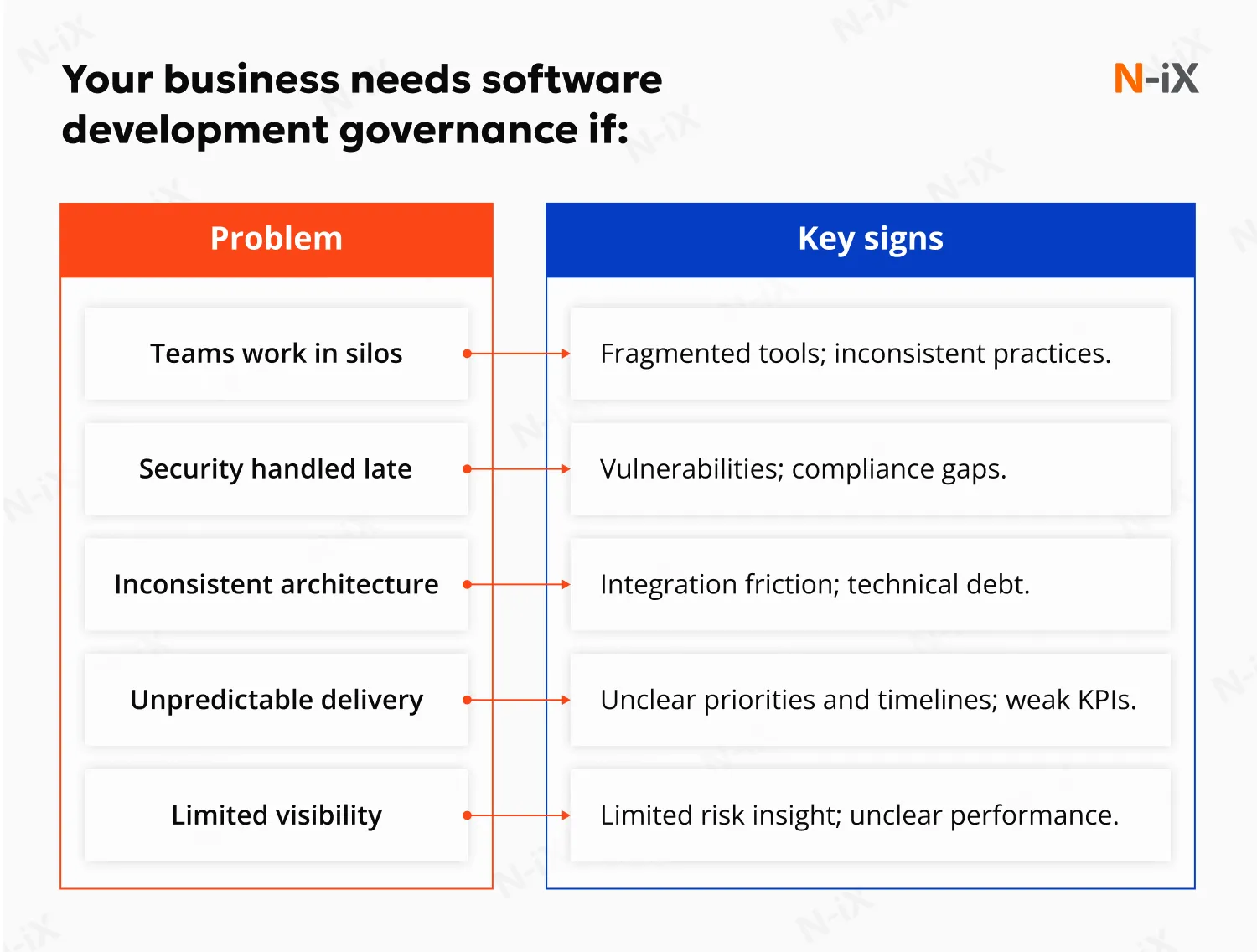
These signals typically appear gradually, but they compound quickly as software portfolios grow. Depending on your specific business case, you may need different-focused governance. Let’s take a look at the key types of governance.
Related: SDLC audit: A business leader’s guide for 2026 and beyond
Types of governance in software development
The governance spans the entire software lifecycle, from early design decisions to long-term operation and optimization. Rather than focusing on a single phase, software governance ensures consistency, accountability, and risk control across all stages of delivery. Below are the core governance types that together form a comprehensive approach.
1. Development
Development governance defines how software is designed and built. It establishes architecture standards, coding guidelines, and review practices that help teams maintain quality and consistency. Clear rules for managing technical debt ensure that short-term delivery decisions do not undermine long-term maintainability.
2. Deployment
Deployment governance controls how software moves from development to production. It covers release policies, CI/CD pipeline standards, approval mechanisms, and environment consistency. Within governance, this area reduces deployment risk while supporting frequent and reliable releases.
3. Security
Security governance embeds protection into every stage of development. It includes secure-by-design principles, vulnerability management processes, and DevSecOps practices. Governance in software development ensures that security responsibilities are clearly assigned and applied consistently across teams and platforms.
4. Data
Data governance defines ownership, access rights, and quality standards for data used and generated by software systems. It also addresses regulatory requirements and privacy obligations. As data-driven and AI-enabled systems grow, data governance becomes a central governance pillar.
Learn how to implement data governance effectively
5. Performance
Performance governance focuses on reliability and user experience. It sets expectations through SLAs, defines reliability and availability metrics, and standardizes observability practices. This ensures performance issues are detected early and addressed systematically.
6. Compliance
Compliance governance aligns software delivery with legal and regulatory requirements. It supports audit readiness, documentation standards, and traceability across the SDLC. Within software development governance, this reduces regulatory risk without slowing development.
7. Cloud
Cloud governance manages how cloud resources are selected, configured, and consumed. It includes cost controls, resource policies, and clarity around the shared responsibility model. Effective cloud governance is essential for keeping modern software environments secure, compliant, and financially sustainable.
Learn more about effective cloud governance
Together, these governance areas form a holistic approach. When applied consistently, they help organizations scale software delivery while maintaining control over risk, cost, and quality.
Apart from types, there are software development models you should consider to gain maximum value from governance endeavors. Choosing the right software development governance model determines how decisions are made, how accountability is assigned, and how consistently standards are applied across teams. In practice, governance usually follows one of three models, each with different trade-offs.
Software development governance models
Centralized governance
In a centralized model, decision-making authority is concentrated within a central architecture, security, or IT leadership function. Standards, tools, and policies are defined at the top and enforced across all teams.
This approach provides strong control and consistency, which can be valuable in highly regulated environments. However, centralized governance can slow down delivery and limit team autonomy if it becomes overly prescriptive.
Decentralized governance
A decentralized model shifts most decision rights to individual teams. Teams select tools, define architectures, and manage delivery independently, based on local needs.
While this model supports speed and innovation, it often leads to fragmentation if governance is too loose. Without shared principles and visibility, organizations risk duplicated solutions, inconsistent security practices, and rising technical debt.
Learn more about technical debt reduction strategies
Hybrid governance
For most enterprises, a hybrid software development governance model offers the best balance. In this approach, central teams define high-level standards, guardrails, and risk controls, while delivery teams retain autonomy within those boundaries.
Decision rights are distributed based on impact and risk. Strategic architecture, security, and compliance decisions remain centralized, while implementation details and day-to-day delivery choices are delegated to teams. Accountability is clear, and standards are consistent without constraining agility.
By adopting a hybrid approach, organizations align governance in software development with scale and complexity. This model enables faster delivery, better risk management, and sustainable growth across large and distributed software portfolios.
Having chosen the model, now it is time to take a look at the best practices that will help you succeed with the governance.
4 software development governance best practices that drive business impact
Effective governance focuses on enabling teams to deliver value while maintaining control over risk, cost, and quality. The goal is not to slow down development, but to create clear guardrails that support consistent decision-making at scale.
1. Move towards decentralized governance with clear guardrails
Modern organizations benefit from decentralized decision-making, but only when boundaries are well defined. Development governance should delegate day-to-day decisions to teams while enforcing shared principles for architecture, security, and compliance. This approach preserves team autonomy without sacrificing consistency.
2. Select KPIs that measure business outcomes, not just delivery velocity
Software governance works best when performance is measured by impact, not activity. Instead of focusing only on sprint velocity or release frequency, governance frameworks should include KPIs tied to reliability, customer experience, cost efficiency, and risk reduction.

3. Prevent silos through shared standards and cross-team visibility
Silos often emerge when teams use different tools, platforms, and practices without coordination. Software governance promotes shared standards, transparent documentation, and visibility across initiatives. This reduces duplication, improves collaboration, and simplifies long-term maintenance.
4. Map initiatives to the right governance depth based on risk
Not all software initiatives require the same level of control. Effective governance adjusts oversight based on factors such as business criticality, regulatory exposure, and technical complexity. High-risk systems require stronger controls, while low-risk initiatives benefit from lighter governance.
Applied consistently, these software development governance best practices help organizations balance speed and control, reduce operational risk, and deliver measurable business value as software portfolios scale.
Wrap-up
The most effective governance approaches are not static. They evolve alongside Agile practices, cloud adoption, and data-driven initiatives. By combining the right model with proven software development governance best practices, businesses can scale software delivery confidently, reduce operational friction, and support long-term growth in increasingly complex environments.
Why choose N-iX for implementing software development governance?
N-iX is a global software engineering and consulting company with more than 2,400 experts supporting complex software ecosystems for enterprises worldwide. With 23 years of experience delivering large-scale software programs, N-iX helps organizations design and operationalize development governance that works in real-world conditions.
With experience across large-scale Agile programs, cloud and data platforms, security-critical systems, and regulated industries, N-iX supports:
- Designing governance frameworks aligned with business strategy;
- Defining decision rights, ownership models, and delivery guardrails;
- Embedding governance into Agile, cloud, and DevSecOps workflows;
- Applying governance best practices without slowing development teams.
By treating software development governance as an enabler rather than a constraint, N-iX helps organizations scale software delivery responsibly while maintaining speed, quality, and control.
Have a question?
Speak to an expert