
 ChatGPT
 Perplexity
 Claude
 Gemini
 Grok
Grok
According to recent industry data, 86% of organizations run workloads in more than one cloud environment [1]. Different providers often serve different purposes: one may host analytics pipelines, another runs customer-facing applications, while a third supports AI or regional infrastructure.
Over time, this creates a distributed data environment. A dataset generated in one cloud may be processed in another and analyzed somewhere else entirely. Before long, your data is spread across multiple platforms without a clear structure or shared ownership.
Making this data coherent, governed, and usable across all environments requires effective multi-cloud data management. This guide explains what this process entails, where it can be challenging, and how to implement it in a structured way.
What is multi-cloud data management?
Multi-cloud data management is the practice of governing and optimizing data across two or more public cloud platforms within a single organization. It addresses how data is stored, secured, accessed, and synchronized across independent environments. Beyond these basics, it also covers:
- How data moves between cloud environments;
- How data ownership and access policies are enforced across teams;
- How storage, processing, and transfer costs are monitored across providers;
- How regulatory and compliance requirements are applied.
Managing data across multiple clouds means coordinating systems that don’t share a common control plane. A dataset may be generated on one platform, processed on another, and analyzed somewhere else entirely. Each provider has its own storage models and monitoring tools, so maintaining consistent policies and visibility requires deliberate oversight.
The business case for multi-cloud strategies is strong. But without the right governance in place, this approach can quickly shift from a strategic advantage to a liability.
Managing data across clouds: Key areas of complexity
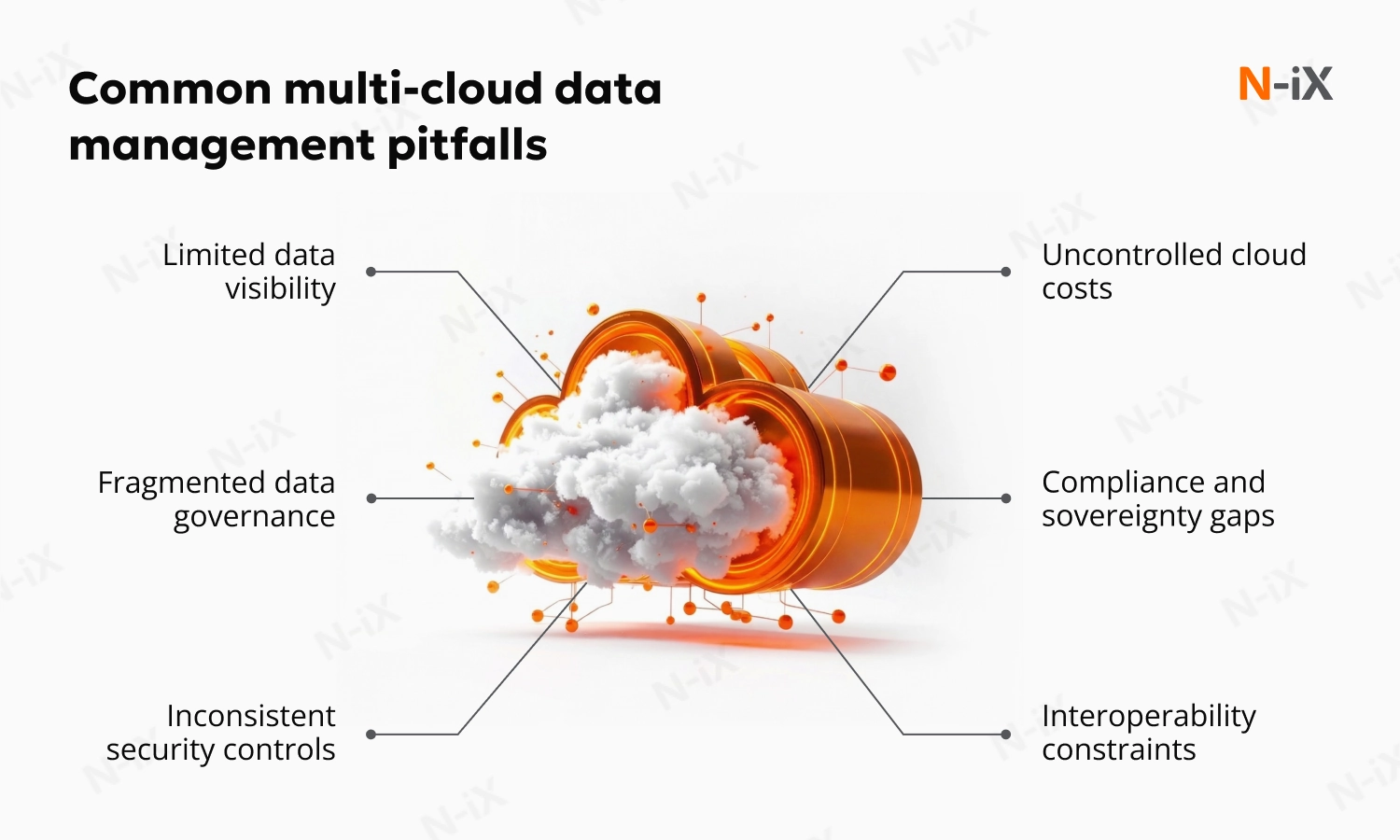
Data management in multi-cloud environments rarely fails due to technological limitations. More often, it requires a level of operational discipline that organizations don’t initially anticipate. Here are the four areas where multi-cloud data management challenges are likely to emerge:
Visibility
When data is spread across multiple cloud environments, tracking where it resides, who has access to it, and what it costs becomes difficult. The problem grows when different teams independently provision new services or data stores. Over time, shadow IT begins to appear, and ungoverned data assets accumulate across cloud platforms. Organizations then lose a clear view of their data landscape, which significantly complicates governance, cost control, and compliance.
Cost management
The multi-cloud approach is often associated with cost efficiency, and it can deliver that, but not without deliberate governance. Effective multi-cloud data management for the enterprise must include clear cost oversight across providers. Hidden costs are common: idle resources, over-provisioned instances, inter-cloud data transfer fees, and pricing models that vary across providers.
Our experts add that limited visibility often amplifies the problem:
In our experience, organizations often discover unused resources during their first proper cloud audit. Storage buckets, databases, or test environments may have outlived their purpose, but they’re still running and generating costs.
Security and compliance
Each cloud platform has its own identity and access management system, security tooling, and compliance reporting. Managing those separately may create gaps. Data can be transmitted across clouds in ways that conflict with privacy regulations, often without detection.
Also, for organizations operating across multiple countries, maintaining compliance with the GDPR and other frameworks simultaneously is a significant and ongoing challenge.
Interoperability
Connecting data and services across cloud providers remains a notable challenge in enterprise IT. Gartner predicts that by 2029, over 50% of organizations will not achieve the expected results from their multi-cloud deployments due to interoperability issues [2]. This highlights how difficult it can be to integrate platforms that were not designed to operate together, especially when data, services, and tooling must move across provider boundaries.
6 best practices for multi-cloud data management
Every organization approaches data management across multiple clouds differently. Yet the principles that help businesses overcome the main challenges stay consistent. Let’s review several best practices that can help you secure and optimize your distributed data.
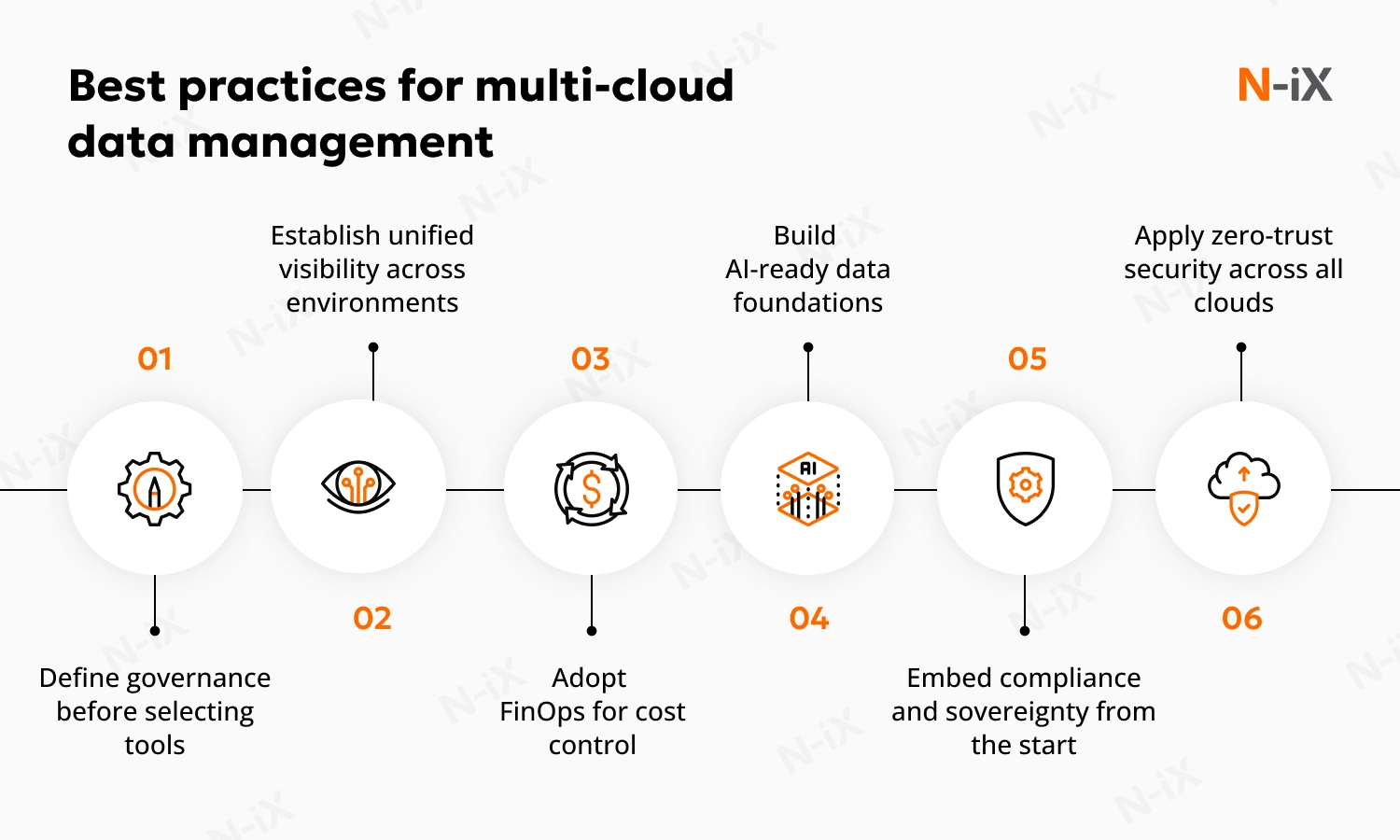
1. Governance first, tools second
The most common mistake is purchasing a suite of cloud management tools and then trying to build governance around them. Our cloud experts recommend defining ownership, accountability, and policy first, then selecting tools to enforce those decisions.
This means answering several questions that determine how multi-cloud data management functions across your organization:
- Who owns specific datasets and is accountable for their quality and access policies?
- Which teams are authorized to provision new cloud resources?
- What approval process governs new deployments and services?
- What policies control how data moves between cloud environments?
These decisions establish the operating model for managing data across clouds. Many organizations formalize them through a cross-functional governance group that includes IT, finance, legal, and key business units. This approach helps ensure policies reflect both technical requirements and business priorities.
2. Unified visibility across all environments
Effective management starts with clear visibility. A cloud management platform (CMP) can provide a unified view across multiple cloud environments. These platforms consolidate cost data, security posture, compliance status, and workload performance into a single interface. This helps both technical teams and business leaders understand how resources are used and where attention is needed.
A similar principle shaped one of N-iX’s engagements with Lebara, a mobile virtual network operator with operations in 10 European markets. As part of a broader digital transformation program, the company adopted a multi-cloud architecture spanning AWS and Azure. We helped Lebara modernize its data architecture by building a unified master data system across online and offline channels and optimizing the company’s BI solution.
To improve operational visibility, our engineers also implemented an Azure-based data lake that enables near real-time reporting across multiple departments. This enabled Lebara’s sales, finance, and marketing teams to access consistent operational data while eliminating reporting delays that previously reached several hours.
Explore the full case study: Faster time-to-market with full-scale digital transformation in telecom
3. FinOps as a business discipline
Cloud financial operations, or FinOps, has evolved from an engineering practice into a business discipline. A structured FinOps approach includes tagging cloud resources by team and department to establish clear accountability and enforcing budget thresholds tied to business priorities. It also involves rightsizing infrastructure based on actual usage and strategically applying commitment-based discounts.
FinOps also depends on close coordination between the finance and engineering departments.
When finance teams lack visibility into cloud billing models, forecasting becomes unreliable. When engineering teams don’t understand budget constraints, resources are often over-provisioned or left running longer than necessary. FinOps closes this disconnect.

Treating FinOps as a core part of the multi-cloud data management strategy helps organizations align financial oversight with day-to-day technical decisions.
Discover how to adopt cloud FinOps and optimize your expenses
4. AI-ready data infrastructure
AI initiatives depend on clean, connected, and well-governed data. When data is fragmented across multiple cloud environments, even well-funded AI programs struggle to gain traction. According to a 2025 industry survey, 98.4% of organizations reported increased investment in AI, yet the most common reason initiatives stalled was a lack of trust in the underlying data [3].
Building an AI-ready foundation helps ensure data remains consistent, discoverable, and reliable across platforms. Within multi-cloud data management, this typically includes:
- Consistent data quality standards applied across all cloud environments;
- Data lineage tracking so teams understand where data originates and how it has changed over time;
- Unified data cataloging that allows analysts and AI systems to discover datasets regardless of where they are stored;
- Standardized metadata management so datasets remain interpretable across teams and tools;
- Secure data access policies that allow AI systems to use data without exposing sensitive information.
5. Compliance and data sovereignty by design
Building compliance into cloud architecture from the start is less costly than retrofitting it later. Consider regulatory requirements during system design, including selecting cloud regions that meet data residency rules, enforcing consistent encryption standards, and automating compliance checks. When these considerations are postponed, bringing an existing multi-cloud environment into compliance often requires extensive reconfiguration.
This approach is particularly important for companies expanding into new markets, where data sovereignty rules and sector-specific regulations vary across jurisdictions.
6. Zero-trust security across every cloud
Securing workloads across multiple providers requires a model that extends beyond individual platforms. Modern multi-cloud security approaches increasingly rely on zero trust principles, where every request is verified rather than assumed safe based on network location. In multi-cloud environments, this typically means centralized identity management, least-privilege access policies, and consistent security controls across all clouds.
How to start building your multi-cloud data management strategy
Implementing a strong strategy doesn’t require a massive transformation from day one. Rather, it calls for establishing the right foundations in the right order. For most organizations, this process includes the following key stages.
Phase 1: Audit and map
Before governing data, you need to know where it is located. This means mapping all active cloud environments, including those that were never formally sanctioned. Teams must also identify who owns each dataset and determine which regulatory requirements apply to each environment. This visibility forms the foundation of effective multi-cloud data management.
N-iX experts note that the first comprehensive audit often reveals data stores created before current governance policies were established. These resources may still be active, but have never been formally reviewed. As a result, the audit phase often yields the most important decisions about data structure, ownership, and risk.
Phase 2: Govern and standardize
Once you have a clear picture, the focus shifts to establishing consistent policies: tagging standards, access controls, approved tooling, and cross-environment compliance rules. This is also the stage where you select and deploy the right cloud management platform. With these foundations in place, your multi-cloud environment becomes far easier to scale and manage.
Phase 3: Optimize and evolve
With governance in place, attention turns to continuous improvement. This is when you begin rightsizing resources, automating compliance checks, and consolidating overlapping tools. It’s also a continuous process of strengthening your data quality foundation that analytics and AI initiatives depend on. This phase is ongoing rather than a final destination.
For many organizations, progress at this stage depends on whether they navigate the process alone or with experienced external guidance. Multi-cloud environments introduce architectural, operational, and regulatory decisions that few internal teams encounter regularly. Working with a trusted technology partner can accelerate multi-cloud data management for the enterprise and help teams avoid costly architectural reversals.
Key takeaways
- Multi-cloud data management means unified governance and control over data spread across multiple public cloud providers.
- Most enterprises already operate in multi-cloud environments; the gap lies in managing them with intention.
- The most significant risks are often invisible: ungoverned data stores, fragmented compliance, hidden costs, and security gaps between platforms.
- Governance, visibility, and financial discipline need to be established before tooling, not after.
- Compliance and security are more effective when designed into cloud architecture from the start.
How N-iX can help you establish reliable multi-cloud data management
N-iX is a global software engineering company with over 400 cloud engineers and 200 data experts, holding official partnerships with AWS, Microsoft Azure, and Google Cloud. With more than 23 years of experience, N-iX has helped enterprises across industries design, implement, and optimize multi-cloud data environments. We support organizations across the full lifecycle of cloud initiatives, from establishing governance frameworks and executing multi-cloud migrations to building AI-ready data platforms and implementing FinOps strategies.
Whether you’re starting from scratch, inheriting a fragmented cloud architecture, or scaling a data platform, N-iX brings the technical depth to help you move forward with confidence.
References
- 2025 State of the Cloud Report—Flexera
- Gartner Identifies the Top Trends Shaping the Future of Cloud—Gartner
- 2025 AI & Data Leadership Executive Benchmark Survey—Randy Bean via DataIQ
Have a question?
Speak to an expert