
 ChatGPT
 Perplexity
 Claude
 Gemini
 Grok
Grok
Businesses worldwide are adopting cloud-based machine learning to automate workflows, predict outcomes, and extract meaningful insights from their data.
The two most prominent cloud providers in this space are AWS and Microsoft Azure, both investing in AI/ML at an unprecedented scale. Azure cloud revenues surged 39% year over year in Q2 fiscal 2026, driven by strong enterprise AI adoption [1]. Meanwhile, AWS is planning a $200B capital expenditure in 2026, primarily focused on expanding AI/ML infrastructure [2].
While both are advanced, Azure and AWS differ in their approaches to model development, automation, governance, and ecosystem integration. Each of them is a good fit for very different business cases.
So, what cloud solution is better suited for your needs? And what are the real differences that matter for selection? In this guide, we break down the comprehensive Azure vs AWS machine learning comparison across pre-built services, MLOps toolkit, and strategic fit to help you make the right choice. Let's start with a closer look at what each platform offers.
AWS Machine Learning services
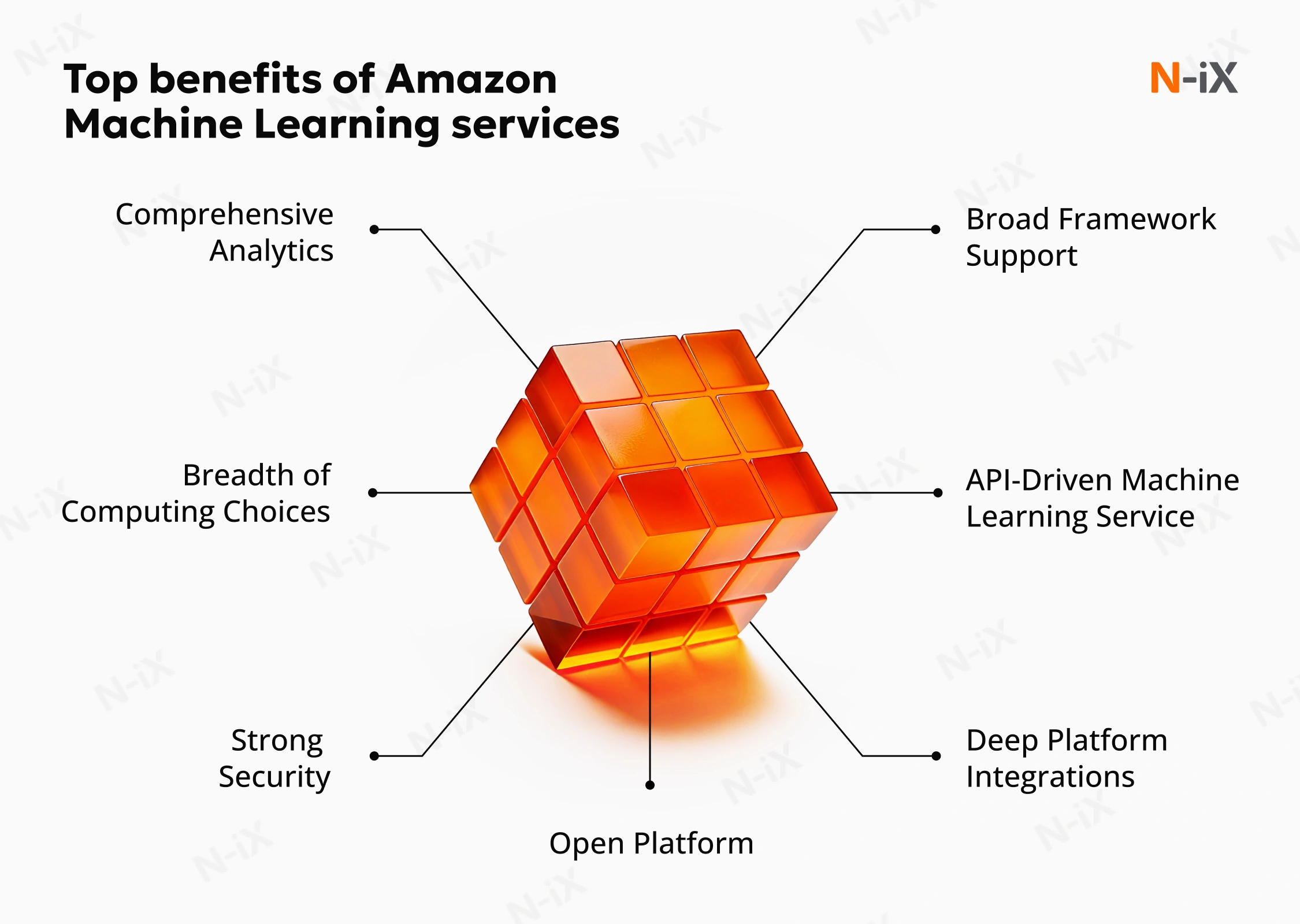
As the largest cloud provider globally, AWS brings considerable depth and maturity to its machine learning offering. Amazon Web Services was recognized by Gartner Magic Quadrant as a leader in cloud-based ML and data science [3]. It offers AWS SageMaker, a fully managed platform covering the entire ML lifecycle, from data preparation and model training to deployment and monitoring. It is integrated with the AWS ecosystem and built for proper control and flexible scaling. Here are the main advantages of AWS ML:
- Mature and polished services: SageMaker has established itself as the backbone of enterprise ML pipelines. Its toolset is deep, well-documented, and continuously updated, giving teams a platform that has been tested at enterprise scale.
- Deep integration with infrastructure: SageMaker Studio brings together coding environments, training, and deployment in one place, but requires familiarity with AWS infrastructure.
- High customization of resources: Engineers get control over compute, scaling, deployment options, and security. Every component, from IAM roles to container configurations, can be adjusted to specific requirements.
- Distributed training: AWS SageMaker supports multi-GPU and multi-node distributed training, with access to specialized hardware like AWS Trainium chips. This allows for scaling datasets effortlessly.
Leveraging these advantages, N-iX helped a client in the ecommerce sector gain a valuable opportunity. Their platform handled subscriptions and billing for digital businesses, but needed a solution to predict customer churn more effectively. N-iX built an AWS-based solution using SageMaker to develop churn-prediction models and implemented MLOps practices to ensure the system was reproducible and efficient. The result was automated, personalized email campaigns for customers at risk of canceling their subscriptions. This significantly reduced manual work and improved customer retention.
Read the full case study: Enhancing ecommerce services with ML-powered churn prediction calculation
Azure Machine Learning services
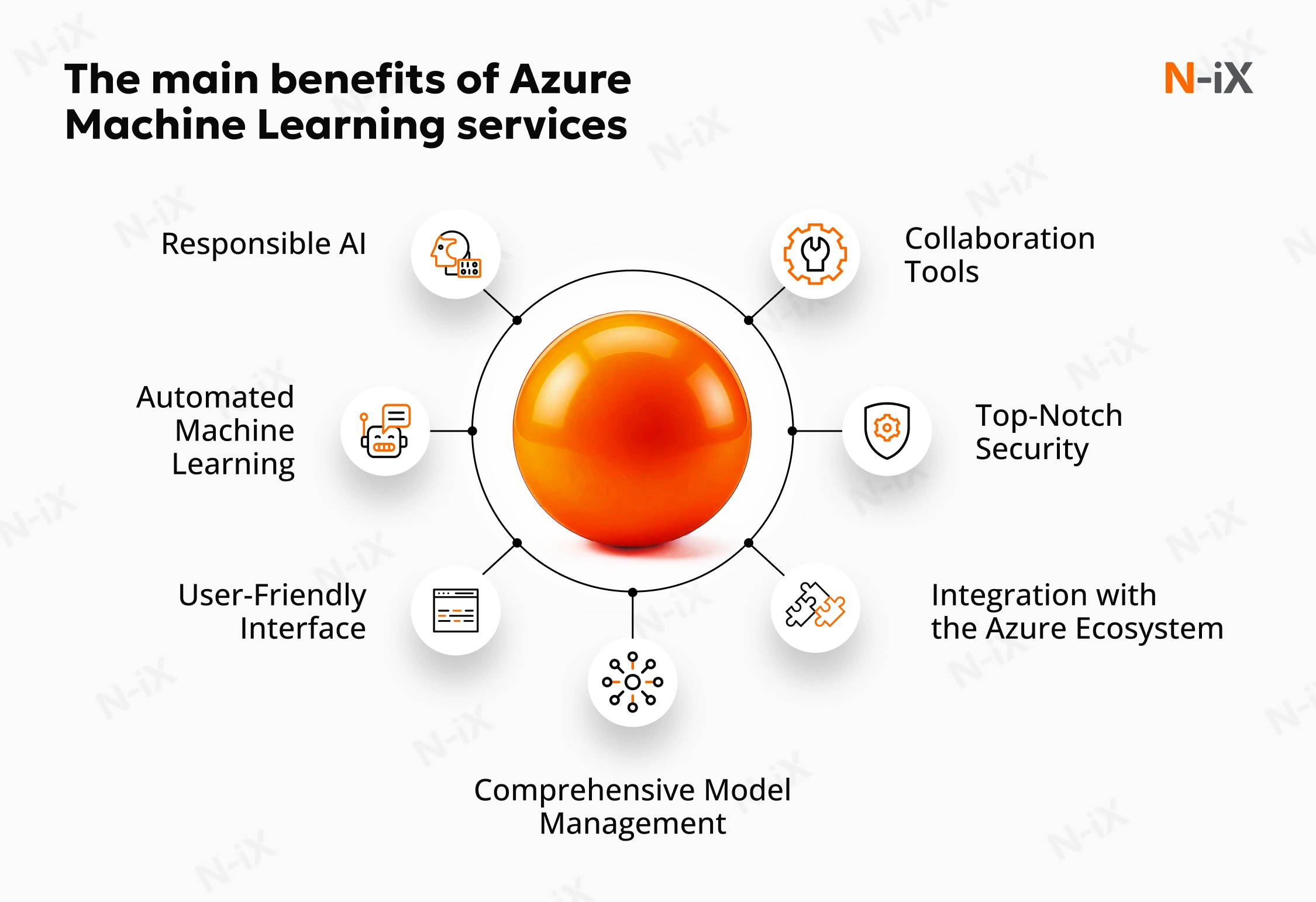
When evaluating Azure vs AWS machine learning, Microsoft Azure stands out for its focus on ease of use and integration. Azure ML is a part of a broader Microsoft ecosystem that millions of enterprises already rely on daily, and the platform is designed to reflect that. Azure ML services are valued for:
- Accessible interface for all skill levels. Azure ML Studio offers a clean, guided environment that is significantly easier to learn and navigate. Its drag-and-drop Designer tool lets non-programmers build and visualize ML pipelines without writing code. This opens model development to business analysts and domain experts.
- Responsible AI by design. Azure was recently recognized by AI Magazine as the leading Responsible AI tool [4]. This platform includes built-in tools for model explainability, fairness assessment, and bias detection. For organizations in regulated industries or those with internal AI governance requirements, this makes it significantly easier to achieve compliance-ready machine learning.
- Enterprise integration. Deep ties to Microsoft 365, Azure DevOps, Power BI, Dynamics 365, and GitHub Actions make Azure a natural extension of existing Microsoft infrastructure.
- Automated ML. Azure's AutoML automatically selects algorithms, tunes hyperparameters, and builds models, significantly reducing manual effort. It is among the strongest AutoML offerings from major cloud providers.
For organizations already running on Microsoft infrastructure, these advantages can translate into faster adoption and lower friction at every stage of the ML adoption lifecycle. N-iX used this benefit to help our manufacturing client scale and automate logistics pipelines. With over 400 warehouses across 60 countries, they needed a logistics platform that could operate at a global scale. N-iX rebuilt it on a cloud-native architecture and applied ML models to automate goods tracking, barcode scanning, and package detection across warehouse docks. The result was a scalable, automated logistics system capable of operating across the client's entire global network, with significantly less manual work for warehouse staff.
Read the full case study: Driving logistics efficiency with industrial Machine Learning
Azure vs AWS machine learning: Pre-built services
Both platforms offer robust ML services, each with unique features and strengths. Let’s compare AWS vs Azure machine learning capabilities.
1. Speech and text
AWS offers Amazon Transcribe for speech-to-text and Amazon Polly for text-to-speech, supporting a wide range of languages and voice types. Azure provides AI Speech, covering transcription, text-to-speech, and custom voice model creation. Azure offers a slight advantage for organizations that require custom-branded voices and out-of-the-box multilingual support.
2. Image and video analysis
AWS provides Amazon Rekognition for detecting objects, faces, scenes, and text in images and videos, with person tracking and real-time analytics. Azure offers AI Custom Vision, with the new Content Understanding service within Microsoft Foundry tools. This service provides broad multimodal analysis across images, documents, audio, and video. For video intelligence, Azure provides Azure AI Video Indexer, which covers audio transcription, speaker identification, sentiment analysis, keyframe extraction, and multimodal video summarization using large language models. Both platforms cover the core use cases well, with Azure offering more flexibility for document and video-heavy workflows.
3. Chatbots
When comparing Azure vs AWS machine learning capabilities in chatbot development, the key difference is just an ecosystem fit. AWS offers Amazon Lex V2 for building conversational interfaces via voice and text, integrating with a serverless compute layer for backend logic. Azure offers Copilot Studio and the Microsoft 365 Agents SDK, enabling low-code chatbot development that integrates seamlessly with Teams, Dynamics 365, and other Microsoft channels. Azure's toolchain is faster to deploy, but primarily for teams already operating within the Microsoft ecosystem.
4. Language and translation
Amazon Comprehend covers sentiment analysis, entity recognition, and key phrase detection, while Amazon Translate handles language translation. Azure Language provides comparable NLP capabilities, including sentiment analysis, text summarization, and conversational language understanding. For most use cases, the two are evenly matched; the right choice depends on the cloud environment you already use.
5. Document analysis
In the AWS ML vs Azure ML comparison, document analysis is another area where the two platforms are similarly suited. Amazon Textract extracts text, forms, and tables from scanned documents with high accuracy. Azure Document Intelligence performs structured data extraction and supports prebuilt models for invoices, receipts, and IDs. The choice here often comes down to which platform already stores your documents.
6. Anomaly detection
AWS approaches anomaly detection through Amazon SageMaker, combined with open-source tooling such as AutoGluon for building custom detection models, and AWS WAF for web-based fraud prevention. Azure handles anomaly detection through its broader platform, with capabilities available via Azure Machine Learning, Microsoft Fabric, Azure Data Explorer, and Azure Stream Analytics, depending on the use case. Azure's approach requires more custom development but provides greater flexibility for complex or regulated environments.
7. Personalization
Personalization is an area of the Azure vs AWS machine learning comparison where AWS holds a clear lead. Amazon Personalize is built on the same recommendation engine technology that powers Amazon's own ecommerce platform. It is one of the most mature personalization engines available as a cloud service. Azure's recommended approach is to build custom recommendation models using Azure Machine Learning, applying techniques such as collaborative filtering or content-based approaches. This gives teams more flexibility to tailor models to specific business logic, but requires more development effort. For recommendation engines at scale, AWS holds a clear advantage.
8. AutoML
Both platforms offer strong automated machine learning capabilities, but they differ in maturity and approach. Azure AutoML is tightly integrated into ML Studio and offers a guided, visual experience. It automates tasks such as hyperparameter optimization, algorithm selection, and feature engineering, enabling teams with limited ML experience to build models easily. AWS SageMaker Autopilot provides similar capabilities with more transparency into the process, generating explainable model candidates and allowing engineers to inspect and customize each step. Azure AutoML is the faster path for non-technical teams. SageMaker Autopilot provides data scientists with greater visibility and control.
9. No-code and low-code ML
A growing priority for business teams is the ability to build and run ML models without deep technical knowledge. Azure ML Designer provides a fully visual, drag-and-drop pipeline builder that non-programmers can use from day one. It is intuitive, well-documented, and tightly integrated with the rest of Azure ML services. AWS offers SageMaker Canvas, a no-code interface that allows business analysts to build predictive models using point-and-click workflows. Both tools are genuinely useful. Azure Designer remains the more polished option for non-technical users, while SageMaker Canvas is a strong choice for teams already operating within AWS.
Learn more about AWS vs Azure AI offerings
Azure vs AWS machine learning: 5 key differences
When evaluating AWS vs Azure for machine learning, it is worth starting with an honest observation: both platforms are genuinely strong. Across MLOps, hybrid deployment, responsible AI, and developer experience, they are broadly comparable. The real differentiators are more specific, and they tend to emerge only when you look at your organization's actual context. Let’s look at what actually makes a difference.
Enterprise ecosystem fit
This is the single most decisive factor for most organizations. Azure integrates natively with Microsoft's identity management, DevOps tooling, and productivity suite. For organizations already running on Microsoft infrastructure, adopting Azure ML requires minimal re-architecture. AWS, on the other hand, is the natural choice for teams already operating within the AWS ecosystem, with deep integrations across its own storage, compute, and data services. Neither platform is inherently superior. The question is which one fits where your organization already lives:
- AWS is a logical choice for AWS-centric organizations, with deep integration across its own cloud ecosystem.
- Azure natively fits Microsoft-centric organizations, with seamless integration with enterprise identity, DevOps, and productivity tools.
Pricing structures
When evaluating Azure vs AWS machine learning platforms in terms of pricing, you can see that both offer pay-as-you-go billing, reserved instances with one- and three-year commitments for predictable costs, and enterprise agreements with custom discounts. AWS adds Savings Plans on top of that, which can be more flexible than Azure reservations, as they apply across instance families rather than being tied to specific ones. The one differentiator on Azure's side is the ability to reuse existing Microsoft software licenses to reduce and optimize cloud spend, delivering significant savings for organizations already invested in the Microsoft ecosystem. So, the main differences in pricing are:
- AWS offers Savings Plans that apply across instance families, not just specific ones.
- Azure enables the reuse of existing Microsoft licenses, directly reducing cloud spend.
Team expertise and hiring pool
The platform your team already works with matters more than most feature comparisons. Onboarding engineers onto an unfamiliar cloud environment adds time, cost, and risk to any ML project. AWS has a larger global pool of certified cloud professionals and a longer market presence. Azure benefits from the familiarity many enterprise IT teams already have with Microsoft tooling. Evaluating your current team's expertise and the availability of talent in your market is a practical consideration that is easy to overlook. Comparing both platforms by team expertise, pay attention to:
- AWS has a larger global pool of certified ML and cloud engineers.
- Azure is a better choice if your teams are highly familiar with the Microsoft toolset.
Specific managed services
Certain managed services can tip the balance for specific use cases. AWS offers specialized capabilities, such as dedicated data-labeling workflows and a broad foundation-model marketplace. They are valuable for teams building custom ML pipelines from the ground up. Azure provides direct access to leading large language models through its partnership with OpenAI, making it the fastest path for organizations building generative AI applications on top of enterprise data. When comparing Azure vs AWS machine learning services by their specific managed services, these differences are important to consider:
- AWS has a strong advantage in custom ML pipeline tooling, data labeling, diverse model infrastructure, and edge ML workloads, enabled by dedicated telco and private network services.
- Azure excels in generative AI and LLM access through its partnership with OpenAI.
Conclusion
When evaluating AWS machine learning vs Azure machine learning, there is no universal winner. The right AI cloud choice depends on where your organization stands today and what goals you set.
Choose AWS SageMaker if:
- Your infrastructure and team are already embedded in the AWS ecosystem.
- You need edge ML capabilities for telco or private network workloads.
- You want access to a broader range of foundation models from multiple providers through a single managed service.
- You benefit from Savings Plans that apply flexibly across instance families.
Choose Azure ML if:
- Your organization runs on Microsoft 365, Azure DevOps, or Dynamics 365.
- You need deep, integrated access to OpenAI models with a tight connection to enterprise workflows.
- You want to reduce cloud spend by reusing existing Microsoft software licenses.
- Your enterprise IT team already has strong familiarity with the Microsoft ecosystem.

How can N-iX help you adopt cloud machine learning?
Understanding the difference between Azure Machine Learning vs AWS SageMaker and implementing the right solution can be challenging. To gain quicker access to advanced technologies and avoid common pitfalls, organizations often partner with trusted consultants. This is where N-iX experience across both platforms becomes invaluable.
N-iX is a global software engineering and technology partner with over 23 years of experience and deep expertise in cloud architecture, MLOps, and AI/ML solutions. Our team of 400+ cloud professionals and 200 data experts helped businesses design, build, and scale ML pipelines. N-iX is also an AWS Premier Tier Services Partner and a Microsoft Solutions Partner, bringing deep cloud expertise. Whether you are beginning your journey or optimizing an existing setup, N-iX provides the technical depth and strategic guidance to accelerate your outcomes.
Ready to move from evaluation to execution? Let's talk about how N-iX can help you build smarter, faster, and at scale.
References
- Microsoft News - Microsoft Cloud and AI strength drives second quarter results
- Amazon - Amazon.com Announces Fourth Quarter Results
- Gartner - Magic Quadrant for Data Science and Machine Learning Platforms
- AI Magazine - Top 10: Responsible AI Tools
Have a question?
Speak to an expert